Vacuum Emulsifying Mixers
Featured




More About Our Machines
Vacuum Emulsifying Mixers for Different Processing Requirements
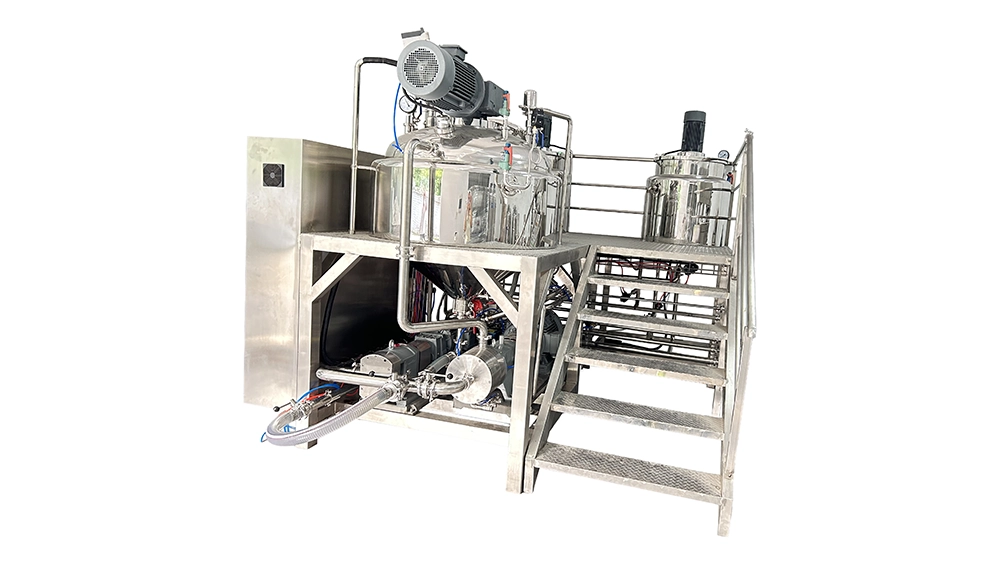
Vacuum emulsifying mixers are integrated batch-processing systems that combine mixing, high-shear homogenization, and reduced-pressure operation. Depending on the selected configuration, they can also incorporate wall scraping, jacket heating and cooling, ingredient charging provisions, and separate phase-preparation vessels.
The equipment category serves manufacturers whose formulations need coordinated processing rather than a single blending action. The purpose of selection is to identify which functions the product requires and which equipment arrangement fits the factory or development environment. A vacuum system, a powerful homogenizer, or a larger vessel is not automatically beneficial without a corresponding process requirement.
This range is organized into three equipment families: Fixed Type Vacuum Emulsifying Mixers, Hydraulic Lifting Vacuum Emulsifying Mixers, and Laboratory & Pilot Scale Emulsifying Systems. They provide different starting points for evaluation. Fixed and lifting systems distinguish installation and access arrangements, while laboratory and pilot systems are primarily defined by their development role.
Use this category page to establish the appropriate equipment family and the questions that need answering. Individual machine pages provide the verified capacities, configurations, utilities, and operating limits needed to evaluate a particular model.
Start with the Processing Requirement
The first selection question is whether vacuum emulsification is necessary for the intended formulation. Some products require intensive emulsification and air removal; others need controlled bulk blending without all the functions of a vacuum emulsifying system.
Describe the product in processing terms. Identify whether ingredients must be combined as separate phases, whether powders need incorporation, whether the batch becomes more viscous during cooling, and whether entrained air affects the required result. These characteristics provide a more useful starting point than a broad label such as “cosmetic mixer.”
Also distinguish the process requirement from the desired finished-product claim. Equipment selection can address the mixing arrangement and operating conditions, but product stability, texture, and appearance depend on the formulation and the way it is processed. For supporting formulation context, refer to the oil-in-water and water-in-oil emulsion guide.
When conventional agitation is sufficient, a stainless steel mixing tank may deserve consideration. When the requirement is a specific high-shear operation without an integrated vacuum vessel, a high shear mixer may be appropriate. Establishing these boundaries helps avoid purchasing functions that add complexity without serving the product.
Three Equipment Families, Three Selection Starting Points
The subcategories below organize the range around practical equipment decisions. They should be compared by operating purpose and installation requirements, rather than ranked as universally better or worse.
| Equipment family | Primary selection question | What to examine next |
|---|---|---|
| Fixed Type Vacuum Emulsifying Mixer | Does a fixed vessel-head arrangement suit the planned production installation? | Equipment layout, access provisions, connections, cleaning arrangement, and service requirements |
| Hydraulic Lifting Vacuum Emulsifying Mixer | Does opening the vessel through a lifting head provide useful operating or maintenance access? | Required head access, lifting envelope, operator access, and maintenance of the lifting assembly |
| Laboratory & Pilot Scale Emulsifying Systems | Is the main objective formulation development, process evaluation, or preparation for larger-scale production? | Trial quantities, experimental requirements, sample recovery, documentation, and subsequent scale-up work |
These families are navigation choices rather than mutually exclusive descriptions of every engineering feature. A laboratory system may also have a lifting head, for example. Select the development family when the main question concerns experimental use; select a production architecture when the main question concerns how the equipment will operate in the factory.
Fixed Type Vacuum Emulsifying Mixers
Fixed-type systems are a starting point for buyers evaluating an emulsifying vessel as a defined part of a production installation. The important question is how the fixed arrangement accommodates routine operation, cleaning, inspection, and maintenance within the proposed layout.
Consider this family when reviewing a stable equipment position and planned connections to preparation, utility, transfer, or receiving equipment. A fixed arrangement does not by itself establish automatic cleaning, easier maintenance, or continuous processing. Those capabilities must be confirmed for the selected system.
The Fixed Type Vacuum Emulsifying Mixer subcategory addresses the installation and access decisions in greater detail. At this parent-category level, the key decision is whether a fixed-head approach fits the operating method, rather than whether a particular vessel size is suitable.
Hydraulic Lifting Vacuum Emulsifying Mixers
Hydraulic lifting systems are a starting point when open-head access is an important requirement. Raising the head can provide access for inspection, cleaning tasks, or maintenance, depending on the actual arrangement of the moving and stationary components.
The lifting function should be evaluated against a real access need. It adds a moving assembly and an operating envelope that must fit the installation. It does not inherently produce a finer emulsion or a more stable formulation than a fixed system.
The Hydraulic Lifting Vacuum Emulsifying Mixer subcategory focuses on when that access is valuable and what it requires from the facility. Use it to evaluate the architecture before comparing individual lifting models by their verified specifications.
Laboratory and Pilot Scale Emulsifying Systems
Laboratory and pilot systems are selected around development questions. Their purpose may include investigating formulation behavior, evaluating processing conditions, preparing samples, or identifying requirements for a later production system.
A development machine should therefore be evaluated as more than a smaller production vessel. The useful trial quantity, material needed for analysis, recoverable sample volume, and ability to document experiments can be central to selection.
The Laboratory & Pilot Scale Emulsifying Systems subcategory covers these equipment-selection considerations. The laboratory and R&D application page provides a separate starting point for development workflow requirements.
A successful laboratory result does not automatically establish an equivalent production method. For the next stage of evaluation, consult the cosmetic formulation scale-up guide.
Working Capacity and Batch Flexibility
Capacity selection begins with the intended batch, not the largest vessel available. Define routine batch quantities, smaller commercially important runs, and the largest foreseeable requirement before evaluating models.
Total vessel volume, working capacity, and minimum batch size are different specifications. Headspace may be needed during processing, while the minimum useful batch depends on effective engagement of the mixing and homogenizing elements. Do not assume that every vessel can operate effectively at an arbitrary fraction of its working capacity.
Batch flexibility matters when a manufacturer handles multiple products or production schedules. A system that suits the largest order may be less appropriate for frequent short runs. Conversely, repeatedly dividing demand into small batches can create additional preparation, handling, and cleaning work.
Use category-level capacity planning to define the required operating range. Then check each candidate machine page for its verified working volume and minimum batch. For procurement questions extending beyond capacity, refer to the vacuum emulsifying mixer buying guide.
Formulation Behavior and Mixing Configuration
Formulation behavior helps determine the agitation, homogenization, and product-handling arrangement required. Relevant information includes viscosity at processing temperature, changes during cooling, solids content, ingredient incorporation needs, and sensitivity to shear.
Bulk agitation, wall scraping, and high-shear homogenization perform different jobs. A suitable system needs those functions to work together for the intended product. Comparing homogenizer motor power alone does not establish how effectively the full batch will move through the vessel.
Provide viscosity information with its measurement conditions where available. A single maximum-viscosity number is not a complete description of suitability, especially when products differ in flow behavior or change substantially during processing.
Where circulation is part of the proposed configuration, review the internal and external circulation guide for supporting technical context. Confirm the actual arrangement on the selected machine rather than assuming that all vacuum emulsifying systems use the same product route.
Vacuum Requirements and Ingredient Handling
Vacuum processing is relevant when reduced-pressure operation serves the formulation, such as supporting the removal of entrained air. Its role should be defined within the intended process rather than treated as a general guarantee of product quality.
Describe any foaming behavior, volatile ingredients, temperature-sensitive additions, and restrictions on ingredient charging. These details help establish whether the proposed vacuum and feeding arrangement fits the product. For a related production concern, see the resource on air bubbles in cosmetic creams.
A vacuum vessel does not automatically include every possible charging method. Vacuum feeding ports, powder additions, fragrance additions, and liquid connections must be checked against the selected machine configuration. Their presence also does not establish automatic weighing or dosing.
Where the formulation introduces flammability or other special hazards, raise those conditions at the beginning of the equipment assessment. Standard cosmetic-processing equipment should not be assumed suitable merely because it operates under vacuum. The fragrance and active-ingredient addition guide provides a separate reading path for formulation-stage considerations.
Heating, Cooling, and Phase Preparation
Thermal requirements influence the vessel jacket, utility selection, phase preparation, and production schedule. Identify whether the process needs heating, controlled cooling, separate temperature preparation of ingredients, or a combination of these functions.
Electric and external steam heating are configuration choices where available. The appropriate option depends on the selected equipment and site utilities. For supporting technical discussion, refer to the steam versus electric heating guide.
Cooling should be evaluated against the actual duty and local supply conditions rather than chosen from a generic preference. Review the associated utility systems when defining the heating and cooling scope.
Separate oil and water preparation vessels may be useful for formulations requiring distinct phases. Their inclusion, capacities, agitation, heating, and transfer arrangements vary by system and must be confirmed. They should not be assumed to accompany every vacuum emulsifying mixer.
These decisions establish the required equipment functions. Detailed heat-transfer calculations belong in supporting technical resources, while the final utility requirements belong to the selected machine specification.
Control Functions and Operator Responsibilities
Control selection should begin with the functions the production team needs. Push-button and PLC/HMI arrangements can support different operating methods, but the interface alone does not describe the complete automation scope.
Define which actions remain with the operator and which functions must be executed by the equipment. Relevant questions include adjustment of process settings, indication of operating conditions, stage timing, alarm handling, recipe management, and production records.
Do not infer automatic dosing, stored recipes, batch reporting, remote access, or communication with other machines from a touch screen. These are separate requirements that should be identified in the control-function schedule.
Training and documentation should match the selected approach. An operator-led process needs clear batch instructions, while a programmed sequence needs a clear description of its functions, limits, and permitted interventions.
Where future control changes are part of the plan, consult the equipment upgrade and retrofit guide, then assess compatibility against the actual supplied system.
Product-Contact Construction and Cleaning Provisions
Material selection and cleanability should reflect the formulation and changeover requirements. Review the product-contact materials, seals, accessible surfaces, discharge arrangement, and components that require separate attention.
Stainless steel grade and surface finish are useful specifications, but neither alone establishes suitability for every ingredient or cleaning chemical. The 304 versus 316L stainless steel guide provides a supporting resource for material selection. Confirm the complete product-contact arrangement, including gaskets, mechanical seals, and valves.
A spray ball is a cleaning provision rather than proof of a complete automatic cleaning system. Where cleaning-in-place is required, define the supply, return, coverage, drainage, and operating scope. See the CIP spray ball versus manual cleaning guide for further discussion.
Set cleaning expectations before purchase. This is particularly useful when the factory processes different fragrances, colors, or formulations that need controlled changeover. Review potential access concerns alongside the equipment cleaning-access guide, while keeping the final procedure specific to the delivered machine.
Installation and Utility Planning
The installation must accommodate the equipment’s operating envelope, not only its closed dimensions. Allow for operator access, loading, discharge, inspection, maintenance, and the movement of any lifting or tilting assembly.
Review electrical supply, heating and cooling services, vacuum equipment, drainage, and compressed air where required. Different configurations can have different utility demands, so requirements from one machine should not be copied across the category.
Where process-water quality affects the formulation, assess suitable water treatment systems alongside the mixer. The cosmetic water treatment guide provides a supporting route for reviewing treatment options.
Check the destination supply against the delivered electrical rating. A configurable voltage range describes manufacturing options rather than universal compatibility of a single unit.
Coordinate architecture-specific access with the wider layout. The cosmetic factory equipment planning guide and equipment installation guide provide related planning resources.
Product Transfer and Connections to Related Equipment
A vacuum emulsifying mixer is one equipment stage within a wider production arrangement. Its interfaces may involve phase preparation, process-water supply, bulk receiving and storage vessels, fluid transfer systems, or filling machinery.
At category level, the task is to identify those connections rather than describe a complete application-specific production line. Discharge temperature, product flow behavior, transfer distance, receiving capacity, and scheduling can affect the interface.
Tilting discharge, bottom discharge, and pump transfer are possible configuration approaches, subject to the selected model. Confirm which arrangement is supplied and whether additional transfer equipment is required. The pump selection guide provides a separate resource for transfer decisions.
Where the finished bulk product proceeds to packaging, evaluate cream filling machines or tube filling and sealing equipment according to product behavior and container format.
Pressure-assisted discharge must receive separate technical review where proposed. A jacket pressure specification is not evidence that the product chamber can be pressurized. Connection details and permitted operating conditions must follow the delivered equipment documentation.
Typical Product Applications
Typical application products include face creams and body lotions, ointments, hair masks and conditioners, and compatible cosmetic emulsions.
Compare Equipment Against a Shared Requirement
Equipment comparisons are most useful when every candidate is assessed against the same requirement. Prepare a common brief describing the product, intended batch range, processing functions, installation conditions, and required control scope.
Distinguish standard equipment from optional components and separately supplied accessories. A list of available motor, drive, or seal brands should be resolved into the actual configuration being offered.
Where trials are needed, agree what they are intended to demonstrate. Depending on the application, this may include ingredient incorporation, product condition, discharge behavior, or operation at an important batch size. A demonstration should not be represented as a formal acceptance test unless that scope has been agreed.
Include the operating and service implications of the proposed configuration when comparing offers. The total cost of ownership guide for cosmetic machinery provides a related procurement resource.
Use the subcategories to narrow the architecture, then use the individual product pages and technical proposals to compare specific machines. After selection, the vacuum emulsifying mixer maintenance guide offers a supporting reading path alongside the delivered machine documentation.
Custom Vacuum Emulsifying Systems from StriversMachinery
StriversMachinery manufactures core mixing and emulsifying equipment in-house. Complementary equipment is sourced from long-term partner manufacturers where required, with StriversMachinery responsible for complete production line integration and delivery.
Configuration starts with the formulation and operating requirement. Relevant considerations include batch range, viscosity, temperature sensitivity, cleaning needs, automation, available space, utilities, and future expansion.
The objective is to match the equipment arrangement to the process rather than apply one configuration to every customer. A laboratory development system, a lifting production vessel, and a fixed installation should each be assessed against the role they need to perform.
Begin by selecting the appropriate equipment family. For a configuration review, contact our team with representative product information, intended batch quantities, required processing functions, available utilities, and the proposed installation layout.