

A spray ball is a cleaning device; an effective process also defines supply conditions, cleaning steps, drainage, and result checks
CIP describes cleaning in place, while automation level, recovery strategy, and validation status are separate questions
Choose static, rotary spray, or rotary jet devices for the residue and actual vessel arrangement
Coverage testing, ATP checks, chemical residue methods, microbial sampling, and process monitoring answer different questions
Select manual, spray-assisted, or CIP tasks from access, effectiveness, workload, quality requirements, and total cost

Choose laboratory mixing equipment by the task, usable batch range, material behavior, temperature profile, and cleaning needs
Homogenizers and high-shear mixers overlap; compare their working heads, flow, torque, and demonstrated product results
Use pilot trials to test the process differences that matter before moving to the intended production setup
Tip speed is one useful comparison during scale-up, alongside geometry, circulation, power input, time, and heating and cooling history
Keep trial conditions and product test methods consistent so results can be compared across batches and scales

FAT checks whether the supplied machine meets agreed requirements before shipment, using recorded conditions and acceptance criteria
Use representative product and packaging, and document the limits of substitute materials
Review fill results by head, continuous-run records, protective functions, changeovers, and open issues
The project examples show commissioning delay after limited checks and a timing fault corrected before shipment
Complete site installation and SAT to verify the equipment with the customer’s actual utilities and production conditions

TCO compares purchase, installation, operation, maintenance, downtime, replacements, disposal, and residual value over the same period
Start with the same acceptable output, product requirements, and scope before comparing equipment prices
Use measured consumption, task-based staffing, service records, and supported assumptions to build annual costs
Count each cost once and test how production volume, downtime, and energy prices change the result
The worked example shows simple payback and discounted costs using explicit assumptions, not customer performance claims
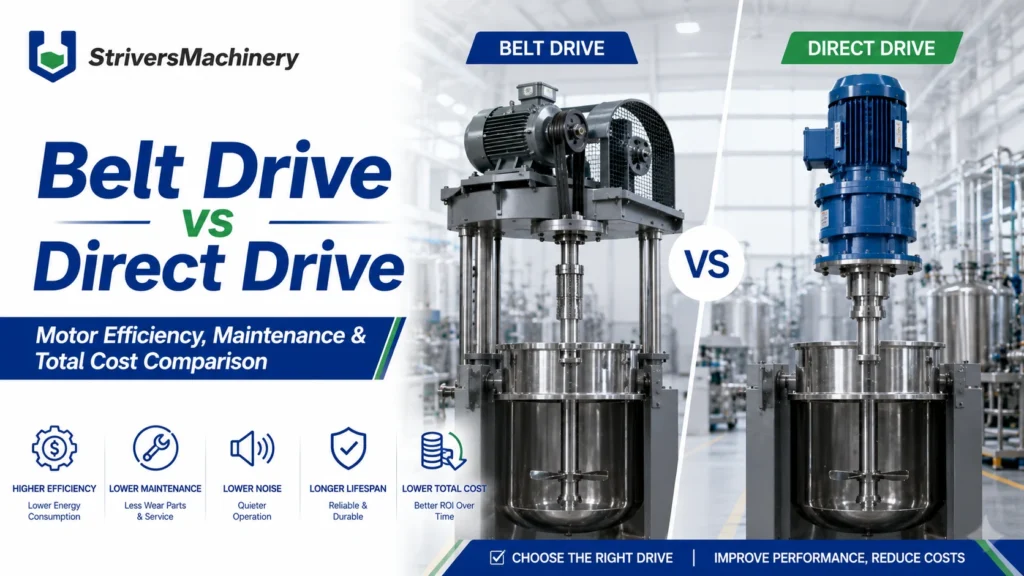
Choose the drive from required shaft speed and torque, how well it holds the required speed or position, service access, hygiene, and lifetime cost
Compare frictional V-belts and synchronous belts separately; synchronous belts can support accurate speed and positioning
Separate motor efficiency, mechanical-transmission efficiency, and complete-machine electricity use
Evaluate cleaning and external washdown from the actual assembly design, not a belt-drive or direct-drive label
Use comparable operating task, measured power use or a calculation based on manufacturer data, maintenance scope, and operating hours to calculate TCO and payback

Use online pH monitoring when changes during dosing, reaction, or cooling need a timely response; a suitable manual method may be enough for stable, low-risk batches
Choose the complete probe assembly for the product, working volume, cleaning cycle, temperature, and pressure or vacuum conditions
Treat ATC, representative installation, calibration, and verification as separate parts of reliable measurement
Use rinse pH as an appropriate monitoring tool within an established cleaning procedure, not as proof that every residue has been removed
Define dosing limits, interlocks, signal-fault behavior, and record requirements before enabling automated control
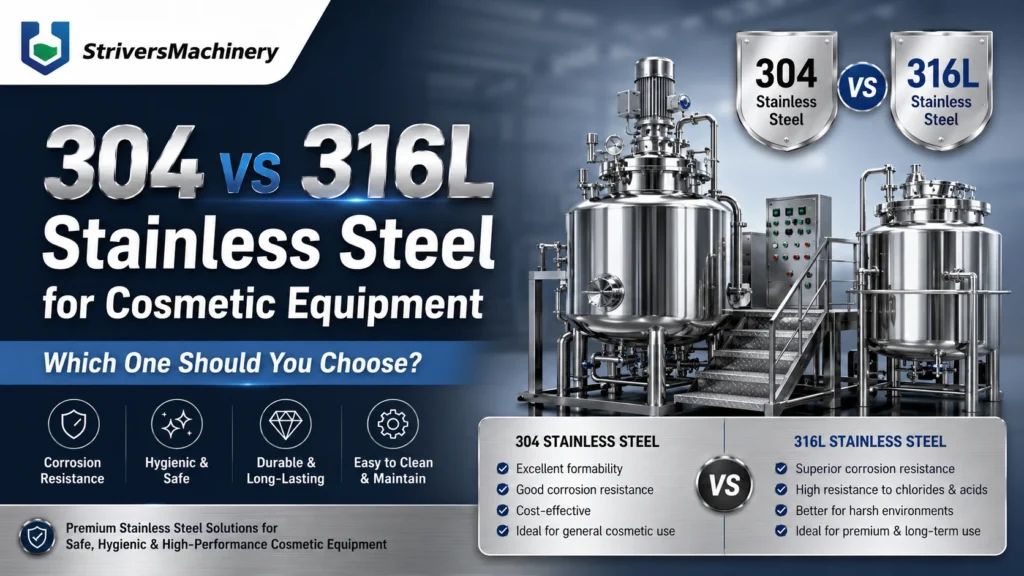
This guide explains why “is it stainless steel?” is not enough when buying cosmetic equipment, and why the more useful question is which grade is used on each component.
It compares 304 and 316L, explains common corrosion mechanisms, and shows how formulation, cleaning conditions, fabrication, and surface finish affect the choice.
It covers tanks, emulsifying mixers, fillers, water systems, and transfer components without treating 316L as a universal requirement.
It also explains how to check material certificates and traceability, what XRF can verify, and why raw-material price differences should not be confused with finished-machine costs.

O/W and W/O identify the continuous phase, not a fixed oil percentage, viscosity, sensory profile or preservation requirement
Both structures can contain compatible water-soluble and oil-soluble ingredients in their respective phases
Choose the formulation and developed process against the complete product brief, quality requirements, package and intended use
Develop additions, mixing, cooling and any vacuum for the actual formula rather than applying universal rules by emulsion type
Evaluate representative pilot samples and relevant physical, chemical, microbiological and packaging results before scale-up decisions

Choose the complete clamp or flange assembly against product, utility, cleaning, pressure, vacuum, temperature and installed loads
Distinguish hygienic flange designs from ordinary industrial flanges and internal retention from external cleaning concerns
Confirm gasket compatibility, assembly method, fabrication, drainability and the evidence required for the intended service
ISO 2852:1993 is withdrawn and does not establish universal interchangeability; a fixed 1.5D rule does not prove cleanability
Use approved pre-commissioning review and maintenance procedures instead of universal torque checks, replacement intervals or connection assignments

Assess actual heat, humidity, water and salt exposure against equipment ratings and manufacturer maintenance requirements
Distinguish water ingress from condensation, and compare relevant surface temperatures with the dew point of adjacent air
Select enclosure protection, lubrication and corrosion controls for the installation rather than applying a universal tropical upgrade
Use documented condition and risk to review tasks and intervals, including building, utilities, spares and worker protection
The verified coastal cosmetic-factory case shows site-specific improvements without establishing a universal IP rating, material or inspection interval

Conventional aluminum tubes normally use mechanical folding and crimping; compatible plastic and laminated tubes use thermoplastic tail sealing
Full tube construction, formulation and closure integrity matter more than a material label or a simple barrier ranking
Compare actual tooling, supplied functions, accepted output and ownership costs rather than assuming fixed speed or price advantages
Assess recyclability for the complete package and destination recycling system; PBL is not automatically recyclable
Use representative machine trials and suitable package tests to establish the supported application and its limits

Compression followed by cooling can condense moisture already present in intake air; compression itself does not create water
Pressure, temperature and water content together determine condensation; merely cooling air does not remove its water without separation
Select drying, filtration and drainage for the actual air use, load, conditions and required quality rather than an industry label
Use suitable pressure-dew-point sampling and safe authorized investigation instead of routine opening of pressure equipment
The confirmed cosmetic-factory case improved performance through combined dryer-capacity, distribution-drainage and drain-control changes

Hot air delivers heat through airflow; ultrasonic equipment converts mechanical vibration into localized heat in a loaded joint
Actual tube construction and tooling determine compatibility; PE, PBL and ABL labels do not guarantee suitability
Compare the complete production cycle and supplied configuration rather than active heating or weld time alone
Use suitable integrity and mechanical tests with defined limits; a passing test does not establish an absolute leak-free barrier
Assess representative trial samples and relevant product effects before accepting a technology for the intended application

Confirm the actual leak location and control suspect product before investigating a hot air tail-seal defect
Assess heat input, timing, contamination, tube specification, compression and fitted cooling without treating symptoms as diagnoses
Distinguish leak integrity from mechanical seal strength and qualify test methods for the actual tube and product
Use a controlled nine-step investigation, verify representative trials and document the suspect-batch disposition
Base maintenance and calibration on equipment instructions, duty and evidence rather than universal calendar intervals

Existing mixing, filling, and packaging equipment may be upgraded when condition, design limits, support, and intended duty justify the work
Measure the line bottleneck before selecting automation, speed, inspection, or handling changes
Vacuum, pressure, temperature, drive, and safety changes require engineering assessment rather than simple accessory installation
Compare complete retrofit and replacement costs, including downtime, commissioning, remaining life, and support
Reserve documented interfaces for credible future needs, then verify the modified equipment before production resumes

Rounded internal transitions can reduce residue retention and improve cleaning and inspection access
Corner radius must be assessed with weld quality, surface finish, drainage, and the actual cleaning procedure
Spray coverage does not establish residue removal or complete cleaning validation
In the confirmed cosmetic-factory project, combined geometry, weld, drainage, and spray changes reduced CIP time by about 35%, water by 20%, and detergent by 30%
Agree the applicable hygienic design criteria and acceptance evidence before fabrication
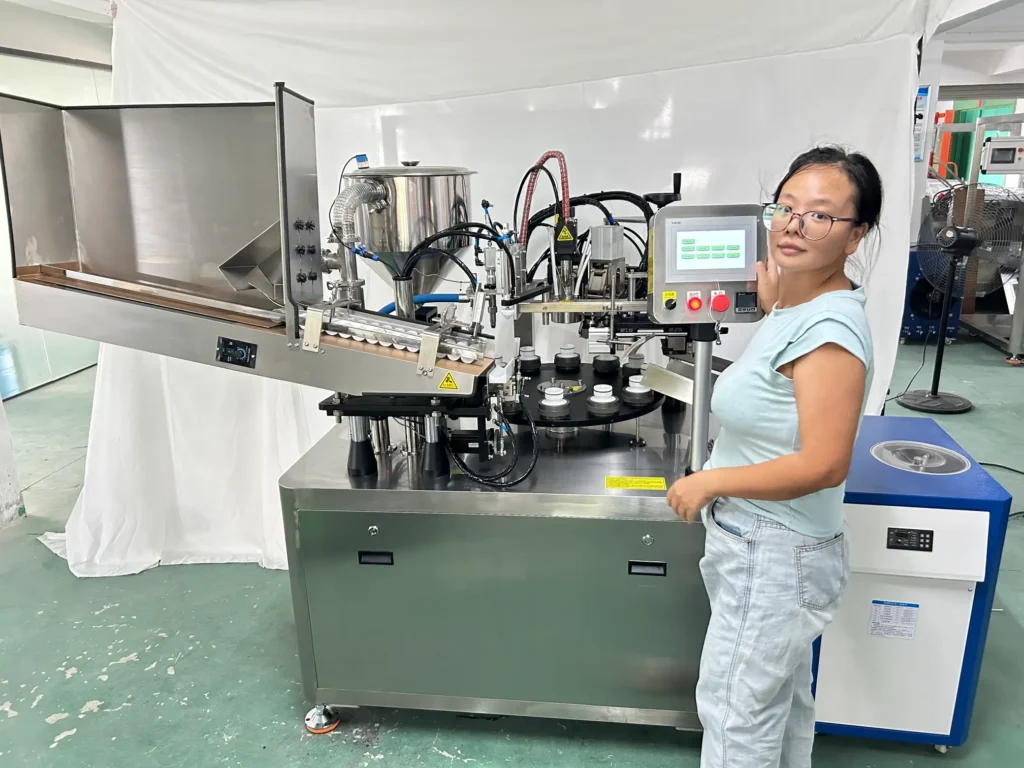
This guide explains normal shutdown of the demonstrated hot air tube machine while separating emergency, fault and power-loss responses
The five-step sequence disables heat, maintains specified cooling airflow, confirms cooldown conditions and then completes normal power-down
Below 80°C is the demonstrated configuration’s indicated reference, not a universal endpoint or safe-to-touch temperature
The confirmed Indonesia case records heating-assembly damage and replacement after a power outage interrupted cooling
Maintenance and recovery must follow the installed equipment’s instructions, including any required isolation and safeguards

This guide distinguishes machinery emission declarations, sound pressure at working positions and daily worker exposure
It identifies noise sources across utilities, mixing, filling, packaging, conveying, pumping and automation
Its comparison table is a survey and procurement checklist rather than an unsupported set of category-wide noise guarantees
Primary guidance and a manufacturer document illustrate why operating conditions, measurement quantities and exposure rules must remain clear
Noise control should address the identified source, preserve the machine’s required functions and be verified under comparable conditions
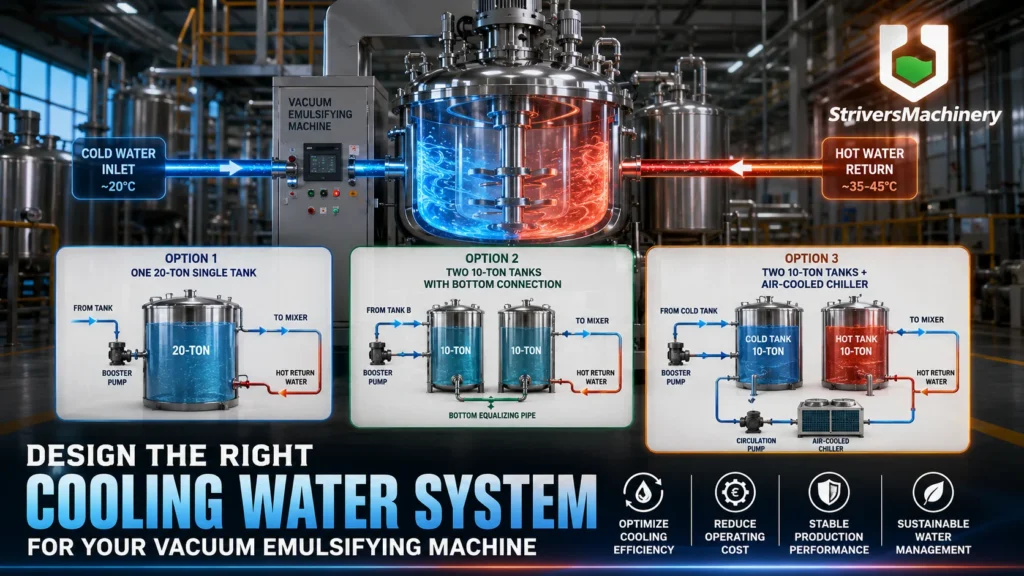
This guide evaluates jacket cooling for an assumed 1,000 kg batch cooled from 100°C to 50°C in approximately 60 minutes
It compares one 20-ton tank, connected dual tanks and storage with active cooling using actual working water volumes
The example gives about 52.8 kWh of product sensible heat per batch; storage and refrigeration must be assessed separately
Daily heat rejection, jacket transfer, tank levels and recovery measurements determine whether passive buffering can meet the duty
The final layout and any chiller must suit the repeated production schedule, site climate and equipment operating limits

This guide compares time-based and volume-based filling, distinguishing pump type, displacement control, flow measurement and gravimetric filling.
It covers product compatibility, viscosity and rheology, temperature, pressure, air, pump wear, and calibration and verification.
It explains feedback-based coarse/fine filling, troubleshooting, a hypothetical overfill-cost calculation and industry application examples.
Neither method is universally better. Select from product trials, required accuracy, throughput, cleaning, support and total cost of ownership.
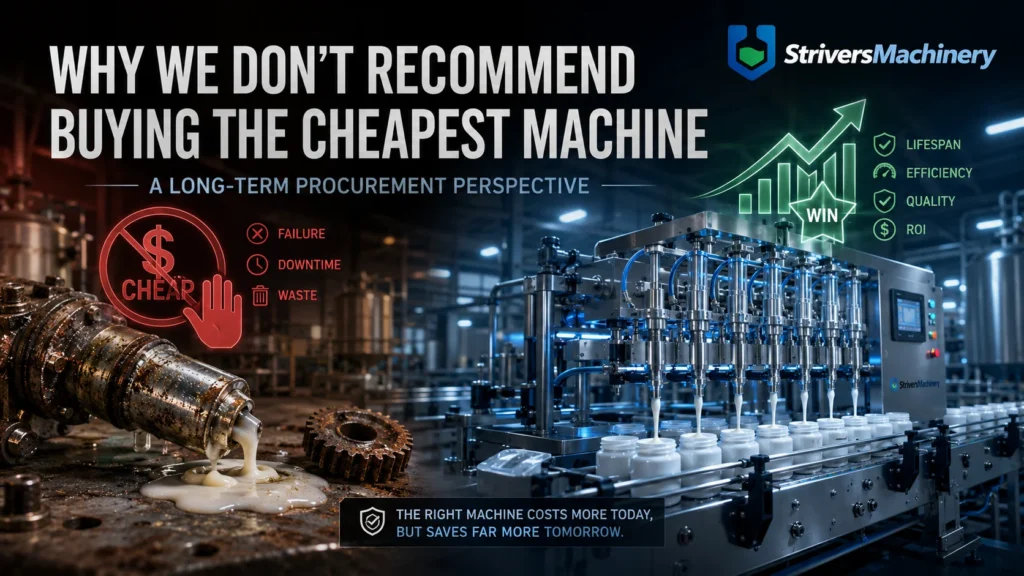
This guide explains how industrial machine pricing actually breaks down, from raw material and components through quality control and after-sales support.
It walks through the specific ways some suppliers offer dramatically lower prices, and why those savings often reappear later as downtime, maintenance, and lost production.
Readers get a Total Cost of Ownership framework for comparing cheap, mid-range, and premium equipment options honestly.
The guide closes with real procurement examples, a supplier evaluation checklist, and the long-term partnership principles that shape sustainable equipment sourcing decisions.