

This guide compares time-based and volume-based filling, distinguishing pump type, displacement control, flow measurement and gravimetric filling.
It covers product compatibility, viscosity and rheology, temperature, pressure, air, pump wear, and calibration and verification.
It explains feedback-based coarse/fine filling, troubleshooting, a hypothetical overfill-cost calculation and industry application examples.
Neither method is universally better. Select from product trials, required accuracy, throughput, cleaning, support and total cost of ownership.
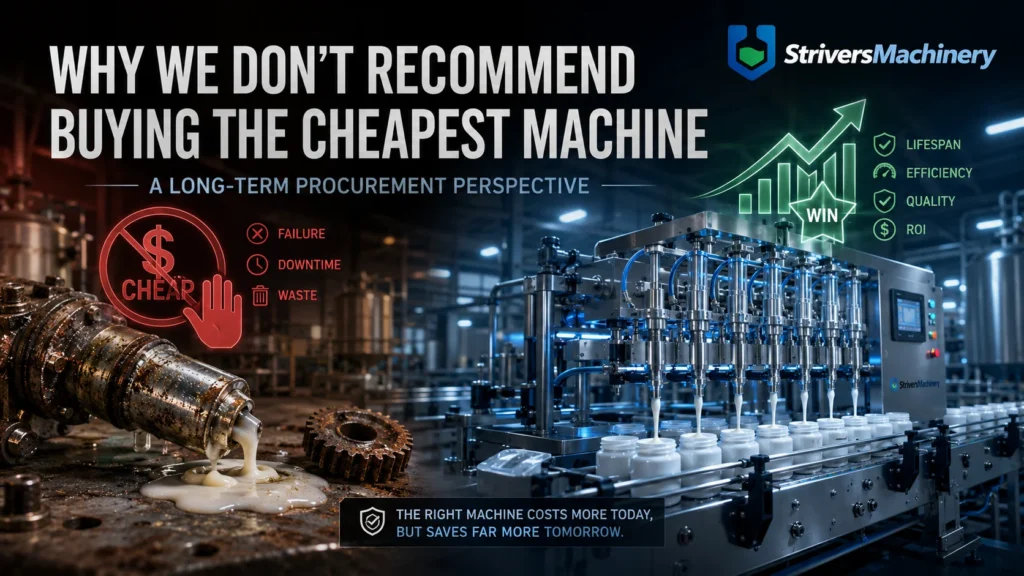
This guide explains how industrial machine pricing actually breaks down, from raw material and components through quality control and after-sales support.
It walks through the specific ways some suppliers offer dramatically lower prices, and why those savings often reappear later as downtime, maintenance, and lost production.
Readers get a Total Cost of Ownership framework for comparing cheap, mid-range, and premium equipment options honestly.
The guide closes with real procurement examples, a supplier evaluation checklist, and the long-term partnership principles that shape sustainable equipment sourcing decisions.

This article explains what nitrogen flushing, purging, blanketing, and inerting mean and why the distinctions matter.
It describes how nitrogen protects products from oxidation, moisture, and fire risk across cosmetics, food, pharma, and chemical manufacturing.
Different system types—continuous purging, vacuum backfill, pressure cycling, liquid nitrogen injection—suit different stages and sensitivities.
Equipment needs (cylinders, PSA generation, compressors, dryers, buffer tanks, analyzers) and common design mistakes are covered.
Guidance on estimating nitrogen consumption, choosing purity, ROI considerations, and regulatory/safety points is provided.

Wax-based products are semi-solid at room temperature, so cold filling gives unstable flow, weight variation and rough surfaces.
Hot filling is for flowability and dosing accuracy, not sterilization.
Cooling forms the final structure, which decides texture, surface and sink-mark risk.
Capping after the product sets prevents wax on the cap, rim contamination and sealing problems.
Natural cooling, cooling rooms and cooling tunnels suit different outputs, SKU mixes and space limits.
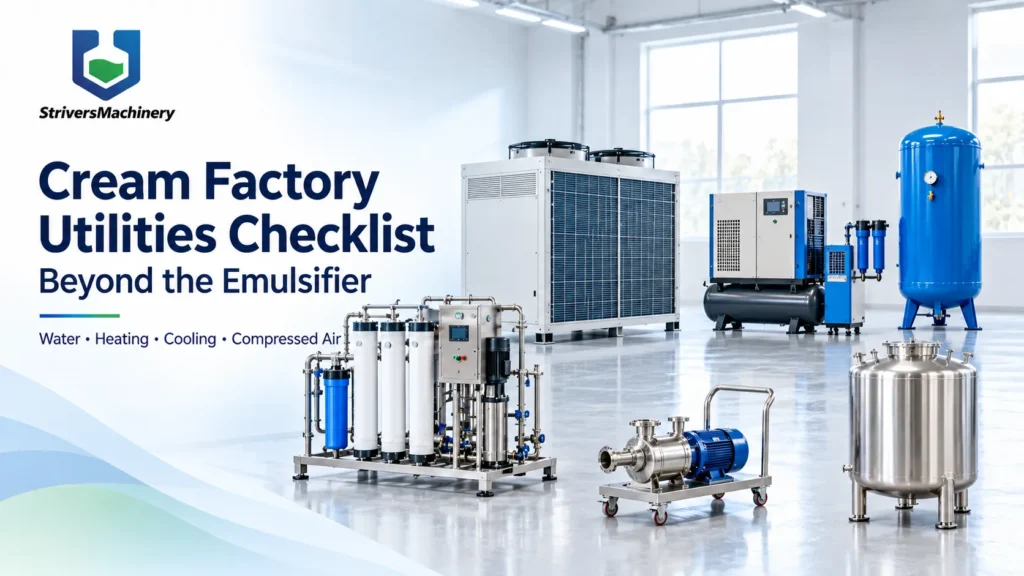
Plan utilities alongside the emulsifier, before delivery.
Separate essential functions from process-dependent equipment.
Calculate demand from batch schedules and overlapping operations.
Specify service quality at the actual point of use.
Assign responsibility for every supply and connection.
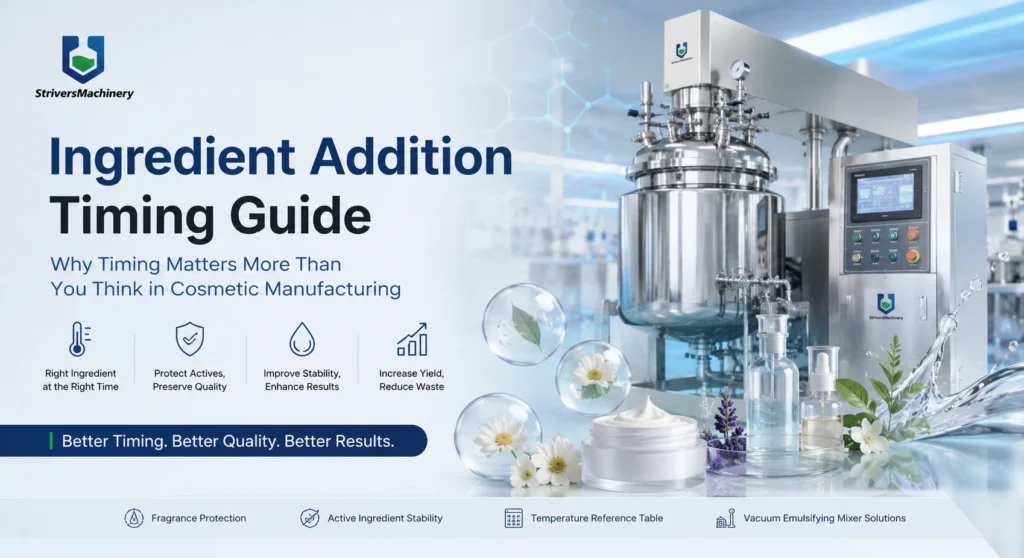
This guide explains why the timing of ingredient addition matters as much as ingredient selection in cosmetic manufacturing.
It covers when fragrance should be added, why most active ingredients need to go in after the cooling phase rather than during emulsification, and what happens to fragrance, vitamins, peptides, and botanical extracts when they’re exposed to excess heat.
It also includes a full temperature reference table by ingredient category and a look at how the right vacuum emulsifying mixer makes this stage easier to control consistently.
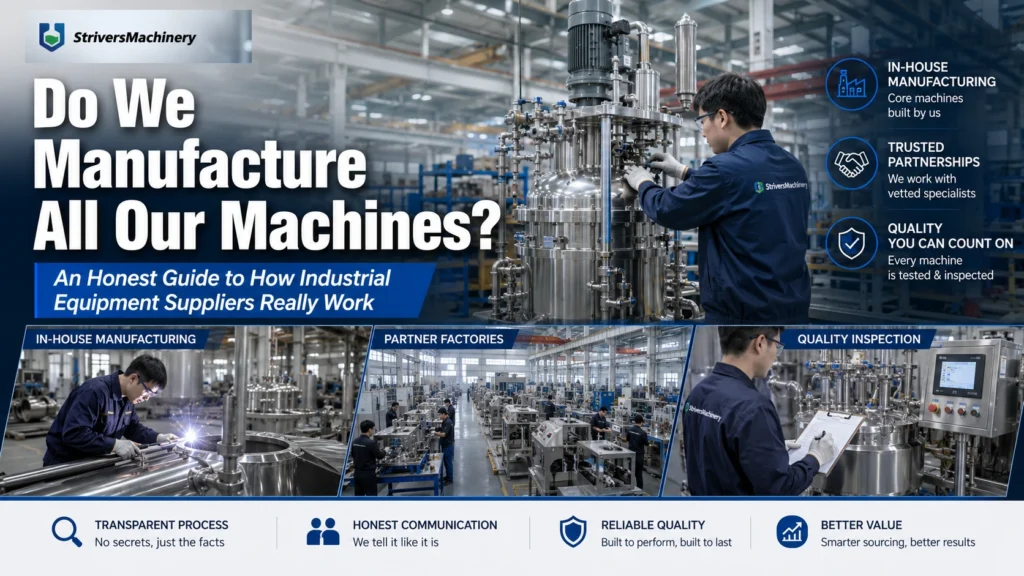
This guide answers the common buyer question of whether an equipment supplier manufactures everything themselves, explaining that most professional suppliers combine direct manufacturing with vetted partner factories.
It walks through the three main industry models — specialized manufacturers, trading companies, and integrated solution providers — and explains why no single factory can realistically build an entire production line alone.
Readers get a clear breakdown of what Strivers Machinery manufactures directly, how partner factories are evaluated, and the quality control process applied to every machine regardless of source.
The guide closes by explaining why project execution, integration, and long-term support matter more to a successful production line than simply claiming to manufacture everything in-house.

Setting up a cosmetic manufacturing plant involves far more planning than selecting equipment from a catalog.
This guide walks through the full process in order: defining your product type and production capacity, planning factory layout, specifying utility systems like water treatment and steam, choosing core processing equipment such as vacuum emulsifying mixers and mixing tanks, selecting filling and packaging lines, building quality control and cleanroom infrastructure, and adopting factory automation where it genuinely pays off.
It closes with a budget breakdown by factory size, the most common setup mistakes first-time builders make, and 36 frequently asked questions covering the practical details that come up throughout the planning process.
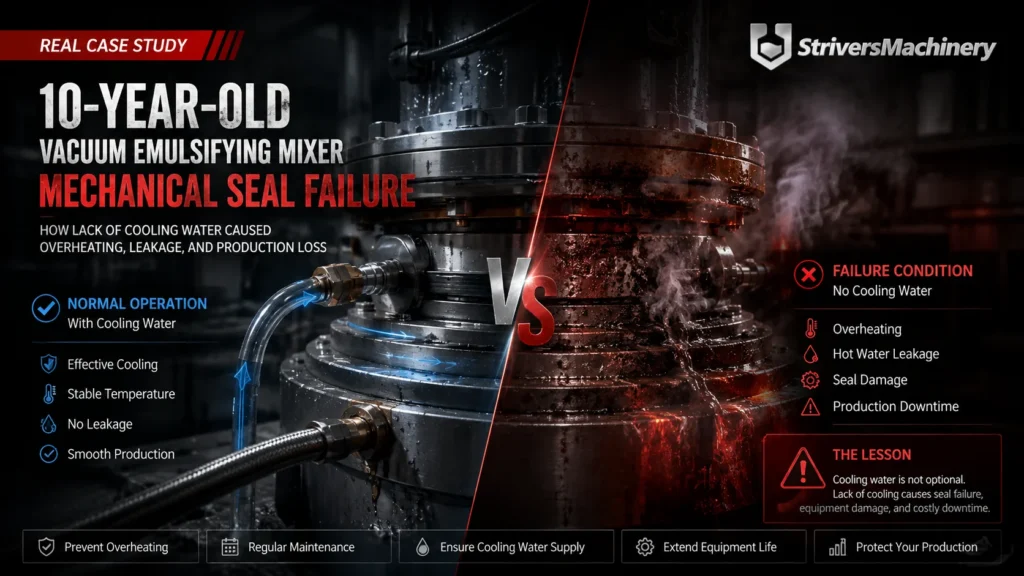
This case study documents a mechanical seal failure on a 10-year-old vacuum emulsifying mixer, caused when a newly hired operator forgot to refill the cooling water tank at startup.
It walks through the symptoms noticed, the emergency response that stopped the machine before further damage occurred, and the on-site inspection that confirmed the root cause.
The article explains why the motor was spared thanks to an immediate shutdown, and compares older manual cooling designs against modern water flow switch and PLC interlock systems.
It closes with four practical prevention tips and confirmation that similar safety upgrades can be retrofitted onto older machines already in service.

This guide explains what filling accuracy means, why it matters for product quality, cost control, and customer satisfaction, and what factors — viscosity, machine design, operating conditions — cause deviation in the first place.
It covers five core filling accuracy testing methods: gravimetric, volumetric, flow meter, dynamic checkweigher, and vision-based inspection, along with when each one is the right fit.
A step-by-step testing procedure, deviation formula, and key statistical indicators (average, SD, CV%, Cp/Cpk) are provided so readers can run and interpret their own tests.
The guide closes with common accuracy problems and solutions, tolerance reference tables by product type, and a full validation checklist.

This guide explains why solenoid valves matter inside vacuum emulsifying mixers and how their failure affects vacuum control, material feeding, heating, and automation.
It walks through seven common failure symptoms, from coil burnout to internal blockage, along with the electrical, mechanical, pneumatic, and process causes behind each one.
Readers get a practical repair and replacement guide, a preventive maintenance schedule, and a quick-reference troubleshooting checklist.
The guide closes with real manufacturing failure cases showing how these problems actually show up on the production floor and how they were resolved.

This guide explains what hygienic design actually means for cosmetic manufacturing equipment and why welding quality, surface finish, and surface roughness matter more than material grade alone.
It covers common welding defects (porosity, cracks, oxidation) and hygienic welding best practices like TIG welding, back purging, and post-weld treatment.
It compares mirror polish vs matte finish and explains Ra roughness values, what they mean for microbial contamination risk, and typical requirements for cosmetic product-contact surfaces.
The guide closes with a buyer’s checklist, three real equipment case studies, and why all three factors need to work together as a system rather than as individual specifications.

This guide explains why the quoted purchase price of industrial equipment often represents only a fraction of its true lifetime cost.
It breaks down hidden costs across every stage of ownership, from supplier evaluation and shipping through installation, daily operating costs, and eventual disposal.
Readers get a practical framework for calculating real Total Cost of Ownership, along with a buyer’s checklist of questions to ask suppliers before purchasing.
The guide closes by explaining how choosing the right supplier and equipment design can meaningfully reduce long-term ownership costs.

Airless packaging is becoming the new standard for premium skincare and personal care products, protecting sensitive formulations from oxidation while reducing preservative needs and improving product evacuation. This guide covers how airless bottles work, which products benefit most, how airless bottle filling machines operate, and the core technologies — servo filling, diving filling, pump pressing, vision inspection — that separate reliable equipment from unreliable equipment. It closes with common production challenges and solutions, a comparison against traditional packaging, and a practical buyer’s checklist for choosing the right machine.
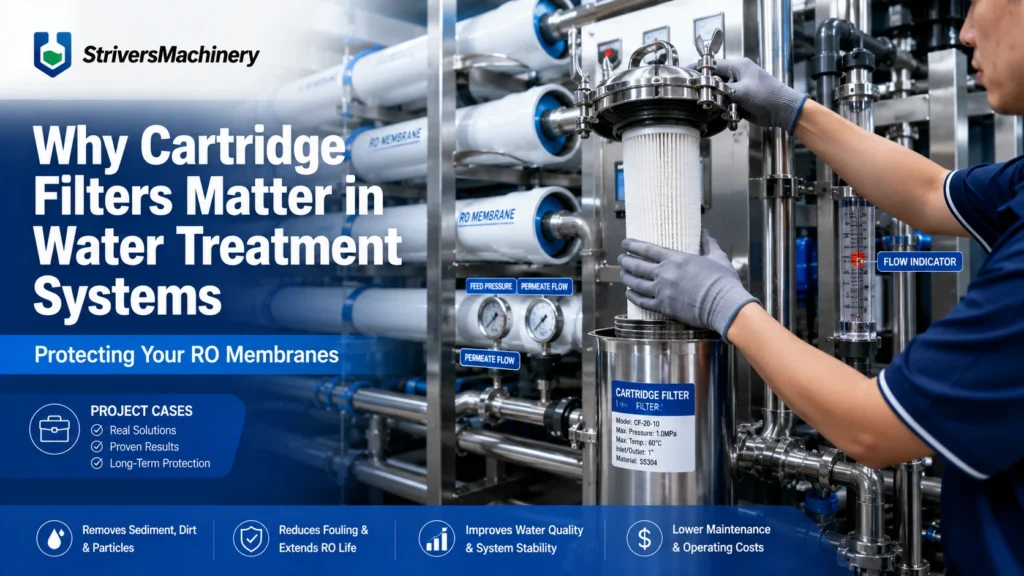
This case study follows a cosmetic OEM factory in Indonesia that saw rising RO pressure, falling flow, and shrinking membrane cleaning intervals, despite finished product staying within specification.
After ruling out the RO membrane, pump, and dosing system, the team found the real cause upstream: clogged and partially collapsed cartridge filters with bypass leakage letting fine particulate matter into the RO system.
Strivers Machinery recommended upgrading to properly specified dual-stage 5 μm and 1 μm cartridge filtration with differential pressure monitoring and a documented maintenance SOP.
Three months later, RO membrane service life more than tripled, unplanned downtime dropped to zero, and the factory saved an estimated USD 45,000–60,000 annually.

This guide explains why water quality is foundational to cosmetic manufacturing, since water makes up 60-95% of most formulations and directly affects stability, shelf life, and safety.
It walks through every stage of a complete water treatment system, from pretreatment through RO, Double-Pass RO, EDI, UV sterilization, and sanitary distribution.
Readers get detailed comparisons between Single-Pass and Double-Pass RO, and between RO water and EDI water, along with guidance on which configuration fits which product category.
The guide closes with common design mistakes that increase operating costs, real factory case studies, and a framework for balancing product quality, compliance, and lifecycle cost.

A cosmetic manufacturer’s 500L vacuum emulsifying mixer began losing vacuum performance after eighteen months of normal operation, with symptoms including slower vacuum pull, gauge fluctuation, and tiny bubbles in the finished product. The vacuum pump, piping, gasket, and valve all tested normal. Close inspection of the lid’s closing cycle revealed a roughly 1mm contact delay on one side during the final stage of travel. The actual root cause was minor foundation settlement beneath the equipment, caused by persistent floor moisture near a newly added CIP zone, which had shifted the machine’s base just enough to unevenly affect lid sealing pressure. Re-leveling the base resolved the issue completely.

Stable mayonnaise and salad dressing depend as much on the production line as on the recipe itself.
This guide covers why these emulsions need specialized processing equipment, the complete production flow from raw materials to packaging, and the full equipment configuration including vacuum emulsifying mixers, sanitary pumps, and CIP systems.
It explains food-grade design requirements, why vacuum emulsification is essential, critical process parameters, product-specific equipment recommendations, and food safety compliance standards.
It closes with common production problems, batch versus continuous production, total cost of ownership, and a practical buying checklist.

This guide explains why standard filling machines like gear pumps and piston fillers often crush particles or struggle with high-viscosity products such as facial scrub, jam, peanut butter, and pharmaceutical suspensions.
It introduces rotary lobe pump filling machine technology — positive displacement, non-contact rotor design, and servo metering — and explains exactly why it protects particles while maintaining accurate fill volume.
The guide compares rotary lobe pumps directly against piston, gear, and peristaltic pump alternatives across accuracy, particle protection, cleaning, and cost.
It also covers viscosity reference ranges, machine configuration options, engineering design considerations, maintenance practices, and real manufacturing case studies across cosmetics, food, and pharmaceutical applications.
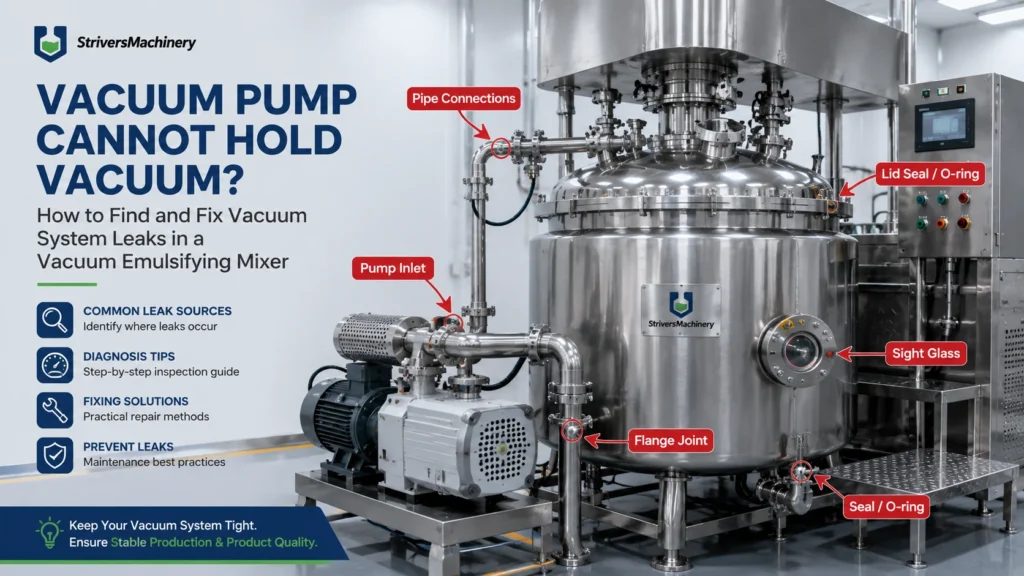
When a vacuum emulsifying mixer can reach target vacuum but can’t hold it, the cause is almost always a leak somewhere in the vacuum system, not a failed pump. This guide walks through how to separate pump problems from system problems, the seven most common leak points including gaskets, valves, mechanical seals, and an often-overlooked PT100 sensor port, and the four types of vacuum leaks worth understanding. It includes a real case from a cosmetic factory in Guangzhou where a cracked O-ring nearly led to an unnecessary pump replacement, a full diagnostic workflow, detection methods engineers actually use, and a tiered preventive maintenance schedule.

This guide explains why high-viscosity and temperature-sensitive products like cream, honey, peanut butter, chocolate, and wax cause clogging, dripping, crystallization, and inconsistent fill weight on standard filling machines.
It breaks down the real cause — a missing Heating + Mixing + Holding + Filling workflow — and shows how a properly engineered heating mixing filling machine solves each failure point.
Product-specific filling practices are covered for creams, hair wax, lip balm, honey, peanut butter, chocolate, and pharmaceutical ointments.
The guide also includes a step-by-step buying process, a troubleshooting section, and a full equipment configuration reference table.