
Color Cosmetics & Nail Care

More About These Applications
Equipment for Color Cosmetics and Nail Care Production
Equipment for Color Cosmetics and Nail Care Production
Foundation, mascara, lip color and nail gel can have very different production routes despite sharing a cosmetics factory. Pigment incorporation, consistency, temperature and the final package each influence the equipment arrangement. The important question is what must happen to the formulation before it can be filled and sold in the intended pack.
StriversMachinery supplies mixing, dispersing, holding, transfer and packaging equipment that can be evaluated for color cosmetic and nail care products. Our core processing equipment can be combined with complementary machines around the confirmed product requirements. Specialized operations should be identified separately rather than assumed to be included in a standard mixing and filling proposal.
This application focuses on the additional demands associated with color and product presentation. Ordinary moisturizers and unpigmented lotions follow the skin care equipment route, while development work and small formulation trials are addressed under laboratory and R&D applications.
Group Products by Their Processing Needs
Group Products by Their Processing Needs
An emulsified foundation, a wax-based lip product and a nail gel should not be treated as interchangeable filling duties. Describe whether the formulation needs pigment dispersion, emulsification, melting, simple blending or a combination of stages. Include the product's behavior at the intended transfer and filling temperatures.
Shade changes can be as important as formula changes. A factory producing many colors in small quantities may spend substantial time cleaning and preparing equipment between runs. The arrangement should therefore account for batch size, retained product and access to the product-contact path, not only maximum output.
Mixing equipment should be selected for the required operation. A high-speed disperser, a rotor-stator mixer and a vacuum emulsifying mixer perform different tasks. Some formulations may need additional processing outside those categories. Keep that requirement visible in the process brief rather than presenting one machine as a complete answer to every color cosmetic.
Pigment Addition and Dispersion
Pigment Addition and Dispersion
Pigment handling begins with how ingredients are introduced and wetted into the formulation. The production procedure should define the sequence and the required finished condition. Equipment selection then considers the mixing action, vessel arrangement and access needed to carry out that work consistently.
High-speed dispersers are relevant where the process calls for dispersion. A mobile electric-lift disperser provides one equipment format to assess, while a pneumatic-lift disperser offers a different lifting arrangement. The lifting method should be distinguished from the drive that rotates the dispersing disc.
The required dispersion result should be checked on product samples prepared under representative operating conditions. Evaluate representative material and the manufacturer's quality checks. Some products require additional processing beyond a disperser. The proposed scope should state that requirement clearly, with space and transfer interfaces planned for any separately supplied equipment rather than hiding it within a broad “mixing” stage.
Emulsified Foundation and Cream Makeup
Emulsified Foundation and Cream Makeup
For emulsified color cosmetics, pigment preparation may be only one part of the process. Phase preparation, emulsification, cooling and later additions can also be required. Vacuum emulsifying mixers may suit that route when the formulation calls for those functions.
The hydraulic-lift vacuum mixer with PLC control is an example of a processing arrangement to evaluate. The equipment discussion should focus on access, ingredient sequence, discharge and the required heating or cooling functions. Its suitability for a particular foundation must be assessed using that formulation rather than inferred from general use with creams.
The oil-in-water and water-in-oil emulsion article provides background on formulation differences. Use the product's established manufacturing procedure to define the equipment functions and the order in which they are used. A pigmented emulsion should not automatically receive the same process settings as an unpigmented lotion, and the filler should be assessed using the finished product after the intended cooling stage.
Wax-Based Lip and Color Products
Wax-Based Lip and Color Products
Wax-based products can need melting, mixing and filling under controlled temperature conditions. Their route should be separated from cold-filled emulsions and water-based products. Identify where heat is required and how the product behaves as it cools in the package.
Mixing tanks with an appropriate thermal configuration can be considered for preparation, while utility systems support the selected heating and cooling duties. A tank with a heater does not automatically provide temperature control through the transfer hose and filler. Those interfaces should be reviewed together.
The guide to hot filling, cooling and capping wax-based products follows this manufacturing sequence in more detail. Some color products also need specialized forming or packaging operations outside a conventional bottle or jar filler. Identify those operations in the project scope. Do not present a liquid filling machine as a universal solution simply because the material is fluid at an elevated temperature.
Nail Polish and UV Gel Require Separate Assessment
Nail Polish and UV Gel Require Separate Assessment
Nail polish and UV gel can differ in composition, viscosity and handling requirements. Provide the formulation information needed to review the product-contact materials, processing conditions and site requirements. Light exposure, volatile ingredients or other product-specific concerns should be handled through the established product procedure and confirmed equipment configuration.
The benchtop dual-head peristaltic weighing filler is one filling arrangement to evaluate for suitable nail care products. Each head has its own weighing platform, and containers are manually placed and removed. The operator places each container on its platform, and filling continues to the set target quantity. The two heads can be used independently.
The machine's applicability should be assessed with the actual product and container. A product being called “gel” does not establish that it will feed through every hose or nozzle successfully. Check the entire wetted path, cleanability and filling behavior, including pauses and restart. Product-specific protection or hazardous-area requirements should be confirmed separately rather than inferred from the pump principle.
Holding Small Batches without Losing Shade Identity
Holding Small Batches without Losing Shade Identity
Color cosmetic production often involves several similar-looking batches or closely related shades. Storage and holding systems should make identification and release status straightforward. The vessel and transfer connection need to remain associated with the correct batch throughout preparation and packaging.
Define whether the product needs agitation or temperature control while waiting. Those requirements differ between a pigmented liquid, a viscous gel and a warm wax-based formulation. The holding method should preserve the product condition required by the filling stage rather than introduce another uncontrolled processing step.
Small batches also make residual material more significant. The product recovery guide discusses the issue of material retained in processing routes. Short, accessible connections can make end-of-batch work easier, but any recovery method must fit the manufacturer's quality procedure. Plan where cleaned containers and transfer parts are stored so they do not become mixed with parts awaiting cleaning from another shade.
Transfer and Dosing after Dispersion
Transfer and Dosing after Dispersion
The product reaching the filler may be more demanding than the ingredients initially placed in the mixer. Pigments, fillers and changes in consistency can influence transfer and wear. Fluid transfer systems should therefore be selected using the finished formulation at its intended operating temperature.
The pump selection guide provides background on transfer principles, but the final choice requires an assessment of the actual product. Do not assume that one pump used successfully for a moisturizer will also suit a heavily pigmented product or a different solvent system.
Review the source vessel, inlet connection, pump and nozzle as one route. A stable supply is important for repeatable dosing, and retained product matters during shade changes. Agree on how the system is emptied and cleaned, how operators recognize the correct product connection and what happens when the filler stops. These details are especially important when expensive small batches move through shared equipment.
Filling Jars, Bottles and Small Cosmetic Packs
Filling Jars, Bottles and Small Cosmetic Packs
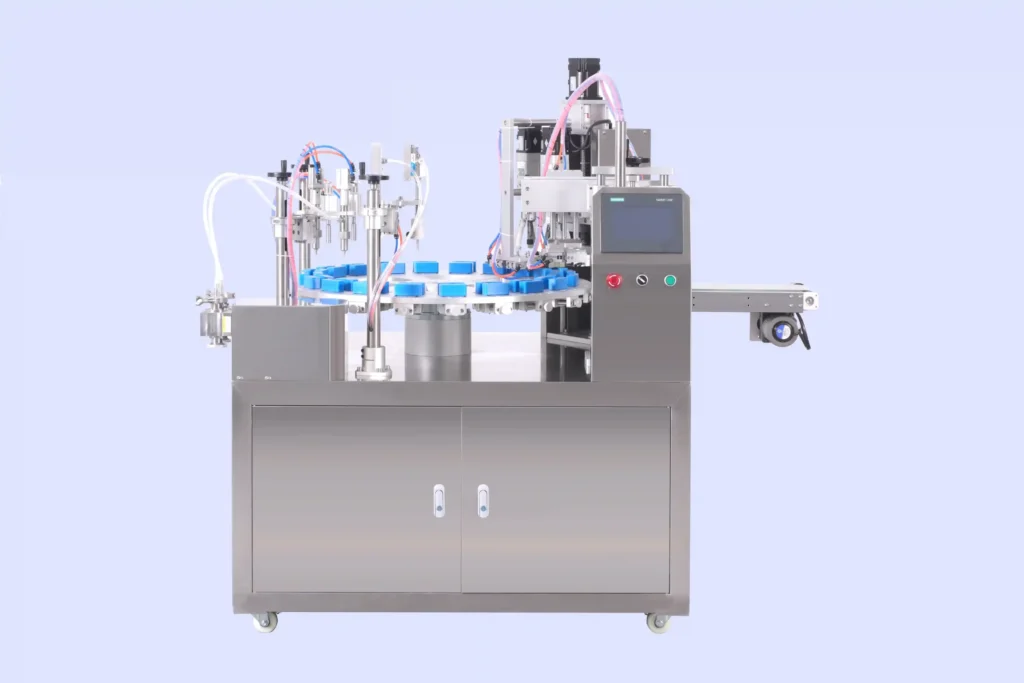
The container opening and finished product consistency determine much of the filling arrangement. Cream filling machines may be relevant for compatible viscous cosmetics, while other products need a different dosing method. Small containers can also need dedicated supports to remain stable during manual or automatic handling.
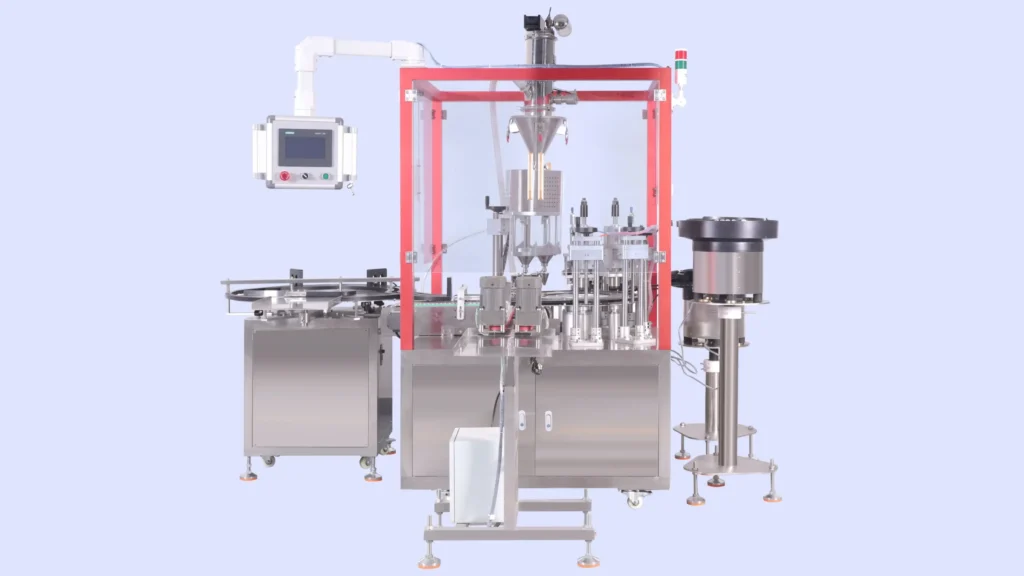
A semi-automatic gear pump filler provides one arrangement to assess for suitable products when operators place and remove containers. For larger repeated runs, a multi-head automatic gear pump filler offers a different production format. Evaluate the product-contact path with the intended pigment system and liquid base, including the required cleaning method and the product's actual filling consistency.
The filling accuracy testing guide helps establish a consistent way to measure results. Also inspect cutoff, product on the container rim and the way the product settles. A satisfactory dose alone does not establish a clean, presentable cosmetic pack. Include representative pauses and the final portion of a batch when planning the equipment trial.
Closures and Decorative Components
Closures and Decorative Components
Color cosmetic packs can include brushes, wipers, inner plugs, pumps or decorative caps. Identify each component and the order in which it is fitted. A screw-capping machine should not be assumed to insert every other component required by the package.
Capping machines can be assessed against the actual threaded closure and bottle support. The semi-automatic four-wheel capper is one option for compatible screw closures where manual handling is appropriate. Components with unusual geometry or sensitive decoration may need different support or tooling.
For tube-packed products, tube filling and sealing equipment follows a separate closing route determined by the tube material. The tube material and sealing guide explains that distinction. Provide production samples of the entire package rather than a drawing of the outer appearance alone, so assembly, support and finished-pack inspection can be addressed before the line layout is fixed.
Shade Labels, Codes and Retail Cartons
Shade Labels, Codes and Retail Cartons
Labels and batch codes must remain associated with the correct shade throughout packing. Labeling equipment should suit the container surface and label stock. For flat cosmetic boxes or compatible flat surfaces, the semi-automatic flat labeling machine is an example of a fixture-based arrangement with manual product placement.
Coding equipment needs an accessible print area and a clear change procedure when products or batches change. The production team should be able to verify the information before packs enter cartons. Decorative finishes and curved surfaces can affect where a readable code can be applied.
Cartoning equipment can be considered for retail packs once the bottle, insert and carton construction are established. Small shade runs may still suit separate manual stations. The choice should follow the real order pattern and handling requirements, including how mixed shades are prevented and how rejected packs are separated without interrupting the entire line.
Treat a Shade Change as a Planned Production Job
Treat a Shade Change as a Planned Production Job
A shade change can require cleaning, new bulk product, different labels and a different retail carton even when the container stays the same. Plan those tasks together. Otherwise, the processing team may finish its change while packaging is still holding components for the previous shade.
Small premium batches also make startup losses more noticeable. Record the amount of material needed to establish a stable fill and the quantity retained when the run ends. The figures help the team compare a compact manual arrangement with a longer automated route without judging them only by maximum cycle rate.
When testing a product family, choose representative formulations that challenge different parts of the equipment. One may be difficult to transfer, another may string at the nozzle, and another may be demanding to clean. This gives a more useful assessment of a shared line than testing only the easiest shade and extending the result to the entire range.
Cleaning, Trials and Production Expansion
Cleaning, Trials and Production Expansion
Shade changeovers need practical access to the complete product path. The cleaning access guide provides background for reviewing tanks, valves and connections. The manufacturer's cleaning procedure should define acceptable results, including any product-specific checks, rather than relying only on whether a visible surface looks clean.
Development batches can help establish processing and filling behavior before larger equipment is chosen. Laboratory and pilot-scale emulsifying systems are relevant where the formulation needs that process, and the laboratory-to-production guide discusses the broader transition. Scale-up work should include transfer and packaging observations, not stop at the mixer.
For a complete production line proposal, provide the product families, shade range, batch quantities, temperature requirements and full packaging samples. Identify specialized processing or assembly operations that need separate equipment. StriversMachinery can coordinate the confirmed mixing and packaging scope around those requirements, with changeover work and manual tasks included in the production plan.
Include the expected product changes and component replenishment work in the agreed operating schedule.