
Perfume Production Equipment

More About Our Machines
Perfume Production Equipment for Processing and Packaging
Perfume Production Equipment for Processing and Packaging
Perfume production equipment covers several distinct equipment duties, including formulation mixing, closed holding, selected cooling and filtration, liquid filling and bottle-component assembly. The appropriate supply scope depends on which operations the factory needs and which equipment is already available.
This category provides an equipment-selection framework rather than a universal perfume-manufacturing recipe. A standalone tank, a combined processing unit and a bottle-packaging arrangement perform different functions and should be specified accordingly.
For broader application context, the Perfume & Fragrance Products page provides a separate reading path. Here, the focus remains on equipment boundaries, configuration options and the interfaces between supplied units.
Define the Required Equipment Scope
Define the Required Equipment Scope
A perfume-equipment enquiry should identify the actual operations required. The phrase perfume making machine does not establish whether a quotation includes only mixing or also temperature treatment, filtration, storage and packaging.
| Equipment duty | Primary selection question | Scope to confirm |
|---|---|---|
| Mixing | What blending function does the formulation require? | Vessel, agitator, access and control arrangement |
| Closed holding | How will the product be held before the next operation? | Vessel duty, connections and transfer arrangement |
| Cooling and filtration | Does the defined process require these functions? | Supplied temperature-control and filtration equipment |
| Bottle filling | Which dispensing arrangement suits the product and bottle? | Metering, bottle handling and operator tasks |
| Pump and collar assembly | How are the selected components attached? | Crimping, pressing or another confirmed operation |
These functions may be supplied separately or combined where the configuration supports them. Each included operation should appear explicitly in the technical scope.
Mixing Tanks and Closed Holding Vessels
Mixing Tanks and Closed Holding Vessels
Mixing and holding requirements should be identified separately, even where one vessel is intended to perform both duties. Selection considers the formulation, charging method, access and the required transfer connections.
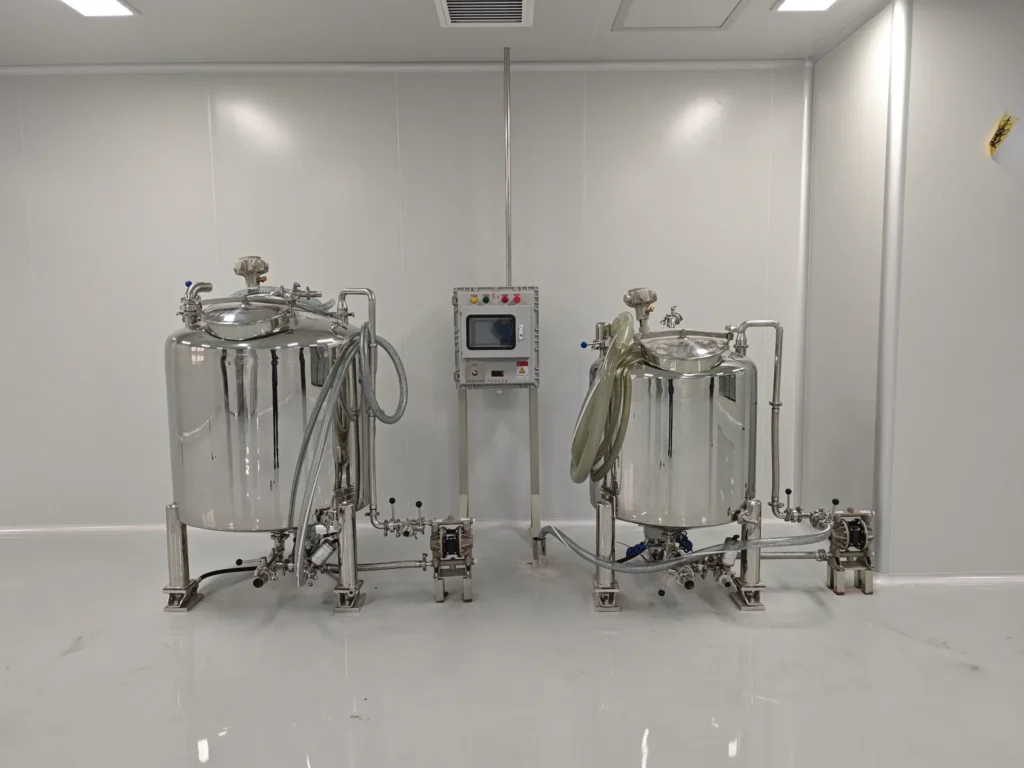
The sealed pneumatic perfume mixing tank provides a product-level reference for a closed mixing and holding configuration. Its supplied scope should not be expanded to include refrigeration or filtration.
Closed construction does not independently establish a positive-pressure vessel rating, vacuum capability or a particular storage condition. Those requirements must be confirmed for the actual equipment.
Where a vessel is used for maturation or holding, the duration follows the formulation and approved production method. A fixed holding period should not be presented as a universal perfume-equipment requirement.
Cooling and Filtration as Separate Configuration Choices
Cooling and Filtration as Separate Configuration Choices
Cooling and filtration should be selected only where the defined process requires them. Neither function should be inferred from a general perfume-tank description.
A perfume processing configuration with chilling and filtration provides a separate equipment direction from a standalone closed mixing vessel.
Confirm the actual temperature-control arrangement, filter components, transfer route and service requirements. The presence of filtration does not independently establish sterile filtration or a guaranteed clarity result for every formulation.
Where these functions are not required, avoid adding them simply because they appear in another perfume-equipment quotation. The equipment brief should follow the intended duty.
Product Transfer and Equipment Connections
Product Transfer and Equipment Connections
Separate processing units need a defined method of moving product between them. Review the source vessel, receiving equipment, transfer method and the connections supplied by each party.
The transfer arrangement should match the formulation and the permitted operating conditions of the connected equipment. A pneumatic drive or compressed-air connection does not establish permission to pressurize the product vessel for discharge.
The pump selection guide for process manufacturing provides supporting transfer-equipment considerations. Actual pump, seal and connection compatibility require configuration-specific assessment.
Identify which hoses, fittings and transfer accessories are included. An equipment layout should not leave the connection between processing and packaging undefined.
Perfume Bottle Filling Configurations
Perfume Bottle Filling Configurations
Perfume filling equipment should be evaluated around the actual bottle and formulation. The dispensing arrangement, bottle presentation and required filling endpoint need to suit the intended packaging duty.
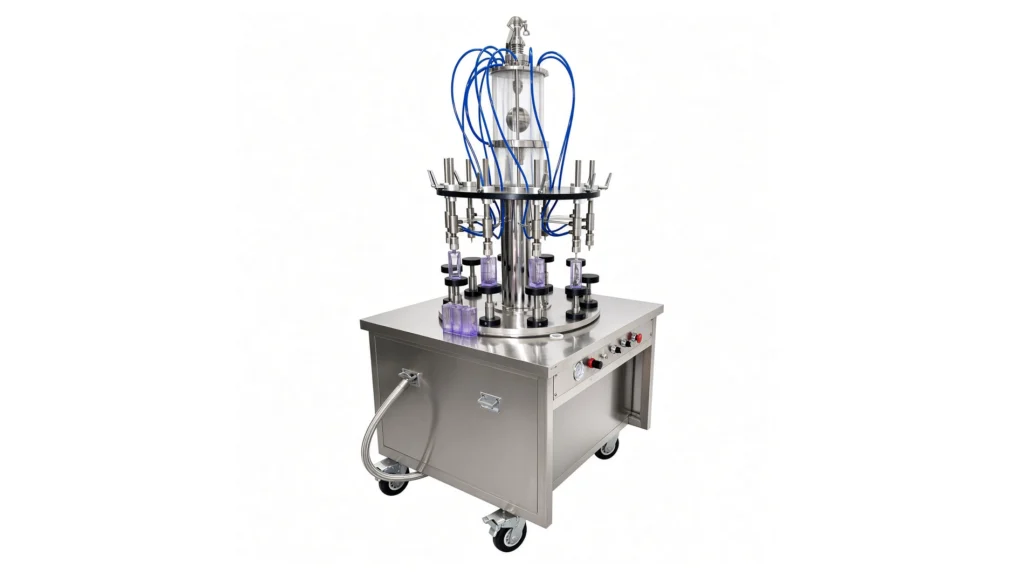
A rotary vacuum perfume filling configuration and a magnetic-pump liquid filling configuration provide different equipment directions to investigate.
Their product pages should be reviewed for the confirmed operating arrangement. These links do not imply equivalent performance, interchangeable bottle compatibility or suitability for every alcohol-containing formulation.
The guide to time-based and volume-based filling offers broader metering context without replacing the selected machine’s technical specification.
Bottle Neck and Spray-Pump Compatibility
Bottle Neck and Spray-Pump Compatibility
The bottle and spray pump should be assessed as a matched packaging set. Neck construction, pump components and the intended attachment method determine the required assembly equipment.
Confirm whether the package uses a crimped pump, a threaded closure or another specified arrangement. Similar external appearance does not establish compatibility with the same tooling.
Representative bottles and pump assemblies should be available for equipment assessment. Where several packaging combinations are planned, identify the approved components and the conversion requirements for each.
Do not describe every perfume closure as a screw cap or assume that every spray pump is crimped. The actual package construction defines the operation.
Pump Crimping and Decorative Collar Pressing
Pump Crimping and Decorative Collar Pressing
Pump crimping and decorative collar pressing are separate assembly tasks. The required sequence depends on the selected pump and decorative components.
The semi-automatic perfume bottle crimping machine provides a product reference for compatible crimped-pump applications. The perfume bottle collar pressing machine addresses a different component-placement duty.
A decorative collar should not be treated as the primary liquid closure unless the actual package design establishes that function. Confirm which operation secures the pump and which installs the decorative part.
Tooling, support and adjustment requirements should be matched to the bottle and components. One compatible package does not establish universal suitability for other perfume bottles.
Separate Stations and Integrated Packaging Equipment
Separate Stations and Integrated Packaging Equipment
Separate filling, crimping and collar-pressing stations can be evaluated where operator-assisted transfer suits the production arrangement. Their staffing and handling requirements should be reviewed as a complete task.
Where coordinated filling and closure are required, an integrated liquid filling and bottle capping configuration provides another equipment reference. Its actual closure method must match the intended package; the word capping does not establish crimping or collar pressing.
Compare what the equipment actually automates, including bottle feeding, component supply and finished-package discharge. Automatic dispensing alone does not establish unattended packaging.
A group of powered stations also does not automatically form a synchronized line. Transfer, spacing and operating responsibilities need their own definition.
Materials and Alcohol-Containing Formulations
Materials and Alcohol-Containing Formulations
Product-contact compatibility should cover the complete wetted pathway, including seals, tubing, valves and pumps as well as vessels and nozzles. A stainless steel frame or tank does not establish compatibility throughout the installation.
Alcohol-containing or otherwise flammable formulations require assessment of the intended equipment and operating environment. Drive type alone does not establish the suitability of electrical controls, accessories or the complete installation.
Pneumatic operation should not be presented as automatic evidence of ATEX certification. Any hazardous-area claim must match the confirmed configuration and supporting documentation.
Raise these requirements during project definition rather than assuming that equipment marketed for perfume has one universal safety configuration.
Fragrance Changeover and Residual Product
Fragrance Changeover and Residual Product
Changing fragrance products places particular importance on retained material and the approved cleaning method. Residue in vessels, transfer accessories or filling components can affect the next production task.
Review the complete product route, including filters where fitted. Identify the components requiring removal, separate cleaning or replacement according to the approved procedure.
The guide to cleaning dead corners in process equipment provides related access considerations. It does not replace the selected equipment’s cleaning instructions.
Define the release checks for the next product. Visible cleanliness alone should not be treated as an established acceptance method for every fragrance changeover.
Acceptance for Product Handling and Finished Packaging
Acceptance for Product Handling and Finished Packaging
Acceptance should be divided by equipment duty. Mixing or filtration checks, filled quantity and pump attachment are different requirements and should not be collapsed into one general performance claim.
For dispensing, define the intended quantity or endpoint and the measurement method. The filling accuracy testing guide provides supporting measurement context.
For packaging, identify the required pump position, bottle condition and any package-specific checks. Crimp appearance, decorative assembly and functional closure requirements should be assessed according to the actual packaging design.
Use representative product, bottles, pumps and collars. A change to one component may require reassessment even where the commercial package name remains unchanged.
Layout, Utilities and Operating Cost
Layout, Utilities and Operating Cost
Plan space for charging, closed holding, transfer, package loading and finished-product handling. Separate stations need an accessible working arrangement as well as sufficient floor area.
Electrical supply, compressed air, cooling and any other services must follow the selected configuration. A cooling-and-filtration unit and a standalone pneumatic tank should not be assigned the same utility requirements.
Include cleaning, changeover, consumables and operator involvement when comparing equipment arrangements. The machinery total cost of ownership guide provides a broader framework for reviewing costs beyond the purchase price.
Future requirements should identify the additional formulations or packaging combinations expected. Expansion may require another function or station rather than only a larger processing vessel.
Typical Applications
Typical Applications
Perfume, eau de toilette, cologne, body mist and selected fragrance liquids, subject to confirmed formulation, packaging and equipment compatibility.
Key Factors to Evaluate Across Perfume Production Equipment
Key Factors to Evaluate Across Perfume Production Equipment
- The actual mixing, holding, cooling and filtration duties required.
- The functions included in each vessel or processing unit.
- The product-contact materials and formulation compatibility.
- The transfer arrangement between processing and packaging.
- The bottle neck, spray pump and decorative component combination.
- The distinction between filling, crimping, capping and collar pressing.
- The automatic functions and remaining operator tasks.
- The fragrance-changeover and cleaning requirements.
- The equipment-specific acceptance criteria.
- The utilities, installation environment and future packaging duties.
StriversMachinery manufactures core mixing equipment in-house and works with long-term partner manufacturers for complementary equipment. Define the formulation and packaging requirements together when evaluating a standalone unit or a coordinated equipment project.