
Buying Guides
This guide explains how industrial machine pricing actually breaks down, from raw material and components through quality control and after-sales support.
It walks through the specific ways some suppliers offer dramatically lower prices, and why those savings often reappear later as downtime, maintenance, and lost production.
Readers get a Total Cost of Ownership framework for comparing cheap, mid-range, and premium equipment options honestly.
The guide closes with real procurement examples, a supplier evaluation checklist, and the long-term partnership principles that shape sustainable equipment sourcing decisions.

Conventional aluminum tubes normally use mechanical folding and crimping; compatible plastic and laminated tubes use thermoplastic tail sealing
Full tube construction, formulation and closure integrity matter more than a material label or a simple barrier ranking
Compare actual tooling, supplied functions, accepted output and ownership costs rather than assuming fixed speed or price advantages
Assess recyclability for the complete package and destination recycling system; PBL is not automatically recyclable
Use representative machine trials and suitable package tests to establish the supported application and its limits

Assess actual heat, humidity, water and salt exposure against equipment ratings and manufacturer maintenance requirements
Distinguish water ingress from condensation, and compare relevant surface temperatures with the dew point of adjacent air
Select enclosure protection, lubrication and corrosion controls for the installation rather than applying a universal tropical upgrade
Use documented condition and risk to review tasks and intervals, including building, utilities, spares and worker protection
The verified coastal cosmetic-factory case shows site-specific improvements without establishing a universal IP rating, material or inspection interval
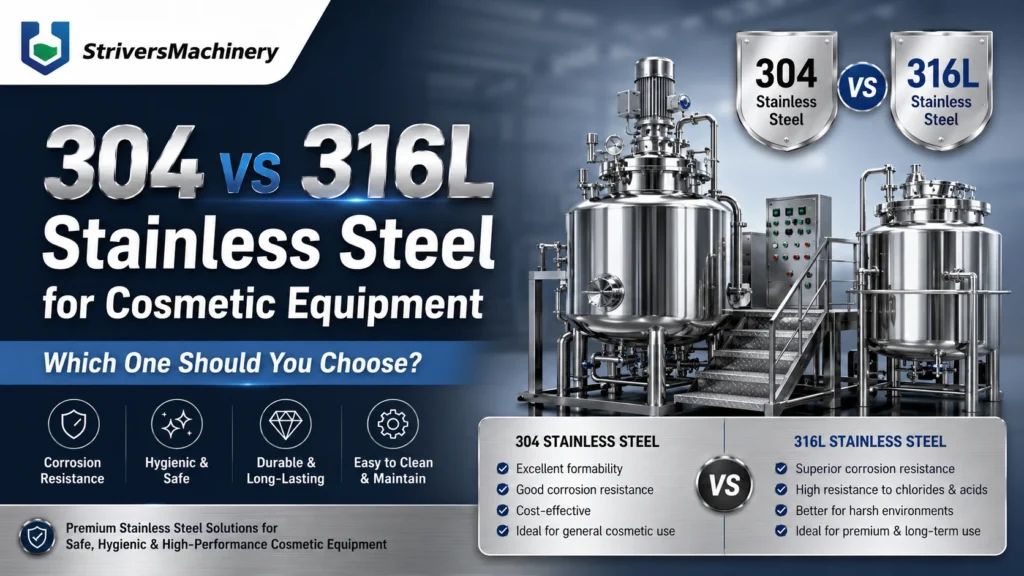
This guide explains why “is it stainless steel?” is not enough when buying cosmetic equipment, and why the more useful question is which grade is used on each component.
It compares 304 and 316L, explains common corrosion mechanisms, and shows how formulation, cleaning conditions, fabrication, and surface finish affect the choice.
It covers tanks, emulsifying mixers, fillers, water systems, and transfer components without treating 316L as a universal requirement.
It also explains how to check material certificates and traceability, what XRF can verify, and why raw-material price differences should not be confused with finished-machine costs.

TCO compares purchase, installation, operation, maintenance, downtime, replacements, disposal, and residual value over the same period
Start with the same acceptable output, product requirements, and scope before comparing equipment prices
Use measured consumption, task-based staffing, service records, and supported assumptions to build annual costs
Count each cost once and test how production volume, downtime, and energy prices change the result
The worked example shows simple payback and discounted costs using explicit assumptions, not customer performance claims

Choose laboratory mixing equipment by the task, usable batch range, material behavior, temperature profile, and cleaning needs
Homogenizers and high-shear mixers overlap; compare their working heads, flow, torque, and demonstrated product results
Use pilot trials to test the process differences that matter before moving to the intended production setup
Tip speed is one useful comparison during scale-up, alongside geometry, circulation, power input, time, and heating and cooling history
Keep trial conditions and product test methods consistent so results can be compared across batches and scales
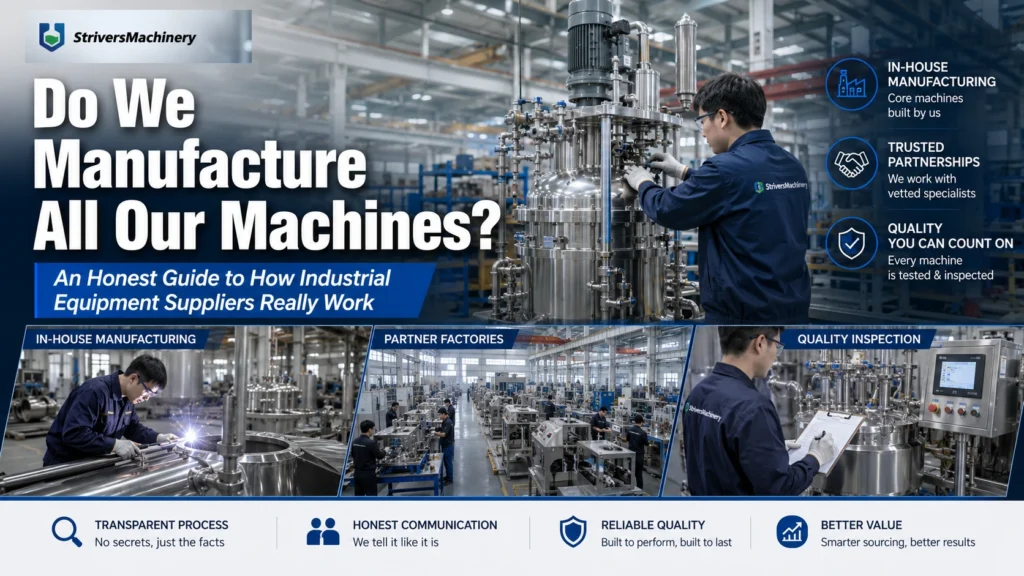
This guide answers the common buyer question of whether an equipment supplier manufactures everything themselves, explaining that most professional suppliers combine direct manufacturing with vetted partner factories.
It walks through the three main industry models — specialized manufacturers, trading companies, and integrated solution providers — and explains why no single factory can realistically build an entire production line alone.
Readers get a clear breakdown of what Strivers Machinery manufactures directly, how partner factories are evaluated, and the quality control process applied to every machine regardless of source.
The guide closes by explaining why project execution, integration, and long-term support matter more to a successful production line than simply claiming to manufacture everything in-house.

Airless packaging is becoming the new standard for premium skincare and personal care products, protecting sensitive formulations from oxidation while reducing preservative needs and improving product evacuation. This guide covers how airless bottles work, which products benefit most, how airless bottle filling machines operate, and the core technologies — servo filling, diving filling, pump pressing, vision inspection — that separate reliable equipment from unreliable equipment. It closes with common production challenges and solutions, a comparison against traditional packaging, and a practical buyer’s checklist for choosing the right machine.

This guide explains why the quoted purchase price of industrial equipment often represents only a fraction of its true lifetime cost.
It breaks down hidden costs across every stage of ownership, from supplier evaluation and shipping through installation, daily operating costs, and eventual disposal.
Readers get a practical framework for calculating real Total Cost of Ownership, along with a buyer’s checklist of questions to ask suppliers before purchasing.
The guide closes by explaining how choosing the right supplier and equipment design can meaningfully reduce long-term ownership costs.

This guide compares sealed and open mixing tanks across engineering, hygiene, process control, and total cost of ownership.
It provides product-specific recommendations (cream, serum, shampoo, essential oil, and more) and factory-specific guidance (startup, OEM, GMP, lab, continuous production).
A hybrid solution section explains how many manufacturers combine open premixing with sealed final mixing rather than choosing one tank type exclusively.
It closes with common buying mistakes, a decision checklist, and expert recommendations for each tank type.
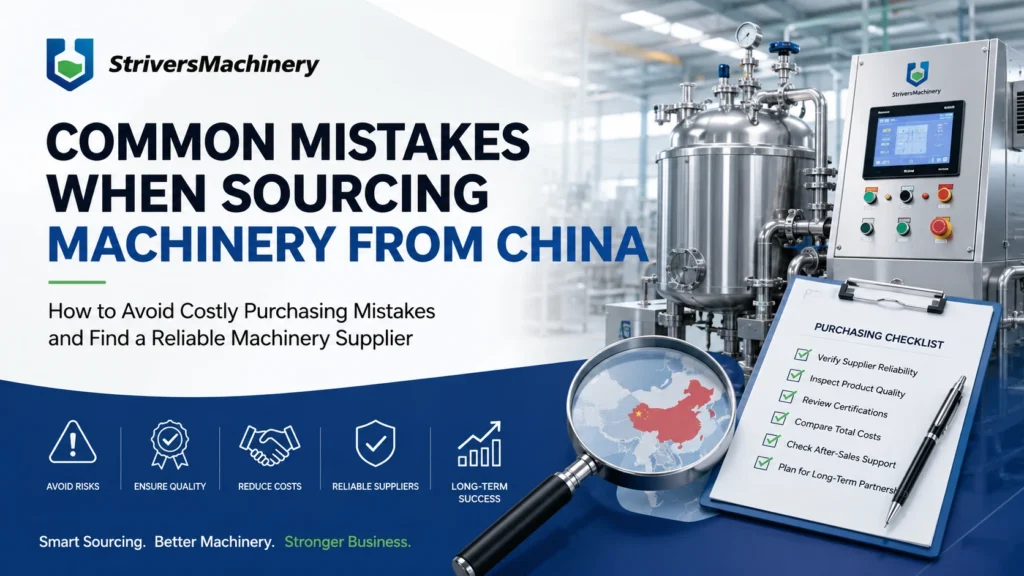
This guide walks through the full process of sourcing production machinery from China, from initial requirement definition through installation and after-sales support.
It identifies 15 specific mistakes — including chasing price over value, skipping factory verification, vague technical specifications, and ignoring warranty terms — that account for most failed or disappointing procurement projects.
A 24-point checklist consolidates these lessons into a practical pre-order reference buyers can run through before signing a contract.
Three anonymized case studies and 22 FAQs round out the guide with real-world context and quick answers to common buyer questions.

This guide walks through how vacuum emulsifying mixers actually work and why particle size determines emulsion stability
It explains how to choose between internal circulation and inner-and-outer circulation homogenizer designs
It covers the most common production problems — foaming, separation, clumping — and what actually causes them
It includes a maintenance schedule and a practical way to calculate ROI before committing to a purchase
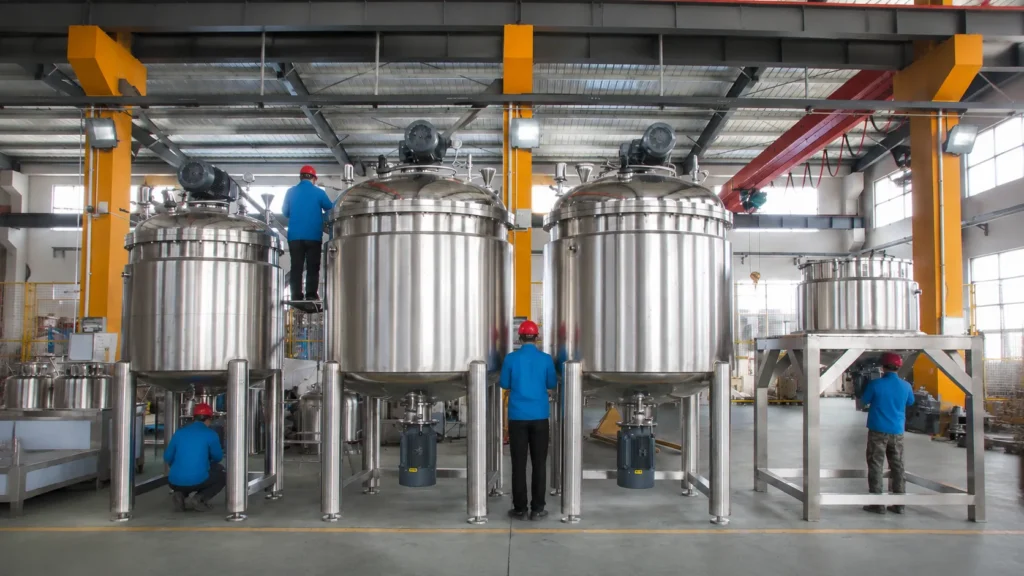
Most delays in a cosmetic equipment project trace back to the buyer’s side, not the manufacturer’s — unclear requirements, unchecked utilities, or an incorrect batch size defined too late in the process.
This guide walks through the entire buying journey in order: defining your production requirements, preparing an effective RFQ, choosing the right equipment configuration, evaluating suppliers beyond price, preparing your factory before delivery, running a proper Factory Acceptance Test, handling shipping and installation, training operators, and avoiding the mistakes that trip up almost every first-time buyer.

Most procurement teams compare equipment quotations line by line and assume the lowest number wins. In practice, the real cost of a production line shows up later — in shipping, customs delays, installation problems, and the time spent managing four or five separate suppliers.
This article walks through why factory-direct purchasing doesn’t automatically save money, what a combined factory + trading model actually looks like, and six concrete ways it lowers total procurement cost rather than just the sticker price.