Paint, Coating, Liquid Fertilizer & Chemical Products


More About These Applications
Mixing and Packaging Equipment for Coatings and Chemical Liquids
Mixing and Packaging Equipment for Coatings and Chemical Liquids
Paint, coating, ink, liquid fertilizer and adhesive products do not form one uniform mixing duty. Some require powder dispersion, some need liquid blending, and others must remain as a controlled suspension before filling. The equipment arrangement should follow those physical tasks and the product’s compatibility requirements.
StriversMachinery supplies mixing, dispersing, holding, transfer and packaging equipment that can be evaluated for defined chemical processing duties. The project starts with the formulation information relevant to equipment selection, the required batch schedule and the finished package. A machine used in one chemical application should not be assumed suitable for another without review.
This application focuses on industrial liquid and slurry processing. Household cleaning liquids have a separate detergent production pathway. Color cosmetic formulations involving pigments are addressed under color cosmetics and nail care, where product presentation and smaller packaging formats create different operating priorities.
Separate Dissolving, Dispersing and Suspending
Separate Dissolving, Dispersing and Suspending
Describe the purpose of each mixing stage. Dissolving a soluble ingredient is not the same operation as dispersing a powder or keeping solid material suspended. Some formulations need several stages, with a change in mixing action as the batch develops.
Mixing equipment should be selected using viscosity, solid content, temperature and the product’s required final condition. Identify whether the process aims to retain particles or reduce agglomeration, and whether further processing is needed elsewhere. Where the process also requires milling or a separate reaction stage, include that equipment and its transfer connections in the overall production plan.
For paint and coating work, specify the required downstream quality checks through the manufacturer’s product procedure. For fertilizer solutions, distinguish fully dissolved products from suspensions. For adhesives, include changes in consistency and any restrictions on residence time or processing conditions. This information helps define the equipment duty without relying on broad industry labels.
Powder Addition and Dispersion
Powder Addition and Dispersion
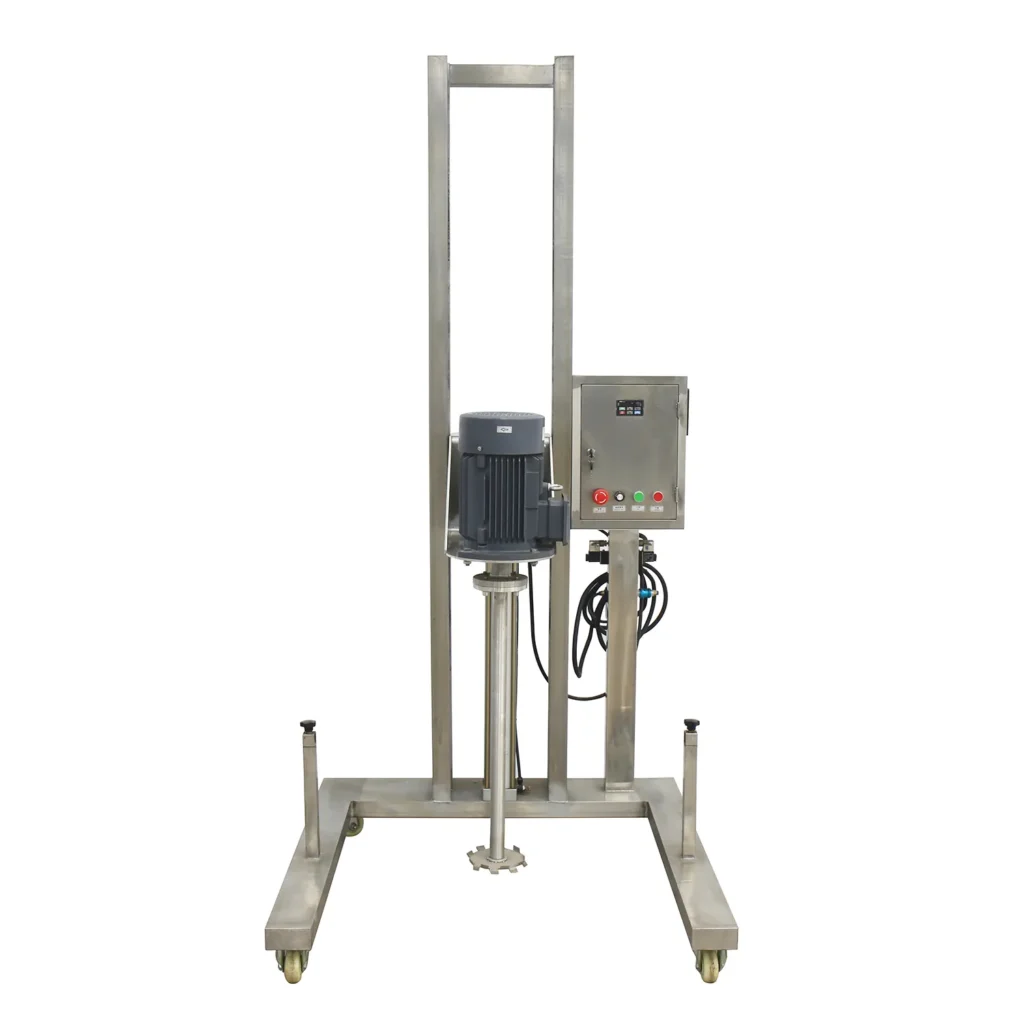
High-speed dispersers are relevant where a formulation requires powder incorporation and dispersion. The vessel geometry, working quantity, dispersing tool and product behavior all influence suitability. The correct arrangement should be assessed with representative material and the process requirements.
The mobile electric-lift high-speed disperser and pneumatic-lift disperser provide two lifting arrangements for a dispersing head. The lifting mechanism should be distinguished from the motor driving the tool. A hydraulic-lift disperser provides another equipment format to compare where the handling duty calls for it.
The high-shear processing article for paint and coatings offers further background. Agree on the dispersion checks required for the product and evaluate samples from representative trials against those checks. If the product requires an additional milling stage, identify that equipment and the transfer interface separately. The disperser proposal should describe its actual task within the complete production process.
Vessels and Access around Lift-Mounted Mixers
Vessels and Access around Lift-Mounted Mixers
A lift-mounted mixer and its process vessel should be considered together. Confirm the vessel dimensions, working quantity, tool position and the space needed to raise and lower the head. Equipment supplied without a vessel needs an explicit agreement on the customer’s vessel arrangement.
Stainless steel mixing tanks provide one vessel category to assess where the construction is compatible with the product. Other material requirements may apply, so the frame or outer finish should not be used as a substitute for a wetted-material review. Include seals, valves, hoses and the mixing tool in that review.
Leave room for vessel movement, ingredient loading and cleaning. A mobile machine still needs a suitable operating position and an agreed method of stabilizing the arrangement during use. The open versus sealed mixing tank guide provides background for vessel configuration discussions, while the final choice should follow the product, site and handling requirements.
Liquid Blending and Fertilizer Preparation
Liquid Blending and Fertilizer Preparation
Some chemical liquids mainly need controlled blending or dissolution rather than high-speed dispersion. Homogenizing mixing tanks or other blending arrangements can be assessed according to the actual duty. A homogenizer should only be included where its function is useful to the process.
For liquid fertilizers, distinguish products made as solutions from those containing suspended solids. The required holding agitation, transfer route and filling system can differ substantially. The formulation should also inform compatibility review of the vessel and connected parts.
If the process requires monitoring of conditions such as pH, specify the measurement task, installation position and maintenance needs. The mixing tank pH sensor guide provides a separate technical resource. Measurement equipment should not be assumed to be included because a tank has a control panel. Keep instrumentation and control functions explicit in the proposed supply, with the manufacturer’s process requirements defining what needs to be monitored.
Temperature and Site Requirements
Temperature and Site Requirements
Some formulations need heating or cooling during preparation, while others should be processed without an added thermal stage. Identify the duty and operating conditions before selecting a jacket, heater or cooling connection. If the selected dispersing vessel is single-layer and unheated, arrange any required thermal processing through equipment specified for that duty.
Utility systems can support the confirmed process duties. The heating, mixing and filling guide discusses coordination between thermal processing and downstream handling. Specify what happens during a pause, particularly if a product changes consistency or condition while waiting.
For solvent-containing or otherwise demanding formulations, the site should define the relevant equipment and installation requirements. The supplier must then confirm the offered configuration and documentation. Electric, pneumatic or stainless steel construction alone does not establish hazardous-area suitability. Keep those questions tied to the actual material and installation rather than applying a general explosion-proof label to the whole category.
Holding Suspensions before Filling
Holding Suspensions before Filling
Storage and holding systems should maintain the conditions required by the product while it waits for packaging. A suspension may need agitation, while another liquid may only need a compatible covered vessel. Determine the permitted waiting time through the manufacturer’s product procedure.
The holding arrangement should support representative filling throughout the batch. Assess the first, middle and final portions, particularly where solids can distribute differently. Product identification and status need to remain clear when several colors, grades or formulations are processed in the same area.
The schedule matters as much as tank volume. A larger buffer can allow a mixer to start another batch, but it also adds material to manage during a packaging stoppage and another vessel to clean. For frequent small runs, mobile or smaller dedicated holding arrangements may fit better. The choice should follow the actual order pattern and cleaning workload.
Transfer Compatibility and Wear Considerations
Transfer Compatibility and Wear Considerations
Fluid transfer systems should be selected for the finished product and the complete route. Viscosity, solid content, temperature and compatibility influence pump and seal selection. Abrasive or reactive ingredients may introduce requirements that cannot be resolved by selecting a generic stainless steel pump.
The pump selection guide provides a comparison of transfer principles, while the final assessment must use the actual formulation. Clarify whether the pump transfers bulk product, feeds a filling hopper or performs dosing. Those are different tasks and may require different control and operating arrangements.
Review the inlet conditions and the response to a stopped filling line. Also decide how the route is emptied, cleaned and inspected. Hose length and inaccessible connections can increase retained material and changeover work. The product recovery article provides background, but any recovery procedure should follow the manufacturer’s quality and handling requirements rather than be applied automatically to all chemical products.
Filling Liquids, Slurries and Viscous Products
Filling Liquids, Slurries and Viscous Products
Liquid filling machines can be assessed for compatible flowable products, while paste filling equipment provides other approaches for thicker materials. The selection should use the actual product at filling conditions, including solids and any tendency to string or drip.
The servo tracking gear pump filling line is one arrangement to evaluate for suitable chemical liquids. It uses nozzles that move with bottles during filling. That motion is different from a vertically diving nozzle arrangement and should be matched to the intended container handling sequence.
Do not generalize gear pump suitability to all paints, adhesives or fertilizer suspensions. Material compatibility, wear, particle handling and cleanability need separate review. The filling accuracy testing guide helps define quantity checks, while trials should also examine cutoff, container contamination and restart behavior. Package appearance and a workable cleaning procedure are part of a useful result.
Bottles, Jars and Larger Containers
Bottles, Jars and Larger Containers
Container size and construction affect the filling and closing arrangement. A small bottle needs different support from a larger handled container. Provide the actual package, including its opening, closure and any liner, rather than only a nominal fill quantity.
Capping equipment applies to compatible threaded closures. Press-fit lids and other closing systems follow different routes. The automatic snap and press capping machine is an example of equipment to assess for compatible press-on packages, not a universal substitute for a screw capper.
Where the package uses a separate sealing operation, sealing machines should be reviewed with the full container and closure assembly. The required finished-pack checks belong to the manufacturer’s procedure. Leave enough space for inspection and handling after filling, especially where larger packs are heavy or the product can contaminate the closing surface during a poorly controlled fill.
Labels, Codes and Packed-Goods Handling
Labels, Codes and Packed-Goods Handling
Labeling machines need a suitable surface and container presentation. The package may be round, flat-sided or shaped around a handle, so label dimensions alone do not establish compatibility. Product residue on the outside of a container should be addressed before the labeling station.
Coding equipment should place the required batch or production information where it remains readable through handling and packing. Specify the substrate and print position, and define the procedure for changing information between grades or colors.
Secondary packaging equipment can support grouping and shipping preparation. The line layout should account for the weight of finished packs, space for accumulation and a clear route for rejected products. A faster filler is of limited value if operators cannot replenish containers or remove finished goods safely and efficiently within the proposed working area.
Cleaning and Product Changes
Cleaning and Product Changes
Changeovers between colors or formulations should be planned as part of production, not treated as an occasional maintenance task. Identify the shared surfaces and the cleaning method approved for the materials involved. The equipment must provide access to those surfaces and a practical route for cleaning liquids and removed parts.
The cleaning access guide provides general design questions, but its examples should be applied according to the chemical duty. Cleaning practices suitable for one product family may not be suitable for another. Review seals and hoses as well as the vessel itself.
Consider whether certain formulations justify dedicated parts or separate equipment. That decision depends on the product, cleaning acceptance requirements and production schedule. Keep cleaned components organized and protect them from being confused with used parts. The most productive arrangement may be the one that makes a demanding changeover manageable rather than the one with the largest nominal batch capacity.
Use Representative Samples for the Most Demanding Duty
Use Representative Samples for the Most Demanding Duty
An equipment trial should reflect the formulation that places the greatest demand on the relevant operation. For dispersion, that may be a difficult powder addition. For transfer, it may be the finished slurry at its lowest intended handling temperature. For cleaning, it may be a formulation that is difficult to remove from the product path.
These may be different products, so one demonstration does not necessarily cover the whole range. Agree on the trial purpose and observations in advance. The resulting information can guide the equipment configuration and operating scope without turning a successful test on one liquid into a universal claim for every chemical product.
Development Trials and Equipment Scope
Development Trials and Equipment Scope
Trials should demonstrate the defined processing task using representative material and a relevant vessel arrangement. The laboratory and R&D application pathway can support planning for formulation and process development. Record observations that influence scale-up, including mixing behavior, temperature, discharge and filling.
For a complete production line proposal, provide the formulation information needed for compatibility review, required process stages, batch sizes, package samples and site services. Identify specialized milling, reaction, containment or treatment equipment that will be supplied separately rather than assuming it is covered by a general mixing proposal.
StriversMachinery can coordinate the confirmed equipment functions and interfaces around that brief. The proposal should state included vessels, transfer connections, automation and manual tasks. That gives the production team a clear basis for reviewing the proposed arrangement against its materials, working schedule and available factory services before equipment is ordered.