
Industry Solutions
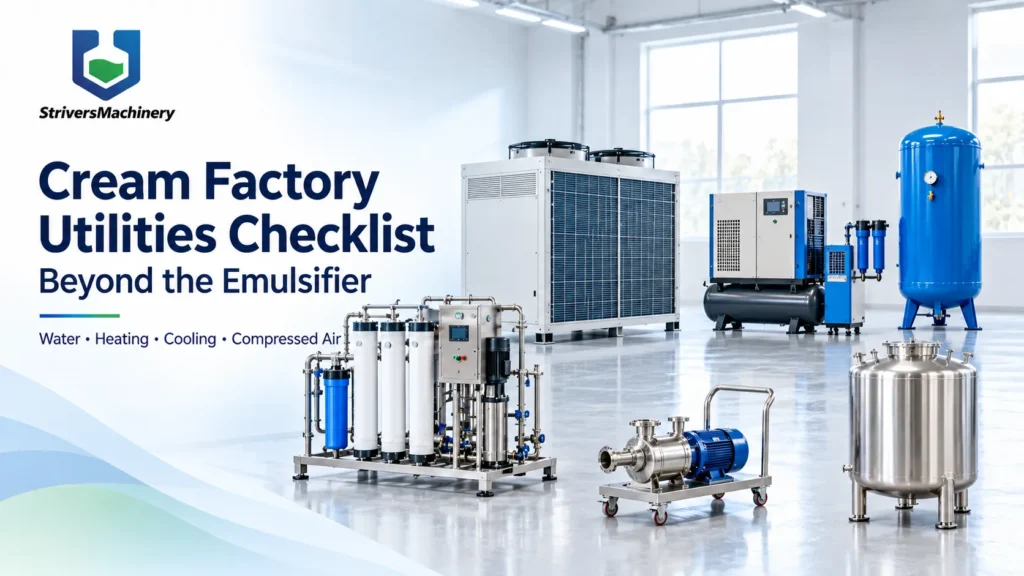
Plan utilities alongside the emulsifier, before delivery.
Separate essential functions from process-dependent equipment.
Calculate demand from batch schedules and overlapping operations.
Specify service quality at the actual point of use.
Assign responsibility for every supply and connection.

Wax-based products are semi-solid at room temperature, so cold filling gives unstable flow, weight variation and rough surfaces.
Hot filling is for flowability and dosing accuracy, not sterilization.
Cooling forms the final structure, which decides texture, surface and sink-mark risk.
Capping after the product sets prevents wax on the cap, rim contamination and sealing problems.
Natural cooling, cooling rooms and cooling tunnels suit different outputs, SKU mixes and space limits.

This article explains what nitrogen flushing, purging, blanketing, and inerting mean and why the distinctions matter.
It describes how nitrogen protects products from oxidation, moisture, and fire risk across cosmetics, food, pharma, and chemical manufacturing.
Different system types—continuous purging, vacuum backfill, pressure cycling, liquid nitrogen injection—suit different stages and sensitivities.
Equipment needs (cylinders, PSA generation, compressors, dryers, buffer tanks, analyzers) and common design mistakes are covered.
Guidance on estimating nitrogen consumption, choosing purity, ROI considerations, and regulatory/safety points is provided.

O/W and W/O identify the continuous phase, not a fixed oil percentage, viscosity, sensory profile or preservation requirement
Both structures can contain compatible water-soluble and oil-soluble ingredients in their respective phases
Choose the formulation and developed process against the complete product brief, quality requirements, package and intended use
Develop additions, mixing, cooling and any vacuum for the actual formula rather than applying universal rules by emulsion type
Evaluate representative pilot samples and relevant physical, chemical, microbiological and packaging results before scale-up decisions

This guide explains what cleaning dead corners are, how they differ from dead legs, dead zones, and dead space, and why even a few millimeters of poor geometry can cause biofilm, corrosion, and contamination.
It walks through the fluid dynamics and microbiology behind dead corner formation, then maps exactly where they hide inside mixing tanks, vacuum emulsifying mixers, piping, valves, filling machines, CIP systems, and instrumentation.
The guide covers hygienic design principles that prevent dead corners from forming, cleaning technologies (CIP, COP, SIP) that address them, and validation methods like riboflavin, ATP, and TOC testing that confirm cleaning actually worked.
It closes with relevant global standards, common design mistakes, an inspection checklist, four real engineering case studies, and emerging technologies shaping the future of hygienic equipment design.

This guide explains why standard filling machines like gear pumps and piston fillers often crush particles or struggle with high-viscosity products such as facial scrub, jam, peanut butter, and pharmaceutical suspensions.
It introduces rotary lobe pump filling machine technology — positive displacement, non-contact rotor design, and servo metering — and explains exactly why it protects particles while maintaining accurate fill volume.
The guide compares rotary lobe pumps directly against piston, gear, and peristaltic pump alternatives across accuracy, particle protection, cleaning, and cost.
It also covers viscosity reference ranges, machine configuration options, engineering design considerations, maintenance practices, and real manufacturing case studies across cosmetics, food, and pharmaceutical applications.

This guide explains why high-viscosity and temperature-sensitive products like cream, honey, peanut butter, chocolate, and wax cause clogging, dripping, crystallization, and inconsistent fill weight on standard filling machines.
It breaks down the real cause — a missing Heating + Mixing + Holding + Filling workflow — and shows how a properly engineered heating mixing filling machine solves each failure point.
Product-specific filling practices are covered for creams, hair wax, lip balm, honey, peanut butter, chocolate, and pharmaceutical ointments.
The guide also includes a step-by-step buying process, a troubleshooting section, and a full equipment configuration reference table.

Stable mayonnaise and salad dressing depend as much on the production line as on the recipe itself.
This guide covers why these emulsions need specialized processing equipment, the complete production flow from raw materials to packaging, and the full equipment configuration including vacuum emulsifying mixers, sanitary pumps, and CIP systems.
It explains food-grade design requirements, why vacuum emulsification is essential, critical process parameters, product-specific equipment recommendations, and food safety compliance standards.
It closes with common production problems, batch versus continuous production, total cost of ownership, and a practical buying checklist.

This guide covers why cosmetic cream develops too many air bubbles, breaking causes into four categories: equipment problems, process problems, formula problems, and operator errors.
It includes a step-by-step troubleshooting sequence, a real customer case involving a leaking mechanical seal and inadequate vacuum pressure, and recommended process parameters for deaeration.
A dedicated section covers engineering improvements in modern vacuum emulsifying mixers that prevent this issue at the design level, along with ten maintenance tips.
A quick diagnosis table and FAQs round out the guide for fast symptom-to-cause reference.

This guide explains why a cosmetic formula that succeeds in lab testing can behave differently at commercial production scale
It covers how mixing dynamics, shear force, heat transfer, and air entrapment all change as batch size increases
It walks through why viscosity shifts during scale-up and how to correctly scale mixing time and homogenization
It includes the most common scale-up problems, a validation checklist, and how to choose equipment built for reliable scale-up

Setting up a cosmetic manufacturing plant involves far more planning than selecting equipment from a catalog.
This guide walks through the full process in order: defining your product type and production capacity, planning factory layout, specifying utility systems like water treatment and steam, choosing core processing equipment such as vacuum emulsifying mixers and mixing tanks, selecting filling and packaging lines, building quality control and cleanroom infrastructure, and adopting factory automation where it genuinely pays off.
It closes with a budget breakdown by factory size, the most common setup mistakes first-time builders make, and 36 frequently asked questions covering the practical details that come up throughout the planning process.

Most manufacturers focus on equipment price and overlook the ongoing cost of product left behind in every batch.
This guide maps where product loss actually happens across the full production process — from raw material loading and mixing through tank discharge, pipeline transfer, filling, and CIP cleaning — and explains the specific equipment and process decisions that improve recovery at each stage.
It covers full-drain tank design, scraper and homogenizer selection, transfer pump matching, discharge techniques, and cleaning sequencing, along with 20 common recovery problems and their practical solutions.
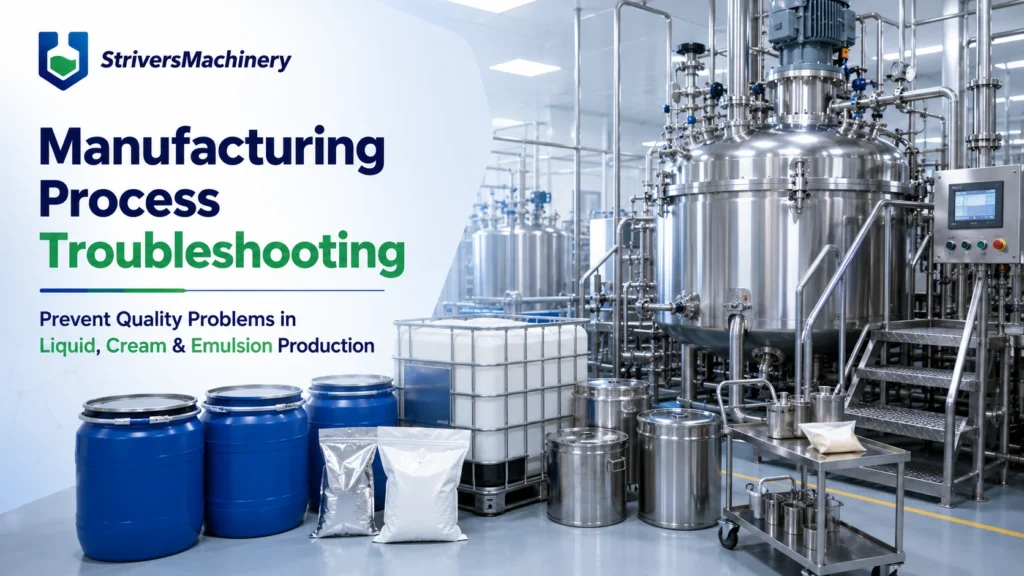
This guide explains why quality problems like burning, sedimentation, oxidation, discoloration, foaming, and product loss happen during liquid, cream, and emulsion manufacturing. It breaks the root causes down into three categories — raw material characteristics, equipment design limitations, and incorrect process parameters — then walks through seven of the most common production problems with their real causes and fixes.
It also covers how mixing, homogenization, vacuum, heating, transfer, and cleaning equipment map to these issues, and closes with a practical checklist for consistent, high-quality production.
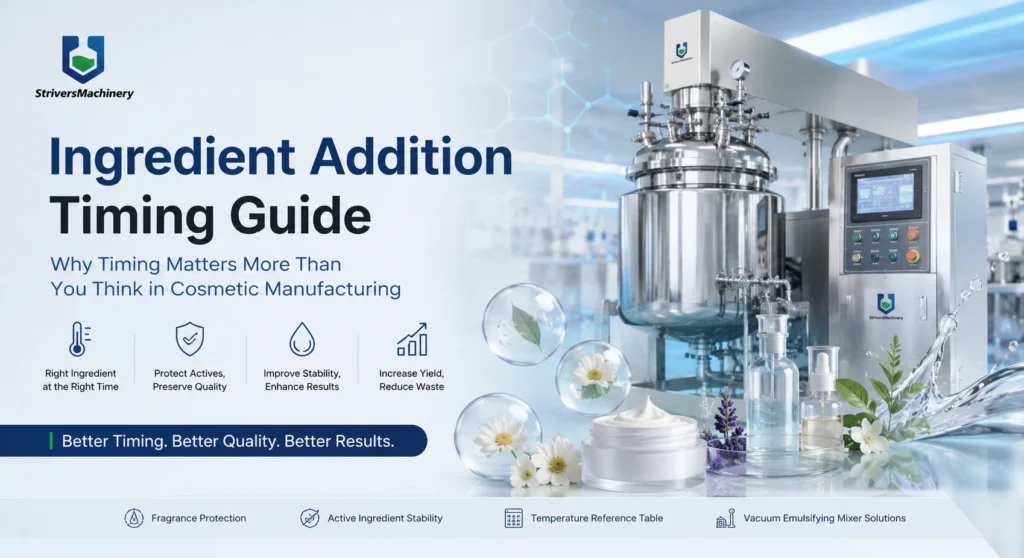
This guide explains why the timing of ingredient addition matters as much as ingredient selection in cosmetic manufacturing.
It covers when fragrance should be added, why most active ingredients need to go in after the cooling phase rather than during emulsification, and what happens to fragrance, vitamins, peptides, and botanical extracts when they’re exposed to excess heat.
It also includes a full temperature reference table by ingredient category and a look at how the right vacuum emulsifying mixer makes this stage easier to control consistently.