
Rotary Filling & Sealing Machines

More About Our Machines
Rotary Filling & Sealing Machines and Related Configurations
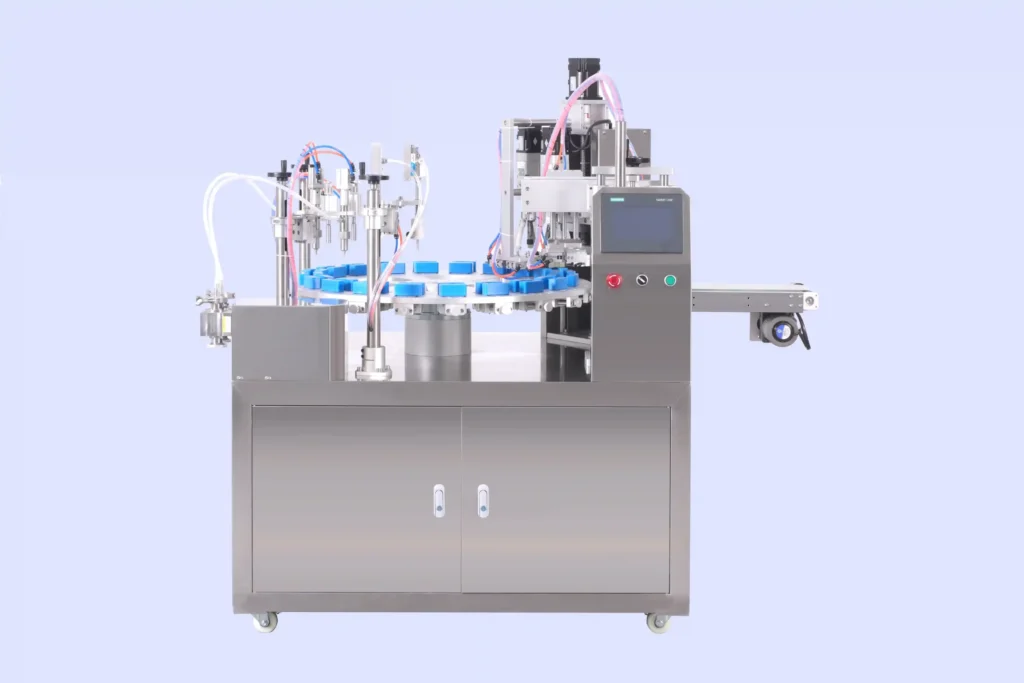
Rotary filling and sealing machines coordinate container handling with product dispensing and a defined closure operation. Within this category, equipment is organized around cup and tray sealing, rotary bottle filling and capping, and related spout pouch filling and capping requirements.
These packaging formats require different handling arrangements. Rotary describes a machine layout, while sealing and capping describe package-closing operations. Related equipment grouped within this section may use another layout, so the category name should not replace a review of the actual machine configuration.
As part of the broader Filling Machines range, this section helps identify the appropriate packaging route. Individual equipment pages provide the confirmed container compatibility, dispensing method, operating functions and performance specifications.
Packaging Formats and Closure Operations
The first selection decision is the package to be filled and the method used to close it. Cups, trays, bottles and spout pouches should be assessed as distinct formats rather than treated as interchangeable containers.
| Packaging format | Equipment focus | Key compatibility requirement |
|---|---|---|
| Cups and trays | Filling followed by the specified sealing operation | Container support, sealing surface and compatible closure material |
| Rigid bottles | Filling followed by the confirmed cap or closure application | Bottle geometry, neck finish and closure construction |
| Spout pouches | Filling through the designated opening and applying the specified cap | Spout dimensions, pouch support and cap compatibility |
A single category can contain these different configurations without implying that one machine processes every package. The selected equipment must be assessed against the actual container and closure samples.
Cup and Tray Filling and Sealing
Cup and tray equipment combines dispensing with the operation required to close the container opening. Selection should establish how the container is supported and how the sealing material is presented and applied.
The sealing surface and closure material must be compatible with the supplied sealing method. Container appearance alone does not establish that a package can use the same tooling or settings as another format.
Product placement also matters. The filling arrangement should be assessed around the container opening, required quantity and condition of the sealing area after dispensing. Product behavior during filling can affect the suitability of the overall packaging arrangement.
Confirm which functions are included, such as container loading, closure-material feeding, sealing and discharge. Automatic sealing does not independently establish that all upstream and downstream handling is automatic.
Rotary Bottle Filling and Capping
Rotary bottle equipment moves containers through the supplied processing stations using a rotary handling arrangement. Filling and cap application may be coordinated within an integrated machine where confirmed by the configuration.
Bottle support and positioning must suit the actual package. Relevant details include body shape, stability, neck finish and the surfaces available for handling. Format changes may require different guides, supports or other tooling.
The closure operation needs a separate definition. Cap placement, tightening, pressing and crimping are different duties; none should be assumed from the word capping alone.
Where closure application is a separate requirement, related capping machines can be evaluated against the actual package. The equipment scope should make clear which operations occur within the filling machine and which remain external.
Spout Pouch Filling and Capping
Spout pouch equipment handles a flexible package through its specified support and filling arrangement. The pouch body, spout and cap together determine the packaging requirement.
Confirm how empty pouches are loaded, how the spout is positioned and how the filled pouch is supported during closure. A semi-automatic arrangement may retain manual loading or transfer tasks even where dispensing and capping are powered.
Pouch filling and capping should not automatically be described as rotary operation. The actual layout and handling sequence belong to the selected equipment specification.
The stand-up pouch filling and capping guide provides packaging-specific context for reviewing flexible containers and their equipment requirements.
Product Characteristics and Dispensing Selection
The product must be assessed at its intended filling conditions. Flow behavior, temperature, foaming tendency, suspended particles and separation characteristics can influence the appropriate dispensing arrangement.
The package opening also affects selection. Filling an open cup, a narrow-neck bottle and a spout pouch presents different access and positioning requirements, even when the same product is being packed.
Where temperature control or agitation is required, confirm the supplied provisions separately. These functions should not be inferred from a general description such as liquid, paste or viscous-product filling.
The guide to time-based and volume-based filling provides a broader comparison of dispensing approaches. Actual metering functions remain specific to the selected equipment.
Semi-Automatic and Automatic Operating Arrangements
Automation level describes how tasks are divided between personnel and equipment. Semi-automatic configurations retain defined operator actions, while automatic configurations coordinate more of the packaging sequence.
Review container loading, product replenishment, closure supply and finished-package collection individually. A machine can automate its central filling and closure cycle while still requiring manual support at either end.
Detection, alarms and rejection also require separate confirmation. A container-presence function does not establish closure inspection, and an automatic discharge function does not establish separation of defective packages.
The appropriate arrangement depends on production continuity, staffing and package consistency. Compare the complete operating sequence rather than selecting solely from the automation label.
Output, Changeovers and Packaging Schedule
Required output should describe the complete packaging duty, including the product, target quantity, container and closure. A nominal machine speed does not establish finished production under every operating condition.
Product replenishment, container loading and closure-material supply can affect sustained operation. The production schedule should also allow for setup, cleaning and format conversion where these tasks interrupt packaging.
For multi-format operation, identify the parts and adjustments needed for each package. Cup tooling, bottle-handling components and pouch supports are different conversion requirements and should not be grouped under a general size-adjustment claim.
Future expansion should be expressed as specific additional products or packaging formats. A different closure or container construction may require a revised configuration rather than a higher operating speed.
Filling and Closure Acceptance
Acceptance should address both the dispensed quantity and the completed package. Consistent filling does not independently establish an acceptable seal or correctly applied cap.
Define the filling measurement basis and the agreed evaluation conditions. The filling accuracy testing guide provides related measurement context.
Closure checks should reflect the package and intended use. Sealed cups, capped bottles and capped pouches need acceptance criteria appropriate to their construction. Any required leakage or package-integrity assessment should be defined separately.
Use representative product, containers and closure components when assessing a configuration. Packaging substitutions can change compatibility even when the nominal container capacity remains similar.
Cleaning and Product Changeover
Cleaning requirements depend on the product-contact pathway and the residue left by the formulation. Confirm which dispensing components are removable and which require an approved cleaning route through the assembled equipment.
Closure tooling and container-handling components may have different service requirements from the liquid circuit. Their inspection and cleaning arrangements should be identified separately.
Where product condition during filling requires special handling, the heating and mixing filling guide provides related context. The selected equipment must still confirm any temperature-control or agitation provisions.
Stainless steel construction does not independently establish automatic cleaning, sterilization or compatibility with every cleaning method. Those capabilities require confirmation for the supplied configuration.
Installation and Production-Line Interfaces
Installation planning should include space for package loading, product supply, closure replenishment and finished-product handling. Maintenance access and format conversion require additional working space beyond the equipment footprint.
Electrical, compressed-air and other utility requirements must follow the actual machine specification. Confirm services for any separate product-feeding or closure-handling equipment within the project.
Completed packages may connect to labeling machines or other downstream packaging operations. Transfer conditions should account for the stability and presentation of the actual cup, bottle or pouch.
For connected equipment projects, the complete production lines category provides the broader integration context. Define the interfaces and operating responsibilities between machines rather than assuming separate automatic units form a coordinated line.
Typical Applications
Cosmetic liquids, creams, gels, shampoo, detergent, essential oil, perfume, serum, juice and sauce, subject to the confirmed product and packaging compatibility.
Key Factors to Evaluate
- The package format and actual container construction.
- The required sealing or cap-application method.
- The product characteristics at the intended filling conditions.
- The supplied dispensing method and target quantity.
- The actual rotary or alternative handling arrangement.
- The automatic functions and remaining operator tasks.
- The tooling and adjustments needed for format changes.
- The agreed filling and closure acceptance criteria.
- The cleaning method, installation services and maintenance access.
- The downstream transfer and packaging interfaces.
StriversMachinery evaluates equipment configurations according to individual project requirements. Define the product, package and closure duty together before selecting the appropriate filling and sealing arrangement.