High Speed Dispersers


More About Our Machines
High Speed Dispersers for Powder Incorporation and Dispersion
High speed dispersers are selected for tasks involving the wetting, incorporation, and dispersion of solid ingredients in a liquid phase. The relevant materials may include pigments, fillers, or other powders, depending on the formulation and the supplied equipment configuration.
The machine should be evaluated around the condition the material needs to reach. Visible movement in a vessel does not establish that a powder has been adequately wetted or dispersed throughout the batch.
This equipment family focuses on dispersion-led processing. For a broader comparison with conventional mixing tanks and batch homogenizing units, visit the parent Mixing Equipment category.
Individual product pages provide the verified drive, lifting arrangement, dispersing components, controls, and dimensions of a particular model. Those specifications should not be generalized across the complete category.
Distinguish Wetting, Incorporation, and Dispersion
Powder processing can involve several related tasks. Wetting concerns bringing the liquid into contact with the powder. Incorporation concerns introducing and distributing the solid ingredient within the batch. Dispersion concerns the required distribution and condition of that ingredient after processing.
A formulation may present difficulty at one stage even when another appears satisfactory. Powder can enter the vessel but remain in unwanted agglomerates, or a batch can appear uniform while failing an agreed dispersion criterion.
Describe the actual problem before selecting equipment. Provide the powder form, liquid phase, addition sequence, relevant material behavior, and the condition required before discharge.
If the reason for changing equipment is a product-quality problem, the manufacturing process troubleshooting guide provides a supporting framework for reviewing possible contributors rather than attributing the result to mixer speed alone.
Compare Dispersers with Batch High Shear Mixers
A high speed disperser and a lifting-type batch homogenizer should not be selected as equivalent machines. Their processing elements and application priorities differ, even when both use a lifting structure.
| Selection point | High speed disperser | Lifting-type batch homogenizer |
|---|---|---|
| Primary focus | Powder wetting, incorporation, and dispersion | Rotor-stator processing for supported homogenizing tasks |
| Working element | Dispersing element selected for the material and process | Rotor-stator homogenizing head |
| Evaluation requirement | Demonstrate the required powder incorporation and dispersion result | Demonstrate the required formulation or homogenizing result |
| Shared planning needs | Compatible vessel, usable batch range, access, and operating conditions | Compatible vessel, usable batch range, access, and operating conditions |
Where a rotor-stator operation is the appropriate starting point, review High Shear Mixers. In this range, that category refers to lifting-type batch homogenizing machines rather than inline units.
Powder and Liquid Characteristics Drive Selection
Provide information about both the powder and the liquid phase. Relevant considerations can include powder form, loading, tendency to form agglomerates, liquid viscosity, temperature, and changes as ingredients are added.
Do not assume that one formulation represents every product sold under the same industry label. Two coatings or cosmetic products can create different wetting, circulation, cleaning, and material-compatibility requirements.
Identify sensitive ingredients, abrasive components, corrosive materials, or other characteristics relevant to the equipment review. Confirm the required product-contact construction rather than selecting from the frame material alone.
The 304 versus 316L stainless steel guide provides a related material-selection resource. Final compatibility must still be assessed against the complete formulation and cleaning conditions.
Evaluate the Dispersing Element and Vessel Together
The dispersing element, vessel geometry, product level, and working position form one processing arrangement. A machine should not be approved independently of the vessel in which it will operate.
Working Position
Confirm the approved location and clearances of the dispersing element. Do not apply an assumed positioning ratio to every vessel or material. The required setting must follow the selected configuration and its operating instructions.
Batch Movement
The proposed arrangement must support movement of material through the relevant working region. A localized dispersion action does not automatically establish that the complete batch has reached the required condition.
Where a process vessel is required separately, review the Stainless Steel Mixing Tanks family and confirm compatibility with the disperser. The suitability of an existing vessel should be assessed rather than presumed.
Usable Batch Range and Changes During Processing
Define routine batch quantities, smaller commercially important runs, and the largest intended requirement. Total vessel volume is not the same as the effective processing range of a particular disperser.
At the lower end, confirm that the dispersing element engages the material as intended. At the upper end, confirm that product movement and operating conditions remain suitable for the complete batch.
Also consider how the material changes as powder is added. The initial liquid may behave differently from the later formulation. Selection should address the relevant processing stages rather than rely only on the starting viscosity.
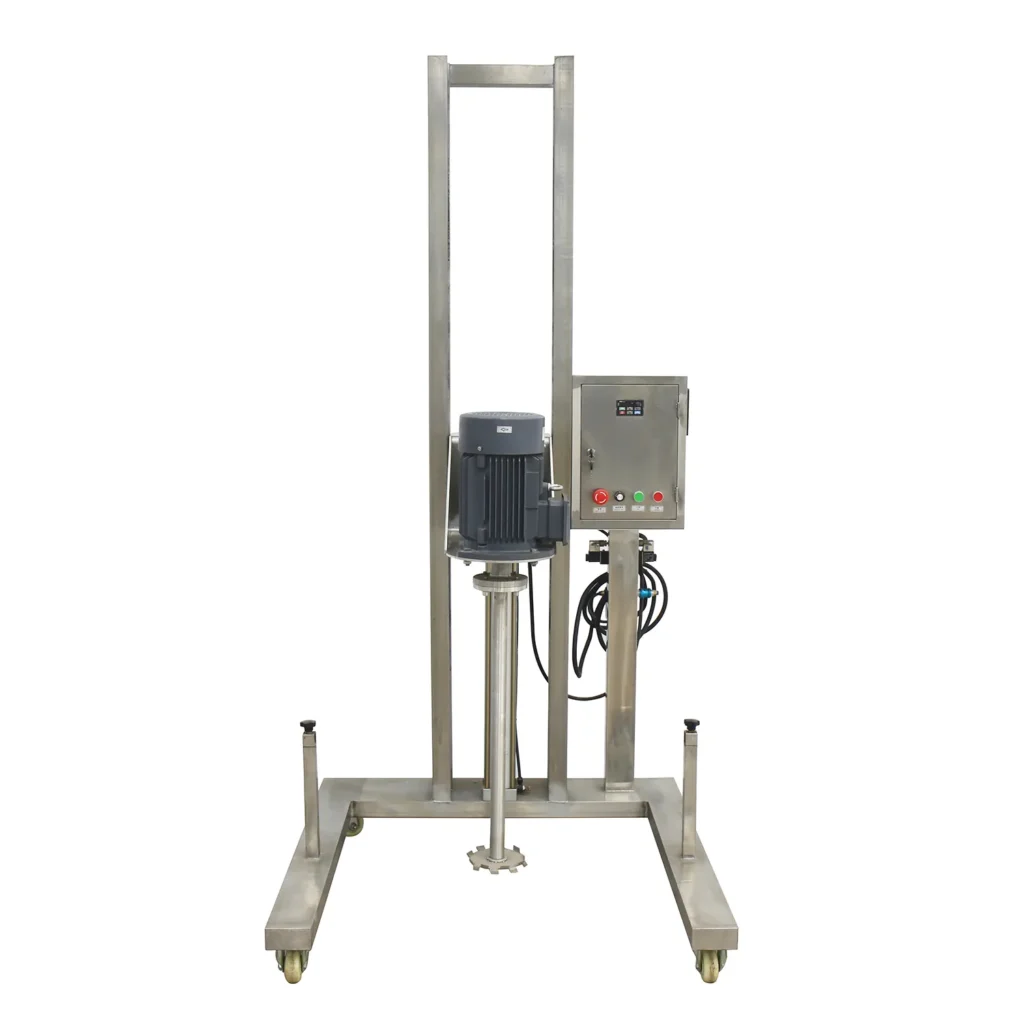
For an example of a supplied configuration, review the hydraulic lifting disperser product page. Its verified limits belong to that model and should not be applied to every machine in this category.
Plan Powder Charging as Part of the Workstation
The method used to introduce powder affects the operating arrangement. Confirm the access point, handling method, operator position, and the way additions are coordinated with the batch procedure.
A lifting disperser does not automatically include powder conveying, weighing, automatic dosing, dust extraction, or containment. Identify those requirements separately where they are relevant to the material and working environment.
Review whether a covered or open arrangement is appropriate for the process. The sealed versus open mixing tank guide provides related context, but any proposed enclosure must be assessed for the selected disperser.
Special material hazards need early review. Standard equipment should not be assumed suitable for flammable liquids, combustible powders, or classified hazardous areas without a specific equipment and installation assessment.
Define Dispersion Acceptance Beyond Motor Power and Speed
Motor power and available rpm are useful specifications, but they do not establish the finished dispersion. Processing-element geometry, vessel arrangement, material behavior, batch quantity, and the operating method also influence the result.
Agree what an evaluation must demonstrate. Depending on the formulation, acceptance may involve an appropriate fineness assessment, absence of unacceptable agglomerates, distribution, appearance, or another defined product criterion.
Do not promise a universal particle size or assume that high speed dispersion replaces a separate milling or grinding operation. If the required result lies outside the proposed arrangement’s demonstrated capability, additional or different equipment may be needed.
Record the material, settings, addition sequence, operating conditions, and sampling method during trials. Comparisons are more useful when they share the same acceptance basis.
Temperature and Air Incorporation
Temperature changes and air incorporation should be considered where they affect the formulation. Neither should be inferred solely from how the batch surface appears during a demonstration.
Confirm whether the process requires a temperature-controlled vessel, external utilities, or observation at defined stages. A separate disperser does not automatically provide heating or cooling.
Where thermal services are required, review the associated utility systems and identify which equipment supplies each function.
If vacuum processing or a sealed emulsifying system is central to the requirement, evaluate Vacuum Emulsifying Mixers separately. Do not infer vacuum capability from a lifting disperser or an ordinary vessel cover.
Lifting Arrangement, Vessel Positioning, and Installation
Confirm the lifting mechanism, available travel, operating positions, and compatible vessel arrangement on the selected model. Different configurations may have different installation and utility requirements.
Allow space for full movement, ingredient handling, cleaning, inspection, and maintenance. Closed machine dimensions alone do not establish the complete operating envelope.
Where a vessel is movable or separately supplied, define the approved positioning and restraint arrangements. Do not assume that the machine can operate with any container that physically fits beneath the head.
Review the equipment installation guide when assigning site responsibilities. The final layout and operating instructions must address the actual machine, vessel, services, and protective functions.
Cleaning, Product Recovery, and Maintenance Access
Review the dispersing element, shaft, vessel, seals where fitted, and any other contacted components as a complete cleaning arrangement. Lifting can provide access, but does not establish a complete or validated cleaning procedure.
Material can remain on contacted surfaces and in the receiving or discharge arrangement. The product recovery guide provides related considerations when assessing batch recovery.
For frequent color or formulation changes, establish the condition required before the next batch. The equipment cleaning-access guide supports the review of areas requiring inspection or separate attention.
Maintenance should follow the supplied drive, shaft, lifting assembly, and processing-element configuration. Use approved parts and procedures rather than assumed service intervals or generic component replacements.
Development Trials and Production Requirements
Development trials should establish information useful for the next production decision. A successful small batch does not automatically prove that the same rpm and processing time will give the same result in another vessel or machine.
Identify which variables need comparison and what changes between the trial and proposed production arrangement. The formulation scale-up guide provides a related resource for planning that evaluation.
When reviewing existing equipment, confirm that proposed changes remain compatible with its design. The equipment upgrade and retrofit guide provides supporting context without establishing approval for a particular modification.
Typical Product Applications
Application examples include compatible paints, coatings, and chemical formulations, and pigmented cosmetic and nail-care formulations.
Define the Disperser Configuration with StriversMachinery
StriversMachinery manufactures core mixing and emulsifying equipment in-house. Configuration review can address the dispersion task, compatible vessel, batch range, material characteristics, lifting arrangement, and required operating access.
Provide representative formulation information, powder and liquid characteristics, the required dispersion result, intended batch quantities, available utilities, and vessel details. Identify whether additional charging, thermal, or material-handling equipment is required.
When comparing proposals, include the operating arrangement and service requirements alongside the equipment price. The total cost of ownership guide provides a supporting procurement resource.
Contact our team to review the processing requirement and define the supplied configuration, documentation, and proposed evaluation method.