
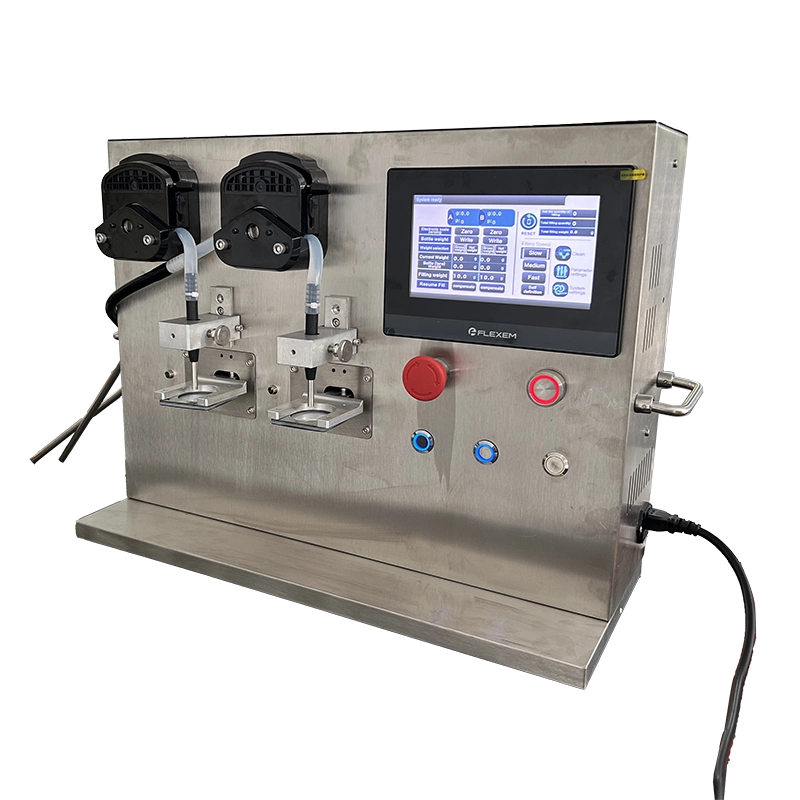
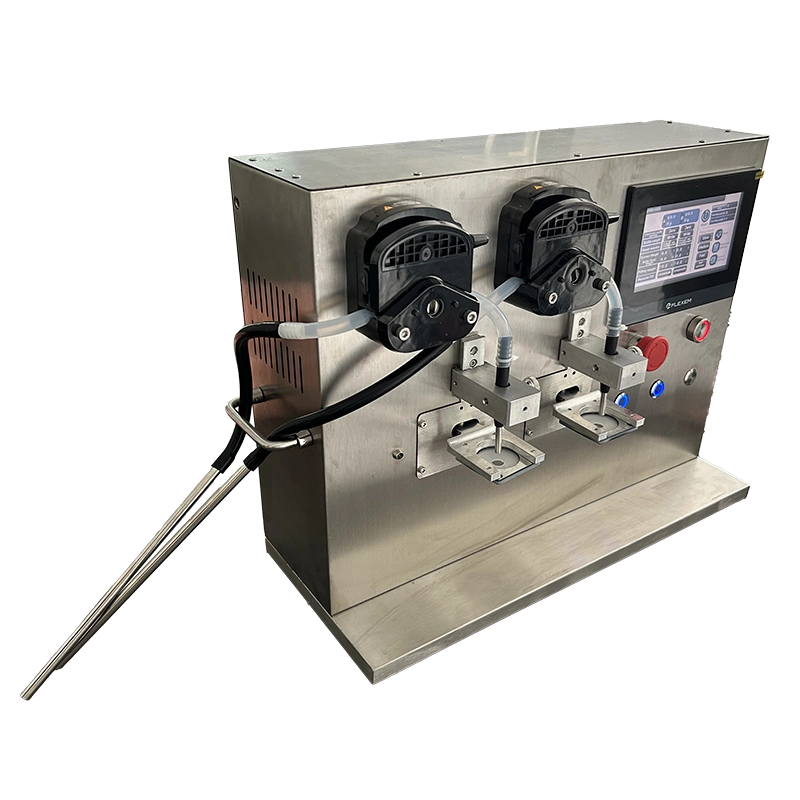
Semi Automatic Benchtop Dual-Head Peristaltic Pump Weighing Filling Machine with PLC Touch Screen Control for Nail Gel Polish, UV Gel, Glue, Adhesives and High Viscosity Liquids

The Dual-Head Peristaltic Weighing Filling Machine dispenses compatible nail gel polish, UV gels, glues, adhesives, and viscous liquids into manually positioned containers. Each filling head has an independent weighing platform and can operate separately, stopping delivery when the set filling weight is reached. The electric benchtop arrangement combines PLC touchscreen operation with manual bottle handling and requires no compressed-air supply.
| Filling Principle | Peristaltic Pump | Material Contact Parts | SUS316L Stainless Steel (Pharmaceutical Grade) |
| fill_automation_level | Semi-Automatic (Tabletop / Floor Type) | Machine Frame Material | SUS304 Stainless Steel Frame |
| Container Type | Bottles & Jars | Conveyor System | Without Conveyor (Manual/Semi-Auto) |
| Container Material | PET/HDPE/PP / Glass | fill_electrical_components | Schneider / Siemens / Omron (Optional/Customizable) |
| Product Viscosity | Low Viscosity (Water, Toner, Alcohol) / Medium Viscosity (Lotion, Shampoo, Oil) / High Viscosity (Cream, Paste, Mascara) | Voltage | Configurable to local grid (110V–480V, 50/60Hz, Single or 3-Phase) |
| Filling Volume Range (ml) | Maximum Filling Weight: 2KG | Total Power (kW) | 0.4 |
| Filling Accuracy | ±0.15g | Air Pressure | No Compressed Air Required |
| Filling Head/Heads | 2 | Drive Type | Electric |
| Nozzle Type | Standard Direct Flow Nozzles | Installation Type | Benchtop |
| Production Capacity (Bottles Per Hour) | 1000-1300 | Automation Level | Fully Automatic |
| Bottle / Container Diameter (mm) | Maximum Container Diameter: 65mm | Control System | PLC + HMI Touch Screen Control |
| Bottle / Container Height (mm) | Maximum Container Height: 150mm | PLC System | Panasonic |
| Feeding Method | Self-priming | Control & Interaction Systems | Semi-Automated (Efficiency-Focused) |
| Bottle Handling Method | Manual | Machine Dimensions(L*W*H)mm | 650*450*500 |
| Capping Type | Filling Only (Without Capping), Capping Machine Sold Separately | Machine Weight (kg) | 25 |
Product Gallery
Product Video
Product Overview
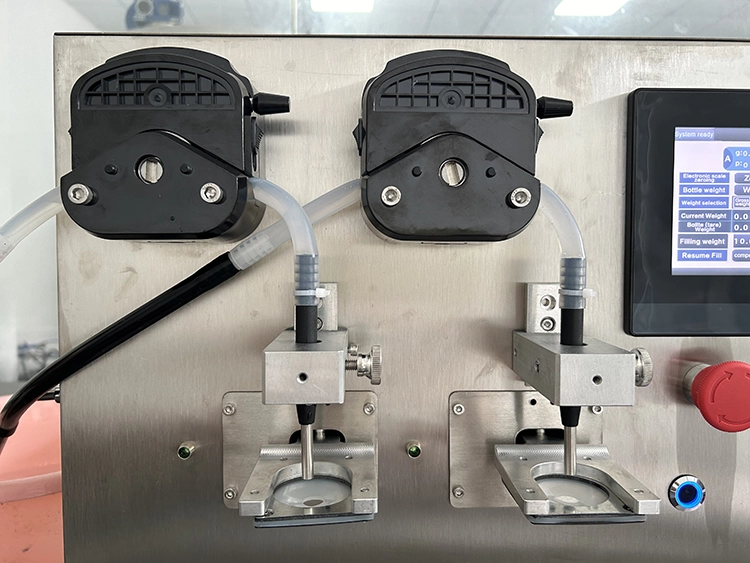
StriversMachinery’s semi-automatic weighing filler combines peristaltic product transfer with weight-based stopping. Operators place bottles or jars beneath the filling outlets and remove them after dosing. The machine performs filling only, leaving container transport and closing to separate operations.
Each head has its own weighing platform and can operate independently. This arrangement allows the two stations to be used according to the batch workflow without requiring every filling operation to start and finish together.
The equipment is used for compatible nail gel polish, UV gels, glues, adhesives, and other viscous formulations. Application assessment should consider the actual product, tubing compatibility, filling temperature, and behavior at the outlet. Fast-curing products, reactive formulations, and two-component adhesive systems require a separate review rather than a general compatibility assumption.
Peristaltic pumping moves product through flexible tubing toward the filling outlet. The tubing and other nonmetallic contact components are selected separately from the specified stainless steel contact parts.
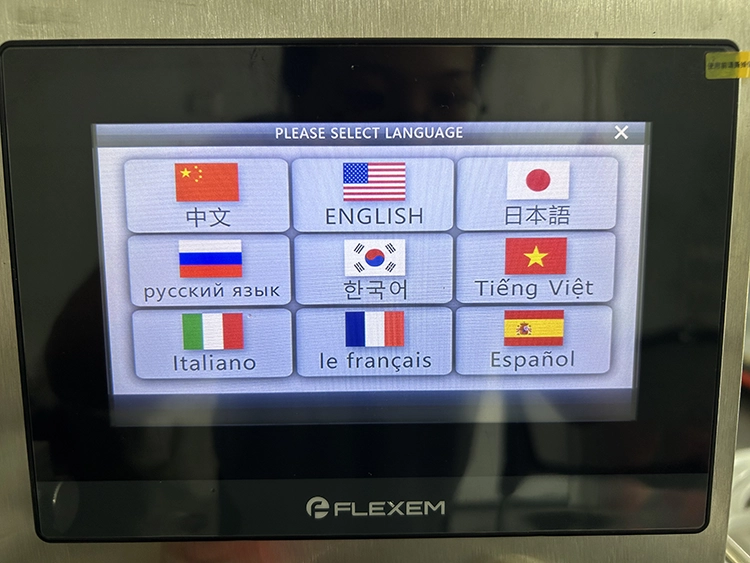
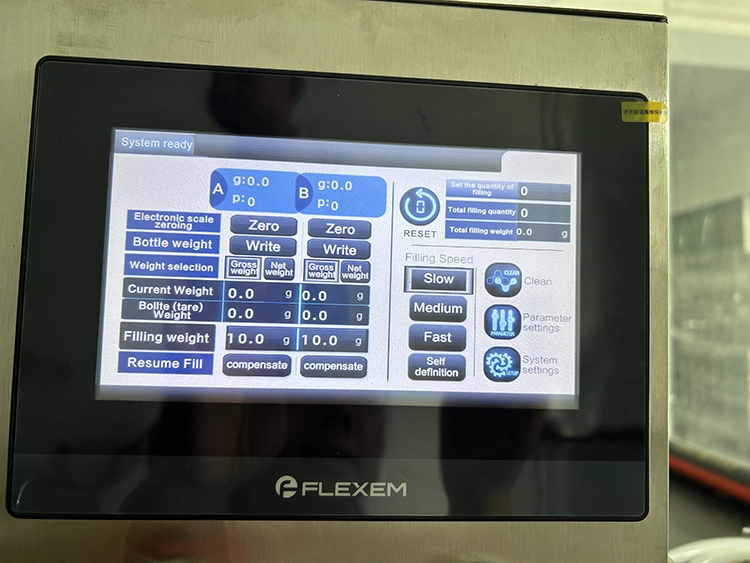
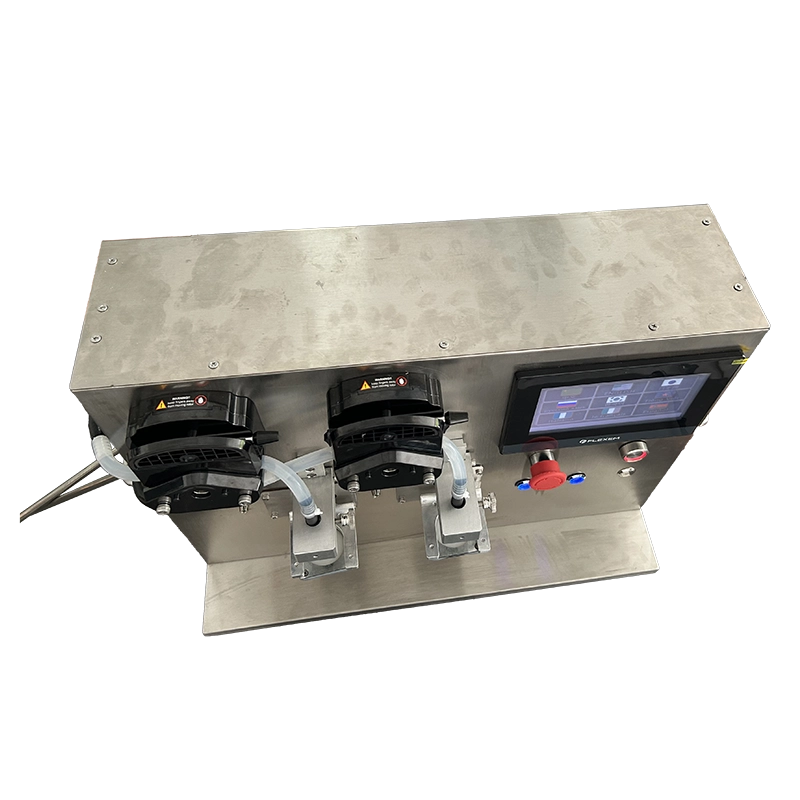
A compact benchtop frame places the filling stations and operating interface together. Panasonic PLC and Weintek touchscreen controls support routine operation, while the absence of a conveyor keeps container placement and collection directly with the operator.
Machine Configuration
The standard configuration includes two peristaltic filling heads, two independent weighing platforms, product tubing, and direct-flow filling outlets. Each station can operate independently and stops product delivery when its set filling weight is reached.
A Panasonic PLC and Weintek touchscreen provide the control interface. Container placement and removal are manual; the machine has no conveyor or capping assembly. Electric operation does not require compressed air.
The frame is SUS304 stainless steel, with specified SUS316L stainless steel product-contact metal components. Flexible pumping tubing and other nonmetallic components require separate selection against the formulation and cleaning method.
The benchtop arrangement brings both stations into one working area. Fast-and-slow dosing stages, a particular foot-switch or push-button starting arrangement, automatic container taring, and production-data functions are not assigned to this configuration.
Key Features
- Independent weighing platforms provide a separate filling-weight reference for each dispensing head.
- Each head can operate independently rather than requiring synchronized filling cycles.
- Weight-based stopping ends delivery when the selected filling target is reached.
- Peristaltic pumping transfers compatible formulations through a selected flexible tubing pathway.
- Manual container placement supports direct operator access to both filling stations.
- Electric operation avoids the need for a compressed-air connection at the workstation.
- Panasonic PLC and Weintek touchscreen controls centralize routine operation.
- The benchtop structure groups filling and weighing within a compact working arrangement.
Applications
- Color Cosmetics & Nail Care
Recommended Machines

20L Laboratory Vacuum Emulsifying Mixer for Cosmetic Cream, Lotion, Gel, Ointment, Shampoo, Toothpaste and Pharmaceutical Products
View Details
Automatic Hot Air Inner Heating Plastic & Laminate Soft Tube Filling Sealing Machine for Cream, Gel, Ointment, Toothpaste, Lotion, Cosmetic Paste
View Details

Working Principle
The dual-head weighing filler combines two functions: peristaltic pumping moves the product, and the weighing system determines when delivery stops. Each head has its own weighing platform and can operate independently.
Before filling, the operator prepares the product pathway and places a compatible container on the relevant platform. The container must be positioned beneath the outlet without unintended support from adjacent objects. The weighing reference is established according to the machine’s operating procedure.
During dispensing, the peristaltic pump progressively compresses flexible tubing to move product from the source toward the filling outlet. As material enters the container, the weighing system monitors the changing load.
When the set filling-weight target is reached, the control system stops delivery. The operator then removes the filled container and positions the next one. The other filling station can be used independently according to the production workflow.
Weight-based stopping is different from relying only on a preset pumping duration or a calculated volume per pump cycle. The finished quantity is assessed in mass units, while any required relationship to product volume must be established separately for the formulation.
The machine performs dispensing without automatic bottle conveying or closure assembly. Product preparation, container handling, downstream capping, cleaning, and quality checks remain part of the surrounding operation. The accepted setup should account for the product’s behavior after pumping stops, including any material remaining at the outlet.
Optional Upgrades & Configurations
Custom Requirements
Corrosive-Resistant Construction for Strong Acids & Alkalis
Explosion-Proof Filling Systems for Flammable & Hazardous Environments
Custom Machine Layouts & Space-Saving Footprint Constraints
Extended & Custom-Length Long-Distance Conveyor Systems
Designated electrical component brands (Siemens PLC, Festo Pneumatics, etc.)
Irregular Bottle Shapes & Custom Packaging Solutions
Suitable Products
| Warranty | 24 Months | Payment Terms | 40% T/T Deposit, 60% Balance Before Shipment (Alibaba Trade Assurance Available) |
| Lead Time | In Stock | Packaging | Standard Export Fumigation-Free Wooden Case |
After-Sales & Technical Support
🔧 Common Problems
Possible operating symptoms include an unstable weighing indication, different final quantities between stations, or inconsistent results during a run. Product may remain at the filling outlet, form strings, or reach the container rim after delivery stops. Air pockets or interrupted product movement may be visible in the supply pathway. Containers may sit unevenly, move during filling, or contact surrounding parts. Tubing may show flattening, visible deterioration, or leakage at a connection. Other symptoms include unusual pump noise, inconsistent delivery, residue around the filling position, or difficulty maintaining an orderly manual loading and removal sequence. Product flow or appearance may change during an extended operating period.
🛠 Troubleshooting
Problem: The weighing indication does not settle consistently. Possible Cause: Worktable vibration, drafts, or unintended contact with the container or platform. Recommended Solution: Inspect the workstation and remove external interference before reviewing the weighing setup.Problem: Final quantity varies. Possible Cause: Unstable measurement conditions, changing product behavior, or residual delivery after stopping. Recommended Solution: Check the platform arrangement and observe the complete end-of-fill behavior before repeating the agreed mass test.Problem: The two stations produce different results. Possible Cause: Different setup conditions, pathway assemblies, or product presentation. Recommended Solution: Evaluate each station separately with the intended formulation and container before changing settings.Problem: Product strings or remains at the outlet. Possible Cause: Formulation behavior, outlet buildup, or an unsuitable filling setup. Recommended Solution: Inspect and clean the outlet before reassessing operation with representative product.Problem: Delivery is interrupted or air appears in the pathway. Possible Cause: An inadequate source supply, a loose connection, or incorrectly installed tubing. Recommended Solution: Inspect the source and tubing assembly according to the pump instructions before restarting.Problem: Tubing leaks or shows abnormal wear. Possible Cause: Material incompatibility, incorrect installation, or deterioration during use. Recommended Solution: Stop operation and inspect the tubing specification and installation before replacing it with an approved matching component.
🧼 Cleaning Method
1. Stop both filling heads according to the operating procedure. 2. Remove containers from the weighing platforms. 3. Recover residual product using the approved handling method. 4. Isolate the electrical supply under the maintenance instructions. 5. Disconnect the product source according to the machine procedure. 6. Remove accessible tubing and product-contact components under the pump instructions. 7. Clean reusable tubing with a method compatible with the formulation and tubing material. 8. Replace tubing designated for single-use service under the production procedure. 9. Clean reusable filling outlets and connectors using the approved method. 10. Rinse reusable contact components where required by the cleaning procedure. 11. Inspect cleaned parts for retained product or cleaning residues. 12. Dry reusable components using the established production method. 13. Wipe the weighing-platform surfaces without applying excessive load. 14. Clean external surfaces without flooding electrical or weighing components. 15. Reassemble the product pathways according to the equipment instructions. 16. Check platform clearance before returning the machine to service. 17. Record cleaning completion according to the facility’s requirements.
📋 Maintenance
1. Inspect pumping tubing for flattening, cracking, swelling, or visible deterioration. 2. Examine product connections for loosening or leakage. 3. Check filling outlets for buildup or damage. 4. Inspect platform surfaces for residue affecting container placement. 5. Check platform clearance for contact with surrounding parts. 6. Examine accessible cable protection for damage. 7. Inspect outlet supports for loosening that affects alignment. 8. Check the product-path installation against the pump instructions. 9. Keep electrical ventilation areas clear of accumulated material. 10. Review weighing verification according to the machine and quality procedures. 11. Inspect touchscreen and control components for visible damage. 12. Review electrical connections through qualified maintenance personnel. 13. Service pump components only according to their installed instructions. 14. Replace worn tubing with a matching approved specification. 15. Verify filling performance separately for each head after relevant maintenance. 16. Record inspections, adjustments, and replaced components in the maintenance log.
⚙️ Installation
1. Position a stable worktable in the intended filling area. 2. Place the machine on a level supporting surface. 3. Establish access for both filling stations and manual container handling. 4. Check the workstation for vibration and avoidable drafts. 5. Connect protective earthing through qualified electrical personnel. 6. Connect the electrical supply specified for the ordered configuration. 7. Position the product source for the approved supply arrangement. 8. Install pumping tubing according to the pump instructions. 9. Fit the filling outlets for the approved containers. 10. Route tubing clear of the weighing platforms and container movement. 11. Check container fit against platform support and outlet clearance. 12. Establish the weighing reference according to the operating instructions. 13. Introduce representative product using the approved handling method. 14. Set the required filling-weight target. 15. Check operation of each head independently. 16. Verify finished quantities using the agreed measurement procedure. 17. Assess product behavior after delivery stops. 18. Document the accepted setup before routine production.
🔩 Spare Parts
Why Choose This Machine
- Direct filling-weight reference: Each station uses a weighing platform to determine the stopping point, keeping the control objective connected to the required mass rather than an assumed volume conversion.
- Independent station use: The two heads can operate separately, allowing the operator to organize work around the actual batch without requiring synchronized container handling.
- Defined manual workflow: Container placement and removal remain visible tasks, making staffing and workstation layout easier to assess realistically.
- No compressed-air utility: Electric operation simplifies utility preparation where a suitable electrical supply is available but plant air is not.
- Accessible product pathway: Flexible tubing, connections, and filling outlets can be included in a formulation-specific cleaning or replacement plan.
- Compact installation: The benchtop structure groups dosing, weighing, and controls together, supporting use at a dedicated filling workstation.
- Focused filling scope: Separating filling from conveying and capping allows downstream handling to be selected against the actual container and closure.
Frequently Asked Questions
Installation Requirements
Position the machine where vibration, drafts, or contact from nearby equipment will not interfere with weighing. Arrange product tubing and outlet supports so they do not apply unintended force to containers or platforms during measurement.
Provide an electrical supply matched to the ordered voltage, frequency, and phase configuration. The listed total power is 0.4 kW. Protective earthing and connection must follow the machine instructions and applicable installation requirements. No compressed-air connection is required.
Locate the product source so tubing can be routed without kinks, excessive handling interference, or contact with the weighing platforms. Assess the formulation’s storage, ventilation, light-exposure, and cleaning requirements as appropriate.
Containers should suit the stated maximum diameter of 65 mm and maximum height of 150 mm, together with the actual outlet clearance and platform arrangement.
Related Articles


Technical Buyer's Handbook & Deep Insight
Ready to Get a Quote?
Contact our team directly for pricing, customization options, and delivery timelines.
💬 WhatsApp Us NowGet Your Download Link
Please fill in your details and we'll send the download link to your email.