

This guide explains why manufacturers across cosmetics, food, household, and pharma are shifting from bottles to stand-up pouches, driven by lower packaging and shipping costs, better sustainability, and consumer demand for refills.
It breaks down how a stand-up pouch filling and capping machine actually works, from bag feeding through servo filling and torque-controlled capping.
Readers get a full comparison of pouch types — including spouted, corner spout, center spout, and doypack styles — along with the core technologies that separate accurate, reliable machines from mediocre ones.
The guide closes with a practical buyer’s checklist, a troubleshooting reference for common filling problems, and a side-by-side comparison of pouches versus bottles to support the purchasing decision.

This guide compares steam heating and electric heating for vacuum emulsifying mixers across engineering principles, cost, and maintenance.
It provides product-specific recommendations (cream, shampoo, toothpaste, and more) and factory-specific guidance (startup, OEM, GMP, lab, continuous production).
A total cost of ownership section weighs upfront investment against long-term operating cost, and a buying mistakes section covers the most common specification errors.
It closes with a practical decision checklist and expert recommendations by batch size.

This guide walks through the full equipment installation and commissioning lifecycle, from site preparation through startup and early operation.
It covers mechanical, electrical, utility, and cleanliness mistakes, showing how small oversights compound quietly into failures that surface weeks or months later.
A structured installation checklist, three real-world failure case studies, and equipment-specific requirements round out the practical guidance.
It closes by explaining Factory Acceptance Testing, Site Acceptance Testing, and when to request manufacturer commissioning support.

This guide explains what cleaning dead corners are, how they differ from dead legs, dead zones, and dead space, and why even a few millimeters of poor geometry can cause biofilm, corrosion, and contamination.
It walks through the fluid dynamics and microbiology behind dead corner formation, then maps exactly where they hide inside mixing tanks, vacuum emulsifying mixers, piping, valves, filling machines, CIP systems, and instrumentation.
The guide covers hygienic design principles that prevent dead corners from forming, cleaning technologies (CIP, COP, SIP) that address them, and validation methods like riboflavin, ATP, and TOC testing that confirm cleaning actually worked.
It closes with relevant global standards, common design mistakes, an inspection checklist, four real engineering case studies, and emerging technologies shaping the future of hygienic equipment design.

This guide compares sealed and open mixing tanks across engineering, hygiene, process control, and total cost of ownership.
It provides product-specific recommendations (cream, serum, shampoo, essential oil, and more) and factory-specific guidance (startup, OEM, GMP, lab, continuous production).
A hybrid solution section explains how many manufacturers combine open premixing with sealed final mixing rather than choosing one tank type exclusively.
It closes with common buying mistakes, a decision checklist, and expert recommendations for each tank type.

This guide explains why paint and coating quality problems — pigment agglomeration, sedimentation, floating color, uneven gloss — trace back to inadequate dispersion shear.
It covers how hydraulic lift high shear homogenizers work, including rotor-stator mechanics, mechanical/hydraulic shear, turbulence, and cavitation.
It details where this equipment applies across pigment dispersion, resin emulsification, and functional coatings, plus a full selection guide by capacity, motor power, rotor type, and explosion-proof requirements.
A problem-and-solution section and maintenance guide round out the practical, production-floor-focused content.

This guide covers why cosmetic cream develops too many air bubbles, breaking causes into four categories: equipment problems, process problems, formula problems, and operator errors.
It includes a step-by-step troubleshooting sequence, a real customer case involving a leaking mechanical seal and inadequate vacuum pressure, and recommended process parameters for deaeration.
A dedicated section covers engineering improvements in modern vacuum emulsifying mixers that prevent this issue at the design level, along with ten maintenance tips.
A quick diagnosis table and FAQs round out the guide for fast symptom-to-cause reference.

This guide explains why a cosmetic formula that succeeds in lab testing can behave differently at commercial production scale
It covers how mixing dynamics, shear force, heat transfer, and air entrapment all change as batch size increases
It walks through why viscosity shifts during scale-up and how to correctly scale mixing time and homogenization
It includes the most common scale-up problems, a validation checklist, and how to choose equipment built for reliable scale-up
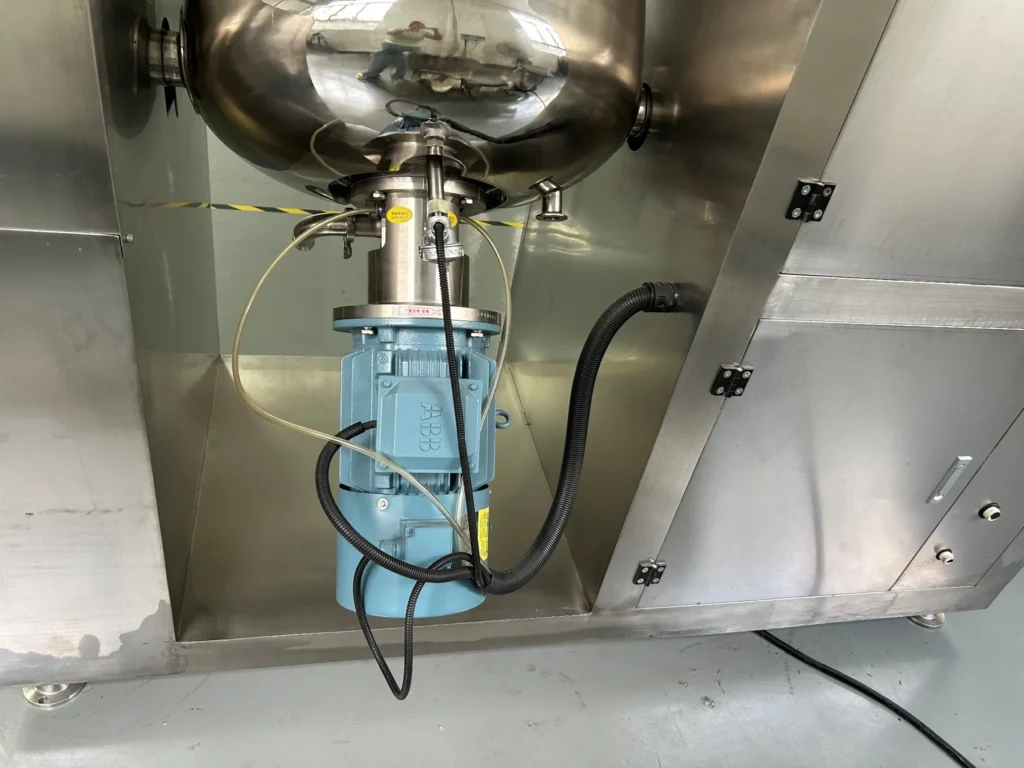
During a 1,000L cream batch at a cosmetic OEM factory in Guangzhou, the temperature reading jumped wildly the moment high-shear mixing started — swinging from 74°C to 31°C to 92°C and triggering an E02 fault code.
The initial suspects were a failed PT100 sensor, a faulty PLC module, or a temperature controller fault.
Tracing the signal step by step revealed the real cause: a loose sensor terminal connection, shaken slightly loose by sustained high-shear vibration.
The fix took under 30 minutes, and the case is a reminder that erratic readings are often mechanical, not electronic.
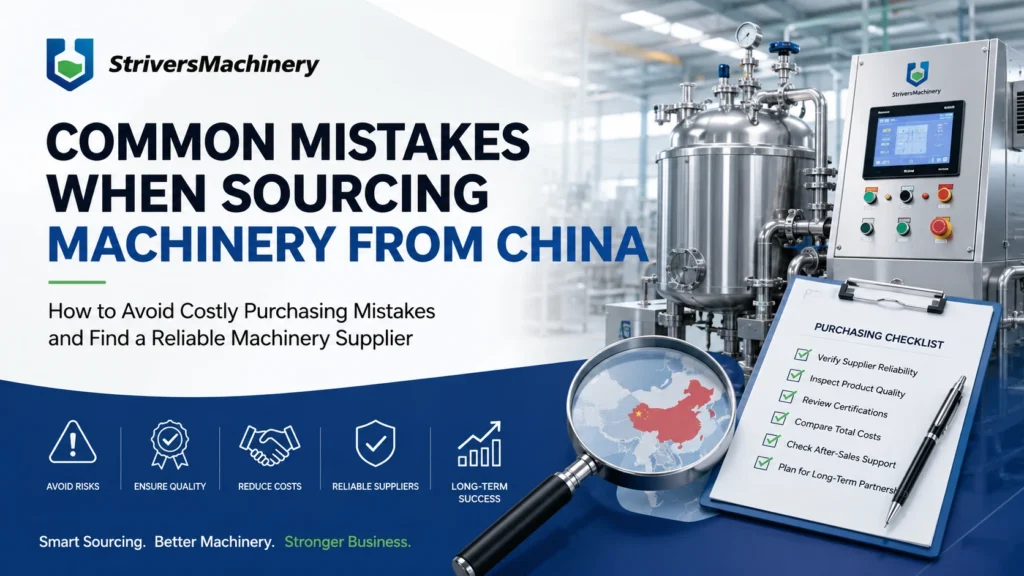
This guide walks through the full process of sourcing production machinery from China, from initial requirement definition through installation and after-sales support.
It identifies 15 specific mistakes — including chasing price over value, skipping factory verification, vague technical specifications, and ignoring warranty terms — that account for most failed or disappointing procurement projects.
A 24-point checklist consolidates these lessons into a practical pre-order reference buyers can run through before signing a contract.
Three anonymized case studies and 22 FAQs round out the guide with real-world context and quick answers to common buyer questions.

This guide explains what an Inner and Outer Circulation Vacuum Emulsifying Mixer is and why it has become the standard equipment choice for large batch production in cosmetic, pharmaceutical, food, and chemical manufacturing.
It covers the machine’s complete structure, its step-by-step working principle, why dual circulation eliminates dead zones and shortens cycle time compared to traditional single-circulation emulsifiers, typical applications, technical specifications, and how to choose the right capacity for your production volume.
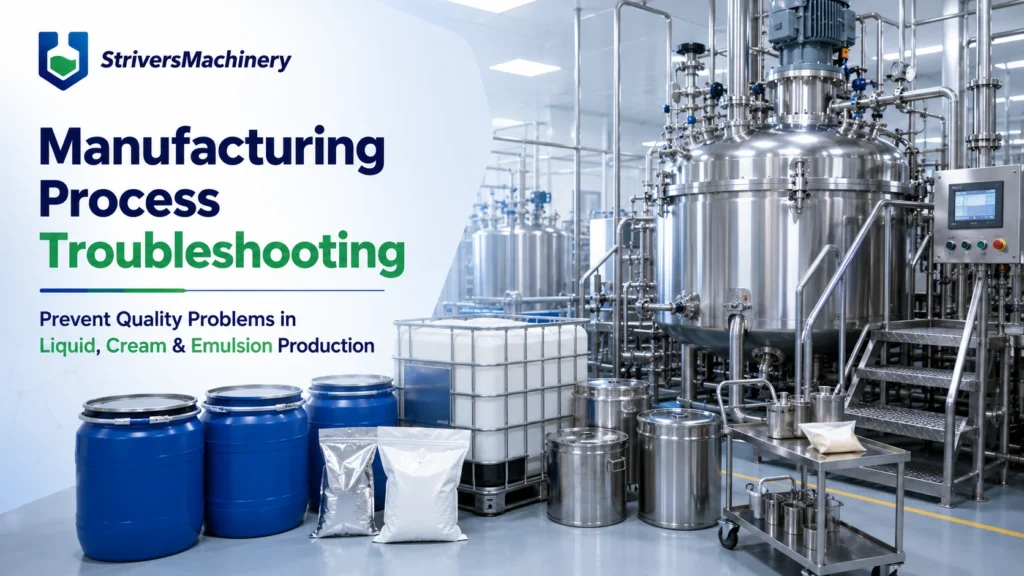
This guide explains why quality problems like burning, sedimentation, oxidation, discoloration, foaming, and product loss happen during liquid, cream, and emulsion manufacturing. It breaks the root causes down into three categories — raw material characteristics, equipment design limitations, and incorrect process parameters — then walks through seven of the most common production problems with their real causes and fixes.
It also covers how mixing, homogenization, vacuum, heating, transfer, and cleaning equipment map to these issues, and closes with a practical checklist for consistent, high-quality production.

Most manufacturers focus on equipment price and overlook the ongoing cost of product left behind in every batch.
This guide maps where product loss actually happens across the full production process — from raw material loading and mixing through tank discharge, pipeline transfer, filling, and CIP cleaning — and explains the specific equipment and process decisions that improve recovery at each stage.
It covers full-drain tank design, scraper and homogenizer selection, transfer pump matching, discharge techniques, and cleaning sequencing, along with 20 common recovery problems and their practical solutions.

Most procurement teams compare equipment quotations line by line and assume the lowest number wins. In practice, the real cost of a production line shows up later — in shipping, customs delays, installation problems, and the time spent managing four or five separate suppliers.
This article walks through why factory-direct purchasing doesn’t automatically save money, what a combined factory + trading model actually looks like, and six concrete ways it lowers total procurement cost rather than just the sticker price.

This guide walks through how vacuum emulsifying mixers actually work and why particle size determines emulsion stability
It explains how to choose between internal circulation and inner-and-outer circulation homogenizer designs
It covers the most common production problems — foaming, separation, clumping — and what actually causes them
It includes a maintenance schedule and a practical way to calculate ROI before committing to a purchase
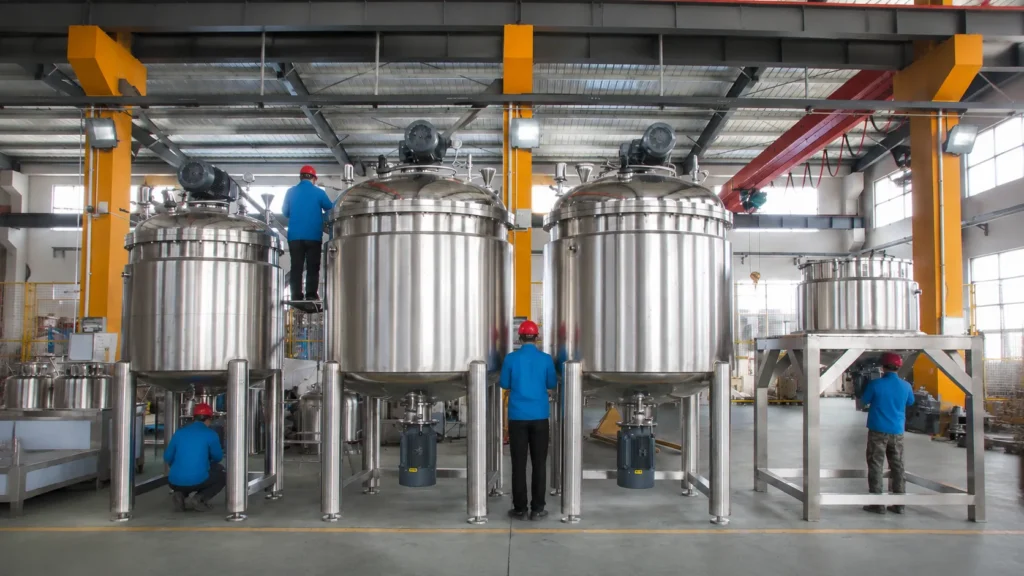
Most delays in a cosmetic equipment project trace back to the buyer’s side, not the manufacturer’s — unclear requirements, unchecked utilities, or an incorrect batch size defined too late in the process.
This guide walks through the entire buying journey in order: defining your production requirements, preparing an effective RFQ, choosing the right equipment configuration, evaluating suppliers beyond price, preparing your factory before delivery, running a proper Factory Acceptance Test, handling shipping and installation, training operators, and avoiding the mistakes that trip up almost every first-time buyer.
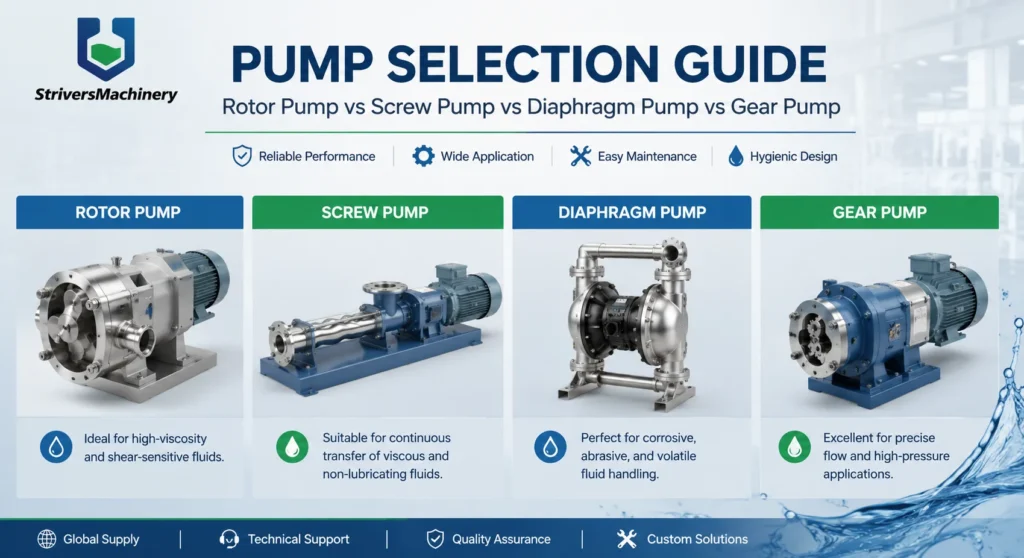
Most pump problems on a cosmetic or food line don’t start at the pump — they start weeks earlier, with a decision that skipped viscosity and shear in favor of flow rate and price.
This guide walks through the factors that actually decide pump selection, compares Rotor, Screw, Gear, and Diaphragm pumps directly, and maps each one to specific products, industries, and production scales.
The goal is a practical framework for choosing the right pump, not another product catalog.

This guide walks through the eight most common vacuum emulsifying mixer problems — vacuum loss, poor emulsification, unusual noise, motor overload, heating and cooling failures, seal leakage, scraper issues, and PLC alarms — and how to diagnose and fix each one.
It also includes a preventive maintenance schedule, a recommended spare parts list, best operating practices, and clear guidance on which issues are safe to handle in-house versus which ones warrant contacting the manufacturer.