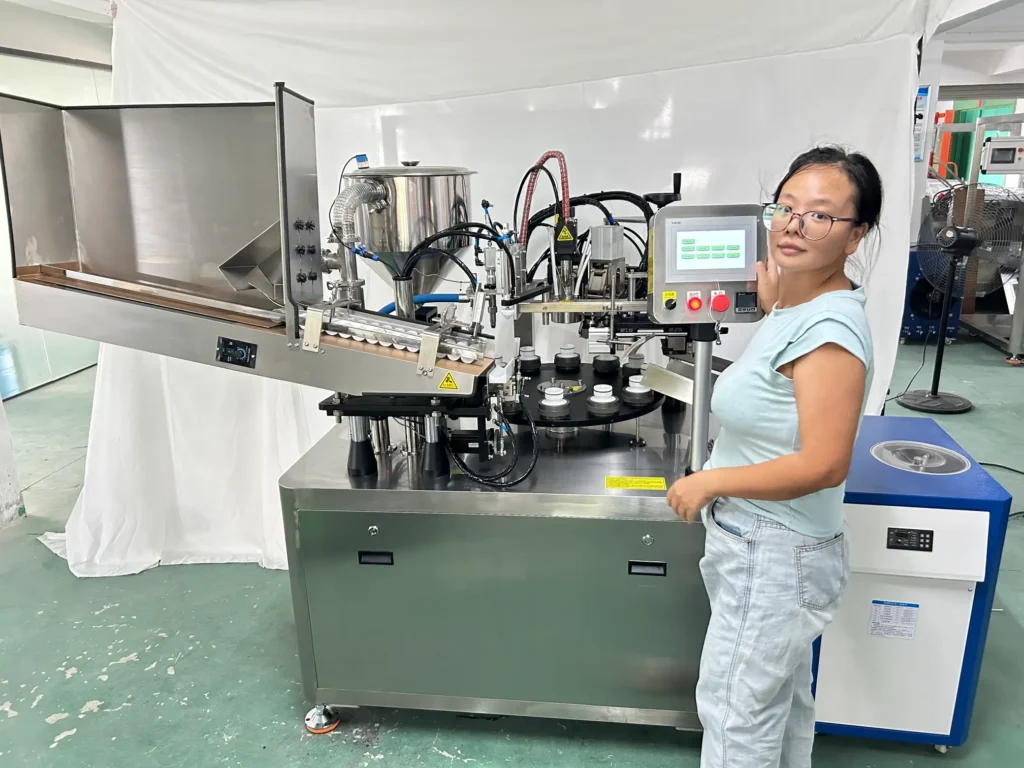
A normal shutdown routine that helps protect the heating assembly of a hot air tube filling and sealing machine.
Some operating habits look minor but affect component life and production continuity. In our factory-floor video, Sunny demonstrates the normal shutdown of a hot air tube filling and sealing machine: switch off the heating function, keep the specified cooling airflow operating, and wait until the indicated temperature falls below 80°C (176°F) before completing power-down. That threshold belongs to the demonstrated configuration and its designated temperature indication; use the instructions supplied for the exact machine in service.
This article concerns normal end-of-production shutdown. If there is a fire, smoke, electrical fault, dangerous movement or another immediate hazard, follow the machine’s emergency procedure and site response arrangements. Do not delay an emergency stop or required isolation while waiting for a cooling temperature.
The sequence can help reduce residual-heat damage and avoidable downtime. Cooling duration depends on operating temperature, airflow, ambient conditions and the installed assembly; a fixed number of minutes is not a substitute for the specified shutdown condition. The factory demonstration and the Indonesia after-sales case below show why the cooling stage needs to be included in operator training.
Some Things Can Never Be Overemphasized
In manufacturing, there are certain operating principles that deserve to be repeated again and again — not because they are complicated, but because they are easy to forget. Machine shutdown procedures are a perfect example.
Installation, operator training and after-sales work have shown us that operating sequence can contribute to failures alongside component condition, installation and controls. Cutting power before the normal cooling cycle is complete is one issue worth checking on the hot air equipment covered here. A shutdown history is a diagnostic clue, not proof that every failure was caused by the operator.
To many operators, it feels natural. Production is complete, so the machine is turned off. It’s the same instinct most of us apply to nearly every piece of equipment we operate — the job is done, so power goes off. However, the heating system doesn’t stop being hot simply because the electricity has been disconnected. Understanding what happens inside the machine explains why manufacturers recommend a controlled cooling process before shutdown, and why skipping that process, even occasionally, carries real long-term cost.
The Correct Shutdown Procedure
The following five steps describe normal shutdown of the demonstrated configuration. Keep guards and interlocks effective and use the approved controls. Other hot air sealing systems may use an automatic cooldown program or different air-supply arrangements; follow the machine-specific sequence.
Step 1: Finish Production
Complete the final sealing cycle and use the approved sequence to clear or park tubes and the heating head. Check from the normal operator position that no tube is left exposed to continued heat. Do not reach into guarded mechanisms or manually clear a jam as part of routine powered operation.
Step 2: Turn Off the Heating Function
Disable the heating function using the approved control or cooldown command. Keep the power and services required by the cooling sequence available. Confirm that the heater is no longer commanded to heat and that the machine is in its intended stopped or cooldown state; leaving power available does not mean production motion must continue.
Step 3: Maintain the Specified Cooling Airflow
On the demonstrated machine, the cooling fan continues moving air through the heating assembly after heating is disabled. Confirm the intended cooling state and required airflow by the approved indication. Other configurations may use a separate blower or compressed air, so do not shut off the relevant utility early. If cooling airflow is lost or an alarm appears, follow the machine’s fault procedure rather than improvising a restart or bypass.
Step 4: Confirm the Specified Temperature and Cooldown Completion
For the demonstrated configuration, monitor the designated actual-temperature indication until it falls below 80°C (176°F), together with any other completion conditions in the machine instructions. Distinguish an actual reading from a temperature setpoint. A reading at one sensor does not prove that every internal part or accessible surface has reached that temperature, and 80°C is not a safe-to-touch limit.
Step 5: Switch Off the Main Power
After the required cooldown condition is confirmed, complete the normal power-down and utility shutdown in the specified order. If cleaning, inspection, tube removal or other work exposes personnel to hazardous parts or stored energy, use the required isolation procedure before that work. Normal power-down alone is not a complete maintenance isolation procedure.
When arranging Factory Acceptance Testing, agree how normal stopping, cooldown indication and relevant fault responses will be demonstrated. Record the approved sequence in the operating instructions and training handover; a brief sealing demonstration alone does not establish how the machine should be shut down.
Recommended Equipment

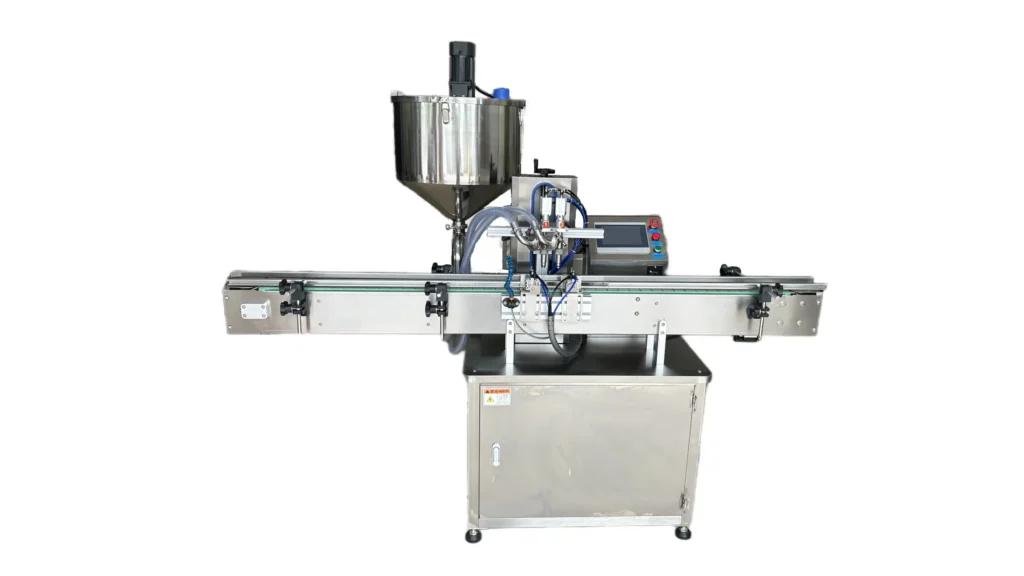
Automatic Hot Air Inner Heating Plastic & Laminate Soft Tube Filling Sealing Machine for Cream, Gel, Ointment, Toothpaste, Lotion, Cosmetic Paste
View Details

Why Normal Shutdown Should Not Skip Cooling
Hot air sealing heats air and directs it into a suitable plastic or laminated tube before the tail is closed and sealed. The operating setting depends on the heater, nozzle, airflow, tube construction and production cycle. Values such as 200–400°C may describe selected operating settings, not a universal requirement and not necessarily the temperature of the heating element or tube wall. Confirm the relevant indication and validated settings for the application.
The shutdown sequence belongs to the installed hot air system. It should not be copied unchanged to aluminum folding, ultrasonic sealing or another closure process simply because those machines also fill tubes. Tube material selection and the sealing method determine which operating instructions apply.
After heating is switched off, stored thermal energy remains in the element and surrounding assembly. Keeping the designed airflow available helps remove that energy and limit unwanted heat transfer into adjacent parts. Some heat also leaves by conduction, radiation and natural convection; forced cooling is an engineered part of the sequence rather than the only physical way heat can escape.
If airflow stops while the assembly is hot, the temperature distribution can change as heat moves into nearby components. The consequences depend on the installed design, starting condition and duration. This is why the correct sequence matters even though one abrupt shutdown does not inevitably destroy a heater.
Manufacturer instructions also show why the cooling endpoint must remain equipment-specific. For example, Leister’s GHIBLI AW manual describes its own cooldown function and an endpoint near ambient temperature. That is evidence for following the correct cooldown procedure on that device; it is not a reason to substitute its endpoint for the 80°C instruction of the demonstrated tube machine.
Cooling Airflow Is Part of the Heating System
During production, airflow carries heat to the sealing nozzle and helps keep the heater within its intended operating conditions. During cooldown, heat generation is disabled while the required air continues to remove stored energy. The machine may provide this through a fan, independent blower or compressed-air circuit. Identify which services must remain available instead of assuming every tube machine has the same cooling hardware.
An immediate loss of power or air can interrupt this function. The assembly may remain hot and redistribute heat into nearby components for longer than intended. A rotating fan does not by itself prove adequate flow: restrictions, filters and the actual air path also matter.
If the approved cooldown mode is automatic, confirm its completion indication before normal isolation. A change in fan sound, a flow warning or a stalled cooldown is a reason to investigate using the equipment instructions; it is not a reason to alter interlocks or guess a different shutdown threshold.
What Can Happen If Cooling Stops Too Early?
Loss of required cooling can expose the installed heating assembly to unwanted thermal conditions. The inspection findings determine what has actually failed. The following are possible consequences to investigate, not a claim that every abrupt shutdown produces all of them.
Reduced Heating Element Life
A heating element has operating and cooling limits defined by its design. Repeated operation outside those conditions can contribute to early failure. Check the element, airflow, supply conditions and control history before attributing reduced life to shutdown practice alone.
Damage to the Hot Air Gun
Unwanted heating of the nozzle assembly, insulation or adjacent parts may affect reliability. If sealing becomes inconsistent, investigate the relevant components and process settings. Tube leakage after hot air sealing can have several causes, so a poor seal alone is not proof of residual-heat damage.
Temperature Sensor Drift
Temperature sensing can be affected by damaged sensors, connections or unsuitable operating conditions. Verify a suspect indication using the prescribed procedure. Do not assume that a low displayed value proves the assembly is safe or that every sensor problem arose from an abrupt shutdown.
Premature Aging of Wiring and Insulation
Electrical insulation materials deteriorate more quickly when repeatedly exposed to unnecessary high temperatures. This kind of degradation accumulates quietly across many production cycles rather than showing up as a single dramatic failure, which is exactly why it’s easy to underestimate until wiring problems start appearing.
Related Solutions


Unexpected Downtime
A failed heating component can interrupt an entire production line while the cause is investigated and parts are obtained. Include suitable spare parts, documentation and technical support in the supply discussion. These are practical operating costs, not just the purchase price of the heater.
A Real Customer Example
In a confirmed after-sales case, a customer in Indonesia experienced an unexpected factory-wide power outage during production. The machine’s cooling fan stopped when power was lost, while the heating assembly remained very hot.
Inspection found damage to the heating assembly, which required replacement before production resumed. The case confirmed the relevance of interrupted cooling on that installation. The outage was outside the operator’s normal shutdown sequence; any backup or protective arrangement would require a machine-specific engineering assessment, rather than a generic instruction to reconnect power.
The incident supports including a defined power-loss response in operator training. During planned shutdown, operators can keep the specified cooling services available. During an outage, follow the site and equipment recovery procedure. Do not assume that any available electrical supply, air connection or restart action is an acceptable substitute for the installed controls.
Why Do We Recommend Waiting Until Below 80°C?
Below 80°C is the normal shutdown reference used in the demonstration for that configured heating system. It gives the operator a defined indication to check instead of relying on elapsed time or touching a hot component. The number does not, by itself, quantify how much energy remains inside the assembly.
Apply the threshold only where it matches the instructions for the actual machine and designated temperature channel. Different heaters, airflow arrangements, sensors and automatic programs can require different completion conditions. Keep any required dwell time or additional checks specified in those instructions.
Do not describe 80°C as universally safe, claim that every component is below it, or assume that further cooling could never add protection. The relevant question is whether the installed system has completed its approved cooldown sequence. If the actual-temperature indication is implausible, falling unusually fast or inconsistent with an alarm, investigate rather than accepting the number alone.
What If You Accidentally Switched Off the Machine?
If power is accidentally cut, first identify why it stopped and follow the equipment’s recovery instructions. Do not automatically re-energize a machine with a fault, active maintenance isolation, exposed personnel or uncertain controls. An authorized operator may use a documented recovery or cooling-only mode only after the required safe-state checks, with the heater and production restart controlled as specified. Do not bypass an emergency stop or other protection to recover airflow.
Smoke, unusual smells, visible damage or abnormal alarms require the equipment’s fault or emergency response. Keep personnel away from hot and moving parts and arrange inspection before resuming production. Whether cooling-only recovery is permitted depends on the actual fault and machine instructions. Restoring power is not a universal remedy for residual heat.
OSHA’s hazardous-energy guidance distinguishes normal operating controls from the isolation needed when servicing exposes workers to unexpected startup or stored energy. This includes thermal and pneumatic energy as well as electricity. Apply the site’s authorized procedure for the work being performed rather than treating a heater-off command as maintenance isolation.
Additional Tips for Extending Heating System Life
Keep the specified air path available and arrange inspection of inlets, filters, fans or other air-supply components according to the maintenance instructions. Perform cleaning or component work only under the required cooled and isolated conditions. Where compressed air supplies the heater, confirm the specified cleanliness, dryness, pressure and flow; moisture control in the compressed-air system is a separate requirement from simply hearing air at the nozzle. Do not disassemble a hot air gun, remove guards or clean near moving parts during the powered cooldown cycle.
Product-contact cleaning is also separate from heater cooldown. Follow the machine’s approved cleaning method; the presence of a spray device or a cleaning connection does not establish that a complete CIP process is available. Coordinate utilities and any subsequent cleaning so that shutting off one service does not interrupt the required cooling sequence.
Preventive maintenance, suitable spares and clear operating records can reduce avoidable interruptions. Include local temperature and humidity conditions in the maintenance plan, and confirm support and warranty responsibilities against the agreed contract. Do not presume that a shutdown event automatically determines warranty coverage. If the present controls do not support the required sequence, assess an engineered upgrade rather than changing wiring or adding an unapproved timer.
Final Thoughts
Operating sequence is one part of reliability alongside design, installation, component condition and maintenance. For the demonstrated hot air machine, normal shutdown means disabling heat, maintaining the required cooling airflow, confirming the specified actual-temperature and completion conditions, and then powering down in the approved order.
StriversMachinery supplies and integrates tube filling and sealing equipment with specialist manufacturing partners, alongside our core mixing and emulsifying equipment. We aim to make operating requirements clear in the quotation, handover and training. For the wider packaging system, coordinate the shutdown responsibilities of connected equipment and utilities so that a line stop does not unintentionally cut a service needed for cooldown.
The practical lesson from Sunny’s demonstration is to include cooldown in normal shutdown, while keeping emergency and fault responses separate. Use the 80°C reference only for equipment whose instructions specify it, and never interpret a displayed shutdown temperature as permission to touch or service the assembly. If the correct sequence or temperature channel is unclear, confirm it with technical support before changing the procedure.