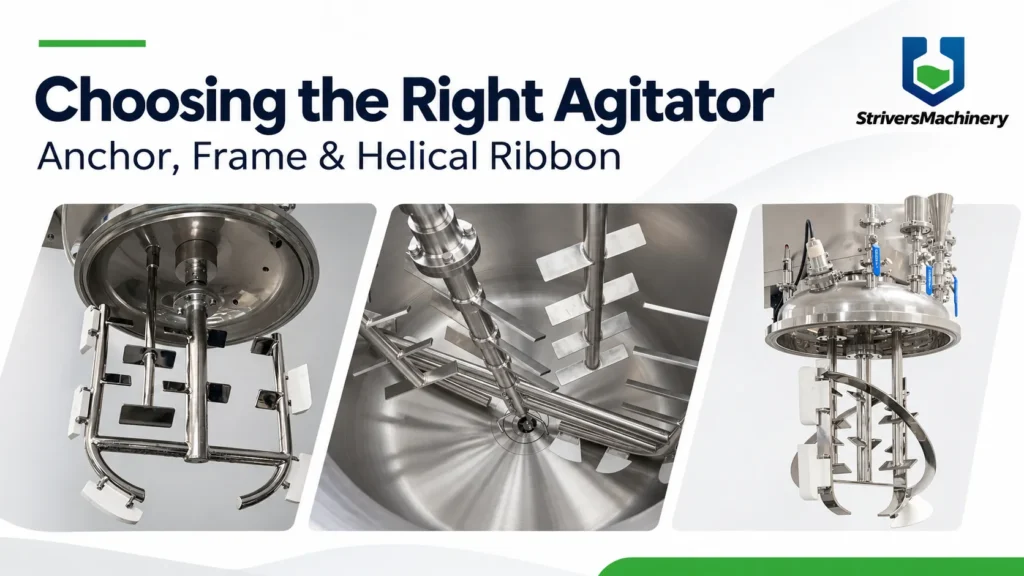
Start with a close-clearance anchor or frame when wall renewal and controlled heating or cooling are the main tasks. Evaluate a helical ribbon when a viscous batch also needs stronger top-to-bottom exchange. Then test the actual geometry at the difficult product conditions and the smallest batch you intend to run.
For tasks involving wall renewal and controlled heating or cooling, the anchor agitator is a reliable choice.
The names overlap between suppliers. A drawing, a defined drive duty, and a representative trial tell you more than an “anchor,” “frame,” or “ribbon” label alone. This guide explains what each design is intended to do, including the anchor agitator, where the differences matter, and what to put in a comparable quotation.
Why Motor Power Alone Does Not Describe Mixing
Buyers often begin with kilowatts, rpm, and liters. Those numbers matter, but they do not show whether product moves through the center, exchanges between the top and bottom, or remains near the heated wall.
Two vessels with the same motor can produce different circulation because the agitator diameter, members, clearance, bottom shape, and operating speed differ. The mixer specification should describe the job and the geometry as well as the installed power.
Torque and Speed Depend on the Complete Drive
Mechanical shaft power, torque, and speed are related by P = T × ω. With power in kilowatts and speed in rpm, the useful equivalent is T ≈ 9,550 × P ÷ N, where T is torque in N·m and N is shaft speed.
Illustrative drive calculation: assume a motor delivers 15kW mechanically at 1,450rpm. Its shaft torque is approximately 98.8N·m. A 50:1 reduction gives an output speed of 29rpm. With an assumed gearbox efficiency of 95%, the transmitted output power is 14.25kW and the calculated output torque is approximately 4,690N·m.
Those assumptions illustrate the relationship, not the rating of a particular gearbox. Confirm the allowable output torque, starting duty, service-factor basis, shaft and bearing loads, and actual drive arrangement.
A VFD changes motor speed; it does not supply unlimited torque. If the drive operates in a constant-torque region, available shaft power falls as speed falls. Check the motor cooling and permitted continuous duty at the proposed low speed instead of treating 15kW as available at every setting.
Request the output speed range, allowable operating torque, starting conditions, and the product basis used for sizing. A belt-drive versus direct-drive comparison addresses another part of the proposal: transmission, maintenance, and access should be identified alongside the gearbox.
Thick Products Are a Flow Problem
Choosing the right design, such as an anchor agitator, can significantly impact the mixing efficiency of thick products.
In a viscous product, material close to the moving members can circulate while another region barely moves. Turning faster may improve exchange, but it can also add heat, air, or load without solving the slow region.
Many creams, gels, and pastes are non-Newtonian: their apparent viscosity depends on how they are sheared. Some also need a minimum stress before they begin to flow. Describe that behavior across the process, especially during cold starts, restarts, powder addition, and cooling.
Identify the highest-load condition rather than relying on average viscosity. A settled or rested batch can present a different starting duty from a batch that is already moving.
Five Questions Before Choosing a Structure
1. What Does the Product Do During the Batch?
Provide viscosity with its measurement temperature and method. Explain whether the product thins under shear, changes with time, develops structure during cooling, or contains solids. Include samples and the intended product-quality checks where practical.
The scale-up review should follow the whole process history. A laboratory sample taken after intensive mixing may not represent the condition the production agitator must start.
2. What Are the Vessel and Batch Dimensions?
Record vessel diameter, working height, bottom shape, outlet location, and minimum and maximum batch levels. Mark the agitator members and their wall and bottom clearances on the same drawing.
Check the smallest batch as well as the largest. The liquid may not engage the same members at both levels. Use laboratory and pilot mixing trials to establish useful process evidence, then confirm the geometry at production scale.
3. Is Heating or Cooling Part of the Job?
Product near the wall must be exchanged with the batch for effective heat transfer. A close-clearance agitator can help; a suitable contacting scraper can provide a different wall-renewal action.
Check the jacket, heating or cooling medium, wall condition, circulation, and bulk movement together. The choice of steam or electric heating does not settle how well the thick product moves against the heat-transfer surface.
4. Which Mixing Task Must Be Completed?
Bulk blending, heat transfer, powder preparation, emulsification, and deaeration are separate tasks. One machine can combine them, but the components and operating sequence should be clear.
Anchor, frame, and helical-ribbon designs discussed here are primarily bulk-circulation tools in vertical vessels. Fast powder dispersion or fine-emulsion work may need a separate disperser or rotor-stator homogenizer.
5. How Will the Assembly Be Cleaned and Changed Over?
Inspect access to both sides of members, blade holders, shaft connections, welds, and the outlet. Confirm which parts remain installed during cleaning and which must be removed.
Recommended Equipment


The hygienic-design review belongs at selection, while geometry and access can still be changed. Evaluate the proposed structure for the actual residue and cleaning method.
How Each Agitator Moves the Product
Anchor Agitator
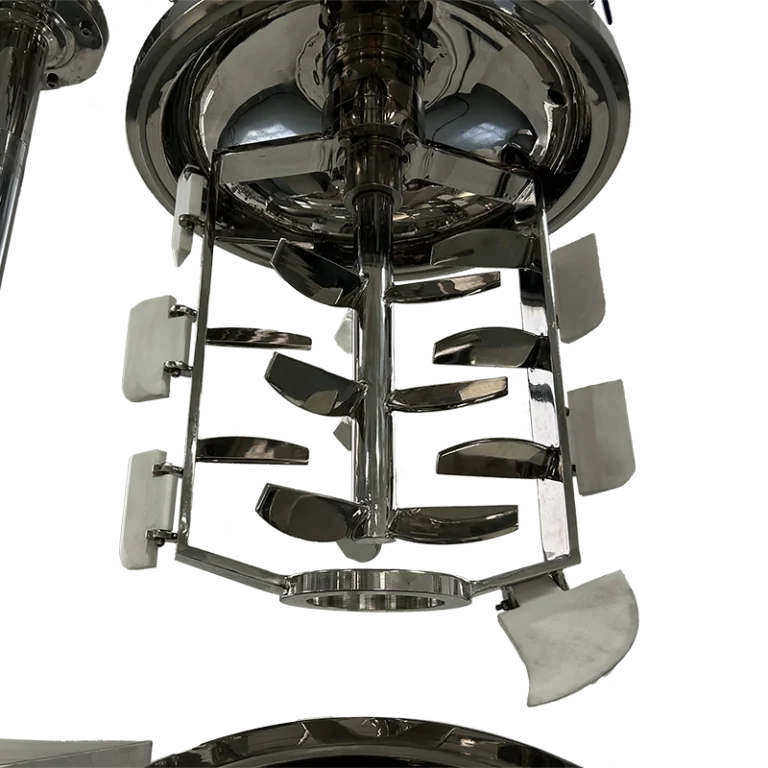
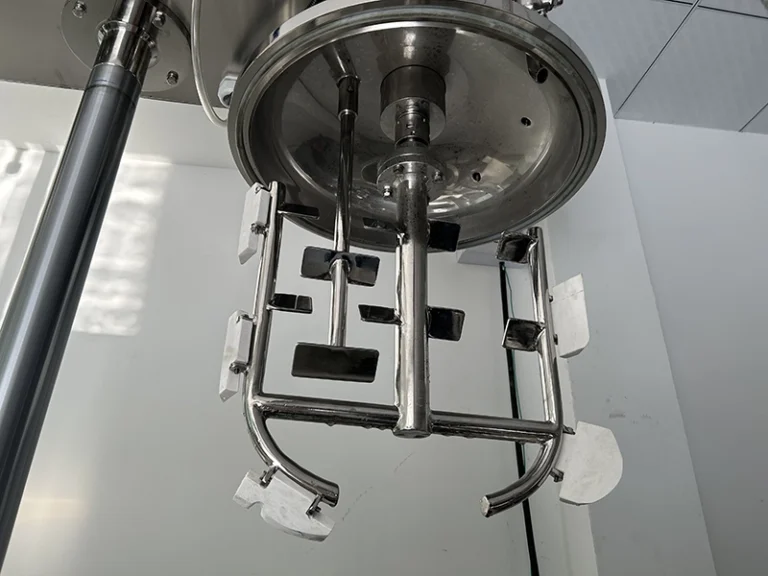
An anchor commonly follows the vessel wall and lower contour. Its outer members move product around the vessel, with vertical or inward exchange influenced by the shape, attachments, clearance, and product behavior.
This makes a close-clearance anchor a useful candidate when wall renewal and gentle bulk movement matter. Scrapers, where supported by the design, can lift material from the wall and support heating or cooling.
Check exchange near the shaft, surface, and bottom outlet. Following the wall closely is not the same as demonstrating uniformity everywhere. A plain anchor and an anchor carrying angled members or helical flights should not be treated as identical.
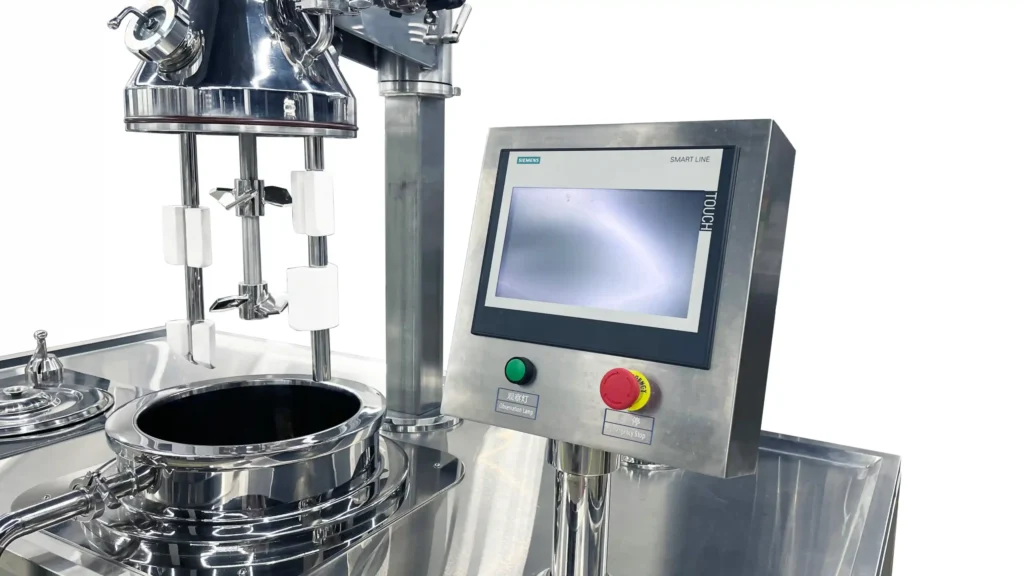
The 100L PLC hydraulic-lift vacuum emulsifying mixer has a published anchor arrangement with wall scrapers and a separate bottom-entry homogenizer. The two mixing functions should be specified and tested separately.
Frame or Gate Agitator
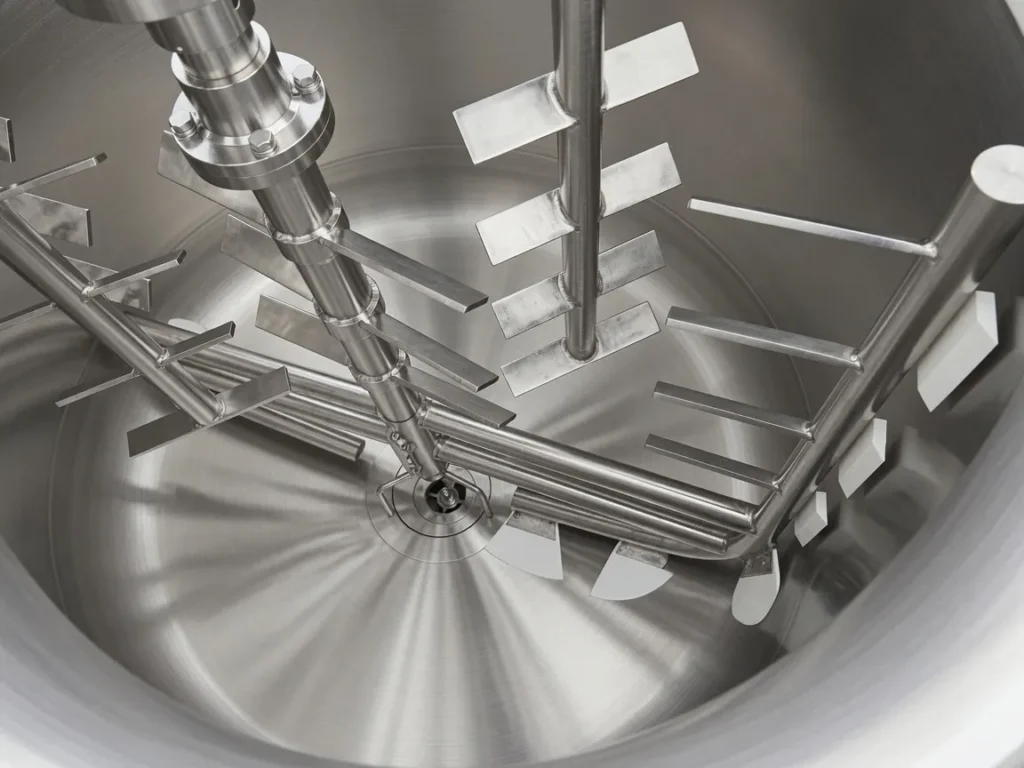
A frame or gate uses horizontal and vertical members across the vessel. The additional members change how the batch is swept. Their position, angle, width, and interaction with fixed elements influence the circulation.
A frame may be worth testing when a simpler peripheral sweep leaves weakly exchanged regions. It does not automatically provide better vertical circulation or a higher viscosity limit than every anchor.
The 100L button-control vacuum emulsifying mixer is described with gate agitation, fixed paddles, and PTFE scrapers. That is a useful example of why the member layout should appear in the proposal rather than only the word “agitator.”
Helical Ribbon Agitator
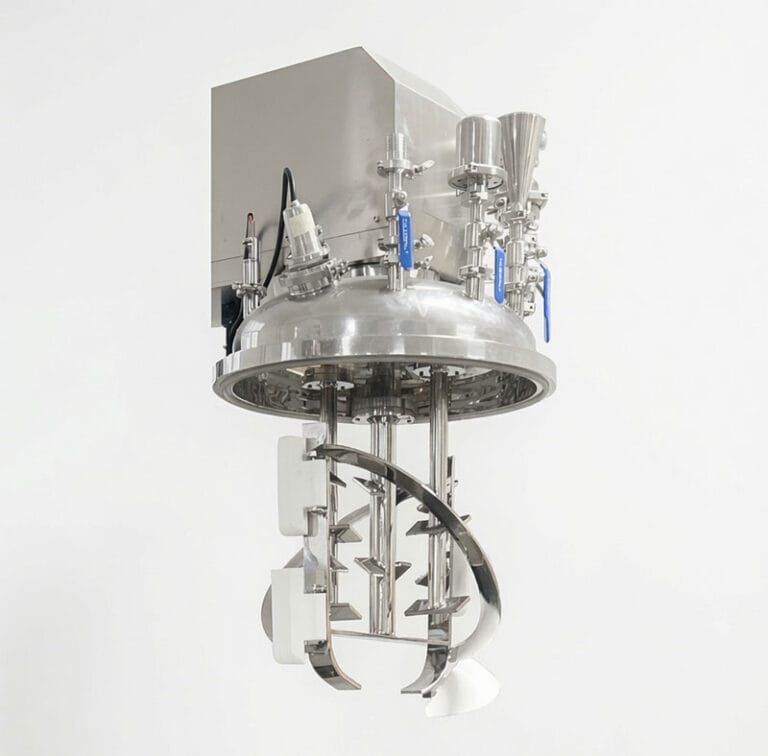
A vertical helical ribbon uses a spiral member to promote movement along the vessel height. Its pumping direction depends on the helix and rotation. The return flow and completeness of circulation depend on the whole vessel and agitator arrangement.
Designs can use more than one ribbon or combine helical members with an anchor, central element, or other features. Do not assume every vertical ribbon has separate inner and outer ribbons moving material in opposite directions.
A horizontal ribbon blender with a trough is a different arrangement from the vertical vessels discussed here. Show the supplier the orientation, drawings, and actual application before comparing descriptions.
A ribbon is a strong candidate when top-to-bottom exchange in a viscous product is the limiting task. Check the center and bottom return path, minimum batch engagement, starting load, access, and air behavior. Scraper compatibility depends on the specific construction.
The 100L hydraulic-lift ribbon-agitated vacuum emulsifying machine is listed with helical-ribbon agitation, PTFE scraping, and bottom-entry homogenization. This is a particular combined configuration, not a feature list shared by all ribbon agitators.
A Practical Comparison
| Structure | Useful Starting Question | What to Verify |
|---|---|---|
| Anchor | Is wall renewal with controlled bulk movement the main task? | Center, surface and bottom exchange; clearance; any scraper action; heat-transfer performance |
| Frame or gate | Would additional members improve exchange across the working volume? | Actual drawing, fixed elements, circulation, minimum batch, torque and cleaning access |
| Vertical helical ribbon | Is top-to-bottom movement limiting a viscous batch? | Helix and return path, center and bottom exchange, starting duty, air handling and cleanability |
Use these as trial starting points. The names do not form a universal ranking from simple to advanced.
Scrapers, Wall Clearance, and Heat Transfer
Distinguish a metal member running near the wall from a blade intended to contact it. Specify clearance or contact arrangement, blade material, holders, wear inspection, and replacement access.
Ask whether the scraper covers the relevant wall and lower contour at the working level. Inspect holders and blade edges as well as the visible vessel surface. A 300L open-top jacketed mixing tank offers a different access arrangement to compare with a closed or hydraulically opened vessel.
When cooling becomes slow, compare product movement with the available cooling-water service. Stable jacket conditions and poor wall renewal call for a different investigation from inadequate cooling-water flow or heat rejection.
Confirm what the temperature sensor measures and where it sits. A temperature-reading disturbance during mixing should be resolved before changing the process to chase the display.
When One Agitator Is Not Enough
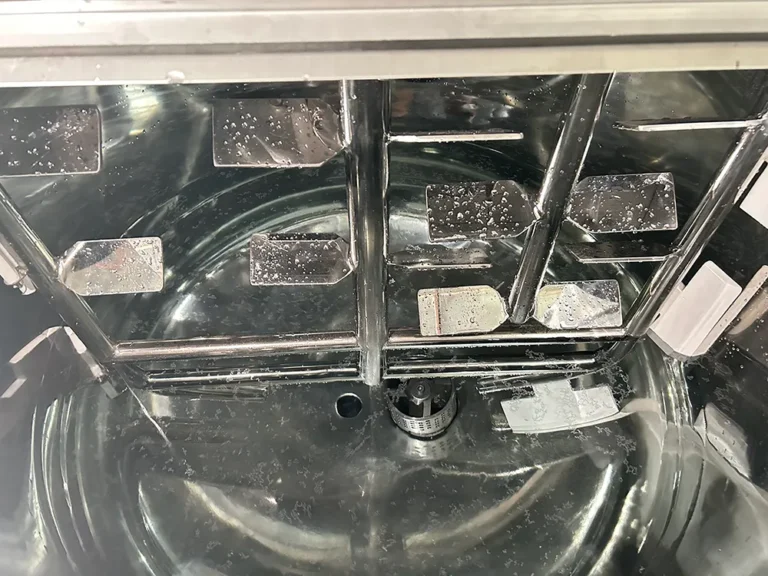
A circulation agitator, scraper, disperser, homogenizer, and vacuum system can be combined because each performs a different task.
- Circulation agitator: moves material through the working volume and presents it to the other processing zones.
- Scrapers: renew the wall where the construction provides the required contact and coverage.
- Rotor-stator homogenizer: applies high shear for the specified emulsifying or dispersion task.
- Disperser: performs its defined powder wetting and dispersion duty.
- Vacuum system: supports the intended air-removal operation under the selected process conditions.
Related Solutions


A lifting high-shear homogenizer is therefore not a direct alternative to a slow wall-sweeping agitator. Identify which task the equipment must complete before comparing it.
For an external loop, the circulation arrangement determines how product reaches the inline workhead and returns. Vessel circulation and loop processing need to work together.
The same separation of tasks appears in a mayonnaise processing line: ingredient preparation, oil incorporation, bulk movement, air control, and downstream handling each need verification.
If a cream contains bubbles, use the air-entry checks before assuming a different slow agitator will solve the problem. Loading, vortexing, vacuum operation, and transfer can all affect the result.
Worked Selection Example: A 500L Cream Batch
Illustrative scenario: a manufacturer plans a 500L working batch in a jacketed vessel. The cream is heated during preparation and cooled before filling. Assume it becomes more viscous during cooling and is shear-thinning. The targets are uniform product, controlled cooling, low air, and acceptable discharge residue.
Find the Difficult Operating Conditions
Check the cooled, structured product as well as the hot stage. Include restart after the planned pause and any ingredient-addition stage that increases load. Those conditions define what the drive and circulation must handle.
Separate the Jobs
Assign bulk movement and wall renewal to the circulation agitator and scraper arrangement. Assign the required emulsification to the homogenizer. Evaluate vacuum for the stated air-removal target.
An anchor with scrapers is a reasonable first candidate for the wall-related duty. Compare a frame if the proposed member layout offers better exchange in the actual geometry. Test a helical arrangement where vertical circulation remains limiting.
Define a Demonstration
Example sampling plan: at a defined processing stage, compare samples representing upper, middle, and lower regions at two agreed observation times. That gives six sample results for the chosen condition. Use engineered sampling points or a defined safe sampling method; do not reach into operating equipment.
Agree the measured property and acceptance limits before the run. Depending on the product, that may involve concentration, a validated marker, or another relevant measurement. Visual movement alone is not a uniformity test.
Repeat the relevant checks at the minimum intended batch and during the difficult cooled condition. Record product and jacket conditions, speed, time, load observations, air, discharge residue, and cleaning access. The six-sample illustration is not a universal acceptance standard.
A Second Scenario: Very Thick Paste
For a paste whose main problem is weak movement near the shaft and surface, prioritize the full circulation path. A vertical helical design becomes a stronger candidate, provided the proposed geometry and drive can move the actual batch.
If a fixed-axis arrangement still leaves unacceptable regions or starting loads, reassess the mixing concept. Adding more motor power to an unsuitable structure is not the only option.
What to Verify Before Acceptance
A representative trial should answer the following questions:
- Does the product meet the defined uniformity and quality checks at the intended batch limits?
- Can the drive start and run through the specified difficult conditions without exceeding its permitted duty?
- What heating or cooling performance is achieved under recorded service conditions?
- Where does product remain after discharge, and can it be removed by the planned procedure?
- Can operators inspect the required blades, holders, shaft areas, welds, and outlet after cleaning?
Plan the factory acceptance test structure around the actual mixing duty. The linked acceptance guide provides a documentation framework; replace filling-specific checks with the mixing criteria required here.
Decision Guide
Water testing can check selected functions but may not reproduce the flow and starting duty of a thick product. Record the substitute medium and the product-specific checks still outstanding.
How These Differences Should Appear in a Quotation
A proposal stating “agitator, 15kW” leaves too much unresolved. Ask for a drawing and a functional scope covering:
- Vessel and working-batch dimensions, including the minimum level
- Agitator geometry, direction, members, wall and bottom arrangement
- Scrapers where supplied, material, coverage, access, and replacement
- Output speed range, drive rating, starting duty, and sizing assumptions
- Separate homogenizer, disperser, vacuum, and thermal functions
- Contact materials, finish, welding, connections, and cleaning method
- Inspection, testing, documentation, and buyer-supplied services
Use the material-selection review for the formulation and cleaning exposure. Compare CIP, assisted washing, and manual cleaning for the complete assembly instead of inferring cleanability from polished metal.
Inspect retention areas around joints and holders. Different structures can mix acceptably yet require different dismantling and cleaning work.
Compare the operating consequences through total cost of ownership, including cycle time, cleaning, scraper replacement, maintenance access, and product loss. A product-recovery review can make discharge comparisons measurable.
Common Selection and Operating Mistakes
| Mistake | Better Check |
|---|---|
| Comparing motor power or rpm alone | Compare shaft duty, geometry, drive limits, and product trial results |
| Treating names as fixed designs | Compare drawings, member layout, helix, clearances, and fixed elements |
| Testing only a hot or thin sample | Include the difficult product conditions, restart, and intended batch limits |
| Assuming visible movement means uniformity | Use the defined sampling and measurement method |
| Expecting bulk agitation to replace high shear | Assign dispersion, emulsification, circulation, and air removal to their actual functions |
| Overlooking installed access and services | Confirm inspection, lifting, cleaning, seal services, and utility readiness |
The installation release checks should establish the allowed conditions before first motion. Later, the mixer maintenance and troubleshooting plan should retain verified settings and the normal operating baseline.
Choosing the Agitator with StriversMachinery
StriversMachinery manufactures core mixing and emulsifying equipment in-house. We can review the circulation structure, scraping, drive, high-shear processing, thermal services, and access together. Complementary equipment for a broader line is coordinated with long-term partner factories.
Send product information and samples where practical, viscosity behavior across the process, minimum and maximum batches, vessel constraints, heating or cooling duties, and the quality result you need. We can then identify a candidate configuration and the checks needed to compare it with alternatives.
Contact [email protected] with those details and any existing drawings. The useful decision is the structure and drive that meet your process—not the most impressive motor number.
Technical References
- ROSS: Choosing the Right Anchor Agitator for Your Multi-Shaft Mixer — anchor profiles and combined mixing duties
- INOXPA: Agitators for Standard Tanks — alternative anchor and helical arrangements
- AGITEC: Anchor Helical Agitators — combined anchor and helical construction
- ROSS: Ribbon Blenders — horizontal trough construction, distinct from the vertical vessels discussed here
- SEW-EURODRIVE: Basic Principles of Control Modes for Drive Inverters — speed, torque, and drive operating behavior
- ROSS: Processing Techniques for Multi-Agitator Systems — complementary circulation and high-shear functions