The best way to improve product recovery is to measure what remains in each part of the line, then fix the largest avoidable loss. Start with the tank, transfer route and filler. A bigger pump or a more polished vessel may help, but neither tells you where the missing product went.
This guide is for manufacturers of creams, lotions, shampoo, sauces and other liquid or semi-solid products. It explains how to separate residue from waste, compare equipment changes and keep recovered material under quality control.
1. Put a Number on the Loss Before Buying Equipment
“We lose a little at every changeover” is hard to act on. “We collect 4 kg from the tank and 3 kg from the transfer line after this recipe” gives you two places to investigate.
Record the product, temperature, batch size, discharge time and recovery method. Compare repeated batches under similar conditions. Otherwise, a warmer product or a longer drain time can make an equipment change look better than it is.
A small residue can become a large annual quantity
Illustrative calculation: assume a line leaves 15 L per batch, runs five batches per day and operates 250 days per year.
15 L × 5 × 250 = 18,750 L per year. At an assumed density of 1.05 kg/L, that is 19,687.5 kg, or about 19.7 tonnes.
This is the annual quantity left behind under those assumptions. The amount you can turn into approved finished product still needs to be established. Some residue may be contaminated, diluted or outside its allowed holding time.
For investment decisions, use the same cost boundary as your equipment total-cost-of-ownership calculation: saved product value, added operating cost, cleaning time and maintenance.
Use a mass balance that closes
Weighing is often easier to compare than volume when temperature and trapped air vary. Define the start and end of the measurement first.
Example only: the following balance starts with 1,000 kg of released bulk product, ready for transfer. It ends after filling and collection of remaining material. These are hypothetical figures.
| Where the product went | Mass | What to record |
|---|---|---|
| Product inside conforming filled packs | 986 kg | Actual product mass, excluding packaging |
| Identified bulk or work in progress remaining | 5 kg | Location, batch identity and quality status |
| Collected tank residue | 4 kg | Collected separately; reuse status pending |
| Collected line and filler residue | 3 kg | Collection point and condition |
| Samples | 1 kg | Sampling purpose and quantity |
| Unaccounted balance | 1 kg | Check weighing uncertainty and missing records |
| Total | 1,000 kg | Compare against the starting bulk mass |
The 986 kg includes any extra product given away through overfilling. Track that commercial giveaway separately; adding it as another physical loss would count the same product twice.
Also compare the 1 kg unexplained difference with the uncertainty of your measurements. An unexplained balance is a prompt to investigate, not proof that 1 kg went down the drain.
2. Find Where Product Stops Moving
Follow the product route in order: vessel, outlet valve, pump, hose or pipe, buffer hopper and filling nozzle. Inspect and measure each section after a defined discharge endpoint, with the equipment safely isolated.
A tank may look almost empty while a long hose remains full. A filler may run accurately during steady production but reject many containers at startup. Keep these losses separate so each has a clear owner and corrective action.
Problems such as scorching, unstable emulsions or off-spec viscosity need a process investigation as well. The manufacturing process troubleshooting guide covers those causes; recovering more of an off-spec batch does not solve them.
3. Improve Tank Drainage Where the Product Actually Collects
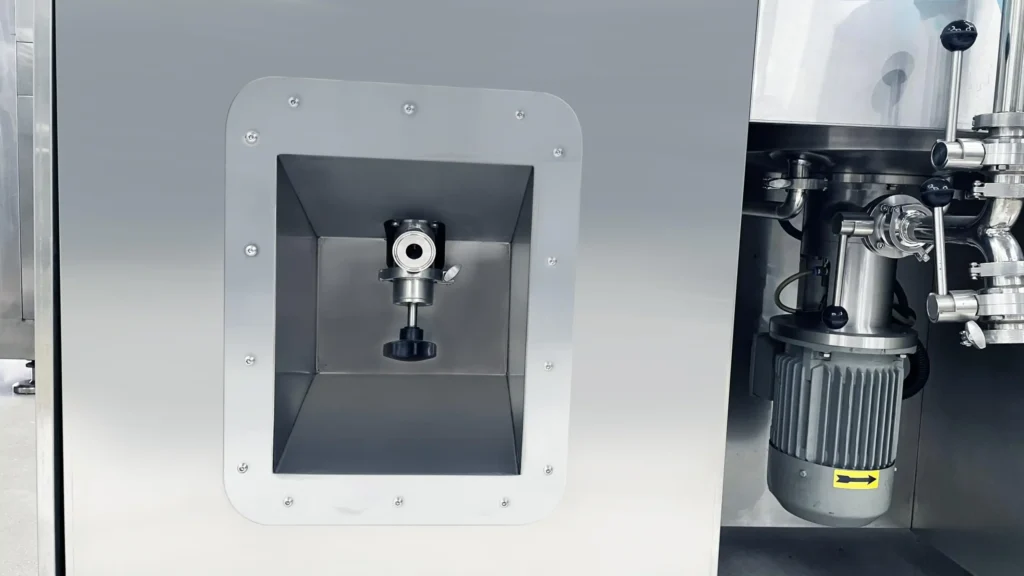
Look at the installed low point, not just the shape shown in a brochure. Product needs a clear route from the vessel floor to the outlet. A raised valve entrance, short uphill pipe or pocket below the outlet can leave a pool behind.
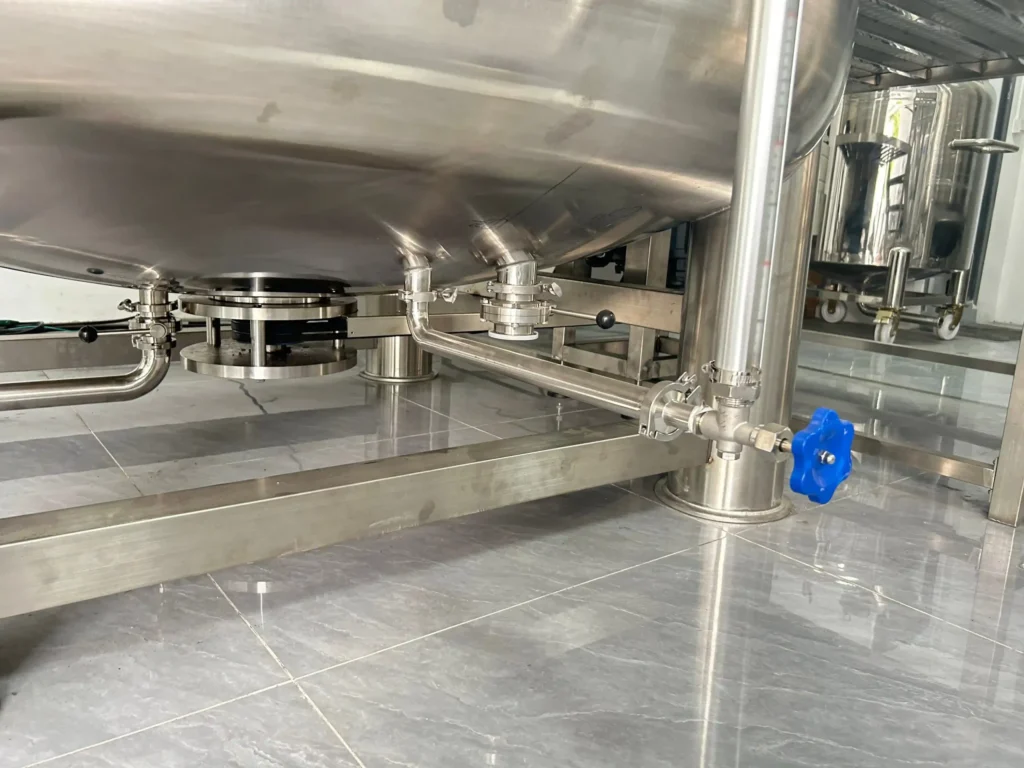
Conical and dished bottoms can help direct flow. A well-arranged flat-bottom vessel can also be suitable for some products. An off-centre outlet may sit at the true low point. Inspect the geometry and installation together before choosing a replacement tank.
During a drainage trial, note where residue remains. A pool around the outlet suggests a different problem from a thin film across the wall. Thick product stuck behind a bracket needs a different fix again.
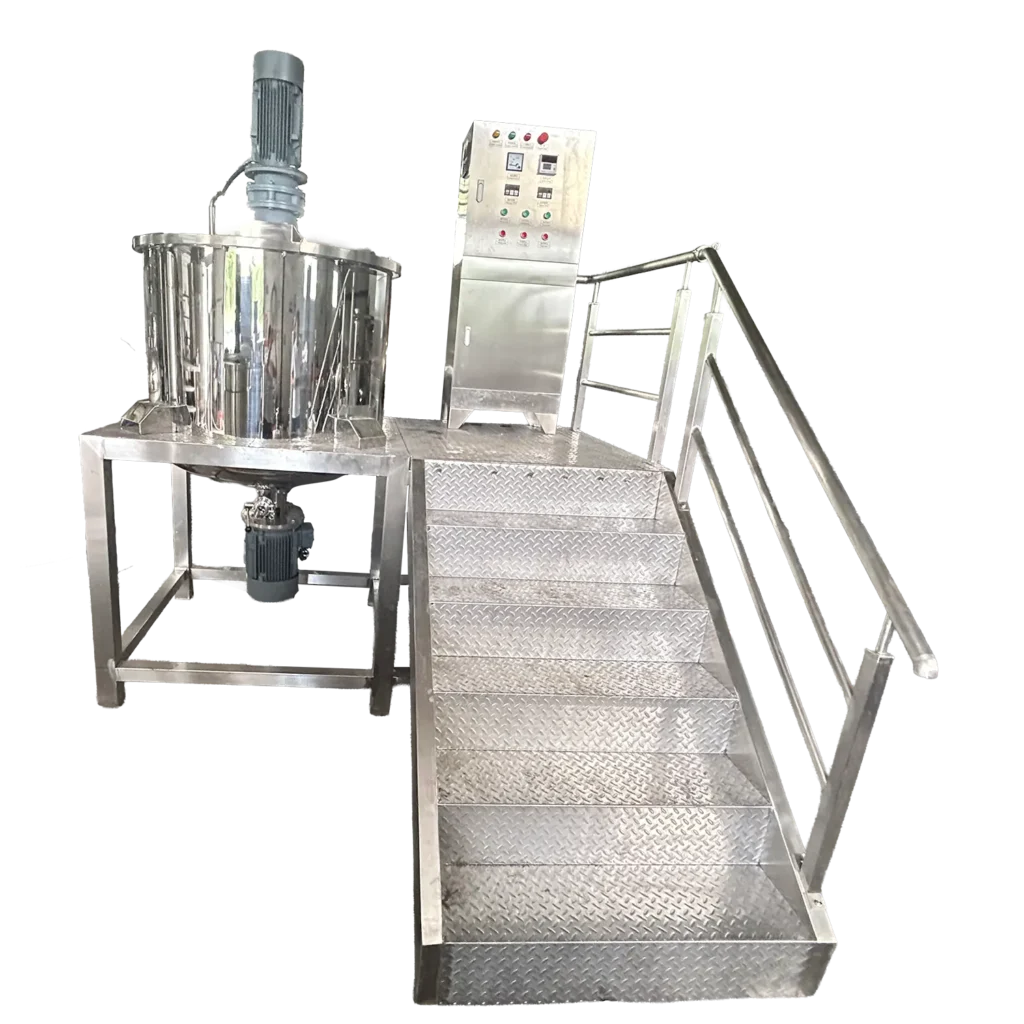
Ask the supplier to define a “full-drain” claim using your product, temperature, discharge method, elapsed time and permitted residue. This belongs in the specification when comparing a 1,000 L fixed vacuum emulsifying mixer or another production vessel.
Small batches deserve the same check. On a 100 L vacuum mixer, a few kilograms left behind may represent a substantial share of the batch. Record both the residue mass and its percentage of the starting quantity.
Check welds, fittings and small pockets
Inspect outlet transitions, sensor connections, internal supports and gasket joints. A vessel can have a smooth wall and still trap product at one poorly placed fitting. The guide to cleaning dead corners explains where these pockets often appear.
Rounded transitions improve access and reduce sharp internal corners, but the whole flow path matters. Use the sanitary corner-radius guide when reviewing drawings, alongside outlet and cleaning details.
Separate surface finish from material grade
Surface roughness is measured in micrometres, written as μm. A mirror-like appearance alone does not establish a measured Ra value. Nor does one low Ra number guarantee that a sticky cream will drain cleanly.
Recommended Equipment

100L PLC Hydraulic Lift Vacuum Emulsifying Mixer with Diaphragm Discharge Valve for Sanitary Production
View Details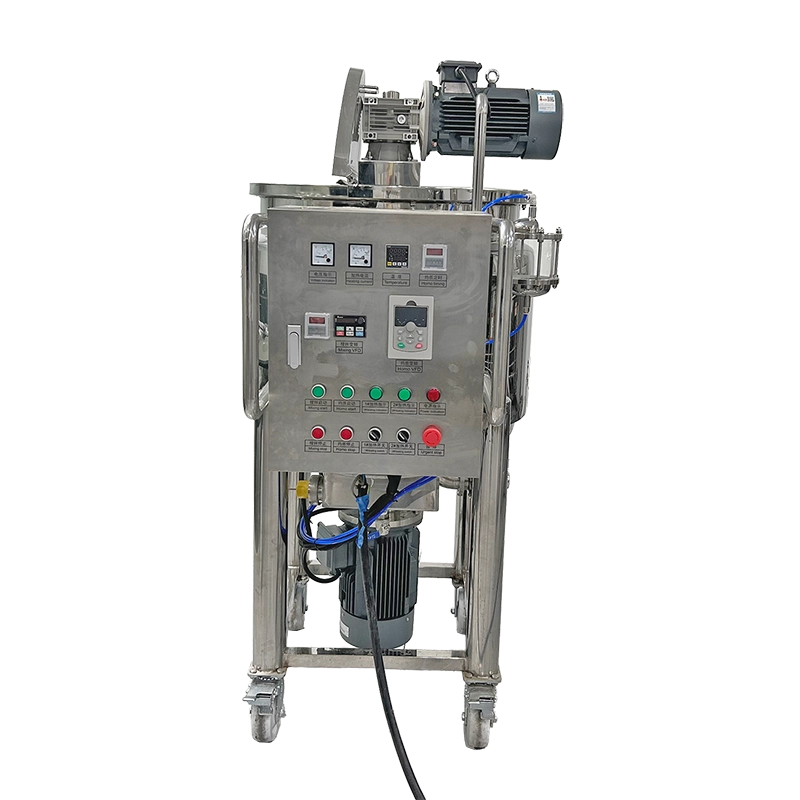
200L Mobile Electric Heating Homogenizing Mixing Tank with High Shear Mixer for Cosmetics, Cream, Lotion, Shampoo and Liquid Products
View Details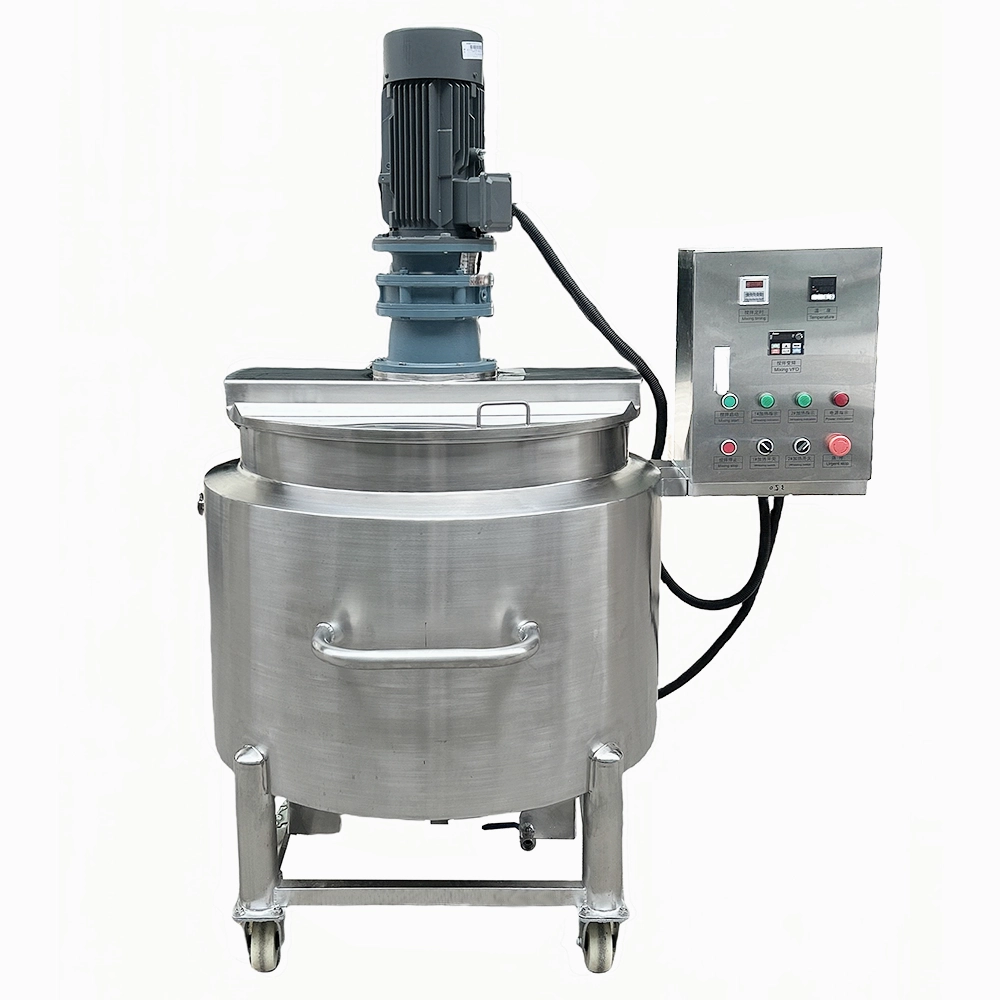
Specify an appropriate finish, sound welds and an inspectable surface. Then test the actual product. Choose stainless steel and seals for chemical compatibility as well; the 304 versus 316L equipment guide explains why material selection is a separate decision from drainage.
4. Match the Mixing and Discharge Method to the Product
A scraper helps where it reaches
A designed wall scraper can move cream from the vessel wall back into the bulk. Check blade condition, contact, movement and access for cleaning. Worn or poorly fitted blades can leave a visible strip of residue after every batch.
An anchor agitator is not automatically a scraper. PTFE blades work through mechanical wiping; they do not turn the entire stainless-steel vessel into a non-stick surface. The anchor, frame and helical-ribbon agitator comparison helps separate these functions.
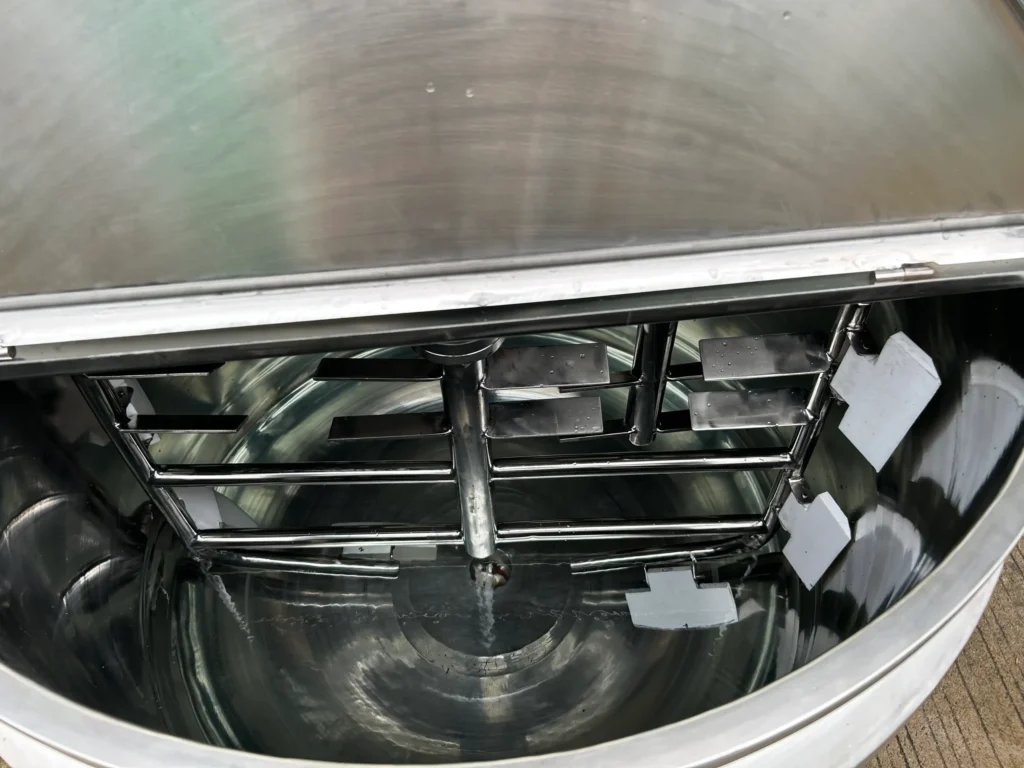
As the level falls, use the installed machine’s minimum working level and seal-support requirements. Stop at its defined endpoint. Running the mixer or homogenizer dry to chase the final residue can cost far more than the product recovered.
If the seal needs a separate support-water system, keep that system operating as specified. The mechanical-seal cooling-water case shows why seal support deserves its own check.
Bottom homogenizers and external loops need a residue assessment
A bottom homogenizer may offer a convenient process layout. Its workhead, valve and connecting passages can also retain product. A top-mounted workhead has different geometry; its position alone does not determine the final recovery result.
For an inner- and outer-circulation mixer, include the external loop in the balance. It adds product inventory, connections and cleaning surfaces. Compare the process benefit with the extra material held in that route.
When selecting a new unit, put these questions beside batch size and mixing performance in your vacuum emulsifying mixer specification. Recovery should be designed into the discharge route, not added as a final sales claim.
Keep temperature within the product’s approved range
Some products become much harder to transfer as they cool. Record the temperature at the start and end of discharge. A planned transfer window may solve a slow-draining problem without changing the pump.
Do not heat a finished product simply to make it flow faster. Check the formula’s temperature limits, quality requirements and holding time first.
Pressure-assisted discharge requires an engineered system
Do not connect compressed air to a vacuum vessel unless the installed system is designed and approved for that duty. A vacuum rating does not establish a positive-pressure rating.
The review must cover the vessel and connected equipment ratings, pressure limits, protective devices, controls, gas quality and receiving route. HSE’s pressure-equipment guidance highlights equipment suitability, operating limits and protection as core safeguards. There is no universal air-pressure setting for recovering cream from a tank.
5. Choose the Pump and Route Together
Start with the product at its transfer temperature: viscosity, solids, shear sensitivity and tendency to foam. Add the required flow, inlet conditions, pipe losses and cleaning method. The process pump selection guide provides a practical comparison.
Rotary lobe pumps can handle a wide viscosity range when properly selected. Gear, screw and diaphragm pumps also have useful applications, but the exact design matters. “Rotor pump” and “lobe pump” may describe overlapping equipment categories, so compare drawings and specifications rather than names.
A portable variable-speed lobe pump can make a transfer route more flexible. Keep the inlet adequately supplied, choose suitable hoses and measure what remains in the complete route after discharge.
If the pump becomes noisy or flow falls near the end, check inlet supply, air entry, restrictions and product temperature before buying a larger pump. Higher speed can make a poor inlet condition worse.
Remove unnecessary line inventory
Use the shortest practical route with suitable bore, support and drainage. Eliminate avoidable low pockets and unused branches. Check these during installation, when changes are easier; the equipment installation guide explains why routing deserves an early review.
Geometric example: a straight pipe with a 50 mm internal diameter and a 20 m length holds approximately 39.3 L when full:
Pipe volume = π × 0.05² ÷ 4 × 20 = 0.03927 m³ = 39.3 L
This is full-pipe inventory, not measured residue. It excludes fittings and equipment. Use it to identify where substantial product might sit, then measure the actual discharge result.
Review the valve’s internal path
A butterfly valve leaves a disc in the flow path. A suitable full-bore hygienic ball valve can offer a clearer passage for viscous or particle-containing products. Check cavities, seals and cleaning access as well as nominal connection size.
The best choice is the one that transfers and cleans well in your layout. A large connection label can hide a smaller internal opening.
When does pigging make sense?
Related Solutions




Pipeline pigging uses a fitted device to push product along a designed route. It deserves consideration when measured line residue and frequent changeovers create a substantial recurring cost.
It needs compatible piping, launch and receiving arrangements, pig detection, a controlled driving medium, interface handling and cleaning provisions. GEA’s VARICOVER documentation illustrates this system scope. Treat pigging as an engineered project, not an accessory for any existing hose.
6. Reduce Filling Loss Without Lowering Quality
Separate three issues: material left inside the filler, rejected packs and overfill giveaway. Each needs its own measurement.
Collect startup, steady-running, restart and end-of-batch results. Compare filling heads individually. A machine can give a good overall average while one head regularly overfills and another underfills. The filling accuracy testing guide explains how to record the variation.
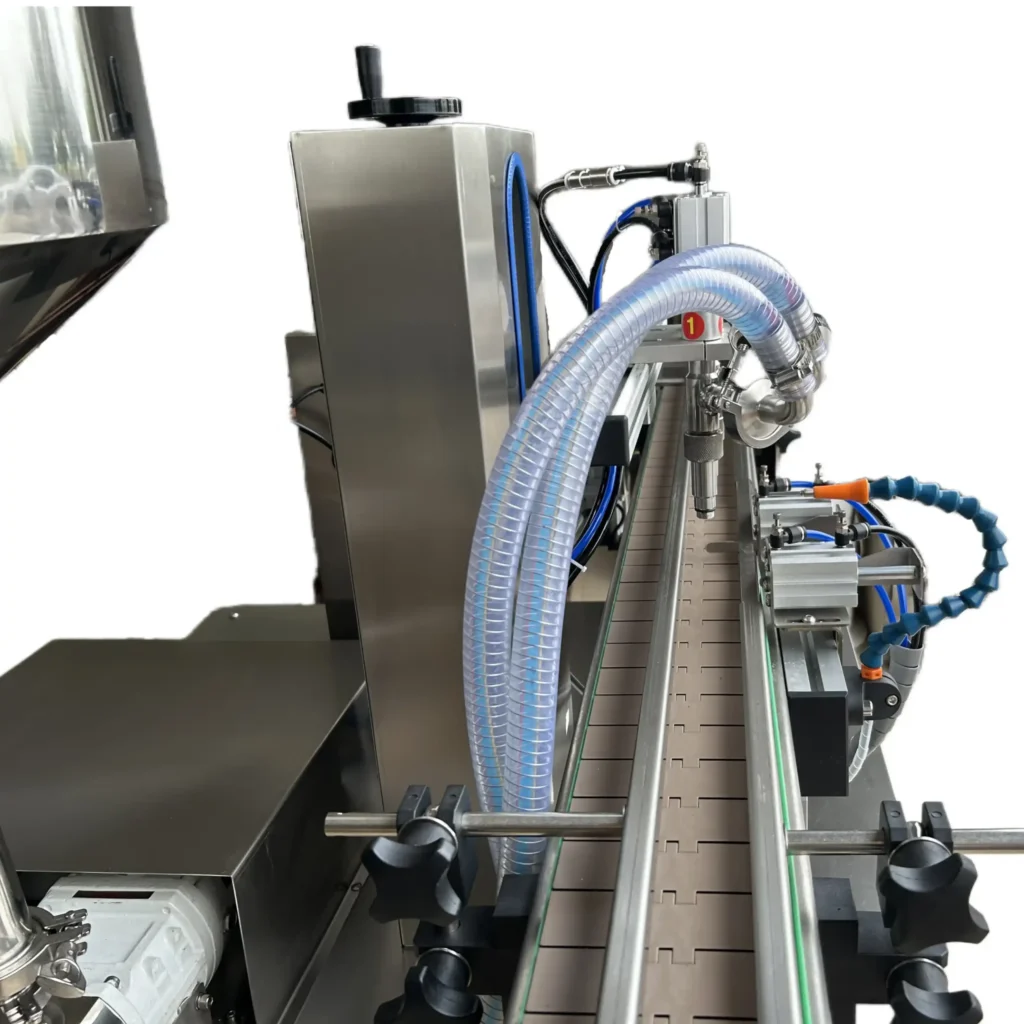
For thick products, review hopper feed, pump supply and the remaining quantity needed to maintain stable dosing. A dual-head rotor-pump filler with an agitated hopper combines several functions, but its end-of-batch result still depends on the product and settings.
Do not lower the fill target just because the average is above the declared content. First establish measurement accuracy, process variation and the applicable net-content requirements. Then set a target that consistently produces compliant packs.
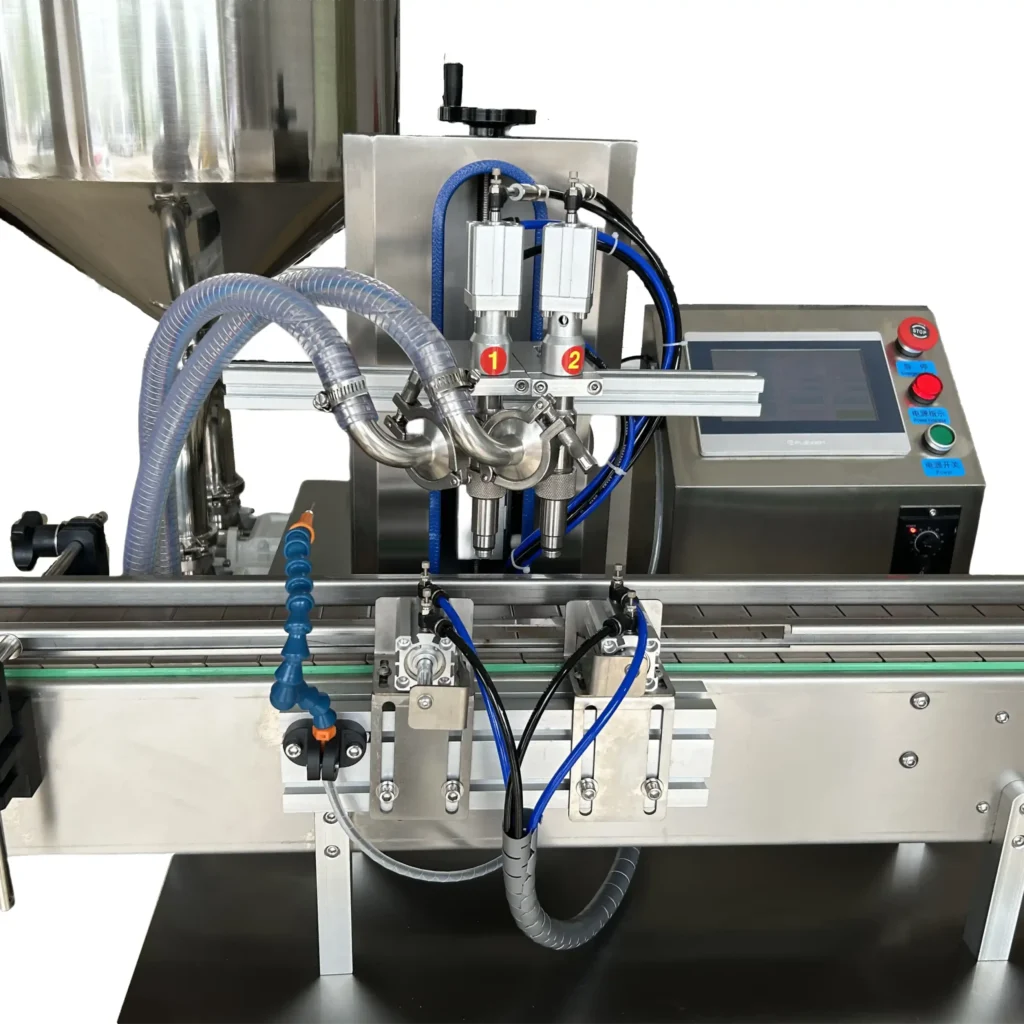
Dripping may come from product stringing, nozzle condition, closing timing or pressure in the feed. Diagnose the cause before changing hardware. The rotary lobe pump filling guide explains how the feed and dosing arrangement work together.
7. Finish Recovery Before Starting the Cleaning Cycle
Set a clear handover point: product recovery has ended, remaining material has a recorded destination, and cleaning can begin. This prevents an operator from extending discharge indefinitely or sending unlabelled material back to production.
Keep recovered product, dilute rinses and cleaning solutions separate. Record batch identity, collection time, container condition and quality status.
Can the first rinse be reused?
Only through an approved process. Water changes concentration and may affect preservation, texture and microbiological quality. The receiving batch also needs a controlled composition and traceable history.
Review dilution, carryover, microbiological risk, holding time and any required testing before deciding on reuse. FDA’s cosmetics GMP checklist supports control of equipment, materials, testing and production records; it is not a blanket approval to reuse a first rinse.
Removing more product before washing may reduce the load entering the cleaning cycle. Keep the established cleaning procedure until a reviewed change has shown that it still achieves the required result. The CIP spray-ball and manual-cleaning comparison explains the difference between helping a wash and delivering a complete cleaning process.
8. Twenty Recovery Problems and the First Useful Check
Use this table to choose the next observation. Confirm the cause before ordering parts.
| Observed problem | Check first |
|---|---|
| 1. A pool remains below the outlet | Installed low point, outlet height and vessel level |
| 2. Product coats the wall | Scraper reach, wear and product temperature |
| 3. Residue sits behind internal fittings | Bracket geometry, joints and cleaning access |
| 4. Discharge slows as the batch cools | Recorded transfer temperature and allowed holding time |
| 5. Flow drops near the end | Remaining level, inlet supply and the pump’s operating limits |
| 6. Pump noise increases during transfer | Air entry, inlet restrictions and supply conditions |
| 7. A hose remains full | Route, low pockets and the defined emptying method |
| 8. Product stays in an unused branch | Whether the branch can be removed or redesigned |
| 9. A valve area retains a plug | Actual bore, internal cavities and local product cooling |
| 10. A circulation loop retains product | Loop inventory and its separate drainage route |
| 11. Startup rejects are high | Product arrival, priming condition and start sequence |
| 12. One filling head gives away more product | Head-specific results and measurement accuracy |
| 13. Nozzles drip after closing | Nozzle condition, timing and feed pressure |
| 14. End-of-batch filling becomes erratic | Hopper level, air entry and minimum feed requirement |
| 15. Recovery varies between operators | Different endpoints, wait times and collection practices |
| 16. The balance will not close | Scale uncertainty, tare values and missing transfers |
| 17. Collected product has no clear identity | Labelling, batch records and segregation |
| 18. Rinse collection increases but approved output does not | Dilution and quality disposition of the collected material |
| 19. “Better recovery” delays cleaning | Extra collection time versus usable product gained |
| 20. A recovery improvement changes product quality | Temperature, shear, exposure and the revised holding period |
Decision Guide
9. Set Priorities for Your Product and Industry
Creams and lotions: start with wall residue, discharge temperature, hopper feed and filling variation. Keep the emulsion within its approved process conditions.
Shampoo and liquid detergents: look for foaming, air entry, hose inventory and nozzle dripping. A shorter, well-fed transfer route may be more valuable than a faster pump.
Sauces and particulate products: inspect restrictions, particle damage and changeover carryover. Include allergen controls and the product’s food-safety requirements in any recovery proposal.
Pharmaceutical products: put any proposed recovery or reprocessing route through the site’s quality system before implementation. Cosmetic, food and pharmaceutical operations cannot share one generic reuse rule.
10. Compare Improvements Against a Measured Baseline
First fix setup and maintenance issues: worn scrapers, leaking joints, unnecessary hose length and inconsistent discharge endpoints. Next assess changes to outlets, transfer routes and filling equipment. Consider a larger redesign when these smaller changes leave a meaningful recurring loss.
The equipment retrofit guide helps distinguish a workable modification from a change that affects the whole line. Include installation, training, cleaning and downtime costs; the hidden machinery costs guide covers items often missing from the purchase price.
For a simple business case, estimate annual additional approved output and assign one consistent economic value to it. Deduct added labour, utilities, consumables and maintenance. Do not count both the full sales value and raw-material cost of the same saved kilogram as separate benefits.
Agree the comparison conditions before the trial: recipe, starting quantity, temperature, discharge endpoint, residue measurement and quality checks. Report both the improvement and any extra time required.
11. What StriversMachinery Can Review With You
Send a product description, batch size, normal transfer temperature, a simple route drawing and photos of where residue remains. Add your measured tank, line and filler quantities if available.
StriversMachinery can use these details to review the mixing vessel, outlet arrangement, scraper duty and transfer route. Core mixing equipment is manufactured in-house. Complementary equipment can be coordinated with long-term partner factories, with the supply boundary stated in the quotation.
A useful proposal should identify the suspected loss point, the proposed change and how the result will be checked. Ask for a product-trial scope when product behaviour is central to the decision.
Email [email protected] with the subject “Product recovery review” and the equipment or batch details. The most useful starting point is a measured loss at a known location.
Technical References
- HSE: Introduction to pressure equipment — equipment suitability, operating limits and protective measures
- Alfa Laval: Rotary lobe pumps — pump principles and viscosity range
- Alfa Laval: Ball valves — full-bore flow paths and hygienic cavity options
- GEA: VARICOVER Hygienic Product Recovery Systems — pigging components and system layout
- FDA: GMP Guidelines/Inspection Checklist for Cosmetics — equipment, testing and production-record controls