
To calculate industrial machinery landed cost calculation, start with the agreed equipment price and add every charge needed to reach one defined delivery point: freight, insurance, customs duty, import tax, clearance, destination handling, inland transport and unloading. Count each charge once. Then separate the cash you need to pay from taxes your business can recover.
For a vacuum emulsifying mixer shipped from China to Australia, origin paperwork can make a measurable difference. In the example below, an eligible ChAFTA claim reduces customs duty from AUD 1,000 to zero. Import GST falls by another AUD 100 because the duty is removed from its calculation base. The result is AUD 1,100 less cash required, with AUD 1,000 of lasting duty savings for a business that can fully recover import GST.
Our recommendation is to build this calculation before approving the machine order. Ask the supplier for the final equipment scope and estimated packed dimensions, and ask an Australian customs broker to review classification and origin while there is still time to prepare the documents.
1. Why the Machinery Quotation Is Only the Starting Point
Imagine a cream manufacturer ordering a vacuum emulsifier for a factory near Melbourne. The supplier quotes FOB Guangzhou. Purchasing records the equipment price as the project budget. Later, the forwarder sends the sea freight invoice, the broker requests funds for clearance, and the delivery contractor asks who will unload the machine.
Nothing unusual has happened. The budget simply stopped at the wrong point. FOB pricing leaves a substantial part of the import journey for the buyer to arrange and pay.
A more useful question is: “What will this machine cost when it is unloaded at our factory?” That gives purchasing, logistics and finance the same finish line. If the project also includes positioning, electrical connections and commissioning, price those as the next stage.
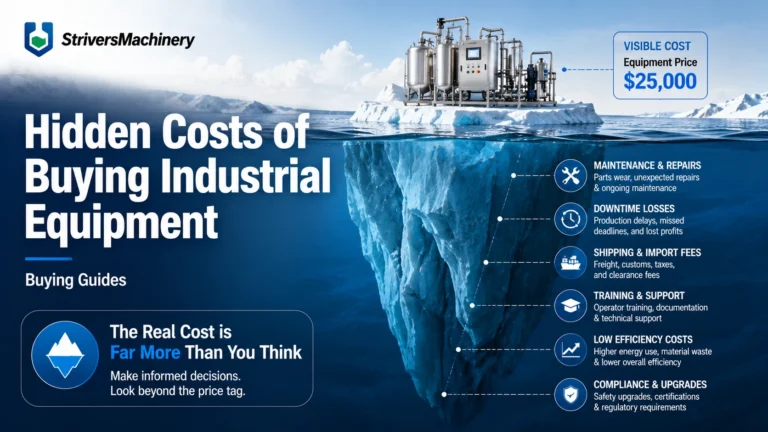
The existing hidden equipment costs checklist helps identify missing supply and service scope. This guide takes the next step: putting the import and delivery charges into a calculation.
That distinction matters when comparing suppliers. A lower machine price can still be the better offer. But the comparison needs equivalent equipment, the same destination and a complete delivery budget. A large difference in freight may come from different packing assumptions rather than better buying power.
2. What to Include in Industrial Machinery Landed Cost Calculation
Set the delivery point, currency and tax treatment first
Write the calculation boundary at the top of the budget. “Unloaded at buyer’s factory, Melbourne” is much clearer than “delivered Australia.” State the budget currency and exchange-rate assumptions beside it.
Landed cash outlay = equipment + uncovered origin costs + international freight + insurance + duty + import tax + destination and clearance charges + inland delivery + unloading.
“Uncovered” matters. Export packing or origin handling already included in the equipment price stays there; it is not added again. The same applies when freight and insurance are already inside a CIF price.
| Cost item | What to record | Where buyers lose track |
|---|---|---|
| Equipment purchase | Machine, agreed options, included packing and trade term | Comparing different supply scopes |
| Origin services | Collection, export handling and clearance outside the price | Adding FOB-included charges a second time |
| Freight and insurance | Route, service, cargo basis, coverage and validity | Budgeting only the advertised ocean rate |
| Duty and import GST/VAT | Classification, origin, valuation and tax base | Treating all border payments as customs duty |
| Destination and clearance | Terminal, carrier, broker and government charges | Leaving local charges until arrival |
| Final delivery | Trucking, unloading and agreed handling | Assuming a truck includes a crane |
Keep cash requirements separate from lasting cost in your industrial machinery landed cost calculation
Maintain two useful totals. The first is the money required to purchase and receive the machine. The second removes taxes recoverable by your business. Recoverable GST can create a funding requirement even when it does not remain an economic cost.
Keep contingency separate from confirmed charges. A broker’s fixed service fee, a freight amount tied to cubic metres and a possible inspection expense are different kinds of inputs. Label each amount as quoted, estimated or contingent, with its source and date.
Landed cost ends at the chosen delivery boundary. Energy, cleaning labour, maintenance and future repairs belong in a total cost of ownership comparison. Use the landed total as one input to that wider study rather than repeating both calculations here.
3. How Incoterms Change the Machinery Import Budget
Incoterms® 2020 allocate delivery obligations, costs and risk. Put the named place or port and the version in the contract. “FOB China” leaves too much room for disagreement; a specific port and agreed loading arrangement are more useful.
| Term | Main carriage arranged by | Import clearance and tax responsibility | Useful purchasing question |
|---|---|---|---|
| EXW, named premises | Buyer | Buyer | Who loads the collection vehicle and handles export formalities? |
| FCA, named handover point | Buyer | Buyer | Where does the carrier receive the export-cleared cargo? |
| FOB, named shipment port | Buyer | Buyer | Is delivery on board the agreed vessel clearly arranged? |
| CIF, named destination port | Seller | Buyer | Which destination charges and insurance cover are included? |
| DAP, named destination | Seller | Buyer | Who clears the import and unloads the arriving vehicle? |
| DDP, named destination | Seller | Seller | Who is the importer and how will tax documentation work? |
Choose FCA when the container handover is at a terminal
For containerised machinery delivered to a carrier before loading on the ship, FCA usually describes the physical handover more accurately than FOB. ICC specifically recommends considering FCA in this situation. FOB remains useful where the agreed delivery actually occurs on board. It is a sea or inland-waterway rule, not an air-freight term.
The worked example uses an expressly agreed FOB arrangement because buyers still encounter that quotation basis. For a new container shipment, we would first discuss FCA at the actual handover point. See ICC’s FOB explanatory notes.
CIF pays carriage further than it carries the seller’s risk
Under CIF, the seller pays freight and the required insurance to the named destination port, while risk transfers on board at shipment. Import clearance, duty and GST remain with the buyer. Some discharge costs can already be included in the carriage contract, so compare itemised charges before adding destination fees.
Under DAP and DDP, delivery is normally on the arriving vehicle ready for unloading. DPU is the rule that includes unloading by the seller. Installation is a separate scope. ICC also distinguishes CIF’s default minimum insurance from CIP’s broader default cover in its Incoterms 2020 guidance.
For DDP, settle the importer and GST arrangements before accepting the price. A short “tax included” message does not tell finance who will hold the import records. Payment terms, ownership, warranty and acceptance also need their own contract provisions.
4. Freight Costs: Price the Packed Machine, Not the Catalogue Size
Choose the service around the whole shipment
FCL gives the shipment a dedicated container and reduces shared-cargo handling. It is often the first option worth pricing for a mixer supplied with phase vessels, a platform and accessories. Container capacity alone is not enough: door clearance, support positions and the loading operation decide whether the cargo fits.
LCL can suit a smaller machine when the final delivered quote stays attractive. Consolidation, warehouse handling, minimum charges and destination collection can absorb much of the saving on ocean freight. Compare complete quotations rather than assuming that a fraction of a container means the same fraction of its cost.
For a 5L laboratory vacuum emulsifier, compare LCL and air freight using the actual crate. Air freight can be sensible when the shorter lead time has a clear value. Large systems may need an open-top container, flat rack or breakbulk service when ordinary container loading is impractical.
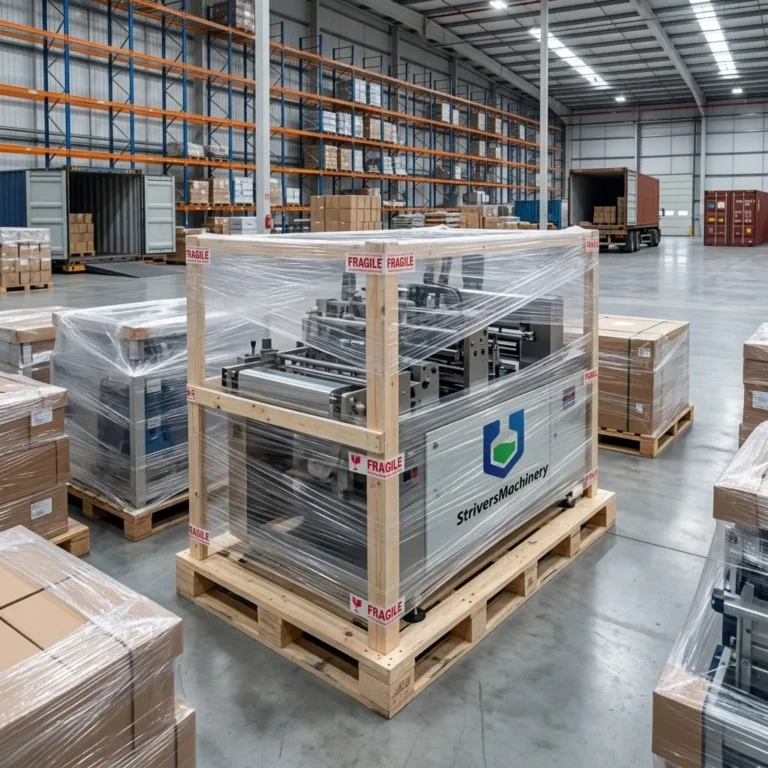
Measure every package after protection is included
Use external packed length × width × height in metres to calculate cubic metres. A crate measuring 2.40 × 1.80 × 2.20 m occupies 9.504 m³. Two such crates occupy 19.008 m³ before any carrier-specific booking or stowage adjustment.
Net weight describes the equipment. Gross weight includes the crate, skid, protection and accessories inside it. A freight quote needs gross weight, package dimensions, package count, stackability and any handling restrictions.
LCL commonly uses a weight-or-measurement basis. If a quotation defines one revenue ton as the greater of 1 m³ or 1,000 kg, a 9.504 m³ crate weighing 2,000 kg is assessed on 9.504 revenue tons before minimums and other charges. Use the definition in that quotation. Air freight has its own volumetric divisor and rounding rules.
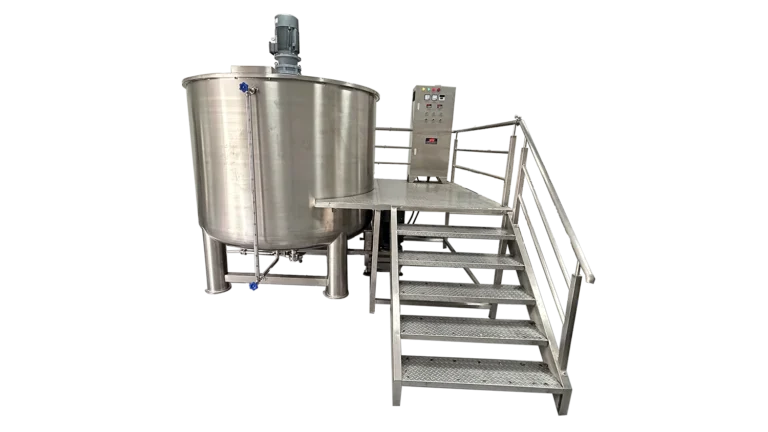
For a large arrangement such as the 2500L emulsifier with oil and water phase pots, ask for a package schedule showing how the tanks, frame, stairs and loose items will travel. An assembled photograph is not a packing list.

Packing can change the best freight option
Removing a detachable staircase or protecting a motor within a lower shipping envelope may avoid an oversized booking. Compare the saving with disassembly, reconnection, extra protection and site labour. Document the approved transport arrangement so the receiving team knows what must be reassembled.
For the moisture plan, specify barriers, desiccant where appropriate, protected openings and restraints designed for the machine’s support points. Stretch film alone is a poor substitute for a complete corrosion and handling plan.
For Australia, solid timber packaging and dunnage must meet the applicable treatment and declaration requirements. Processed plywood is treated differently from raw solid timber; a plywood case may still contain solid timber skids. Review the actual materials using DAFF’s timber packaging requirements, rather than ordering “fumigation” automatically.
Ask the forwarder to list fuel, peak-season, congestion, documentation and special-handling charges, including any subject to change. Record the sailing period and quote validity. A cheap rate that expires before the machine is ready is not a reliable budget input.
5. Cargo Insurance: Compare the Cover Before the Premium
For machinery, we recommend asking for broader cargo cover and a clear transit scope, particularly where controls, exposed pipework or multiple handling stages are involved. CIF minimum cover is not a useful shortcut for deciding what the machine needs.
Institute Cargo Clauses A generally cover physical loss or damage on an all-risks basis subject to exclusions. B and C insure specified perils, with C narrower. “All risks” still has exclusions. Packing deficiencies, delay, inherent problems and particular rust or moisture circumstances can affect a claim.
Ask the insurer how the wording treats loading, unloading, transshipment, water damage, theft, electrical components, deductibles and the end of transit. The published Institute Cargo Clauses A wording shows why the exclusions and duration provisions deserve attention alongside the cover heading.
Premium = agreed insured amount × agreed premium rate, plus applicable charges. Insuring at 110% of an agreed CIF value is a common arrangement. The commercial contract and policy determine the valuation and required cover.
For example, an agreed insured amount of AUD 24,000 at an illustrative 0.4% gives a base premium of AUD 96. That explains the arithmetic, not the current price of machinery insurance. Use the insurer’s actual quotation in the landed-cost sheet.
Photograph the equipment before packing, the restraints, closed packages and visible condition at receipt. If damage appears, retain the packaging and notify the responsible carrier and insurer promptly. Those records are much more useful than trying to reconstruct the loading arrangement afterward.
6. Australian Machinery Duty, GST and the Chinese Origin Certificate
Start with the machine’s function and tariff classification
The HS code connects the equipment to the tariff treatment. Give the broker a clear functional description, process use, configuration and drawings. Vacuum emulsifying mixers, fillers, water-treatment systems and separate support equipment can fall under different headings.
Australian tariff item 8479.82.00 covers mixing, homogenising, emulsifying and related machines, with a general duty rate of 5% in the tariff reviewed for this article. It is a useful candidate for our example, not a classification ruling for every vacuum emulsifier. Heating functions, principal use and the composition of a complete shipment need review. See ABF Chapter 84.
Australia does not simply charge machinery duty on CIF
Australia generally values imports at the place-of-export level, broadly an FOB basis. International freight and insurance are generally outside customs value. The invoice is a starting point; valuation adjustments and customs currency conversion can change the declared figure.
Ad valorem duty = customs value × applicable duty rate. For an assumed customs value of AUD 20,000 at 5%, duty is AUD 1,000. An applicable preference or concession changes the rate used. The valuation basis is explained in ABF’s customs valuation guidance.
Use a ChAFTA preferential certificate, not just a generic certificate
For eligible Chinese-originating machinery, ChAFTA can reduce that 5% general duty to Free. ABF’s Schedule 12 for Chinese originating goods provides the preferential tariff framework.
Ask for a ChAFTA Certificate of Origin when discussing the export documents. A standard non-preferential certificate stating “China” is not a substitute. The machine must satisfy the agreement’s origin rules, and the importer must make the preference claim correctly.
ABF identifies China’s GACC and CCPIT as authorised issuing bodies. Send the draft certificate and shipment details to the broker before departure. Check the goods description, invoice reference, tariff information and origin criterion against the shipment. ABF explains the documentary route on its ChAFTA import guidance page.
A Chinese shipping port does not establish Chinese origin. Likewise, overseas components do not automatically disqualify a machine made in China: the product-specific origin rule determines the result. DFAT’s guide to using ChAFTA explains that distinction. Include transshipment information where relevant to the origin claim.
Our purchasing recommendation is straightforward: agree the preferential origin document with the supplier and broker before shipment, not after a duty invoice arrives. If duty has already been paid, ask the broker whether the ChAFTA refund route is available for the documents and dates involved.
GST remains payable on a taxable importation
Removing customs duty does not remove Australian GST. For this machinery example, the calculation is 10% × (customs value + duty + applicable transport and insurance additions). The additions must follow the statutory taxable-importation basis, rather than simply copying the freight invoice total.
ABF explains the calculation in GST and other taxes when importing. Have the broker identify the transport amounts included, so the budget does not omit an assessable amount or count one twice.
A GST-registered business importing for a fully creditable business purpose may claim the import GST credit when the requirements are met. Keep the import records under the correct entity. ATO’s guidance on claiming GST credits for imported goods explains why paying an amount labelled GST is not sufficient by itself.
Eligible importers approved for deferred GST can change the payment timing. That is a cash-flow arrangement, not a lower tax rate. Duty, tax credits and payment timing should occupy separate lines in the financial review.
Review exceptions without turning the budget into a country manual
Ask the broker whether a tariff concession, anti-dumping or countervailing duty, special permit or temporary-import arrangement affects the actual goods. Used equipment also needs a separate cleanliness and biosecurity review. Tools brought in for installation may have a different temporary-entry treatment from the machine being sold.
These checks belong to the specific shipment. A normal machinery preference claim does not settle electrical installation, workplace acceptance or product-manufacturing requirements at the factory.
7. Destination Charges and the Last Kilometres to the Factory
Ask for destination charges while comparing freight
Request a written local-charge breakdown from the party handling arrival. Include terminal handling, carrier documentation or release fees, LCL warehouse charges where applicable, customs brokerage, government processing and biosecurity costs. Identify which items are already prepaid.
Storage, demurrage and detention need their own attention. Terminal storage concerns cargo or container space at the terminal. Demurrage commonly concerns the carrier’s container remaining at the terminal beyond free time; detention commonly concerns keeping it outside the terminal too long. Carrier tariffs can combine or define these differently.
Record when each free-time period starts, whether it uses calendar days, and who books collection and empty return. A single vague “seven days free” statement is difficult to act on when a weekend or inspection intervenes.
Delivery, unloading and installation are three different jobs
A container truck can reach the gate while the factory still lacks a suitable forklift, crane or unloading area. Get the handling contractor to review package weights, lifting points, access, ground conditions and the route into the building before booking delivery.
Check whether the plan is live unloading, container drop-off or unloading at a nearby facility. Ask about vehicle waiting time, failed delivery, permits and empty-container return. These are concrete costs that a low ocean rate cannot fix.
After unloading comes positioning, reassembly, utilities and commissioning. The cream factory utilities checklist helps assign those connections. Keep their budget separate when the landed-cost boundary stops at unloading.

For the site team, the most useful handover is a package list plus a handling plan. A photograph of an assembled emulsifying system helps explain the equipment, but it does not supply transport weight or lifting instructions. Use the installation-readiness guidance for the work that follows receipt.
8. Case Study: Landed Cost of a Vacuum Emulsifying Mixer, Guangzhou to Melbourne (Actual Project Budget)
Project Background
Our company is exporting a new vacuum emulsifying mixer to a customer in Australia under FOB Guangzhou terms. The equipment ships FCL by sea to Melbourne and is then delivered to a nearby factory for unloading.
Scenarios compared: Entry at the 5% general duty rate versus an eligible 0% ChAFTA (China-Australia Free Trade Agreement) entry, supported by the required preferential origin evidence
Equipment configuration: 100L hydraulic-lift emulsifier with a main vessel, auxiliary phase pots and controls
Price terms: Equipment price is AUD 20,000, including the agreed export packing and origin costs
Currency: All figures are in AUD
Customs assumptions: The Australian customs broker has confirmed HS code 8479.82.00 and a customs value of AUD 20,000, with no additional valuation adjustment, no other concession and no special duty

GST Calculation Basis
For the simplified GST calculation, AUD 2,100 is the broker-confirmed transport-and-insurance addition. The local cost allowances below are not added to this base. They include any local supplier GST where applicable. Actual invoices determine the final allocation.
Side-by-Side Cost Comparison
| Cost item (AUD) | General duty at 5% | Eligible ChAFTA at 0% |
|---|---|---|
| Equipment, FOB | 20,000 | 20,000 |
| International freight | 2,000 | 2,000 |
| Cargo insurance | 100 | 100 |
| Customs duty | 1,000 | 0 |
| Import GST | 2,310 | 2,210 |
| Destination handling allowance | 900 | 900 |
| Government processing and biosecurity allowance | 350 | 350 |
| Customs broker allowance | 300 | 300 |
| Inland delivery allowance | 700 | 700 |
| Factory unloading allowance | 400 | 400 |
| Total landed cash outlay | 28,060 | 26,960 |
| Less fully recoverable import GST, if eligible | 2,310 | 2,210 |
| Outlay after import-GST credit only | 25,750 | 24,750 |
Note: These amounts are planning inputs, not market freight quotations or an official fee schedule. Any certificate charge belongs in the budget too; it is assumed to be included in the agreed document scope here. The final row removes import GST only. Credits for any GST in local services would be calculated separately.
Calculations
Without preference (general duty):
- Duty = 20,000 × 5% = AUD 1,000
- Import GST = (20,000 + 2,000 + 100 + 1,000) × 10% = AUD 2,310
With eligible ChAFTA treatment:
- Duty = AUD 0
- Import GST = (20,000 + 2,000 + 100) × 10% = AUD 2,210
Conclusion
If an applicable tariff concession already produces zero duty, the incremental duty saving from ChAFTA is zero. Compare against the rate the shipment would actually pay, not automatically against 5%.
The preference saves AUD 1,100 in initial cash outlay: AUD 1,000 in duty plus AUD 100 in import GST.
For an importer entitled to full GST recovery, the lasting tax saving is the AUD 1,000 duty. The GST difference only affects funding, since the corresponding credit also falls by AUD 100.
Compare FOB, CIF and DAP without counting freight twice
Holding this example’s underlying costs constant, a CIF invoice of AUD 22,100 combines the AUD 20,000 equipment, AUD 2,000 freight and AUD 100 insurance. Start the budget at AUD 22,100 and add only the uncovered items. Customs valuation still needs the correct goods value and adjustments; the invoice heading does not replace that work.
A DAP quotation moves more transport arrangement into the seller’s scope, but import clearance, duty and GST remain for the buyer. Compare the supplier’s included local handling and delivery against the forwarder’s quote line by line. Commercial prices can differ even when the physical route is the same.
The ChAFTA cash-outlay ratio here is 26,960 ÷ 20,000 × 100 = 134.8%. The uplift over the equipment price is 34.8%. Keep those labels distinct. Neither figure is a standard percentage to apply to the next machine.
Test the shipping choice with the same delivery scope
Suppose an LCL offer saves an illustrative AUD 450 on main carriage but adds AUD 300 in consolidation and destination handling plus AUD 250 for extra transfer and delivery work. The apparent saving becomes AUD 100 of additional logistics cost before any resulting tax difference. Put those lines beside the FCL quote and the choice becomes much clearer.
For a standard container versus a flat rack, compare the approved disassembly and reassembly cost with the full oversized-cargo quotation. For sea versus air, add the value of getting the machine into production earlier only when the site and commissioning schedule can actually use the saved time. Faster arrival provides little benefit if the electrical connection is still three weeks away.
Splitting a production line can also work against the budget. A small urgent shipment creates another set of minimum handling and entry charges, while the remaining equipment still needs its own delivery. Ask which items are essential to the first production stage and which can travel together. A separate shipment is most useful when it removes a specific schedule constraint.
Finally, test exchange-rate exposure on the unpaid foreign-currency amounts. If the outstanding machine balance and freight total USD 15,000, a change from AUD 1.50 to AUD 1.55 per USD adds AUD 750 to those payments. That sensitivity is separate from the customs conversion basis and any related tax changes. It helps finance see where the budget can move before payment.
9. Common Machinery Landed Cost Mistakes
Using the assembled dimensions for a freight booking
A tall drive, loose staircase or crate base can change the transport envelope. Ask for the final package schedule before booking. Where the design is still being customised, budget from the latest packing estimate and identify the point at which it will be confirmed.
Accepting a supplier’s HS code without a destination review
The export code is useful information, but the importing country determines its own entry classification. Send the broker the machine’s function and configuration, not just the code on a proforma invoice. A multifunction system needs more explanation than a short product name.
Treating every Chinese certificate as a duty-saving document
Specify the ChAFTA preferential certificate and origin evidence needed for the claim. Match the documents to the goods. Paying for a generic origin certificate and discovering the difference at clearance creates avoidable work.
Comparing ocean rates while leaving local fees blank
A destination handling charge does not disappear because it is absent from the first quote. Request the arrival breakdown before selecting FCL, LCL or a supplier-arranged freight service. Include free time and delivery assumptions in the comparison.
Buying a larger machine to make better use of a container
Freight efficiency matters after production capacity is right. An oversized vessel adds cleaning, support equipment and possibly installation work. Use batch mixing and filling-line capacity planning to size the process first, then optimise its shipment.
Mixing quotation currencies and tax treatments
Convert every line to the budget currency before adding totals. Record the bank conversion cost separately from the customs exchange-rate basis. Keep gross cash payments and recoverable tax credits visible, so one supplier is not compared inclusive of GST against another exclusive of it.
Combining shipment readiness with production readiness
A machine can be packed and ready to ship while its destination still lacks access or utilities. Coordinate freight dates with the site team. The machinery sourcing guide covers the wider project gates; this budget should show which delivery costs depend on each gate being complete.
10. A Practical Worksheet and Pre-Import Checklist
Give every cost an owner and a source
A useful machinery landed cost calculator needs more than a total cell. Keep columns for cost item, currency, estimated amount, source, quote validity, included elsewhere, actual amount and variance. Add separate inputs for customs value, duty rate, GST base additions and recoverable tax.
The accompanying Australian example worksheet shows the arithmetic with editable assumptions. It is designed to update one selected duty rate and compare the result with the 5% reference. Replace the planning amounts with the actual machine and logistics quotations.
For the freight enquiry, provide the machine description, each package’s dimensions and gross weight, package count, packing material, stackability, loading address, port, factory delivery address and proposed Incoterm. Include photographs where the shape or handling arrangement needs explanation.
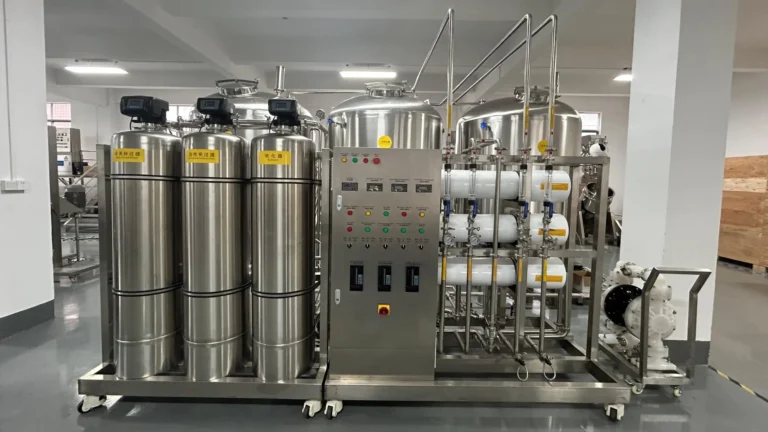
For a phase-pot emulsifier, identify loose pumps, cabinets, platforms, stairs and any separately supplied support equipment. This prevents the forwarder pricing one vessel while the supplier prepares several packages.
Review the budget at three useful points
| Stage | What to resolve | Useful record |
|---|---|---|
| Before shipment | Packing dimensions, invoice scope, classification, origin evidence, freight and insurance | Approved package schedule and cost estimate |
| Before arrival | Clearance documents, arrival charges, funds, delivery booking and unloading resources | Arrival plan with named responsibilities |
| After clearance and delivery | Duty, GST, port invoices, trucking, handling and credits | Actual-versus-budget reconciliation |
For Australian cargo, provide the packing and cleanliness information before departure. DAFF’s pre-import preparation guidance explains how missing declarations or contamination can add inspections, treatment and delay.
Use official tariff tools for the destination
For Australia, use ABF’s tariff and origin guidance cited above. For other markets, start with the USITC Harmonized Tariff Schedule, the European Commission’s TARIC consultation tool, the UK Trade Tariff or the Canadian customs tariff. Use the goods’ origin and the actual entry date in the review.
These sources answer different parts of the calculation. Tariff classification and duty do not establish every tax, trade remedy, permit or destination handling charge. Build the final landed budget from the tariff review plus written logistics and service quotations.
11. Put the Complete Import Budget Beside the Purchase Order
Before approving an imported emulsifier, put three records together: the equipment quotation, the package schedule and the destination cost estimate. They should describe the same machine, shipment and delivery boundary.
For Australia, add the origin plan. An eligible ChAFTA Certificate of Origin can remove a real duty cost, while GST and destination services still need funding. Keep the cash total and recoverable credits separate so finance can see both the investment and its timing.
When discussing a StriversMachinery emulsifier, send the working batch range, product, heating and cooling needs, destination port and factory delivery conditions through the website enquiry form. Ask for the proposed package dimensions, gross weights, included export documents and availability of the ChAFTA certificate for the agreed supply. Those details let your forwarder and broker turn a machine price into a budget you can approve.
Reference Souce: