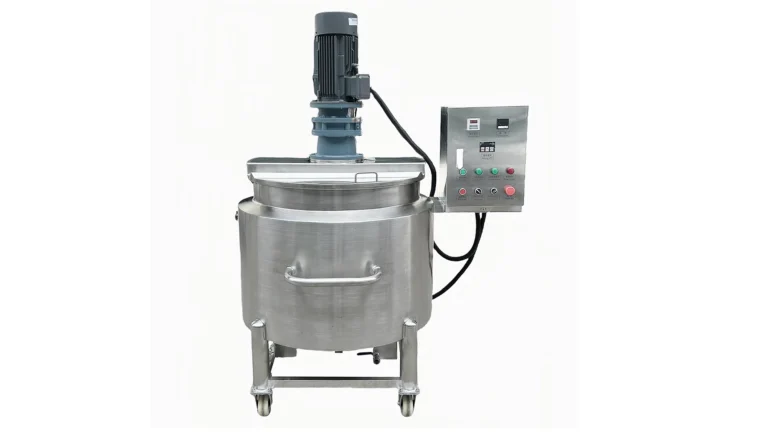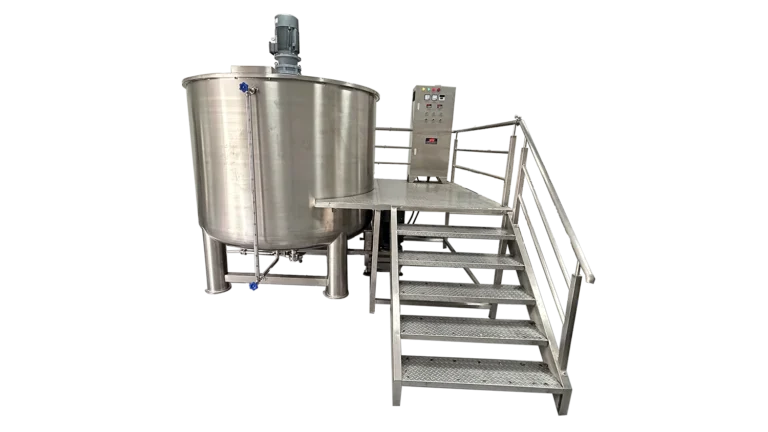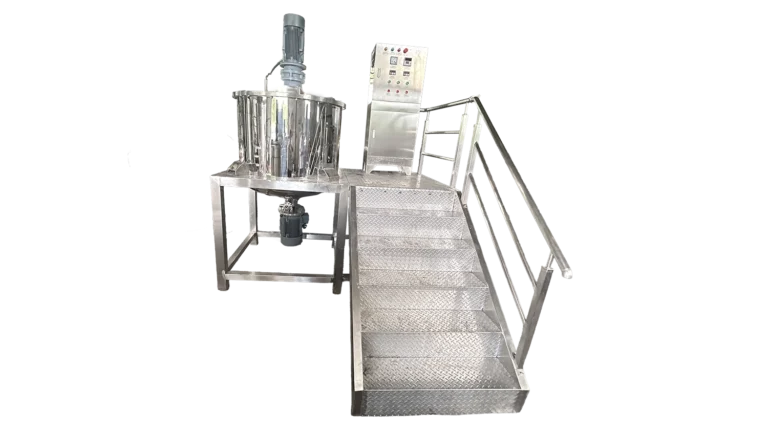

For a typical clear shampoo made from liquid surfactants, start with a variable-speed mixing tank that can circulate the finished product, a clean transfer route and a filler tested with your bottles. Add high shear for difficult dilution or powder wetting, heating for a defined hot-process stage, and vacuum when trapped air delays release or filling. Buy each function for a job it needs to do.
Shampoo manufacturing equipment can range from a small batch tank and semi-automatic filler to a complete mixing, holding and packaging line. The right arrangement depends on how the ingredients arrive, how the batch thickens and how quickly it must reach the bottle. A machine described as a “shampoo making machine” still needs those details before it can be selected.
This guide gives our recommended starting points, explains where extra equipment earns its place and lists the checks to run before approving an order.

Shampoo Manufacturing Equipment: Start with the Formula
Give the equipment supplier the process sheet as well as a finished sample. Two shampoos with similar appearance and final viscosity can require different mixing equipment. One may use ready-diluted surfactants and liquid additives. The other may require concentrated surfactant dilution, polymer hydration and controlled cooling.
Start with the most demanding product you expect to make regularly. Also include your smallest batch. A tank that handles a full batch of thin shampoo may struggle with a small batch of a thicker formula.
| Production requirement | Our starting recommendation | What changes the choice |
|---|---|---|
| Clear shampoo using easy-to-blend liquid ingredients | Adjustable bulk mixing with controlled charging and low air intake | Slow concentrate dilution, powder additions or difficult final circulation |
| High-active surfactant dilution | Assess a controlled high-shear stage or separate premix | Concentrate grade, addition sequence and viscosity during dilution |
| Pearlescent shampoo using a prepared pearl concentrate | Follow the concentrate’s incorporation instructions | A wax-based pearl system made from raw ingredients may require heating and cooling |
| Conditioning shampoo using a silicone pre-emulsion | Controlled incorporation at the specified stage | Making the emulsion onsite introduces a separate dispersion duty |
| Shampoo that retains air after mixing | Compare resting in a holding tank with vacuum deaeration | Air-release time, appearance limits and the filling schedule |
Describe the ingredients as they are supplied
“Contains silicone” does not tell us whether a homogenizer is needed. Specify whether it is an oil, a pre-emulsion or another prepared ingredient. The same applies to pearlizers and thickeners. Their supplied form determines whether the machine must disperse, hydrate, dilute or simply blend them.
Record the addition order and any waiting stages. A slow stage is worth measuring: ten minutes spent charging drums calls for a different improvement from an hour spent dispersing lumps. Equipment selection becomes much clearer when the delay has a name.
Shampoo Manufacturing Equipment List: Essential and Optional Functions
For a small line, we would spend first on reliable mixing, weighing, drainage and filling. These affect every batch. Automated conveying and packaging can follow when the order volume supports them.
| Function | Practical starting arrangement | Reason to add more equipment |
|---|---|---|
| Ingredient water | A supply that meets the approved water specification | Install or upgrade treatment when incoming water cannot meet it consistently |
| Weighing and charging | Suitable scales, identified containers and accessible charging points | Load cells or metered charging when manual handling limits accuracy or output |
| Main mixing | A tank with suitable agitation, speed control and bottom discharge | Extra shear, thermal control or vacuum for identified process stages |
| Holding | A covered, cleanable receiving vessel where the schedule needs one | Additional vessels when resting, release checks or filling occupy the main mixer |
| Transfer | A short, drainable route with a suitable pump where required | Dedicated routes or controlled supply for several products or fillers |
| Filling and closing | A tested filler and a cap-tightening arrangement suited to the package | More heads, automatic cap handling and conveying when useful output justifies them |
| Cleaning | Access to all product-contact surfaces and a repeatable cleaning method | CIP when the equipment geometry and changeover workload support it |
Specify water quality before choosing RO capacity
For an onsite water plant, single-pass RO is a sensible first option to assess against the feedwater analysis and required output quality. Do not add double-pass RO or EDI just because the product is called premium shampoo. Define the water specification, daily demand, peak charging rate and storage arrangement first.
The tank and distribution route matter after treatment. Include access for cleaning, suitable sampling points and a way to manage stored water. Our cosmetic water treatment guide explains the separate roles of pretreatment, RO, EDI and microbial controls.

Shampoo Mixing Tank Selection: Circulation Comes First
Judge the mixer at the end of the batch, when the product has reached its intended viscosity. Easy movement during the first water charge tells you little about its ability to blend a late salt solution or pH adjustment.
The agitator needs to exchange material throughout the working volume. Product near the wall, surface and outlet should join that movement. A central vortex with slow-moving material elsewhere is a reason to review the agitator and tank geometry.
Match the agitator to the working range
For thicker shampoo, an anchor or frame arrangement is a useful starting point. For more mobile liquids, another axial-flow arrangement may be sufficient. Select the impeller diameter, blade arrangement, clearance, speed range and available torque together. Motor power alone cannot describe mixing performance.
Wall scrapers can help move material near the vessel wall and support heat transfer. We would prioritize them where wall buildup or thermal processing makes them useful. They do not replace bulk circulation, and they are not essential for every low-viscosity shampoo.
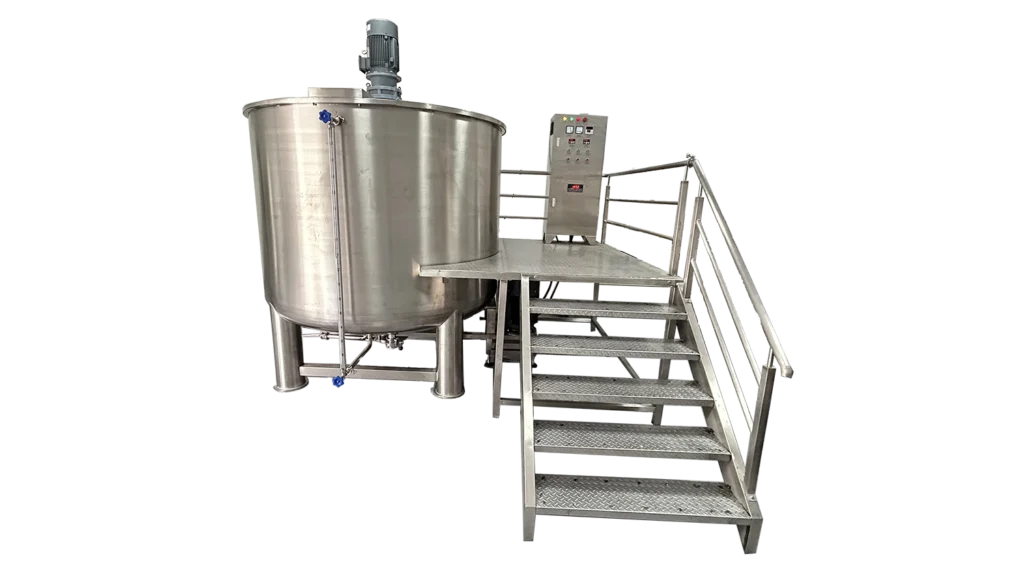
A tank with independent bulk agitation and a bottom homogenizer gives the operator two separate tools. Use bulk mixing to move the batch; use the homogenizer during stages that need local shear. The homogenizing mixing tank range shows this type of arrangement.
Ask for minimum and maximum working batches
A nominal 500 L tank is not a promise that every batch from a few liters to 500 L can be processed. The minimum batch must cover the necessary mixing and sensing components. The upper working level must leave room for charging, foam and any vacuum operation.
Give the supplier your normal batch, smallest regular batch and largest planned batch in kilograms. Include density so the corresponding volume can be calculated. Ask the supplier to mark the proposed working levels on the tank drawing.
For a non-heated route, the 500 L semi-open shampoo mixing machine is one equipment arrangement to assess. It combines bulk mixing with bottom homogenization. Its mechanical-seal cooling service is separate from product cooling; the single-layer vessel does not provide a heating or cooling jacket.
Prefer 316L product contact for a flexible shampoo line
For a line expected to make several salted shampoo formulas over many years, we would normally specify 316L for product-contact parts. It provides more corrosion resistance than 304 in many relevant conditions. Include the cleaning chemicals and temperatures in the material review.
Also inspect the welds, finish, gasket materials and drainability. A 316L nameplate cannot compensate for poor fabrication or product trapped behind a seal. Specify the product-contact construction separately from the outer cladding, frame and platform.
When Shampoo Manufacturing Needs High Shear, Heating or Vacuum
Use high shear to solve a defined incorporation problem
High-active surfactants can pass through difficult, viscous stages during dilution. A rotor-stator mixer can help with that task. Powder wetting and some polymer dispersions can also justify a dedicated high-shear stage.
Our recommendation is to use the required shear early, while the batch can circulate through the mixing zone, then reduce or stop it when the process calls for gentler blending. Running the homogenizer throughout the batch can add heat and draw in air if the liquid level or flow pattern is unsuitable.
Clear appearance does not rule out high shear. Equally, a pearlescent appearance does not prove it is needed. Follow the supplied ingredient and the incorporation task. For example, a cold-process pearl concentrate can remove the need to melt and crystallize pearlizing ingredients in the main tank.
Add heating and cooling for the actual process
Choose a jacket when the formula needs controlled warming, melting or cooling. A cold-process shampoo made from prepared ingredients may not need one. If the same tank will also make heated products, that shared duty can justify the extra equipment.
Specify both the target temperature and the time allowed to reach it. Cooling is often the overlooked part: a tank that heats adequately can still miss the next production slot while waiting to cool. Ask for the required utility temperatures, flow rates and connected load.
Electric heating is convenient where the available power supports the duty. Steam can suit larger or repeated heating loads where the factory has a suitable supply. Tank size alone is a poor cutoff between the two. Include installation and utility costs in the comparison.
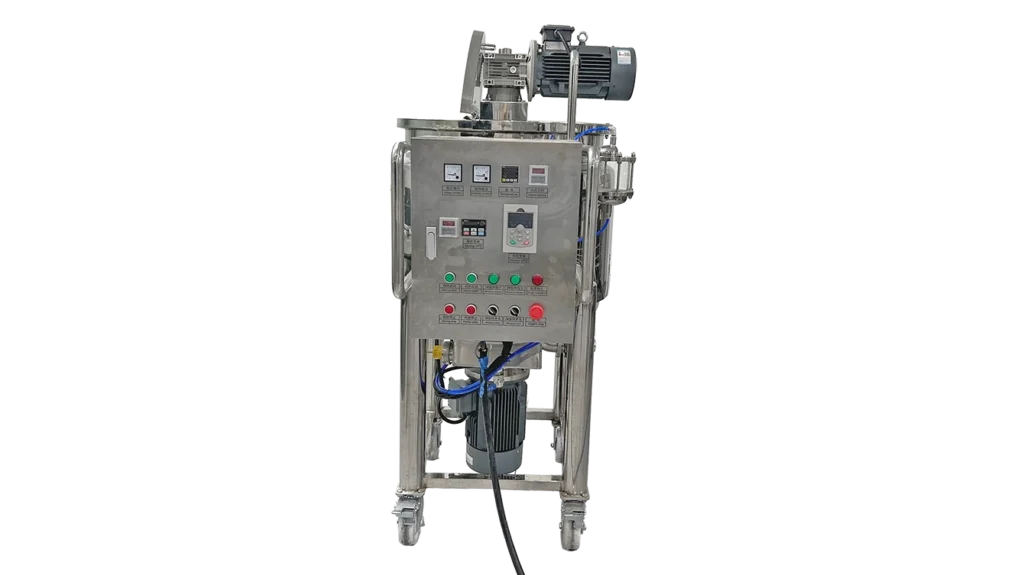
Buy vacuum when air removal is costing production time
For a small operation, first assess a covered holding tank if resting removes air within the available schedule. It can free the mixer for another batch and feed the filler without tying the two machines together.
Move vacuum higher on the purchasing list when persistent bubbles fail the appearance limit, interfere with consistent filling or occupy the mixer for too long. Compare the time saved with the added vessel, vacuum system, cleaning and maintenance costs.
Vacuum treatment still needs an operating method. Allow room for foam expansion and control the application of vacuum. Include product temperature and the stage of fragrance addition in the trial. A transparent bottle makes bubbles easier to see; it does not, by itself, establish that a vacuum emulsifier is required.
Transfer and Filling Equipment for Foaming Shampoo
Check the product after transfer as well as inside the mixer. A good batch can arrive at the filler with air introduced through an inlet leak, an emptying vessel or a poorly arranged return. Keep the transfer route short and size it for the actual product temperature and viscosity.
Shortlist the transfer pump from the finished shampoo
For viscous shampoo, we would usually compare a rotary lobe pump with a suitable screw pump first. Consider cleanability, inlet conditions, seal support, speed control and discharge pressure. Positive-displacement pumps need appropriate protection against a blocked discharge.
A centrifugal pump remains an option for a sufficiently mobile product at a suitable duty point. Do not reject it just because the product is shampoo, or select it from a water-flow rating for a much thicker product. Our process pump selection guide covers the wider selection method.
A filter also needs a purpose. If the process requires a finishing screen, define what it must remove and test its effect on flow and product appearance. Fine filtration is not a cure for incomplete mixing and may be unsuitable for products with intentional suspended material.

Choose the filler with the product and bottle together
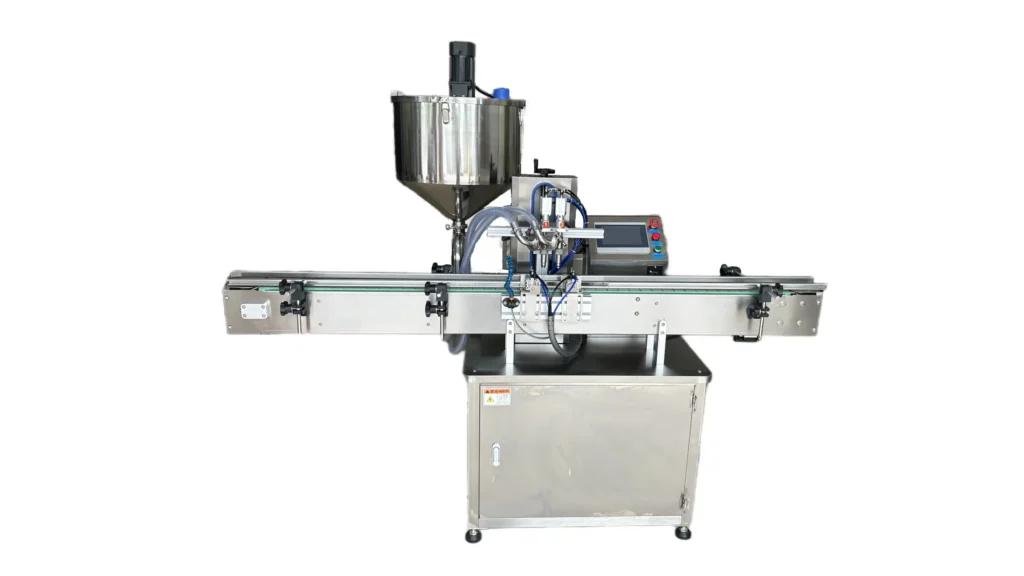
For small batches and frequent changes, a semi-automatic piston or pump filler is a practical starting point. For steady output, compare automatic systems using the actual shampoo, bottle neck and fill quantity. Pump type is only one part of the result.
Ask for adjustable filling speed, controlled nozzle movement where useful, and a clean cutoff. A bottom-up or diving nozzle can help reduce splashing and foaming in suitable packages. Stringing may require a different nozzle and cutoff setting rather than more pump power.
Test the final containers, including the smallest neck and the largest fill. Watch the bottle mouth after each fill. Product on the neck can complicate cap fitting, tightening and downstream handling even when the dose is correct.
The piston, gear pump and rotary lobe filling comparison compares the main dosing arrangements. For this project, select the machine that meets the agreed fill limits and useful output with acceptable foam, drips and changeover time.
Small Scale Shampoo Manufacturing Equipment: What to Add First
For a first small line, prioritize a suitable mixer, reliable weighing, simple transfer and a tested filler. Reserve space and connections for a holding tank. Add automation to the operation that actually limits daily output.
Start with separate mixing and filling schedules. Count charging, processing, waiting, discharge and cleaning in the mixer cycle. For filling, count bottle supply, cap handling, label changes and stops. A fast filler cannot recover time lost while the only mixer waits for a batch to release air.
| Observed delay | First improvement to assess | Why it comes first |
|---|---|---|
| Finished shampoo occupies the mixer while waiting for filling | A suitable holding vessel and transfer route | Releases the mixer for the next batch |
| Concentrate dilution or powder preparation dominates the cycle | A separate premix stage | Moves that work away from the main batch vessel |
| The batch is ready but bottle handling limits output | Improve feeding, filling or closing at the measured bottleneck | Turns available bulk product into saleable bottles sooner |
| Small orders need frequent fragrance or color changes | Better drainage, access and smaller batch capability | Reduces changeover burden and unnecessary leftover stock |
| Demand exceeds the proven mixing schedule | Compare another mixer with a larger mixer | A second vessel may provide better scheduling flexibility |
A simple capacity check before buying a larger mixer
Suppose the production target is 1,200 kg per shift and a trial supports 400 kg working batches. You need three accepted batches. Whether one mixer can supply them depends on its complete cycle and the time the last batch reaches filling.
Assume a measured product density of 1.04 kg/L. Each 400 kg batch occupies about 385 L. The selected vessel must support that working volume, its initial charge and the necessary headspace. This example does not establish that a nominal 400 L or 500 L tank is suitable.
These are planning assumptions, not a customer production result. Put the measured cycle into a shift schedule before ordering. The mixer capacity planning guide shows how to connect batch release times with filling demand.
Compare quotations around the same production job
Ask each supplier to identify what is included: mixer, platform, controls, transfer pump, hoses or pipework, holding vessels, filler and utilities. Separate optional items from the base scope. A cheaper tank quote may simply leave more work for the buyer.
We would keep speed control, accessible cleaning, suitable materials and dependable discharge in the first purchase. We would defer extra packaging automation when manual handling still meets the schedule. Avoid buying a much larger mixer solely for a future forecast; the smallest regular order still has to run well.
Cleaning and Changeover Belong in the Equipment Decision
Inspect the bottom outlet, valve seats, agitator attachments, seals and transfer route before approving the design. These areas determine how much shampoo remains and how easily the next batch can begin. A polished shell is only one part of the cleaning job.
For a small, accessible tank, a well-defined manual or assisted cleaning method may be practical. Frequent changes, enclosed circuits and higher daily use make CIP worth evaluating. A spray ball alone does not establish that the whole system can be cleaned in place.
Use the CIP system design guide when specifying the cleaning circuit. Include the transfer pump, hose connections and filler product path in the discussion. If some parts require removal, make that access straightforward and include it in the changeover time.
Choose a demanding product change for the trial, such as a strongly scented shampoo followed by a lightly scented one. Define the acceptance checks with the quality team. Visual inspection helps, but appearance alone cannot establish that all relevant residue has been removed.
What to Test Before Approving Shampoo Manufacturing Equipment
A water run can check operation, leaks and controls. For mixing and filling performance, use representative product. Agree the trial scope before purchase so both sides know which results the trial must demonstrate.
| Trial check | What to record | Decision it supports |
|---|---|---|
| Charging and incorporation | Addition time, lumps, foam and any manual intervention | Need for better charging access or premix equipment |
| Minimum batch and final viscosity | Circulation, component coverage and sample consistency | Usable working range and agitator suitability |
| Product condition | Appearance, pH and viscosity using agreed methods and temperature | Whether the process reaches the approved product targets |
| Discharge and transfer | Transfer time, retained product and air after pumping | Outlet, pump and pipework suitability |
| Filling | Fill results across heads, start-up, steady running and restart; foam and drips | Useful filling output and consistency |
| Cleaning and changeover | Time, access, disassembly and agreed residue checks | Labor demand and realistic batch scheduling |
Use the same viscosity test conditions when comparing batches. Record sample temperature, instrument settings and sample conditioning. Otherwise, a changed reading may reflect the measurement method rather than a mixing problem.
Write measurable acceptance limits into the trial plan: batch size, cycle time, product checks, fill limits and changeover requirements. Ordinary pre-shipment machine testing is the normal starting point. Where a formal FAT is required, StriversMachinery can agree and support a documented protocol with the customer.
What to Send for a Shampoo Equipment Proposal
Send the information below with the enquiry. It lets the supplier recommend a working arrangement and explain which options are worth including.
- Product types, ingredient forms and the approved process sequence
- Normal, minimum and maximum batches, plus product density
- Final viscosity with its measurement conditions and discharge temperature
- Required daily output, shift length and planned product changes
- Any heating, cooling, powder incorporation or air-removal stages
- Bottle samples, fill sizes, cap types and labeling requirements
- Water specification, available utilities, layout and access limits
- Cleaning method, trial requirements and budget priorities
Use our cosmetic equipment buying guide for the wider purchasing and handover checklist. For the shampoo line itself, our recommendation is straightforward: prove bulk mixing and filling first, then add the equipment that shortens a measured delay or completes a necessary process step.
StriversMachinery can propose the mixing equipment and coordinate the transfer, filling and auxiliary systems around that plan. Share your process sheet, batch targets and bottle samples to get a configuration with clear standard and optional items.