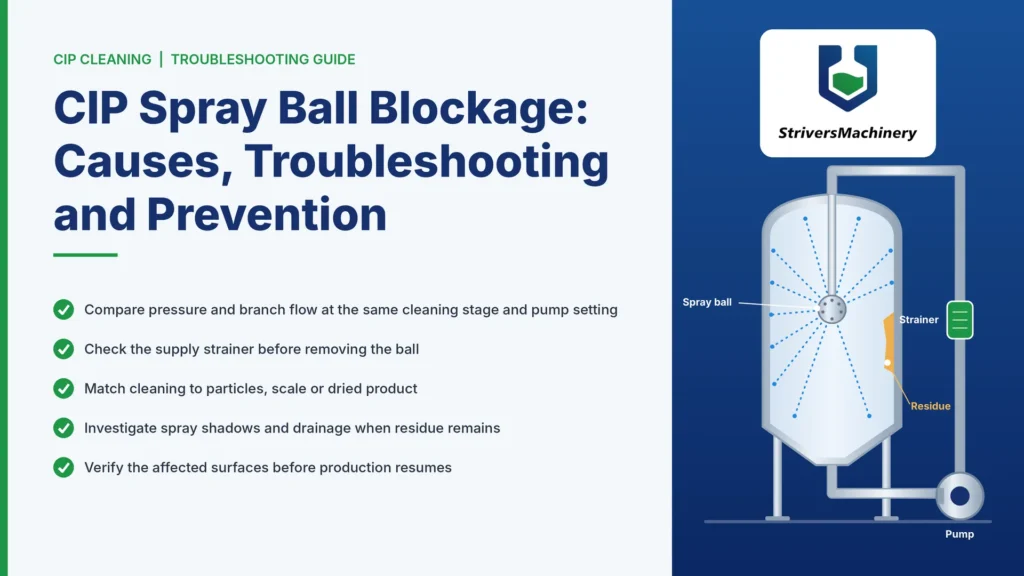
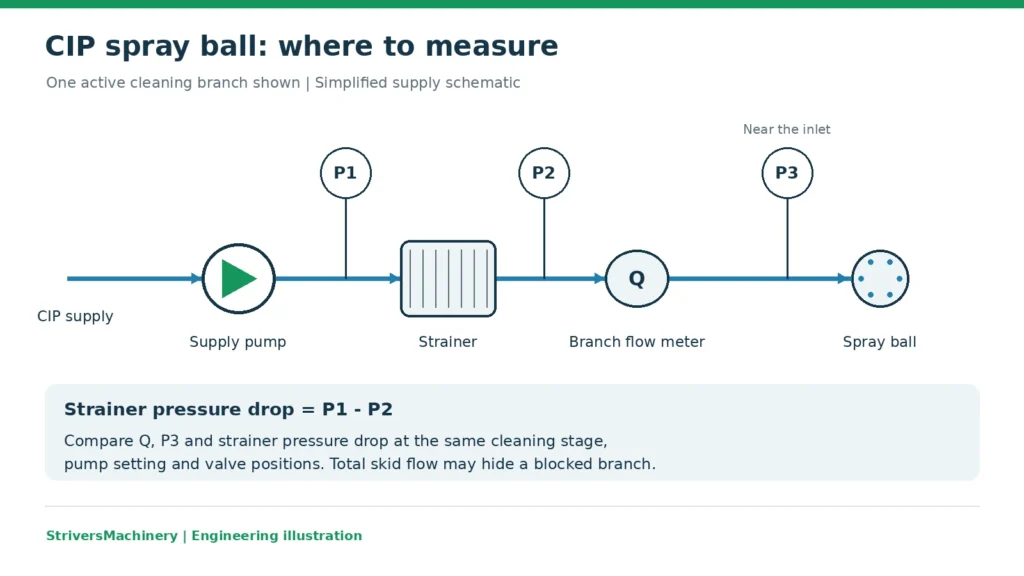
CIP spray ball blockage should be checked against the supply conditions before the ball is removed. Record pressure near the spray ball inlet, flow through the active cleaning branch and pressure drop across the supply strainer. Compare them with a clean-system baseline at the same cleaning stage, pump setting and valve positions. Then inspect the strainer, spray pattern and holes in that order.
Construction debris, dried product and mineral scale can obstruct the openings. A supply fault or a spray shadow can leave similar residue on the tank wall. Replacing the ball without separating those causes often leaves the original fault in place.
This article focuses on blockage diagnosis, cleaning and prevention. The CIP spray ball and manual cleaning guide explains what a spray device can clean and which tasks still require access or separate cleaning.
CIP Spray Ball Blockage: Symptoms Worth Checking
A clogged CIP spray ball may produce missing or uneven jets, reduced branch flow or a changed inlet-pressure reading. The production team may first notice a patch of cream on the tank wall, fragrance carryover or residue around an agitator fitting after the usual cycle.
Record where the residue remains and when the fault started. A problem appearing just after pipework repairs points toward debris. A gradual change through hot-water cleaning cycles calls for a scale inspection. Residue after a longer delay before cleaning suggests a product-hold-time problem. These observations direct the inspection; they do not establish the cause on their own.
Check whether the fault affects one vessel or several vessels served by the same skid. One affected branch suggests a local restriction or coverage problem. Several branches changing together makes the common supply, cleaning recipe and instruments worth checking first.
Read Pressure and Flow Before Diagnosing a Clogged CIP Spray Ball
Use the spray ball inlet pressure and the active branch flow
Pressure measured at the pump outlet includes the losses through the downstream pipework, valves and strainer. It does not tell you the pressure available at the spray ball. Use a suitable measurement point close to the device inlet and identify it on the circuit drawing.
For a shared supply, measure or establish flow through the affected branch. The skid’s total flow can remain acceptable while liquid takes an easier parallel route. Compare readings at the same recipe stage and temperature, with the same active branches and pump-control mode.
| Observation against a clean baseline | Possible cause | First action |
|---|---|---|
| Higher device inlet pressure and lower branch flow, with no evidence of strainer loading at comparable flow | Restriction at the device, including obstructed holes | Check the spray pattern and inspect the ball after isolation |
| Higher strainer pressure drop at comparable flow, with reduced downstream pressure | Loaded strainer | Inspect the basket and identify what it has collected |
| Low branch flow and low device inlet pressure | Inadequate supply, a restricted upstream route, leakage or air | Check pump conditions, valves, suction and the supply route |
| Unstable readings with pump noise | Air entry, inadequate inlet supply or cavitation | Check liquid level, inlet restrictions, air leaks and temperature |
| Expected overall readings but recurring local residue | Spray shadow, local blocked opening, drainage or cleaning-process problem | Inspect the affected location and verify the cleaning conditions |
The first pattern is typical of increased restriction with a centrifugal pump at unchanged speed. A constant-pressure controller may reduce flow while holding pressure steady. Other pump and control arrangements behave differently. Read the pump setting and instrument location before interpreting a trend.
For low supply pressure, review the pump selection principles for flow, pressure and inlet conditions before increasing motor power. A restricted suction line or inadequate inlet conditions will not be corrected by a larger drive.
Record a usable baseline for CIP spray ball troubleshooting
With a clean ball and strainer, record the device model, circuit, active branches, cleaning stage, liquid temperature, pump setting, branch flow, inlet pressure and strainer pressure drop. Note the gauge positions. Use the same conditions for later comparisons.
Where no baseline exists, start with the selected device’s pressure-flow data and a known-good device of the same specification. Check the instruments before treating a small deviation as equipment deterioration. Set site action limits from the required operating range and measurement capability, rather than adopting a generic percentage.
Common Causes of CIP Spray Ball Blockage
Construction debris and a loaded supply strainer
After installation or pipe repairs, look for metal particles, gasket fragments and other assembly debris. Flush the supply route before fitting the spray device, and inspect the strainer after the initial runs. Material generated downstream of the strainer can still reach the ball.
Choose filtration from the cleaning-head manufacturer’s requirements. Check the smallest passages, required screen opening, available filtration area and pressure loss at the operating flow. A finer screen with insufficient area can become the supply restriction itself.
Keep the collected debris for inspection. Metal fragments suggest a different corrective action from soft product residue or mineral flakes. Cleaning the basket without finding the source may restore flow only briefly.
Mineral scale inside the spray holes
Hot water containing scale-forming minerals can leave deposits on the ball and inside its openings. Inspect for a gradual narrowing of holes, particularly when water quality or the hot cleaning stages have changed. Review the incoming water analysis and the cleaning chemistry together.
The cosmetic water treatment selection guide helps separate softening, RO and other treatment duties. Select the water used for each cleaning stage from the actual specification. Changing only the final-rinse water will not remove deposits already formed during earlier hot stages.
Dried cream, wax and gel residues
Splash and foam can carry product onto a ball mounted in the vessel headspace. Cream can dry around a hole edge; wax-containing residue can set as the tank cools; shampoo and gel can leave a persistent film. Inspect the inside as well as the outside of the ball.
Set the permitted delay between emptying the vessel and starting cleaning around the product residue. Select the pre-rinse temperature by trial with that soil. Wax-containing products may need a different approach from protein-containing food residues, which can become harder to remove after inappropriate heating.
Corrosion, damaged openings and the wrong replacement
Pitted surfaces, enlarged holes and dents affect cleanability or spray distribution. Inspect a replacement against the original model and duty, including its hole arrangement, connection and mounting position. A ball that fits the socket can still have the wrong flow demand or coverage pattern.
How Blocked Holes and Scale Reduce Open Area
Illustrative geometry: a ball with 24 equal holes has 25% less open area when six holes are fully blocked. If scale reduces every hole diameter to 80% of its original value, each hole retains 0.80², or 64%, of its original area. That is a 36% area reduction.
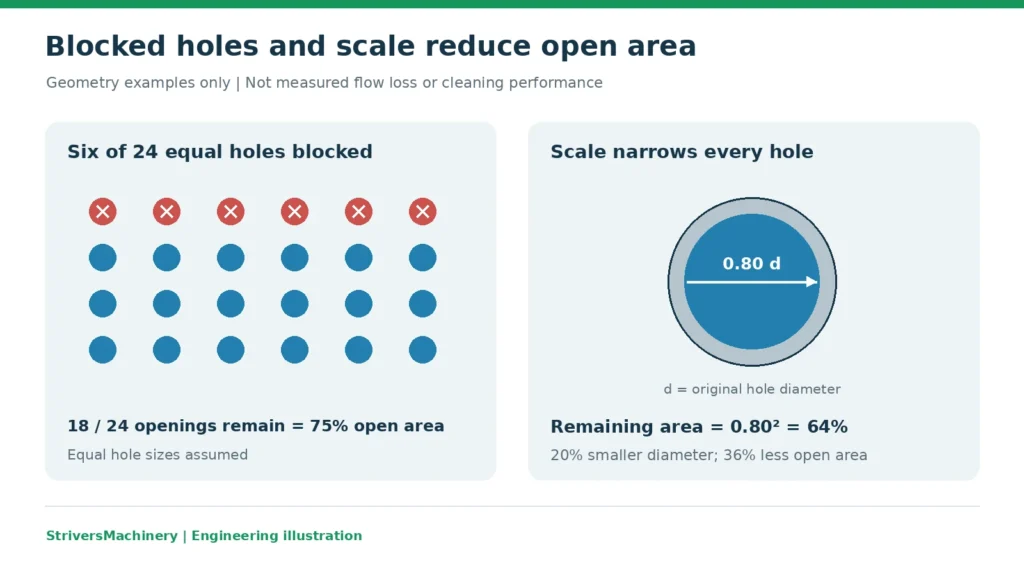
These percentages describe opening area, not measured system flow loss or cleaning performance. Flow through an opening also depends on the pressure difference and discharge characteristics. On a running circuit, the pump curve and control system affect the new operating point. A local blocked opening may leave a poorly wetted area even when total flow has changed very little.
Poor Tank Cleaning Without a Spray Ball Blockage
Check cleaning time, temperature and chemical concentration alongside liquid delivery. A clear spray ball cannot compensate for the wrong detergent or an exposure timer that starts before the required conditions are reached.
- Spray shadows: blades, baffles, shafts and fittings obstruct the liquid path
- Inadequate device duty: flow or inlet pressure falls outside the selected head’s operating range
- Poor drainage: liquid accumulates because the outlet or return route cannot handle the supply
- Incorrect installation: the device has the wrong position, orientation or connection arrangement
- Unreached product paths: valve cavities, branches or discharge components are outside the cleaning route
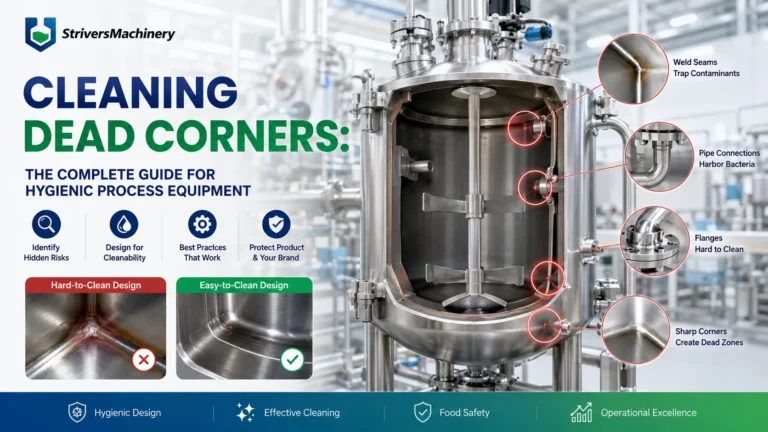
For residue that repeatedly remains behind the same fitting, use the guide to cleaning dead corners and spray shadows to distinguish a spray shadow from a trapped pocket or an unsuitable component. Cleaning the ball will not change an inaccessible surface.
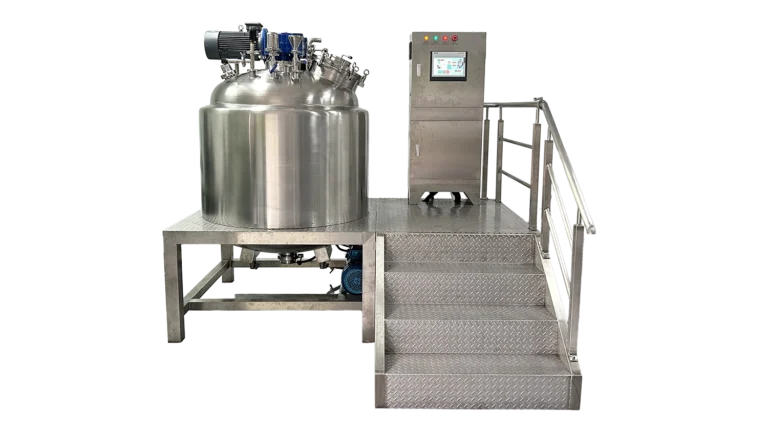
If several problems occur together, review the complete circuit using the CIP system design guide. Include the return route, branch distribution and equipment that still needs manual cleaning. Tank volume alone is not a spray-flow specification.
Blocked CIP Spray Ball Troubleshooting: A Practical Sequence
Before opening a strainer or removing a cleaning device, stop and isolate the circuit, prevent restart, relieve pressure and make the liquid safe to handle. Confirm safe temperature and chemical conditions under the site’s procedure. Observe a running spray only through a suitable closed viewing arrangement; keep the manway closed.
- Record the fault before changing settings. Note the affected tank, residue location, product, last successful cycle and recent maintenance. Capture the relevant pressure, flow and control settings.
- Check the supply strainer. After isolation, inspect the basket, its seating and its condition. Identify the material it caught. Check the downstream route after any recent repair.
- Restore the normal supply conditions. Correct valve routing, liquid level, inlet supply or air entry as indicated. Do not increase pump speed to hide an unidentified restriction.
- Inspect the spray pattern. Use an approved water test and suitable viewing arrangement. Look for missing jets or a device that has stopped rotating. If observation is not possible, proceed with isolated removal.
- Remove and identify the deposit. Examine the holes, interior and connection. Separate loose particles, dried product, scale and physical damage before choosing the cleaning method.
- Clean or replace, then verify. Reassemble correctly, check supply conditions and the affected surfaces, and complete the required cleaning and release checks.
Static spray ball versus rotary cleaning head
| Device | Inspect | Important distinction |
|---|---|---|
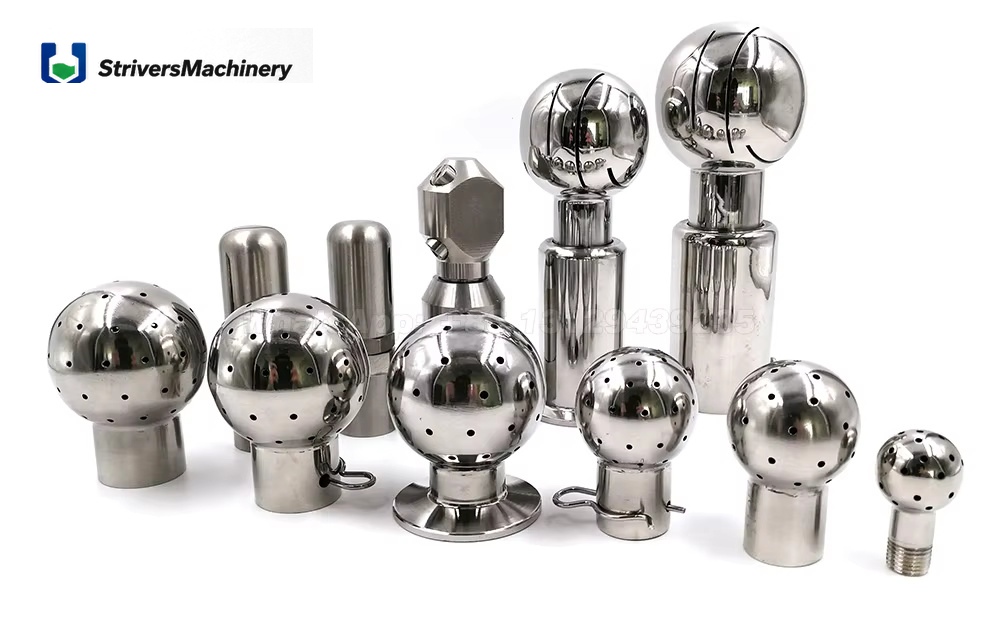
| Static spray ball | Fixed holes, interior, connection and orientation | There is no rotation mechanism to test |
| Rotary spray head | Spray openings, supply duty and model-specific moving parts | Low supply can stop or alter rotation without a broken part |
| Geared rotary jet head | Nozzles, specified cycle, drive and service parts | Do not force rotation by hand; follow the model’s service instructions |
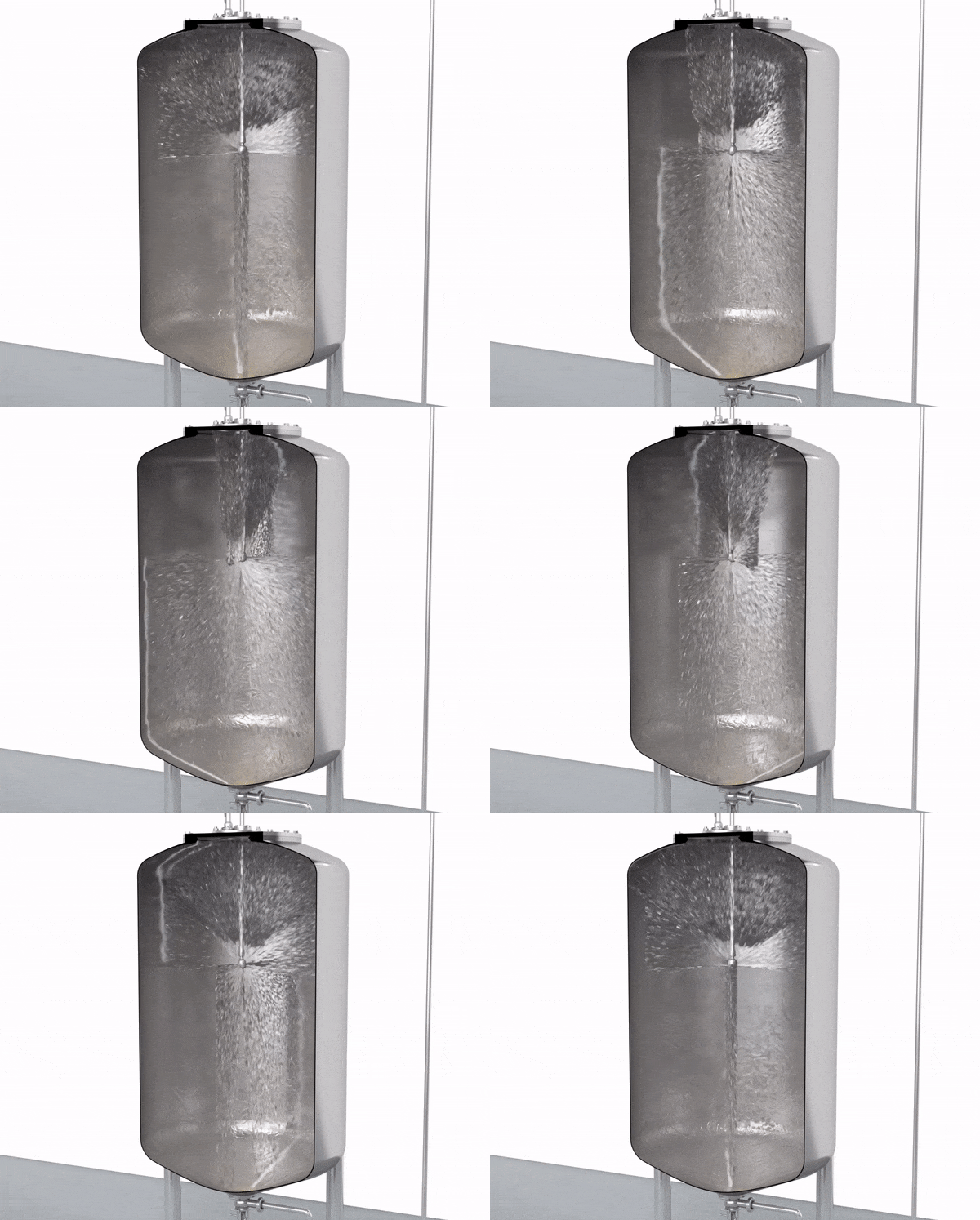
A rotary head turning in a water test does not establish cleaning effectiveness. Its operating conditions, coverage and required pattern time still need to suit the vessel. Keep rotating-head service work separate from the simpler inspection of a static ball.
CIP Spray Ball Cleaning: Match the Method to the Deposit
For a suspected blocked ball, removal gives access to inspect the openings and interior. Clean the removed component offline where its condition can be checked. Use a method compatible with the installed metal, seals and deposit.
| Deposit | Cleaning approach | What to avoid |
|---|---|---|
| Loose particles | Flush through the component; use a soft non-metallic brush on accessible surfaces | Forcing hard particles deeper into small passages |
| Dried cream, shampoo or gel | Soak with a compatible detergent under conditions suited to the product; flush and inspect | Scraping the hole edges or assuming water alone will remove every film |
| Wax-containing residue | Use a detergent and temperature selected for the actual residue and component limits | Applying one universal hot-rinse temperature |
| Mineral scale | Use an approved descaling treatment with specified concentration, temperature and contact time | Unapproved acids, uncontrolled soaking or mixing incompatible chemicals |
Do not drill out the holes or force metal wire through them. Enlarged openings and burrs can change the device’s performance and retain soil. Persistent obstruction calls for further inspection or replacement, rather than machining a new flow path.
An ultrasonic bath may help with suitable removable components when the manufacturer permits it. Rotating assemblies and their seals may need different handling from a one-piece static ball. After cleaning, rinse away the cleaning agent and inspect for remaining deposits, damage and trapped particles.
Verify the cleaning result before returning the tank to production
Reinstall with the correct orientation, seal and fastening method. Run the defined test or cleaning cycle and compare branch flow, device inlet pressure and strainer pressure drop under the baseline conditions. Reinspect the original residue location.
A restored water pattern is a functional check. Release the equipment using the site’s cleaning acceptance procedure, including residue or microbiological checks where required. Record what was found, what was changed and the result. Add this work to the tank’s maintenance record; the vacuum emulsifying mixer troubleshooting and maintenance guide shows how to connect cleaning inspections, disturbed seals and reassembly checks with the wider equipment history.
Clean or Replace a Clogged CIP Spray Ball?
| Finding | Decision |
|---|---|
| Removable deposits; undamaged openings; acceptable checks after cleaning | Clean and return to service through the release procedure |
| Deformed or enlarged holes, significant corrosion, cracks or damaged connection | Replace with a suitable matching component |
| Serviceable rotating component with a diagnosed worn part | Use the specified service kit or manufacturer repair route |
| Same opening or location repeatedly fouls | Investigate deposit source, position, water and cleaning delay; replace only if condition warrants it |
| Flow or coverage remains unsuitable after cleaning | Check model, installation and supply; replace a defective device or correct the design mismatch |
For a critical tank, keep a matching spare with its model and operating data. A swap allows the removed component to be inspected offline. Complete installation and cleaning checks before production resumes. Repeated blockage is a reason to fix the source, not a reason to consume a succession of new balls.
Prevent CIP Spray Ball Blockage Through the Maintenance Record
Begin with the last confirmed cause. Debris after pipework repairs needs flushing and installation control. Mineral deposits need a review of water and cleaning conditions. Product films need attention to splash exposure, cleaning delay and the first rinse. Each requires a different action.
Review pressure and flow trends during each cycle where instrumentation is available. Set physical inspection intervals from the cleaning-head instructions, product behavior and findings. Shorten the interval when deposits recur; extend it only when the records support the change. Record the strainer condition with the ball inspection so the two are not treated as separate faults.
If blockage keeps returning, send StriversMachinery the device model, tank dimensions and internal arrangement, product type, residue photographs, cleaning recipe, pump-control mode and pressure/flow readings with their measurement locations. Include the time between emptying and cleaning. Those details let us discuss the next inspection and any equipment changes around an identified problem.