

5L Lab Circulation Vacuum Emulsifier for Cosmetic & Ointment R&D
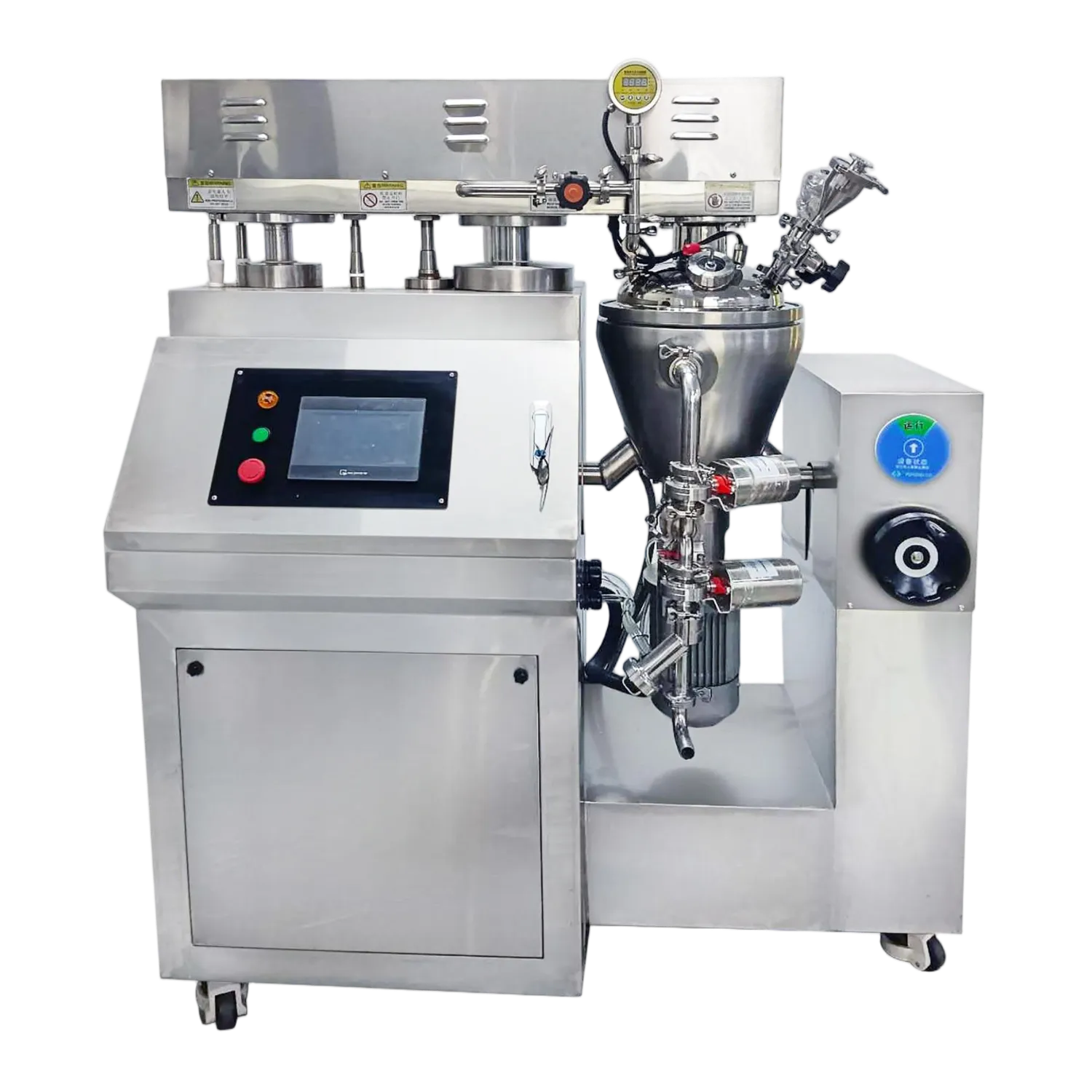
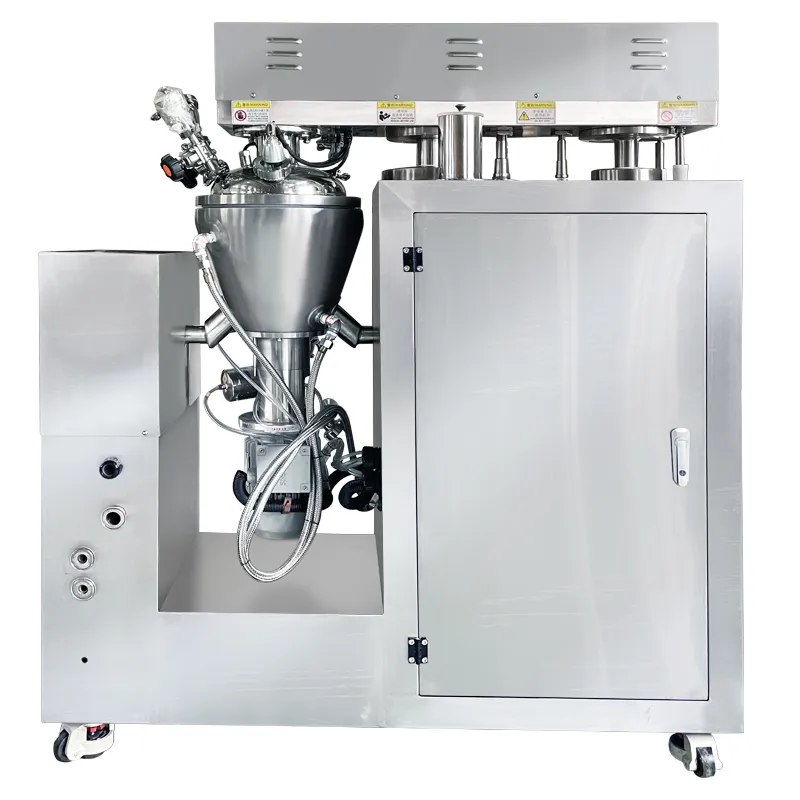
The 5L lab circulation vacuum emulsifier is a standalone development system for cosmetic creams, lotions, and ointment formulations. A jacketed vessel combines gate agitation, PTFE wall scraping, bottom-entry high-shear homogenization, and vacuum processing. Siemens PLC and HMI controls provide the operating interface, while the 5L working capacity supports small-batch formulation trials before further pilot or production evaluation.
With pneumatic valve, automatic control
| Total Capacity (L) | 6 | Discharge Method | Electric/Manual Tilting Discharge / Bottom Valve Discharge (Optional Air Pressure Assist) / External Pump Transfer System |
| Working Capacity (L) | 5 | Discharge Valves | Pneumatic Ball Valve |
| Min Batch Size (L) | 1 | Lid Lifting System | Hydraulic Lifting System (Automatic) |
| Structure Type | Triple Layer (with Jacket & Insulation) | Mechanical Seal Brand | Single Mechanical Seal (John Crane/EagleBurgmann Optional) / Double Mechanical Seal (EagleBurgmann) |
| Contact Material | SUS316L Stainless Steel | Tilting System | Electric Tilting |
| Non-contact Material | SUS304 Stainless Steel | Types of Upper Heads | Hydraulic Lifting Head |
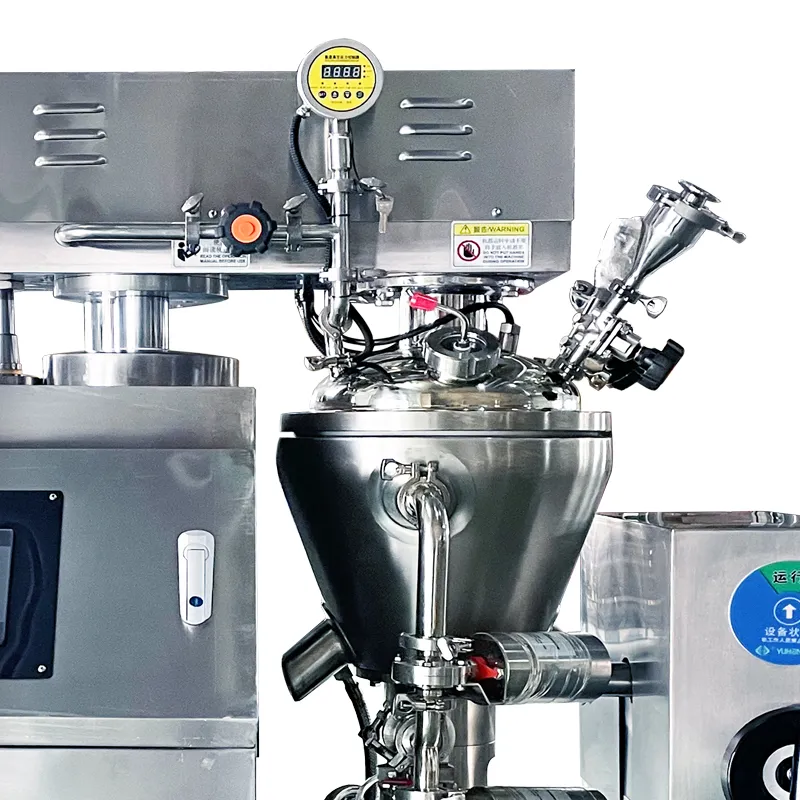
| Surface Finish | Interior Mirror Polish (Ra ≤ 0.4 μm) & Exterior Satin/Matte Finish | Top Openings & Accessories | Vacuum Port / Vacuum Feeding Port / Powder Feeding Port / Liquid Inlet / Fragrance Addition Port / Manway / Sight Glass with Wiper / LED Inspection Light / CIP Spray Ball / Vent Filter / Vacuum Gauge / Pressure Sensor / Compressed Air Inlet |
| Jacket Design Pressure (MPa) | 0.3 | Motor Brand | SEW / ABB / Siemens / Top-Tier Chinese Brands (Optional) |
| Main Tank Mixer Type | Gate Agitator + Single/Dual Fixed Paddles | vem_electrical_components | Schneider / Siemens / Omron (Optional/Customizable) |
| Mixing Speed (rpm) | 0–63 rpm | Oil & Water Pot | Standalone Main Unit Only |
| Mixing Motor Power (kW) | 0.55 | Fully Raised Height (mm) | 1680 |
| Frequency Control | Variable Speed with VFD (Delta, Siemens, ABB, Schneider, Optional) | Explosion Proof | Standard Non-Explosion Proof (For Regular Cosmetics) |
| Scraper System | Wall-Scraping PTFE Scrapers | Voltage | Configurable to local grid (110V–480V, 50/60Hz, Single or 3-Phase) |
| Homogenizer Position | Bottom-entry Homogenizer | Total Power (kW) | 2.5 |
| Homogenizer Type | High Shear Stator-Rotor Homogenizer | Air Pressure | 0.4–0.8 MPa |
| Homogenizer Power (kW) | 1.5 | Drive Type | Electro-Pneumatic Combined |
| Homogenizer Speed (rpm) | 0–3000 rpm (Variable Speed) | Installation Type | Floor-Standing |
| Max Processing Viscosity (mPa·s / cP) | 50,000 | Automation Level | Fully Automatic |
| Heating Method | Electric Heating via Jacket / External Steam Heating (Optional) | Control System | PLC + HMI Touch Screen Control |
| Cooling System | Tap Water / Cooling Tower Circulation (Chilled Water / Glycol Circulation Optional) | PLC System | Siemens |
| Water Chiller | External Water Chiller Unit (Optional) | HMI / Touch Screen | Siemens |
| Temperature Control Accuracy | ±1°C | Machine Dimensions(L*W*H)mm | 1270*680*1180 |
| Vacuum Degree (MPa) | -0.09 | Machine Weight (kg) | 400 |
| Vacuum Pump Brand | High-quality domestic/joint venture brands | ||
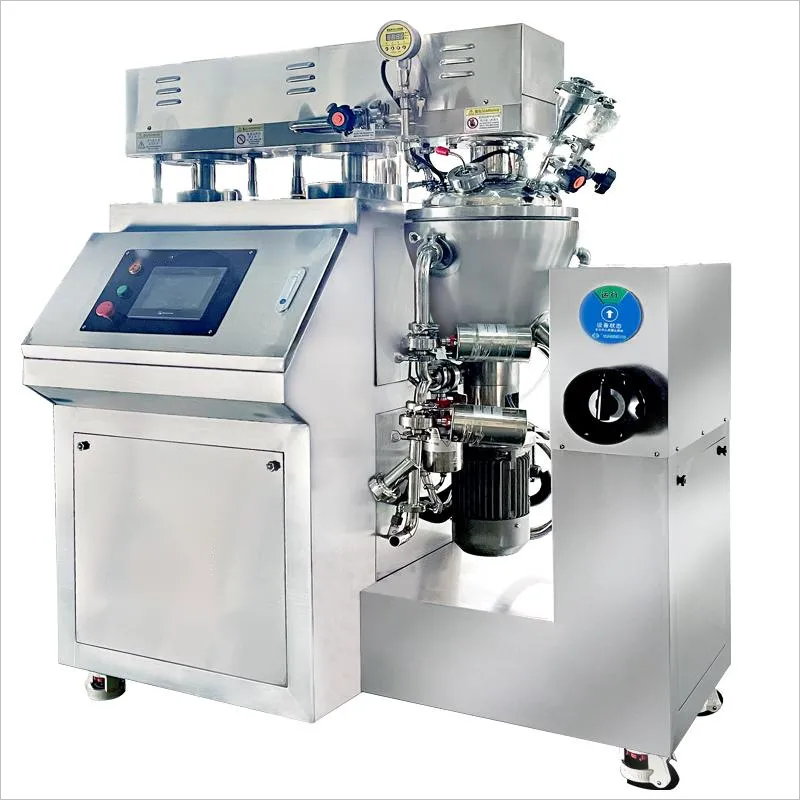
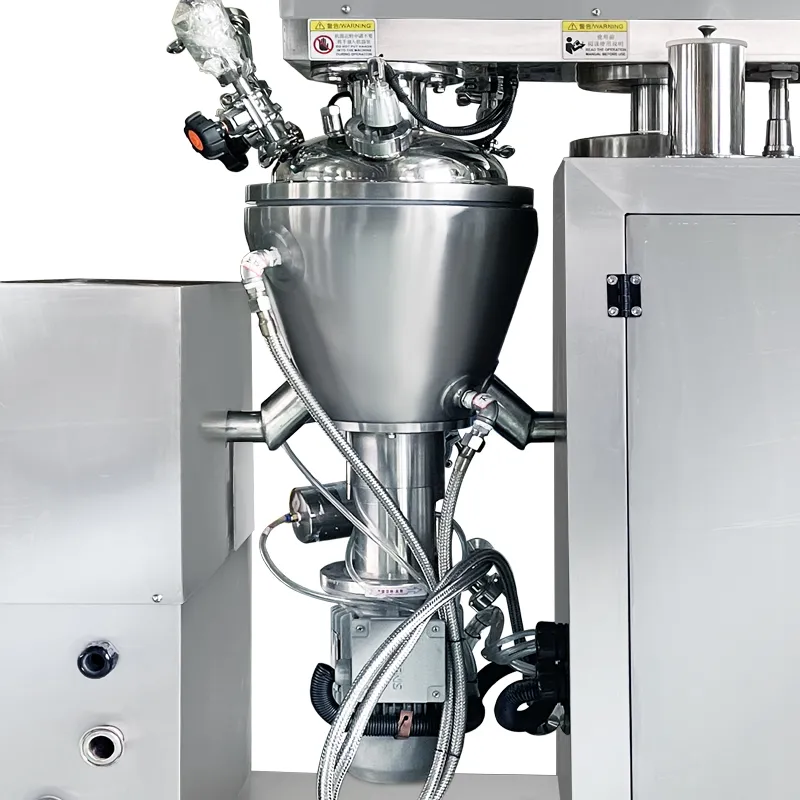
Product Gallery
Product Video
Product Overview
This laboratory model is intended for formulation development and process evaluation rather than routine 100L production. Its value lies in allowing a development team to examine how a small batch responds to ingredient addition, agitation, homogenization, thermal processing, and vacuum.
The main vessel has a 6L total capacity and a specified 5L working capacity. The listed minimum batch is 1L. Trials near that minimum require particular attention to product engagement and material retained outside the vessel, including any configured circulation path.
The supplied arrangement is a standalone main unit without integrated oil and water preparation pots. Formulations requiring separate phases therefore need an appropriate external preparation method.
A gate agitator with the selected fixed-paddle arrangement provides bulk mixing, while PTFE scrapers act along the wall. The bottom-entry rotor-stator homogenizer provides a separate high-shear function. Hydraulic head lifting and electric tilting support access and product handling.
Siemens PLC and HMI controls are specified. Recipe storage, automatic dosing, electronic records, and remote connectivity are not established by the supplied data.
The standard version is non-explosion-proof. Ointment R&D suitability does not establish sterile processing, pharmaceutical qualification, or regulatory approval.
Machine Configuration
The system consists of a standalone main vessel, hydraulic head-lifting assembly, electric tilting mechanism, vacuum system, and Siemens PLC/HMI controls. Separate oil and water preparation pots are not included.
The triple-layer vessel uses SUS316L product-contact construction, a thermal jacket, and insulation. Inside, the gate agitator operates with a single- or dual-fixed-paddle arrangement and PTFE wall scrapers. A separately driven bottom-entry rotor-stator homogenizer supplies high shear.
Electric jacket heating is specified, with external steam heating listed as an option. Cooling requires a suitable external supply. A pneumatic ball valve is specified for discharge, making compressed air part of the installation requirements.
The final technical drawing should define the circulation arrangement, valve routing, sampling provisions, and any removable connections. Motor, drive, electrical, and mechanical-seal alternatives must be resolved into an identifiable delivered configuration.
Key Features
Standalone main unit provides a dedicated platform for small-batch formulation development
Five-liter working capacity supports laboratory evaluation before larger-scale equipment trials
Gate agitation and fixed paddles provide the specified bulk mixing arrangement
PTFE wall scrapers sweep product along the vessel’s internal wall
Bottom-entry rotor-stator homogenizer provides an independently driven high-shear function
Variable-speed drives allow agitation and homogenization settings to be adjusted
Jacket heating and external circulation cooling support formulation temperature studies
Vacuum processing supports air removal where appropriate for the formulation
Hydraulic head lifting provides access for inspection, cleaning, and maintenance
Siemens PLC and HMI provide the specified machine control platform
Applications
- Cosmetic Cream & Lotion, and Skin Care
- Detergents, Liquid Washing & Household Cleaning
- Laboratory Mixing & Emulsifying Equipment
- Pharmaceutical & Ointment Products
- Sauce, Condiment & Food Paste
- Toothpaste & Oral Care Products
Recommended Machines


Working Principle
The development team first defines the trial objective, formulation, batch quantity, and processing sequence. Where separate oil and water phases are required, they are prepared outside the machine because this model does not include integrated preparation pots.
Ingredients enter the main vessel through the appropriate charging arrangement. Gate agitation moves the bulk product around the selected fixed paddles, while PTFE scrapers sweep the vessel wall. Jacket heating or cooling is applied according to the formulation.
The bottom-entry rotor-stator homogenizer provides high shear during the selected processing stage. For circulation trials, the actual flow route and valve arrangement must follow the delivered technical documentation. Homogenizer speed alone does not establish circulation flow or the number of effective passes.
Vacuum may be applied at an appropriate stage to support air removal. Its use must account for foaming, volatile ingredients, product temperature, and available headspace.
The Siemens HMI provides access to the supplied operating functions. The exact automatic sequence and operator interventions should be established in the control-function specification.
After processing, the team samples and discharges the batch using the approved arrangement. Product recovered from the vessel, circulation path, and transfer components should be accounted for when evaluating trial yield and planning cleaning.
Optional Upgrades & Configurations
| Warranty | 24 Months | Payment Terms | 40% T/T Deposit, 60% Balance Before Shipment (Alibaba Trade Assurance Available) |
| Lead Time | 15–20 Working Days | Packaging | Standard Export Fumigation-Free Wooden Case |
After-Sales & Technical Support
🔧 Common Problems
Potential symptoms during development include ingredients remaining unincorporated, uneven bulk movement at a small batch volume, persistent bubbles, unexpected viscosity changes, temperature readings departing from the trial plan, and inconsistent recovered sample quantities. Operators may also observe irregular circulation behavior where that function is installed, interrupted discharge, product remaining in connections, or unusual noise or leakage. Differences between samples can also appear when the recorded formulation is unchanged. These are observation topics rather than documented faults of this machine. Record the trial stage, actual batch quantity, settings, and sample timing before drawing conclusions. A disappointing sample should not automatically be attributed to insufficient homogenizer speed or treated as proof that the formulation cannot be scaled.
🛠 Troubleshooting
Problem: A small batch does not circulate or mix consistently Possible Cause: The batch quantity, product behavior, or configured flow route is unsuitable for the selected operating conditions Recommended Solution: Review the approved minimum-volume conditions and circulation arrangement before changing speed or adding materialProblem: Recovered sample quantity varies between trials Possible Cause: Sampling quantities, retained product, or discharge methods differ Recommended Solution: Compare charged, sampled, recovered, and retained quantities using a consistent trial recordProblem: Similar formulations produce different results Possible Cause: Phase preparation, ingredient order, thermal history, or operating settings differ Recommended Solution: Compare the complete trial records before attributing the difference to the formulationProblem: Vacuum processing produces excessive foaming Possible Cause: The formulation, temperature, batch level, or vacuum application method is unsuitable Recommended Solution: Follow the approved process response and review the operating conditions without exceeding vessel limitsProblem: Pneumatic discharge does not operate as expected Possible Cause: Air supply, valve condition, or a required control condition needs inspection Recommended Solution: Check the supplied operating instructions and arrange qualified inspection with the system isolated and depressurized
🧼 Cleaning Method
Confirm the trial-specific cleaning method|Select an approved procedure compatible with the formulation and installed materialsRecover the required samples|Complete sampling before introducing cleaning mediaDischarge remaining material|Use the approved vessel and circulation-emptying arrangementMake the equipment safe|Establish the required isolation, temperature, and pressure conditionsRemove accessible residue|Use approved tools without damaging polished surfaces or scraper componentsClean the main vessel|Follow the specified cleaning conditions and spray-ball supply arrangementClean the circulation path|Use the method defined for the actual installed route and its componentsClean separately accessed parts|Follow instructions for the homogenizer, seal areas, valves, ports, and removable connectionsComplete final cleaning stages|Perform rinsing and any required sanitization under the approved procedureInspect and document release|Check cleanliness, drainage, reassembly, and readiness for the next formulation
📋 Maintenance
Isolate relevant energy sources|Secure electrical, pneumatic, hydraulic, thermal, vacuum, and other applicable sourcesConfirm safe access conditions|Verify temperature and pressure before opening or servicing the systemInspect the agitator and fixed paddles|Check accessible components according to the maintenance instructionsInspect PTFE scrapers|Check for wear, damage, attachment condition, and residueInspect the homogenizer and seal|Follow the procedure for the installed rotor-stator and mechanical-seal configurationInspect circulation components|Check the actual supplied connections, valves, and product-contact componentsInspect the pneumatic discharge valve|Service it only under the specified isolation and depressurization conditionsInspect lifting and tilting assemblies|Arrange qualified checks of moving components and hydraulic connectionsCheck instruments and controls|Follow the supplier’s verification and calibration requirements where applicableRecord and verify maintenance|Document service work and complete the required checks before the next trial
⚙️ Installation
Verify the delivered configuration|Check vessel capacities, controls, circulation components, valve arrangement, and accessories against the orderPosition the machine|Use the approved floor layout and support requirements for the installed systemConfirm the lifting envelope|Check full head travel and required additional clearanceArrange external preparation equipment|Provide suitable positions for phase preparation, weighing, and sample handlingConnect the electrical supply|Use qualified personnel and the confirmed connected load and electrical documentationConnect compressed air|Provide the specified pressure and the air quality and connections required by the delivered equipmentConnect thermal and seal-support services|Install the selected heating, cooling, and mechanical-seal support connectionsVerify the circulation route|Check the actual connections and valve arrangement against the approved drawingComplete commissioning checks|Follow the supplier’s procedure for controls, protective functions, lifting, mixing, vacuum, and dischargeTrial the development workflow|Demonstrate the agreed batch range, sample recovery, and operating functions using representative material
🔩 Spare Parts
Why Choose This Machine
– Focuses equipment use on development questions. The small working volume allows trials to investigate formulation and processing choices before committing to larger batches.
– Combines several process variables in one vessel. Agitation, high shear, temperature, and vacuum can be evaluated within the supplied operating capabilities.
– Separates bulk mixing from homogenization. Independently driven functions allow their operating settings to be considered separately during trial design.
– Supports documented trial methods. The PLC/HMI interface provides a defined operating platform around which the team can record settings and observations.
– Allows external phase-preparation flexibility. The standalone arrangement can be paired with suitable laboratory preparation equipment rather than assuming a fixed auxiliary-pot configuration.
– Provides open-head access. Hydraulic lifting supports inspection of product-contact areas between trials, subject to the operating instructions.
– Creates a basis for scale-up discussion. Trial observations can help identify the requirements that a pilot or production system must address.
A successful laboratory batch does not guarantee equivalent results after scale-up. Product quality, repeatability, recovery, and processing time require evaluation under the relevant conditions.
Frequently Asked Questions
Installation Requirements
Plan space for external phase preparation, ingredient weighing, sample handling, and collection of discharged material. These activities are outside the standalone main unit’s footprint.
Confirm the delivered electrical rating and complete connected load before supply sizing. The listed 2.5 kW total power requires clarification regarding heating and auxiliary equipment.
Provide compressed air within the specified 0.4–0.8 MPa range for the pneumatic functions. Air consumption has not been supplied. Connect the selected cooling source and any mechanical-seal support services according to the final configuration.
The standard machine is non-explosion-proof. Its location and intended ingredients must be assessed accordingly.
Related Articles


Technical Buyer's Handbook & Deep Insight
Ready to Get a Quote?
Contact our team directly for pricing, customization options, and delivery timelines.
💬 WhatsApp Us NowGet Your Download Link
Please fill in your details and we'll send the download link to your email.