
200L Mobile Electric Heating Homogenizing Mixing Tank with High Shear Mixer for Cosmetics, Cream, Lotion, Shampoo and Liquid Products
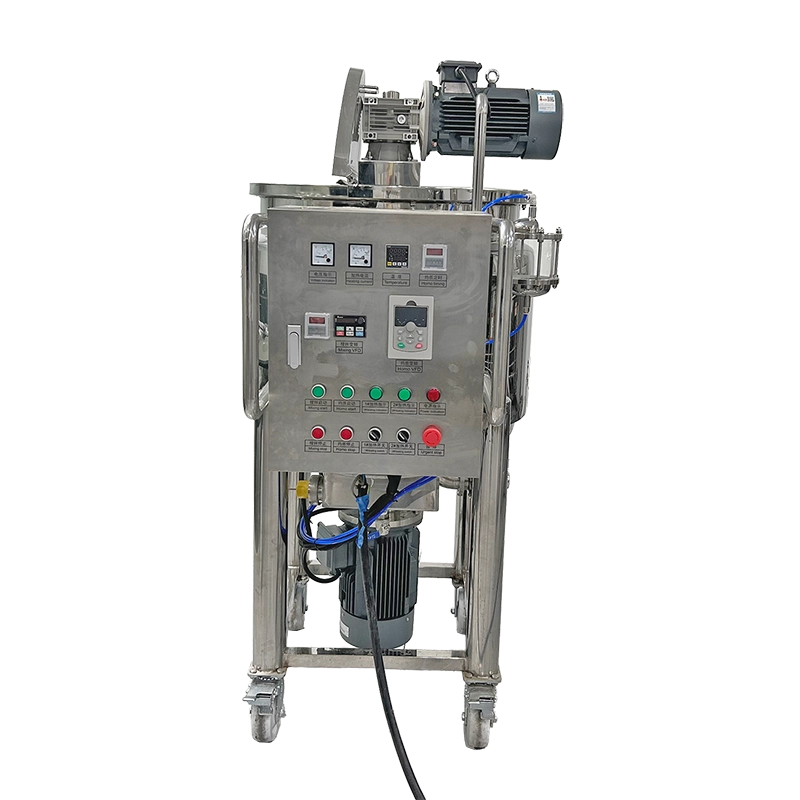
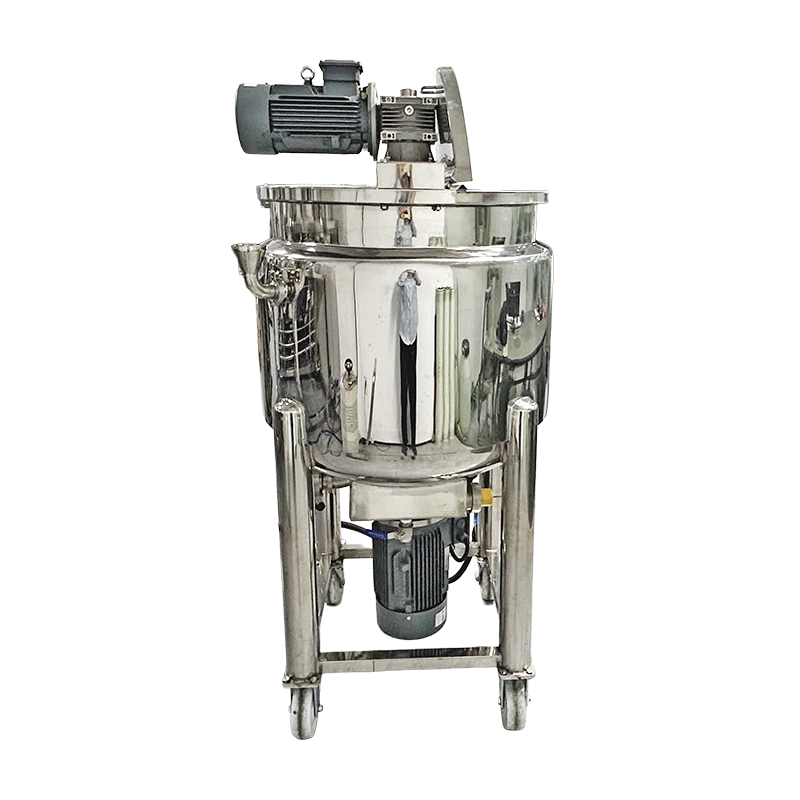
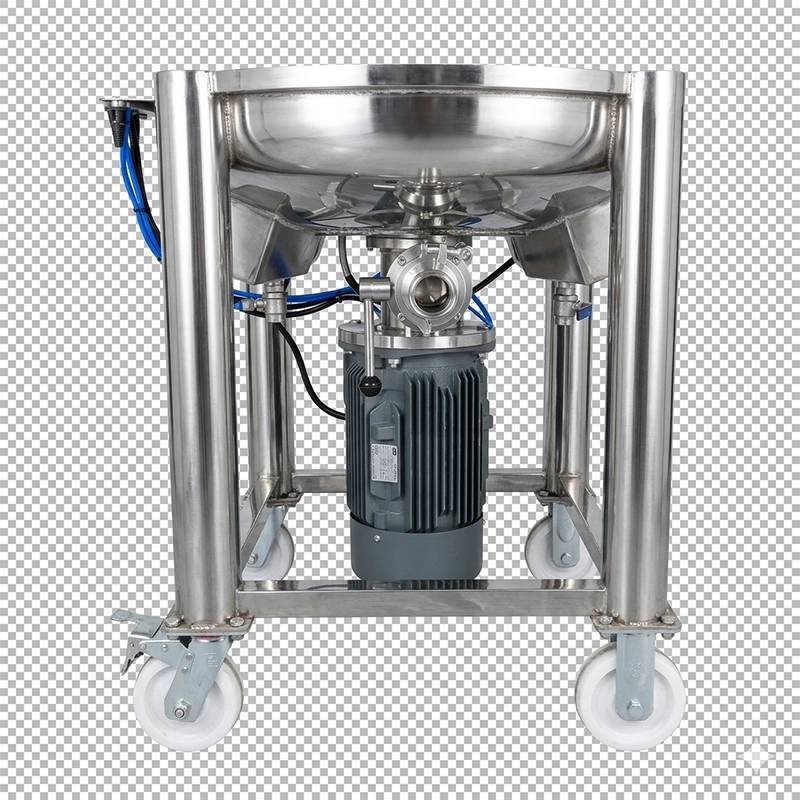
The 200L mobile homogenizing mixing tank combines electric jacket heating, frame agitation, PTFE wall scraping, and bottom-entry high shear for compatible cosmetic and liquid formulations. Its caster-mounted arrangement supports planned repositioning under approved handling conditions. As part of the Homogenizing Mixing Tanks range, this model provides an atmospheric batch-preparation platform where both bulk movement and localized homogenization are required.
| Tank Structure | Triple Layer (with Jacket & Insulation) | Rotor Stator Type | Single-Stage Rotor Stator |
| mix_installation_type | Mobile / Movable (with Wheels) | Disperser Speed | Without High Speed Disperser |
| Contact Material | SUS316L Stainless Steel | Disc Type | Without Disperser Disc |
| Outer Material | SUS304 Stainless Steel | Lifting Method | Fixed Type (Non-Lifting) |
| Surface Finish | Inside Mirror Polished & Outside Brushed Finish / Inside & Outside Mirror Polished Finish | Types of Upper Heads | Flat Head / Open Top Design |
| Surface Roughness | Ra ≤ 0.4 μm (Sanitary Grade) | Cooling Method | Jacket Tap Water / Chiller Water Cooling |
| Insulation Layer | With Insulation Layer | Temperature Range | Water up to 98°C | Steam up to 120°C | Thermal Oil up to 200°C |
| Heating Jacket | Full Jacket / Coil Pipe Jacket (Optional) | Discharge Type | Bottom Valve Discharge (Optional Air Pressure Assist) |
| Full Capacity (L) | 250 | Discharge Valves | Butterfly Valve |
| Working Capacity (L) | 200 | mix_electrical_components | Schneider / Siemens / Omron (Optional/Customizable) |
| Main Mixing Type | Frame Mixer with Wall Scraper | Voltage | Configurable to local grid (110V–480V, 50/60Hz, Single or 3-Phase) |
| Mixing Speed (rpm) | 1-63 | Total Power (kW) | 20 |
| Mixing Power (kW) | 2.2 | Drive Type | Electric |
| Frequency Converter | Variable Speed with VFD (Delta, Siemens, ABB, Schneider, Optional) | Installation Type | Mobile (Caster-Mounted) |
| Scraper System | High-Temperature PTFE Scraper | Automation Level | Fully Automatic |
| Homogenizer Position | Bottom-Entry Homogenizer | Control System | PLC + HMI Touch Screen Control |
| Homogenizer Power (kW) | 5.5 | Machine Weight (kg) | 325 |
Product Gallery
Product Overview
This system provides 200L working capacity within a 250L vessel for compatible creams, lotions, shampoos, and other liquid products. Its role is atmospheric batch preparation that combines conventional agitation, wall scraping, heating, cooling, and a separate high-shear stage.
The frame agitator moves the bulk product, while the bottom-entry single-stage rotor-stator homogenizer processes material entering its working region. The two functions should be evaluated together against the formulation rather than selected from motor power alone.
The electric-heating version uses a jacketed, insulated vessel. Cooling can use a suitable tap-water or chilled-water supply, subject to the required duty. External steam heating is an alternative configuration that must be specified separately.
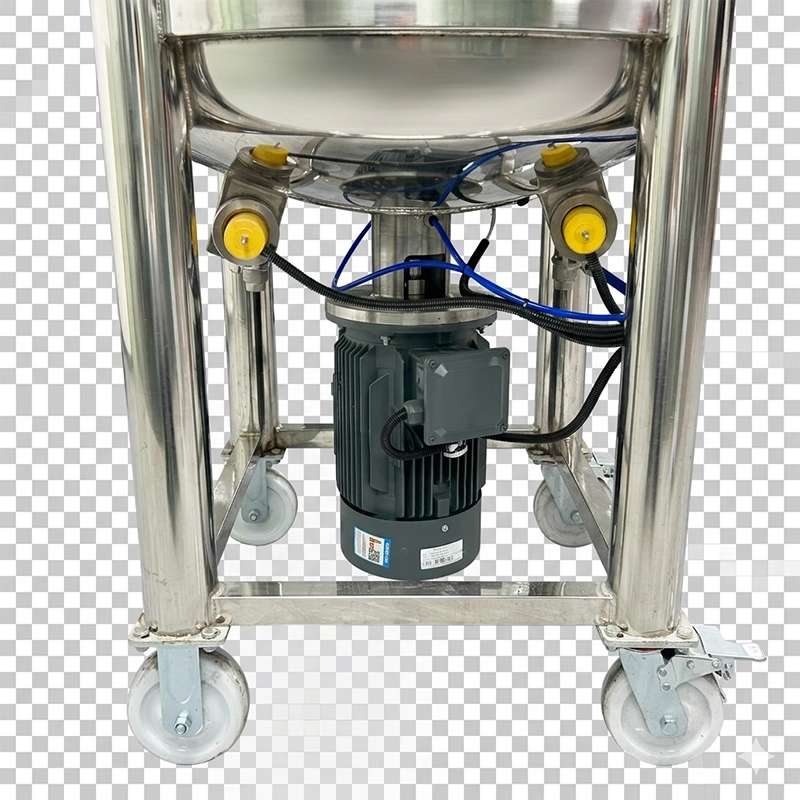
Caster mounting supports a defined handling arrangement; it does not establish permission to move the tank while full, operating, hot, or connected to services. A bottom butterfly valve provides the specified outlet, with external pump transfer available for separate assessment.
This model does not establish vacuum capability or automatic batch execution. For the wider formulation workflow, review the cosmetic cream and lotion application page, then confirm the suitability of this particular configuration.
Machine Configuration
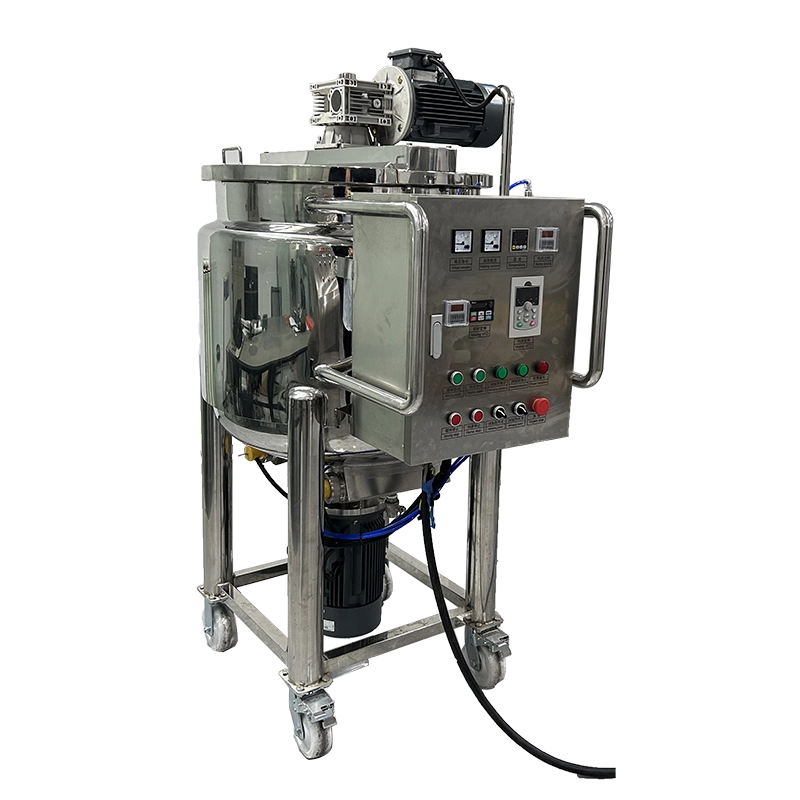
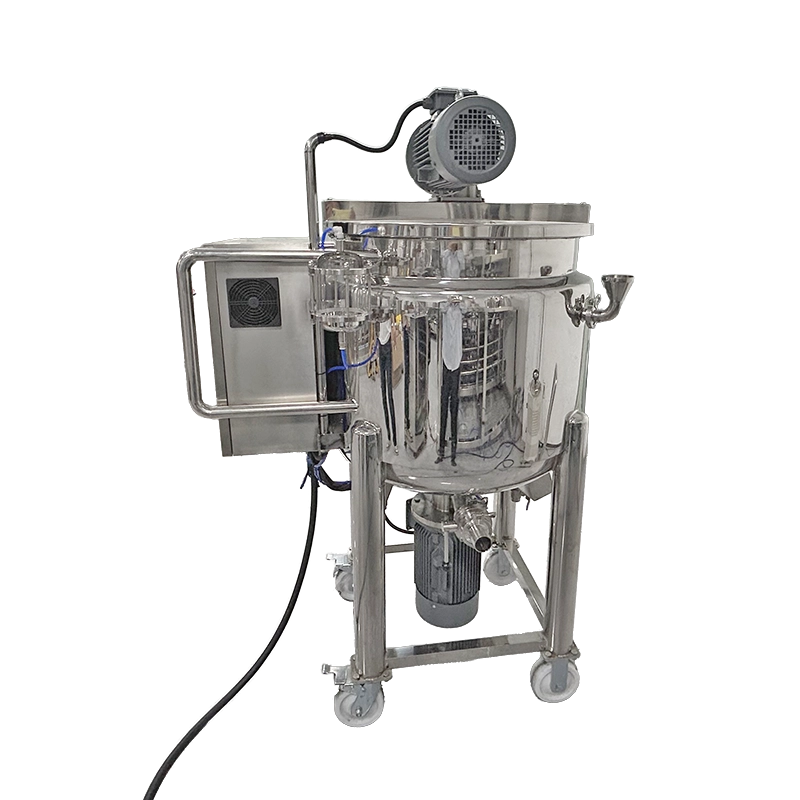
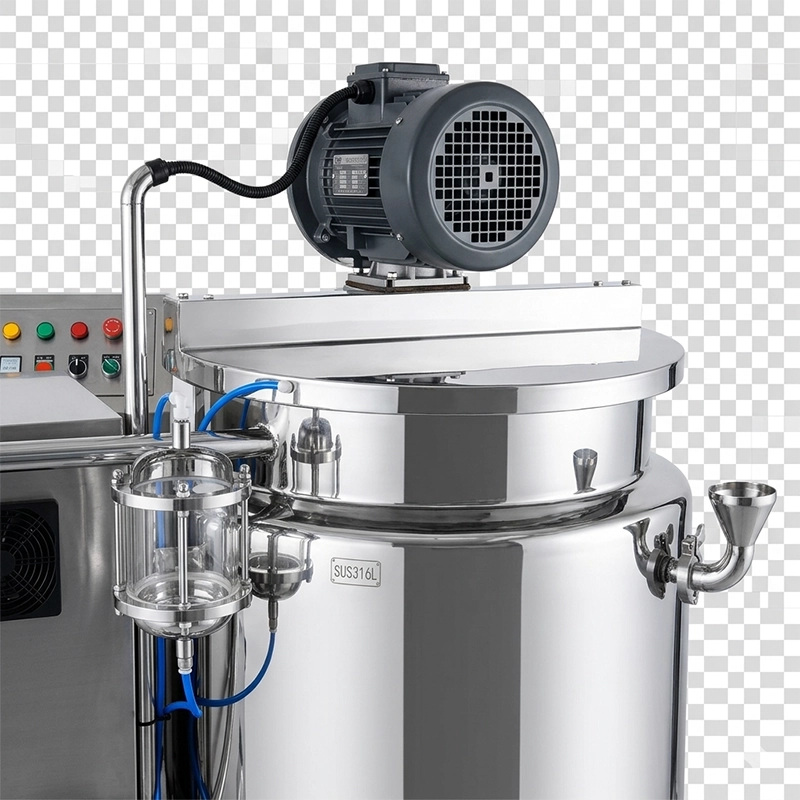
The triple-layer vessel incorporates SUS316L product-contact construction, a thermal jacket, and insulation. SUS304 is specified for the outer construction. The final order should identify the selected external finish and full-jacket or optional coil-pipe arrangement.
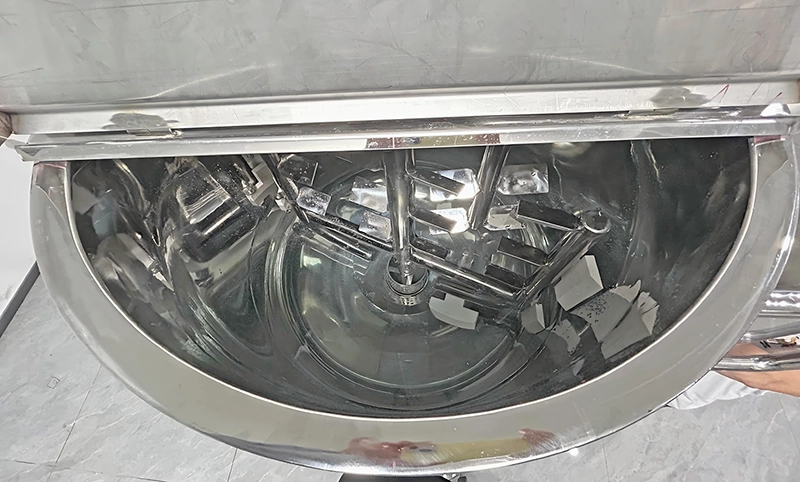
A 2.2 kW frame agitator works with high-temperature PTFE scrapers. A separately driven 5.5 kW bottom-entry homogenizer uses a single-stage rotor-stator arrangement. No high-speed disperser, dispersing disc, or head-lifting mechanism is specified.
Variable-frequency control provides the supplied speed-adjustment function. The electrical interface, adjustable functions, selected component brands, and protective provisions must be identified in the technical agreement.
The fixed mixing assembly is supported by a caster-mounted structure. Electric heating and jacket cooling require the agreed utility systems. A bottom butterfly valve completes the specified discharge arrangement; any external transfer pump is a separately defined item.
Key Features
- Frame agitation provides bulk movement within the approved batch operating range.
- PTFE wall scrapers sweep product along the internal vessel wall.
- Bottom-entry homogenizer provides a separately driven single-stage rotor-stator processing function.
- Electric jacket heating supports formulations requiring thermal preparation during mixing.
- Jacket cooling accommodates an approved tap-water or chilled-water supply.
- Insulated vessel construction forms part of the specified thermal arrangement.
- Caster-mounted structure supports repositioning under the supplier-approved handling conditions.
- Bottom butterfly valve provides the specified outlet for product discharge.
Applications
- Cosmetic Cream & Lotion, and Skin Care
- Detergents, Liquid Washing & Household Cleaning
- Sauce, Condiment & Food Paste
Working Principle
Ingredients enter the main vessel according to the approved formulation procedure. The initial charge and addition sequence should allow the installed processing elements to engage the material effectively.
The frame agitator moves the bulk product through the vessel. PTFE scrapers sweep the wall, helping return wall-adjacent material to the moving batch. The supplied agitation range is 1–63 rpm; the appropriate setting depends on the relevant processing stage.
Electric jacket heating is used when required by the selected method. Product temperature should be monitored through the agreed measurement arrangement. A thermal-medium limit must not be treated as a guaranteed product temperature.
The bottom-entry rotor-stator homogenizer applies localized high shear. Its operating stage and duration follow the formulation requirement, while agitation supports material movement through the vessel. Homogenizer speed and a guaranteed particle-size result are not established by the supplied information.
Cooling is applied through the jacket using the approved external supply. Temperature-sensitive additions should follow the formulation method; the fragrance and active-ingredient addition guide provides supporting context.
After processing, product exits through the bottom valve or an agreed pump-transfer arrangement. This atmospheric process does not establish vacuum deaeration, automatic dosing, or a complete programmed batch sequence.
Optional Upgrades & Configurations
| Warranty | 24 Months | Payment Terms | 40% T/T Deposit, 60% Balance Before Shipment (Alibaba Trade Assurance Available) |
| Lead Time | 15–20 Working Days | Packaging | Standard Export Fumigation-Free Wooden Case |
After-Sales & Technical Support
🔧 Common Problems
Potential symptoms include uneven ingredient incorporation, material accumulating near the wall, persistent bubbles, product temperature departing from the intended profile, unusual homogenizer noise, leakage at a contacted connection, and slow or interrupted discharge. Operators may also observe inconsistent mixing at a smaller batch quantity, scraper deterioration, or difficulty maintaining the approved operating position. These are inspection topics rather than documented faults of this particular machine. Record the process stage, batch quantity, material condition, and settings before selecting corrective action. Differences between finished batches should not automatically be attributed to insufficient homogenizer power. Charging sequence, ingredient condition, temperature, and the operating method may also need review.
🛠 Troubleshooting
Problem: Ingredients remain unevenly incorporated Possible Cause: Charging sequence, batch quantity, or operating settings differ from the approved method Recommended Solution: Compare the batch record with the approved process and confirm effective product engagement before changing settingsProblem: Material remains along the vessel wall Possible Cause: Product behavior, scraper condition, or agitation setup requires review Recommended Solution: Isolate the equipment before inspecting scrapers and compare the arrangement with the supplied documentationProblem: Product temperature does not follow the intended profile Possible Cause: Heating settings, cooling conditions, measurement, or bulk movement differs from the approved conditions Recommended Solution: Record the temperature indication and process stage, then arrange qualified inspection of the relevant systemProblem: Unusual noise or leakage occurs near the homogenizer Possible Cause: An abnormal operating condition or component requires inspection Recommended Solution: Stop the affected equipment and follow the supplier’s isolation and diagnostic procedure before restartingProblem: Product discharges too slowly Possible Cause: Product flow behavior, outlet condition, discharge temperature, or transfer arrangement is unsuitable Recommended Solution: Review the agreed discharge method and inspect the isolated outlet without applying unapproved pressureProblem: The tank shifts from its operating position Possible Cause: The approved positioning arrangement is not correctly established or requires inspection Recommended Solution: Stop operation and restore the supplier-approved securing arrangement before resuming production
🧼 Cleaning Method
1. Select the cleaning procedure approved for the formulation and contacted materials. 2. Discharge the remaining product through the agreed arrangement. 3. Establish the temperature condition required by the cleaning procedure. 4. Isolate relevant energy sources as specified in the supplied instructions. 5. Remove accessible bulk residue using approved tools. 6. Perform the preliminary rinse specified for the product. 7. Apply the approved cleaning stage using its documented conditions. 8. Clean the frame agitator using the approved method. 9. Clean the scraper contact areas using the approved method. 10. Clean the homogenizer area according to its supplied instructions. 11. Clean the butterfly valve according to the approved procedure. 12. Clean any separate product-transfer components. 13. Complete the required final rinsing. 14. Perform sanitization only where required by the approved procedure. 15. Inspect contacted areas for remaining residue. 16. Inspect contacted components for cleaning damage. 17. Verify drainage. 18. Verify correct reassembly before the next batch.
📋 Maintenance
1. Isolate electrical energy according to the supplied maintenance procedure. 2. Isolate connected thermal services. 3. Isolate any other relevant energy sources identified in the maintenance instructions. 4. Confirm the required vessel temperature before access. 5. Inspect the frame agitator for visible damage. 6. Inspect the agitator attachments according to the supplied procedure. 7. Inspect the PTFE scrapers for wear or deterioration. 8. Inspect the bottom homogenizer using the supplier’s approved method. 9. Inspect the installed mechanical seal for abnormal leakage. 10. Check any specified seal-support arrangement. 11. Inspect the butterfly valve for damage or leakage. 12. Inspect product-contact connections for deterioration. 13. Inspect the caster assemblies. 14. Inspect the operating-position restraint components. 15. Have qualified personnel inspect electrical and drive components. 16. Service specified lubrication points using approved materials. 17. Complete the required functional checks after maintenance. 18. Record findings and corrective work before release to production.
⚙️ Installation
1. Verify the delivered tank against the approved configuration schedule. 2. Position the tank according to the installation drawing. 3. Establish the supplier-approved restraint arrangement for the caster-mounted machine. 4. Confirm the charging clearance specified for the workstation. 5. Confirm access to the operating controls. 6. Confirm service space around the bottom homogenizer. 7. Confirm access to the discharge valve and receiving arrangement. 8. Have qualified personnel connect the electrical supply according to the delivered rating. 9. Connect the selected cooling supply according to the utility documentation. 10. Connect the approved cooling return or drainage arrangement. 11. Provide any support services required by the installed mechanical seal. 12. Install the agreed discharge connection without imposing unsupported loads. 13. Complete the prescribed protective-function checks. 14. Commission the heating function under the supplier’s procedure. 15. Commission the agitation function under the supplier’s procedure. 16. Commission the homogenizer under the supplier’s procedure. 17. Trial representative material using the agreed acceptance criteria. 18. Record the accepted operating setup. 19. Document the permitted conditions for repositioning the tank.
🔩 Spare Parts
Why Choose This Machine
- Integrated preparation functions. Bulk agitation and bottom-entry homogenization address different processing needs within one vessel, reducing the need to treat them as unrelated equipment selections.
- Defined production scale. The 200L working capacity provides a basis for batch planning while remaining distinct from the 250L total vessel volume.
- Electric-heating configuration. This version can support the approved thermal process without requiring steam as its selected heating source. Electrical requirements still need confirmation.
- Cooling interface. Jacket connections allow the cooling arrangement to be assessed against the formulation and available utilities rather than assuming a chiller is always necessary.
- Planned layout flexibility. Caster mounting allows repositioning where the approved loading, temperature, connection, and handling conditions permit it.
- Transfer options. The bottom outlet can be evaluated for direct collection or connection to suitable fluid transfer systems, according to product behavior and receiving requirements.
These are configuration benefits. Batch time, product stability, energy savings, and labor reduction require application-specific evidence.
Frequently Asked Questions
Installation Requirements
Establish the approved position and restraint method for the caster-mounted tank. Allow access for charging, controls, inspection, cleaning, bottom-homogenizer maintenance, and discharge. Overall dimensions and service clearances must come from the installation drawing.
Confirm the delivered electrical rating against the destination supply. The listed total power is 20 kW; cable sizing, isolation, and protection must follow the final electrical documentation rather than the motor powers alone.
Provide the selected cooling supply and return or drainage arrangement. Confirm any support services required by the installed mechanical seal. Compressed-air requirements have not been supplied.
Route utility and product connections so they can be managed safely before permitted repositioning. Assess the equipment against the intended ingredients and operating environment; no hazardous-area rating has been established.
Technical Buyer's Handbook & Deep Insight
Ready to Get a Quote?
Contact our team directly for pricing, customization options, and delivery timelines.
💬 WhatsApp Us NowGet Your Download Link
Please fill in your details and we'll send the download link to your email.