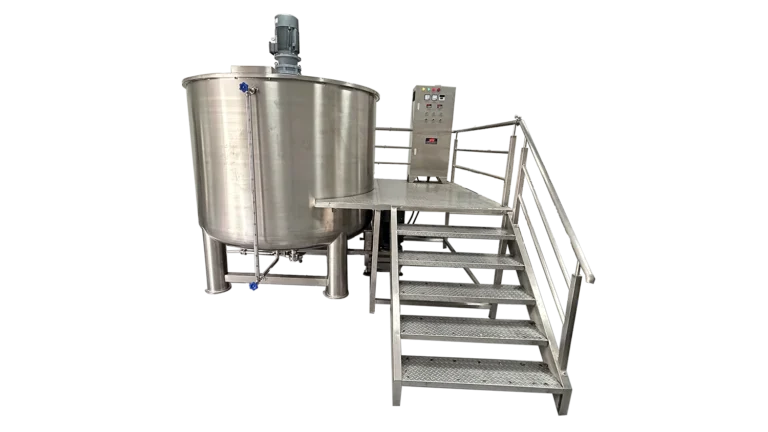
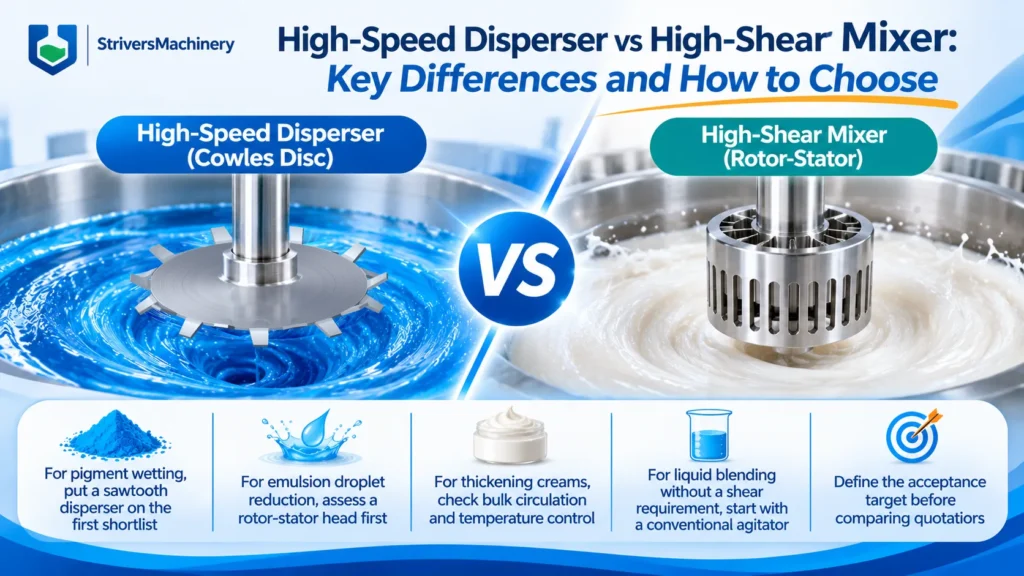
For powder wetting and pre-dispersion, start with a high-speed disperser. For reducing droplets in an emulsion, start with a rotor-stator high-shear mixer. That is the useful starting point in the high shear mixer vs disperser comparison. Then look at how the whole batch moves. A powerful head does little for material that never reaches it.
In our equipment discussions, new colleagues and some customers confuse these two machines. Both have a motor, a shaft and a fast-moving working tool. Sometimes the request stops at “we need higher RPM.” But a sawtooth disc and a rotor-stator head do different work. Calling both a homogenizer can send a quotation in the wrong direction before anyone discusses the product.
This comparison follows the questions in StriversMachinery’s internal equipment-training outline: what is on the shaft, what happens to the product, and which result are we buying the machine to achieve?
1. Look at the working head first
Understanding the high shear mixer vs disperser
A high-speed disperser has an open disc, commonly with teeth around its edge. A rotor-stator mixer has a rotating element inside a stationary head. Ask for a clear photograph of that part before comparing quotations. The lift, frame and control cabinet can look very similar.
“High shear” describes an action. Suppliers also use it as an equipment category. A dispersing disc produces shear too. For this comparison, high-shear mixer means a rotor-stator machine. This definition keeps the discussion useful without pretending that the disc produces no shear.
A hydraulic or pneumatic lift changes how the operator positions and raises the assembly. It does not turn a dispersing disc into an emulsifying head. Select the working tool first. Choose the lifting arrangement after the process is clear.

2. Choose a high-speed disperser for powder wetting and pre-dispersion
A Cowles-type disperser uses the fast-moving edge of a sawtooth disc to apply mechanical work while driving circulation in the vessel. Powder must enter the liquid, become wetted and pass through the active region around the disc. The tank and blade arrangement matter because the tool works with that surrounding flow.
We would put this machine on the first shortlist for pigment slurries, many paints, inks and suitable adhesives. These processes often begin with a substantial powder load. An open disc gives a practical way to wet that powder and break down suitable agglomerates before the next stage.
Feed powder at a rate the liquid can absorb. A dry mound on the surface tells you that incorporation has fallen behind addition. Increasing speed may deepen the vortex and pull in more air without clearing the mound. Adjust the feed rate and working position before treating RPM as the only control.
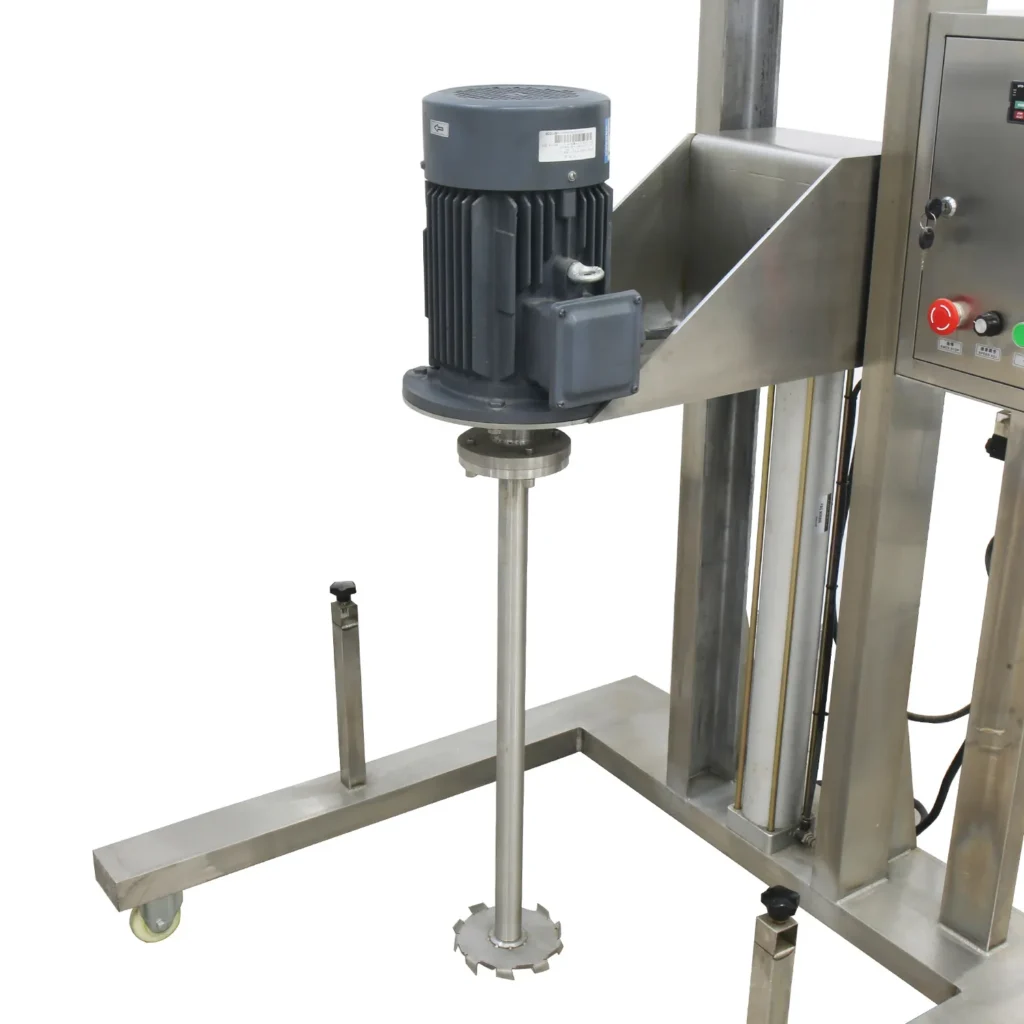
The disc and vessel must work together
A larger motor will not correct every circulation problem. Blade diameter, liquid depth, distance from the bottom, vessel shape and viscosity all affect the flow. If the surface moves while material near the wall barely turns over, inspect the arrangement. The whole batch needs access to the working zone.
For a concrete equipment layout, see our hydraulic lifting high-speed disperser. Its lifting structure is an access feature. The disc, vessel and product determine the dispersion duty.
Fine pigment processing may still need a bead mill after pre-dispersion. Breaking loose agglomerates and grinding hard primary particles are different jobs. Keep the milling stage when the required fineness, color development or coating performance calls for it. Our paint homogenizer guide discusses where rotor-stator processing fits alongside dispersion and milling.
3. Choose a rotor-stator mixer when the product needs concentrated local processing
In a rotor-stator mixer, product enters the working head and moves through the region between the rotor and stator before leaving through the head openings. This concentrates processing in a defined area. Silverson’s batch mixer working-principle explanation shows this intake, shearing and discharge sequence.
We recommend starting here for oil-and-water emulsification and for suitable lumps that survive ordinary blending. Rotor-stator machines can also incorporate powders. Powder processing belongs to both equipment families; the best choice comes from the powder, liquid, feed method and required finish.
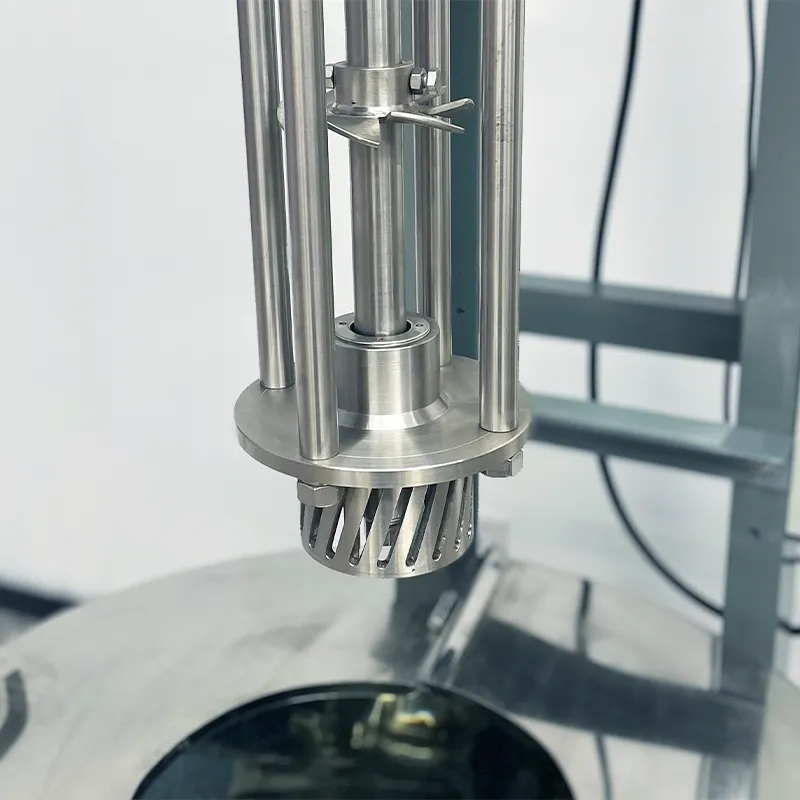
For an emulsion, the practical target is the droplet distribution and product behavior. The rotor-stator supplies mechanical action to break droplets. The formulation and temperature schedule must support the resulting emulsion. If a batch separates during storage, investigate those factors alongside the mixing conditions instead of ordering a faster motor immediately.
Give the head a continuous supply of product
A head can repeatedly process the liquid beside it while thick material stays against the tank wall. That produces an uneven batch. For a cream or paste that stops circulating, prioritize an arrangement that moves the bulk material, such as a suitable anchor or scraper combined with the homogenizing head.
Batch and inline describe different processing arrangements. An immersed batch head works inside a vessel. An inline unit receives product through a pipeline, in a recirculation loop or a defined pass arrangement. Bottom-entry describes a mounting position; a bottom-entry head can still process a batch in a tank.
For open-vessel work with a lifting assembly, our mobile pneumatic lifting homogenizer shows one arrangement. It is a different equipment choice from a complete heated vacuum emulsifying system.

4. Compare the process, not the motor label
The main difference is how the working tool applies energy and how product reaches it. ROSS makes this distinction in its comparison of sawtooth dispersers and rotor-stator mixers. Use the following table to shortlist equipment, then compare the proposed configurations.
| Selection point | High-speed disperser | Rotor-stator high-shear mixer |
|---|---|---|
| Working tool | Open disc, often with a sawtooth edge | Rotor operating inside a stationary head |
| Useful first duty | Powder wetting and pre-dispersion | Emulsification and suitable deagglomeration |
| Product flow | Vessel circulation carries material through the disc region | Product passes through the head and returns to the batch or pipeline |
| Thickening batch | Check whether the disc still turns over the full batch | Check whether fresh product keeps entering the head |
| Result to evaluate | Wetting, remaining agglomerates, fineness and incorporation time | Droplet or agglomerate distribution, uniformity and product performance |
| Cleaning focus | Disc teeth, shaft and vessel | Head openings, rotor-stator surfaces, shaft and relevant seals |
Neither column provides a universal viscosity limit. A thin liquid, a shear-thinning gel and a heavy paste can behave very differently at the same reported viscosity. Include temperature and the viscosity measurement conditions in the discussion. Better still, show how the product flows at its thickest processing stage.
5. RPM alone cannot compare mixing performance
Tip speed connects rotation speed with tool diameter:
Tip speed (m/s) = π × diameter (m) × speed (RPM) ÷ 60
Illustrative calculation: a 200 mm disc at 1,500 RPM has a tip speed of about 15.7 m/s. A 100 mm tool at the same RPM has a tip speed of about 7.85 m/s. These are calculated examples, not recommended operating settings or test results.
Even equal tip speeds do not make the two tools equivalent. An open disc has no surrounding stator. A rotor-stator head has its own clearance, openings and flow path. Those features change the local processing. Compare RPM within the proposed machine’s operating range; do not use it as a ranking across different working heads.
The same issue appears during scale-up. Copying the laboratory RPM onto a larger tool changes tip speed. Matching tip speed alone still leaves circulation, power demand, feed rate and processing time to resolve. Specify the required product result and ask how the proposed machine will achieve it at both the smallest and largest working batch.
6. “Homogenizer” can mean two different technologies
In many mixing-equipment quotations, a homogenizer means a rotor-stator mixer. A high-pressure homogenizer uses a different mechanism: a pump drives product through a homogenizing valve. GEA’s homogenizing valve documentation describes that valve-based technology.
If the purchasing request says only “homogenizer,” ask which mechanism is intended. This is especially important when a process specifies a fine droplet distribution or a downstream homogenizing stage. A lifting rotor-stator machine and a high-pressure unit should not receive interchangeable quotations.
Also define what “smooth” means. A product can look smooth while retaining an unacceptable coarse fraction. Use an appropriate measurement for the task: droplet-size analysis for an emulsion, for example, or a specified fineness check for a coating. Appearance is useful, but it is a weak acceptance criterion on its own.
7. Match the machine to the unfinished job
Start with the operation that the current process cannot complete well. Buying more functions makes sense when those functions solve a production problem.
| Your production task | Our first recommendation | What to settle before purchase |
|---|---|---|
| Wet pigments into a liquid vehicle | High-speed disperser | Powder loading, addition rate, vessel flow and downstream fineness requirement |
| Reduce oil droplets in a lotion | Rotor-stator mixer | Formula, temperature, droplet target and batch circulation |
| Make a thick cream with heating, cooling and air removal | Assess a vacuum emulsifying mixer with suitable bulk agitation | Minimum batch, temperature schedule, scraper duty and discharge behavior |
| Blend compatible liquids without lumps or a droplet-reduction target | Start with a suitable conventional agitator | Blend time, viscosity, foaming and any shear-sensitive ingredients |
| Meet a fine pigment specification after wetting | Assess dispersion followed by the required milling stage | Fineness, color development, mill feed conditions and final performance |
For a cream process that needs combined heating, cooling, scraping and deaeration, compare the complete arrangement shown by our 100 L hydraulic lift vacuum emulsifying machine. Vacuum is valuable when air removal is part of the job. A cream does not automatically need it just because the product is called an emulsion.
Some processes justify both a dispersing disc and a rotor-stator head. Powder pre-dispersion may be followed by a different finishing stage. Specify the purpose of each tool and the material-transfer route. A second head adds cleaning and maintenance work, so it should earn its place in the process.
For frequent formula changes, consider a separate trial station before committing every experiment to the main production vessel. Our guide to mobile homogenizers from lab to production covers that capacity decision.
8. What we would settle before approving the quotation
First, write down the difficult stage. Is powder floating? Are lumps remaining? Are oil droplets too coarse? Does the batch stop circulating as it cools? A clear symptom gives the supplier a process problem to solve.
Next, compare proposals at the same batch size, formulation and processing temperature. Include powder addition and cleaning in the cycle-time discussion. A machine that finishes mixing quickly but is awkward to empty or clean can still hold up production.
Ask how the working head comes apart, which surfaces need manual cleaning and how replacement wear parts are supplied. An open disc is accessible. A rotor-stator head has more internal surfaces to inspect. For sticky or drying products, that difference deserves attention before the order.
Set a measurable acceptance target. It might be remaining lumps, droplet distribution, fineness, batch uniformity or a combination. Agree on when and where samples are taken. Use a representative product trial when the main uncertainty is the material’s response to the proposed tool.
Send StriversMachinery your product, powder loading or phase ratio, smallest and largest batches, vessel dimensions, and temperature and viscosity through the cycle. Include a photograph or short video of the stage that gives you trouble. Use the website inquiry form or your existing WhatsApp conversation. We can then recommend a disc, a rotor-stator head or a combined arrangement around the work your product actually needs.