
Quick answer: pick the test from the failure you need to rule out. Use peel or tensile testing to compare the force needed to separate a seal, burst or creep testing to challenge the complete closed tube, and a validated leak test to find a passage. A tube tail can look clean and still fail during squeezing, transport or storage, and one “seal strength” number cannot answer all three questions. Understanding tube seal strength testing is essential for accurate evaluation.
From an engineering view, tube seal testing is a measurement-system problem before it is a machine-setting problem. Before production, define the method, sample locations, conditioning, pass/fail rule and reaction plan, and apply them to the exact tube material, seal geometry and product condition intended for sale.

Seal Strength vs Package Integrity vs Leak Detection
The importance of tube seal strength testing cannot be overstated, as it directly affects product reliability and consumer safety.
These three terms are often mixed up on drawings and in supplier quotes. Keep them separate:
- Seal strength: how much force is required to separate a defined specimen.
- Package integrity: whether the filled, closed pack resists a defined challenge such as internal pressure.
- Leak detection: whether gas or liquid passes through a defect under specified conditions.
Visual inspection can find wrinkles, contamination, incomplete closure or obvious damage, but appearance alone does not prove any of the three.
Failure mode matters as much as peak force. A specimen may peel at the seal interface, tear through the tube wall, stretch, split at a fold, or fail away from the intended seal. Record the mode and its location. A higher peak is not automatically better if it makes the tube hard to open or lets the body tear first.

Peel and Tensile Testing: Compare Seal Separation Force
In a tensile (peel) test, a prepared strip containing the seal is pulled while force is recorded. ASTM F88/F88M covers seal-strength measurement for flexible barrier materials and requires failure-mode identification. It does not set a universal acceptance limit for every tube. A formed tube tail has its own curvature, wall construction and closure geometry, so a laboratory may need a validated fixture or specimen-preparation method to cut a repeatable, representative strip.
Keep these variables fixed: specimen width, grip position, pull direction, test speed, seal-support technique and conditioning. If one operator supports the seal by hand and another uses a fixture, the results may not be comparable. ASTM notes that technique and alignment affect the measured output, so record the chosen setup and which material sits in each grip.
Report individual values and failure modes, not just an average; an average can hide a weak tail. For process comparisons, sample defined points across the run and hold material lot, fill, machine settings and post-seal cooling condition constant. Set limits from package requirements and validated performance, never from a number copied from an unrelated pouch.

Burst and Creep Testing: Challenge the Complete Tube
Internal pressurization tests assess resistance to a pressure differential. In a burst test pressure rises until failure; in a creep test pressure is held for a set time or until failure. ASTM F1140/F1140M addresses unrestrained packages, while ASTM F2054/F2054M addresses flexible-package seals tested between restraining plates. Match method, fixture and package geometry to the objective.
These tests can expose weak closures or construction problems that a narrow strip test misses, but their results do not necessarily correlate with F88 seal strength. Record pressure profile, restraint, inflation rate, hold time, orientation, fill state, temperature and failure location. A tube can fail at the shoulder, body, cap or tail, so do not blame every failure on the tail seal.

Tube Leak Test Methods: Detect a Passage, Not Opening Force
Common methods are vacuum decay, pressure decay, bubble emission and dye penetration. The right choice depends on package wall, product, defect type, required sensitivity and whether the test may be destructive.
- Vacuum decay: ASTM F2338 describes non-destructive vacuum-decay testing for certain rigid, semi-rigid and flexible non-porous packages. It measures pressure change in a test chamber and gives accept/reject results against a validated baseline. Published sensitivities belong to specific tested systems and are not universal tube guarantees.
- Bubble emission: may show gross leakage when a pressurized sample is submerged, but small channels are hard to see and the sample may be altered or contaminated.
- Dye penetration: depends on wetting, dwell time, applied pressure and operator interpretation.
Product sitting at a defect can block or distort a result, so use a qualified method with the actual pack and contents, or establish a justified surrogate. Do not call a passing burst test “leak-proof” or a visual check “hermetic”; state the actual challenge and the intended defect.

How to Build a Tube Seal Sampling and Acceptance Plan
Sample the conditions that represent real operating variation: startup after the process reaches its defined steady state, routine production, and post-adjustment or changeover. Include tube supplier lots and product-fill conditions where they can affect the closure. State the frequency, sample count, run position, conditioning time, storage orientation and whether samples are destructive.
For qualification, test a range of settings inside the equipment’s approved operating envelope. Change one factor at a time to learn cause and effect, then confirm the selected window with representative production. Relevant factors may include heat input, dwell time, closing pressure or jaw position, tube construction, fill height, product contamination at the tail and cooling interval. Their meaning varies by design, so follow the machine instructions rather than copying universal values.
Minimum record set: method, instrument ID, calibration check, operator, date, tube lot, product, settings, sample position, conditioning, result, failure mode and disposition. Also define the reaction to a failure: hold the affected product, inspect back to the last acceptable check, investigate the specific failure mode, correct the process and document requalification where required.

Tube Seal Test Selection Matrix
| Question | Candidate method | What it tells you | Limit |
|---|---|---|---|
| Does seal separation force vary? | Strip peel/tensile, adapted and validated (ASTM F88 approach) | Force profile and specimen failure mode | Not a whole-pack leak result |
| Does the pack withstand pressure? | Burst or creep matched to package and fixture (F1140, F2054) | Pressure resistance and failure location | Not automatically correlated with seal strength |
| Is there a passage? | Vacuum decay, bubble or dye method (e.g. F2338) | Leak indication under defined conditions | Sensitivity is package-specific |
| Is the tail visibly abnormal? | Defined visual standard | Visible folds, wrinkles or contamination | Does not measure integrity |
Common Mistakes That Make Seal Test Results Misleading
- Different tube construction, cut width, support technique, sample temperature or conditioning between runs.
- Averaging away a low value instead of reporting each specimen.
- Borrowing an acceptance limit from another package.
- Changing machine settings before confirming what the test actually measured.
For method transfer between labs, align fixture, specimen preparation, conditioning and settings, then compare representative samples. When methods disagree, ask what each one measures: low peel force with no leak can indicate a weak but continuous seal, while a good strip result with package leakage may point to a localized channel, another tail region or a leak elsewhere on the tube.
What to Specify When Buying a Tube Sealer
Ask the supplier to document compatible tube constructions and sizes, included tooling, adjustment points, trial samples and the agreed finished-package checks. Keep fill-quantity acceptance separate from closure acceptance. Provide representative tubes, the actual product or an agreed surrogate, target fill, storage and distribution conditions, and the inspection method your quality team will use.
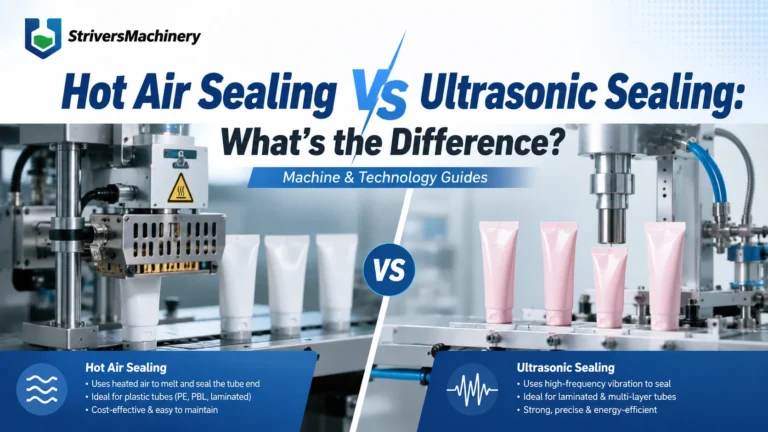
Read the hot-air versus ultrasonic sealing comparison for process choice and the tube leakage troubleshooting guide for defect diagnosis. Then review a tube filling and sealing machine against your actual material and closure method.
Before release, agree who owns sampling, lab testing, acceptance and records. Send us the tube specification and test objective so the trial uses a suitable sample and fixture.
Technical references
ASTM F88/F88M-23, seal strength of flexible barrier materials: https://store.astm.org/f0088_f0088m-23.html
ASTM F1140/F1140M, internal pressurization failure resistance and limitation on correlation to F88: https://store.astm.org/standards/f1140
ASTM F2338-24, vacuum-decay leak testing: https://store.astm.org/f2338-24.html
ASTM F2054/F2054M, burst testing between restraining plates: https://store.astm.org/standards/f2054