The Complete Guide to Sourcing Machinery from China: 15 Common Mistakes Every Buyer Should Avoid
If you’ve ever typed “sourcing machinery from China” into Google at 11 p.m. because a supplier just went quiet on you again, this guide is for you.
Every year, thousands of cosmetics manufacturers, food producers, chemical processors, and pharmaceutical companies place orders for production equipment with Chinese suppliers. Most of those orders go fine. A meaningful number of them don’t — and the buyers who get burned rarely fail because Chinese manufacturing can’t deliver quality machinery. They fail because of decisions made before the first payment ever left their bank account: the wrong supplier, an unclear specification, a rushed inspection, or a warranty clause nobody actually read.
This is a long article — deliberately so. Machinery buying guides that try to cover “everything you need to know” in 1,200 words usually end up covering nothing useful at all. What follows is closer to a working reference: a full walkthrough of the machinery sourcing process, fifteen mistakes that account for the overwhelming majority of failed or disappointing procurement projects, a practical pre-order checklist, three anonymized case studies, and more than twenty frequently asked questions pulled directly from the kinds of conversations we have with buyers every week.
This guide is written primarily for:
- Cosmetics manufacturers scaling from lab-scale batches to full production lines
- Food and beverage companies evaluating processing or filling equipment
- Chemical formulators who need mixing, emulsifying, or storage systems
- Pharmaceutical and nutraceutical producers with compliance-heavy requirements
Realistically, most readers won’t need every section on a first pass. If you’re mid-negotiation with a supplier right now, you might go straight to Part 3’s checklist. If you’re still deciding whether to build a new line at all, Part 1’s process overview and Part 2’s mistakes 1 through 7 probably matter more than the logistics-heavy mistakes near the end. Either way, this is meant to be a reference you come back to at different stages of a project, not a single-sitting read.
If you read the whole thing, you should walk away able to avoid the overwhelming majority of the sourcing mistakes that cost buyers money, time, or both. Let’s get into it.
One more thing before we start: none of what follows is meant to suggest that sourcing machinery from China is inherently risky compared to sourcing domestically or from any other manufacturing region. Every country with a serious industrial base — Germany, Italy, the United States, China — has excellent manufacturers and mediocre ones, and the fundamentals of a sound purchase don’t actually change much based on geography. What changes is distance: it’s simply harder to walk onto a factory floor on the other side of the world on short notice, which means the verification steps that a domestic buyer might handle casually over a single site visit need to be more deliberate when you’re sourcing internationally. That’s really what this guide is about.
Table of Contents
- Part 1: Understanding the Machinery Sourcing Process
- Part 2: 15 Common Mistakes When Sourcing Machinery from China
- Part 3: Practical Checklist Before Ordering Machinery from China
- Part 4: Case Studies
- Part 5: How Strivers Machinery Helps Reduce Procurement Risks
- Conclusion
- Frequently Asked Questions
Part 1: Understanding the Machinery Sourcing Process
Most articles about China machinery sourcing jump straight into a list of horror stories. We’re going to do something slightly different first, because almost every mistake in Part 2 only makes sense once you understand where in the process it tends to happen.
A typical industrial machinery procurement project — whether you’re buying a single vacuum emulsifying mixer or a full turnkey production line — moves through roughly the same stages:
- Requirement definition. You work out what the equipment actually needs to do: product type, viscosity, batch size, output rate, packaging format, available utilities, floor space.
- Supplier selection. You identify and screen manufacturers or trading companies capable of building what you need.
- Technical discussion. Engineering teams on both sides go back and forth on specifications, layout, and process flow.
- Quotation. You receive formal pricing, usually tied to a specific technical proposal.
- Design. Drawings, 3D layouts, and sometimes P&ID diagrams are produced and approved.
- Manufacturing. The equipment is actually built, which for custom lines can take anywhere from 6 to 20 weeks.
- Inspection. Factory Acceptance Testing (FAT) confirms the machine performs as specified before it ships.
- Shipment. Export packing, container loading, and international freight.
- Installation. On-site or remote-guided installation and commissioning.
- After-sales. Training, spare parts support, and ongoing technical service.
Rough timelines vary a lot by equipment complexity, but as a general reference: requirement definition through quotation typically takes one to three weeks; design and drawing approval another one to three weeks; manufacturing itself runs anywhere from six weeks for a standard configuration to twenty weeks for a fully customized turnkey line; and shipment, installation, and commissioning add another four to ten weeks depending on distance and site readiness. A realistic end-to-end project, from first inquiry to a running machine, often lands somewhere between four and seven months for anything beyond an off-the-shelf standard unit. Buyers who go into a project expecting a six-week miracle are the ones most likely to accept shortcuts later in order to hit an unrealistic date.
Almost every “China machinery sourcing horror story” you’ll find online traces back to a shortcut taken somewhere in stages one through five — long before the machine ever gets built. Buyers who treat sourcing as a sequential process, and who refuse to skip stages under deadline pressure, consistently end up with better outcomes than buyers who jump straight from “requirement” to “wire transfer.”
It’s worth being honest about why buyers skip stages in the first place, because the reasons are rarely carelessness. Usually it’s time pressure — a production deadline is fixed, a competitor just launched a similar product, or an investor is asking why the line isn’t running yet. Under that kind of pressure, “supplier selection” quietly turns into “the first supplier who replied to my inquiry,” and “technical discussion” turns into a five-minute phone call before signing. The irony is that skipping stages to save two or three weeks upfront routinely costs six to twelve weeks later, once a specification gap or a capability mismatch surfaces during manufacturing or, worse, after installation.
Keep this flow in mind as you read Part 2. Each mistake below is tagged, loosely, to the stage where it typically originates.
Part 2: 15 Common Mistakes When Sourcing Machinery from China
Fifteen is a lot, so we’ve grouped these roughly in the order they tend to bite buyers — from the earliest decision-making mistakes through to the ones that show up months after the machine is already running. You’ll notice a pattern as you go: almost none of these mistakes are about manufacturing quality in the narrow sense of “can a Chinese factory build a good machine.” They’re almost entirely about process — the decisions, questions, and documentation that happen (or don’t happen) around the machine itself. That’s genuinely good news, because process problems are far easier to fix than manufacturing capability problems.
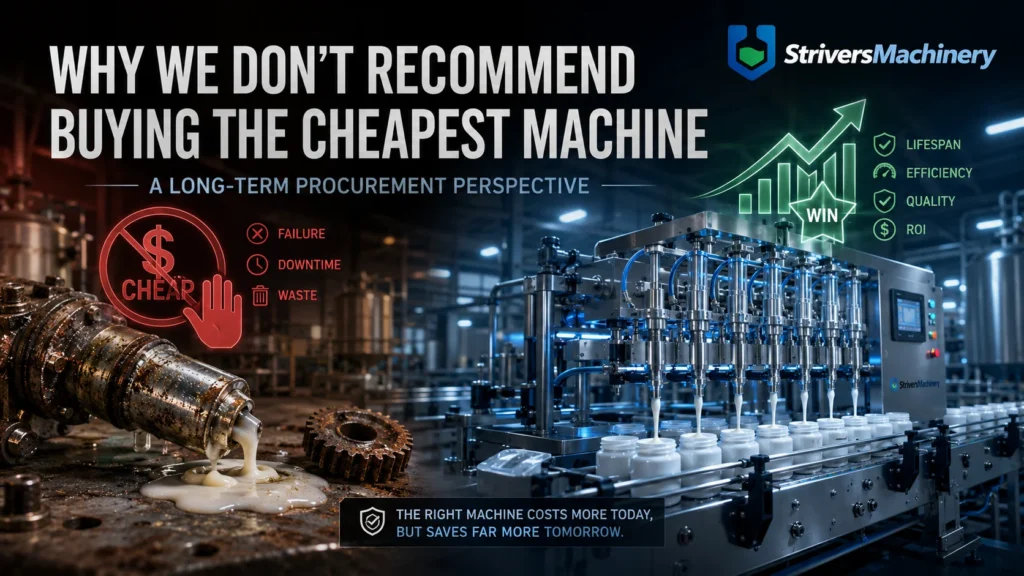
Mistake 1: Choosing Price Instead of Value
This is the mistake that causes almost every other mistake on this list. A buyer collects three or four quotations, picks the cheapest one, and treats the decision as closed.
The problem is that machinery price and total cost of ownership (TCO) are two very different numbers. TCO includes the purchase price, but also:
- Lifecycle cost — how many years of productive service you actually get before major overhaul or replacement
- Maintenance cost — the price and availability of spare parts, wear components, and consumables over the machine’s working life
- Downtime cost — lost production value every time the line stops because a cheap component failed
- Energy and utility cost — motors, pumps, and heating/cooling systems vary enormously in efficiency
- Rework and scrap cost — machines that can’t hold tight tolerances quietly generate waste every single shift
A vacuum emulsifying mixer priced 20% below the market average is not automatically a bad buy — but it’s worth asking why it’s cheaper. Sometimes the answer is a leaner factory with lower overhead. Sometimes it’s a smaller motor, a non-branded PLC, thinner stainless steel, or a mechanical seal rated for half the cycles. None of those are necessarily dealbreakers, but they should be decisions you make on purpose, not discoveries you make eighteen months into ownership.
Here’s a simplified way to compare two quotations honestly. Say Supplier A quotes $42,000 for a mixing tank and Supplier B quotes $51,000 for what looks like the same machine on paper. Before defaulting to Supplier A, ask what a mechanical seal replacement costs and how often it needs doing, what the motor’s expected service life is under continuous duty, and whether spare parts ship from stock or get manufactured to order after a fault occurs. If Supplier A’s seal needs replacing twice as often at a similar unit cost, and a stocked spare from Supplier B ships in days rather than weeks, the $9,000 price gap can disappear inside eighteen months of operation — and that’s before counting a single hour of lost production during downtime.
Mistake 2: Choosing the Wrong Type of Supplier
Chinese machinery suppliers generally fall into three categories, and the differences matter more than most first-time buyers expect.
Factories manufacture equipment in-house. Pricing tends to be more competitive and technical communication more direct, but smaller factories may lack the multilingual sales and project management staff that international buyers rely on.
Trading companies source from multiple factories and act as intermediaries. They’re often easier to communicate with and can compare multiple manufacturing options, but quality control depends entirely on how closely they actually supervise production — and margins get added along the way.
Factory-and-trading hybrids — companies that own or directly control manufacturing while also running dedicated export and engineering teams — try to combine the advantages of both models. This is the category Strivers Machinery operates in: our production is factory-controlled, which keeps quality and cost transparent, while our project management and technical support teams handle the communication, documentation, and after-sales work that a pure production factory often struggles to provide at an international standard.
There’s no single “correct” supplier type for every buyer. A large industrial buyer with in-house engineers who can communicate directly with a factory floor may do fine working with a pure manufacturer. A first-time buyer without technical staff in China usually needs the structure a hybrid or trading model provides. The mistake isn’t picking any particular category — it’s not knowing which category you’re dealing with until something goes wrong.
If you’re not sure which category a supplier falls into, ask directly: “Do you manufacture this equipment yourselves, or do you subcontract production?” A factory will usually answer with specifics — which workshop, which product lines they build in-house, which processes they outsource if any. A trading company will often be vaguer about production details, or will name a manufacturing partner when pressed. Neither answer is disqualifying on its own, but you want to know which one you’re getting before you’re three months into a project, not after a quality dispute forces the question into the open.
Mistake 3: Not Verifying Manufacturing Capability
“We are a professional manufacturer” appears on roughly every supplier website in this industry, including ones operating out of a 400-square-meter workshop with three welders. Verifying capability before you commit is not optional due diligence — it’s the single highest-leverage hour you’ll spend in the entire sourcing process.
A basic factory audit checklist should cover:
What to verify before ordering
- Production line — actual fabrication, welding, polishing, and assembly capacity, not just an assembly-only operation
- Engineering team — in-house design and automation capability versus outsourced drawings
- Quality control — dedicated QC staff and documented inspection procedures, not just “we check everything”
- Warehouse and material stock — stainless steel, motors, valves, and instrumentation on hand versus ordered per-project
- Video or live inspection access — a legitimate factory has no reason to refuse a live video walkthrough of your specific project
You don’t need to fly to China to do this anymore. A 20-minute video call where a factory engineer walks you through the actual shop floor, points at the tank currently being welded for another client, and shows you the parts inventory tells you more than any amount of glossy PDF brochure content.
A few red flags are worth watching for during that process: stock photography that turns up on multiple “different” supplier websites, reluctance to show any work-in-progress equipment beyond finished units sitting in a showroom, and answers that stay generic no matter how specific your questions get. None of these automatically means a supplier is dishonest — some smaller operations are genuinely capable but simply haven’t invested in polished marketing — but they’re reasons to ask more questions, not fewer.
Response time during this verification stage is itself useful data. A factory that answers detailed technical questions within a day or two, with specific engineers weighing in rather than a single sales contact paraphrasing secondhand answers, is showing you how they’ll likely communicate once you’re a paying customer managing a live project across a twelve-hour time difference.
Mistake 4: Ignoring Technical Specifications
Buyers frequently approve quotations that describe equipment in marketing language — “high-quality mixer,” “advanced automation” — without ever pinning down the technical details that actually determine how the machine performs in daily use. At minimum, your specification and quotation should explicitly state:
- Voltage and frequency (matched to your local power supply — 380V/50Hz and 460V/60Hz equipment are not interchangeable)
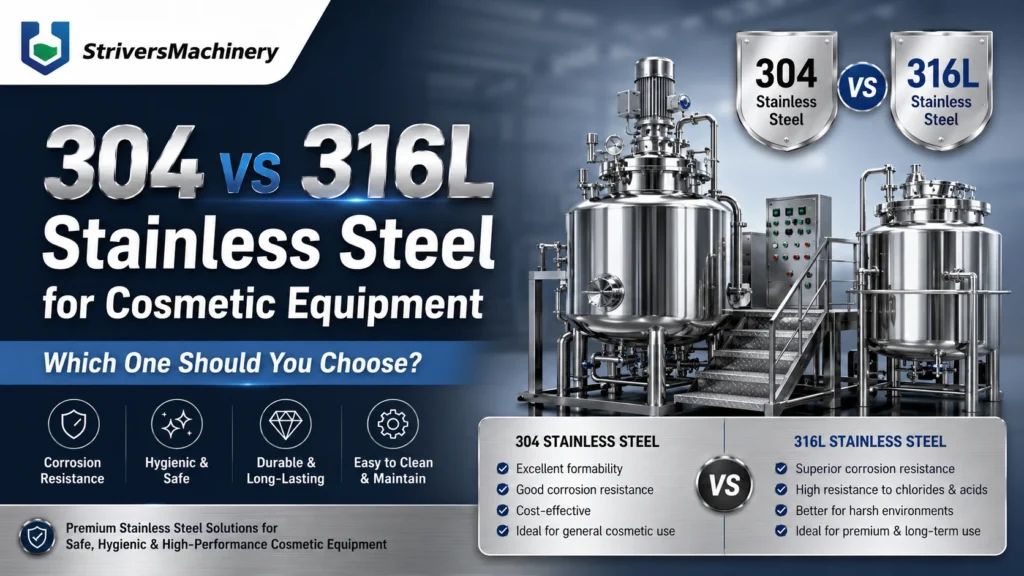
- Contact-part material (SUS304 vs. SUS316L matters enormously for corrosive or pharmaceutical-grade products)
- Motor brand (Siemens, ABB, and generic motors carry very different price points and long-term reliability profiles)
- PLC and HMI brand (Siemens, Schneider, Delta, and unbranded control systems differ in spare parts availability worldwide)
- Valve type and brand (pneumatic vs. manual, and which manufacturer)
- Surface finish (mirror-polished interior surfaces are standard for cosmetic and pharmaceutical contact parts; mill finish is not)
- Seal type (mechanical seal brand and material compatibility with your product)
None of this needs to be adversarial. Reputable suppliers welcome a buyer who asks these questions, because it means fewer disputes later. The suppliers who get evasive about naming specific brands are telling you something worth hearing.
We’ve seen contract disputes that came down entirely to a single undefined word. A buyer assumed “stainless steel” meant food-grade SUS316L; the quotation, read literally, never specified a grade, and the factory built in SUS304 — a perfectly legitimate stainless steel, just not the one the buyer needed for their corrosive formula. Nobody was lying, and nobody had acted in bad faith. The specification simply wasn’t specific enough to prevent two reasonable people from reading the same sentence two different ways.
The same pattern shows up with automation level. “PLC controlled” can mean a fully programmable system with recipe storage, data logging, and remote diagnostics — or it can mean a basic PLC handling three relay functions with none of that. If automation capability matters to your operation, describe exactly what the system needs to do (store how many recipes, log what data, integrate with which upstream or downstream equipment) rather than relying on a phrase that means different things to different suppliers.
Mistake 5: Buying Standard Equipment for a Customized Product
Cream, shampoo, gel, toothpaste, and perfume are not interchangeable from a process-engineering standpoint, even though they might all look similar in a marketing photo of “cosmetic production equipment.” Viscosity, shear sensitivity, temperature requirements, and ingredient reactivity differ dramatically between product types, and a mixer optimized for one can genuinely damage another — either physically (shear-sensitive emulsions breaking under too much agitation) or economically (a mixer too small or too slow for your actual batch size).
A high-viscosity cream typically needs a vacuum emulsifying mixer with a scraper system and a properly matched homogenizer, while a low-viscosity liquid like a toner or a fragrance base may only need a simple mixing tank with an agitator. Buying “whatever the supplier already has in stock” instead of a configuration matched to your actual formula is one of the most expensive mistakes on this list, because the fix is rarely a simple adjustment — it’s often a second machine.
A few signs your product likely needs a customized configuration rather than a standard model: your formula includes ingredients that are unusually abrasive, acidic, or heat-sensitive; your target batch size falls outside common tank sizes (an oddly specific 750 liters, say, rather than a round 500 or 1,000); or your process needs a step — a particular vacuum hold time, a specific homogenization sequence, an unusual heating and cooling curve — that a generic mixer’s standard programming doesn’t support out of the box.
Mistake 6: Ignoring Scale-Up Requirements
Lab-scale success does not automatically translate to production-scale success. A formula that emulsifies perfectly in a 5-liter benchtop mixer can behave completely differently at 2,000 liters, where heat transfer rates, mixing shear profiles, and vacuum draw times all change with volume. Buyers who order production equipment sized purely on projected sales volume — without validating that the formula actually scales the way they assume — sometimes discover the problem only after the first full batch comes out wrong.
If you’re moving from lab or pilot scale to full production for the first time, this deserves its own conversation with your equipment supplier’s process engineers before you finalize a specification. (We cover this in more depth in our separate guide on taking a lab formula through production scale-up.)
Practically, this often means running an intermediate pilot batch — somewhere between 200 and 500 liters — before committing to full production-scale equipment, rather than jumping directly from a 5-liter lab batch to a 3,000-liter tank. Heat transfer surface area doesn’t scale linearly with volume, which means larger batches heat and cool more slowly relative to their size. Mixing shear also behaves differently as impeller tip speed and tank geometry change. A pilot run at intermediate scale catches these issues while they’re still cheap to correct, rather than after a full production batch has already gone out of specification.
Specific things worth validating at pilot scale before finalizing your production equipment order: whether your target viscosity is actually achieved within an acceptable mixing time, whether emulsion stability holds up after the longer heating and cooling cycle a larger batch requires, and whether your vacuum system can reach and hold the draw needed to prevent air entrapment at the larger volume. A supplier’s process engineers should be willing to walk through these questions with you rather than simply quoting a tank size based on your stated output target.
Mistake 7: Not Considering Future Expansion
Buyers frequently spec equipment for exactly today’s volume, with no allowance for growth. Two years later, the company has doubled its sales, and the mixing tank that was perfectly sized at launch is now the bottleneck holding the whole production line back.
It’s worth discussing, at the quotation stage, whether your tank sizing, your automation level, and your layout leave room for a second tank, an additional filling head, or a capacity upgrade down the line — even if you have no immediate plan to use it. Retrofitting expansion capacity into an existing line is almost always more expensive than designing for it from day one.
The cost difference is rarely subtle. Adding a second discharge port, a slightly larger control cabinet, or extra piping connections during initial design might add a few hundred dollars to a quotation. Retrofitting the same features into an already-installed, already-running line — cutting into existing stainless steel, rerouting utilities, scheduling production downtime to do the work — routinely costs five to ten times as much, and sometimes isn’t physically possible without replacing the equipment outright.
The same logic applies to automation. A control system with spare I/O points and a PLC with headroom in its memory and processing capacity costs relatively little extra at the design stage, but makes adding a second filling head or integrating a new inspection camera down the line a software update rather than a hardware replacement. Ask your supplier directly whether the control system they’re proposing has room to grow, and by how much, before you assume “we can always upgrade it later” is actually true.
Mistake 8: Ignoring Quality Control
“Quality control” on a supplier’s website usually means very little without specifics. Ask what actually happens at each stage:
- Incoming QC — inspection of raw materials (steel, motors, valves) before they go into your machine
- In-process QC — checks during welding, polishing, and assembly
- Final QC — a documented pre-shipment inspection
- FAT (Factory Acceptance Test) — running the actual machine, ideally with your product or a close substitute, before it ships
- SAT (Site Acceptance Test) — confirming performance again after installation at your facility
- Inspection report — a written, signed document, not a verbal “everything is good”
If a supplier can’t produce documentation for any of these stages, that’s useful information — not necessarily disqualifying, but worth factoring into your decision.
A genuinely useful inspection report includes more than a checkmark and a signature. Look for actual measured values — recorded temperatures, pressures, running speeds, and cycle times taken during the FAT — along with photos of the equipment during testing and any deviations noted, however minor. A report that simply states “all parameters normal” without a single number attached to it tells you almost nothing about what was actually tested.
It’s also worth asking, specifically, who performs each inspection stage. Some suppliers rotate the same staff between production and QC roles, which creates an obvious incentive problem — the person who built the machine is not always the ideal person to sign off on whether it passed. A dedicated QC function, separate from the production team, is a small structural detail that tells you a lot about how seriously a factory takes its own inspection process.
Mistake 9: Poor Communication During the Project
Machinery projects that go quiet for three weeks and then resurface with “small changes” to the design are far more common than they should be. Structured communication is one of the cheapest risk-reduction tools available to a buyer, and it costs nothing beyond insisting on it upfront:
- Formal drawing approval before manufacturing begins (get it in writing, even if it’s just an email confirmation)
- A 3D layout review so you can catch clearance and utility-connection issues before steel gets cut
- A production schedule with named milestones, not just an estimated ship date
- Weekly (or at minimum biweekly) written progress updates
- Video inspection access at key manufacturing milestones, not just at the end
None of this is unusual to ask for. Suppliers who handle international projects regularly already have these processes in place — you’re simply confirming they’ll use them on your order.
A simple kickoff call at the start of the project, with both your technical contact and the supplier’s project engineer present, sets the tone for everything that follows. Use it to agree on communication frequency, name a single point of contact on each side, and confirm how design changes — however minor — will be documented and approved going forward. Projects that start this way rarely go quiet for three weeks in the middle.
The failure mode worth watching for specifically is the “small change” that arrives without a formal update — a slightly different valve because the originally specified one was out of stock, a minor dimension change to accommodate a manufacturing constraint, a substituted motor brand. Individually, any one of these might be perfectly reasonable. The problem is when they happen without your sign-off and you only discover them during FAT, or worse, after the machine has already shipped.
Mistake 10: Ignoring Compliance Requirements
Depending on your target market and industry, your equipment may need to meet specific compliance standards: CE marking for the European market, FDA-relevant material and design standards for U.S. food and pharma applications, GMP-compliant design (smooth welds, no dead legs, cleanable surfaces) for cosmetic and pharmaceutical production, UL certification for electrical components sold into North America, or ATEX compliance for equipment operating in explosive atmospheres (common in certain chemical and fragrance applications).
Confirm compliance requirements before you sign a contract, not after the machine arrives and your customs broker or your own quality team flags a missing certificate. Retrofitting compliance onto an already-built machine ranges from expensive to impossible.
One nuance worth understanding: CE marking, for many categories of industrial machinery, can be self-declared by the manufacturer based on a technical file and risk assessment, rather than always requiring third-party laboratory testing. That’s not a loophole — it’s how the system is designed to work for most machinery categories — but it does mean “CE marked” isn’t automatically the same guarantee as a product independently certified by a notified body. If your market or your own compliance team requires third-party certification specifically, confirm that distinction with your supplier before assuming standard CE marking covers it.
Mistake 11: Not Planning Logistics
Export logistics for industrial machinery is its own specialty, and buyers who assume “the supplier will handle it” without asking specifics sometimes discover gaps only when a container arrives with rust on unprotected carbon steel components, or when a tank turns out to be 15 centimeters too tall for the doorway it needs to pass through.
Before shipment, confirm: container loading plan and whether the equipment requires flat-rack or open-top shipping, export packing standard (fumigated wooden crates, moisture-barrier wrapping, desiccant for electronics), rust protection for any non-stainless components during ocean transit, and — critically — that your installation space, doorways, and ceiling heights have actually been checked against the equipment’s real dimensions, not the dimensions on an early-stage drawing that changed during design.
It sounds almost too basic to mention, but measure your actual doorway, stairwell, and ceiling clearance — not the dimensions from the building’s original floor plan, and not the equipment dimensions from an early design revision that changed before the final drawing was approved. We’ve seen tanks that needed to be tilted, partially disassembled, or routed through a different entrance entirely, simply because nobody double-checked a doorway against the final, as-built machine dimensions.
Mistake 12: Ignoring Installation and Training
A machine that arrives in perfect condition still needs to be installed, commissioned, and operated correctly to deliver value. Buyers sometimes treat installation support as an afterthought, only to find themselves with a fully paid-for line and no clear process for actually getting it running.
Before you order, clarify what installation support is included: remote video-guided commissioning, an engineer dispatched to your site (and who covers travel costs), a written operation and maintenance manual (ideally with photos or video, not just text), and structured operator training — not a two-hour walkthrough on the last day the supplier’s engineer is on site.
Remote commissioning has come a long way and works well for equipment your own maintenance team is already comfortable with conceptually — a standard filling or capping machine, for example. For genuinely novel process equipment, or a full turnkey line being commissioned for the first time, having an engineer physically on-site for at least the initial startup is usually worth the added cost, simply because some issues are much faster to diagnose in person than over a video call routed through a shaky factory-floor connection.
Training deserves its own sign-off, separate from installation. Before the supplier’s engineer leaves your site (or ends the final remote session), confirm your own operators can run the machine through a full cycle unassisted, including routine cleaning and basic troubleshooting — not just watch someone else do it once.
Mistake 13: Ignoring Spare Parts Strategy
Every machine has components that wear out on a predictable schedule — mechanical seals, gaskets, valve diaphragms, filling nozzles — and components that fail unpredictably but catastrophically when they do, like a specific motor or PLC module. Buyers who order a machine without also ordering a starter set of critical spares often find themselves facing weeks of production downtime waiting for an international parts shipment, over a component that costs a few hundred dollars.
Ask your supplier for a recommended spare parts list at the time of purchase, broken into “wear parts to stock immediately” and “critical parts worth holding in reserve,” along with a realistic maintenance schedule so you know when those wear parts actually need replacing.
A simple way to build that list: rank every major component by two factors — how likely it is to fail or wear out, and how badly production stops if it does. A gasket that wears predictably but takes ten minutes to swap is low priority to stock heavily. A specialty PLC module that rarely fails but would stop the entire line for three weeks while a replacement ships internationally is exactly the kind of part worth holding in reserve, even when it feels wasteful to buy a spare for something that “probably won’t break.”
Keep this list current, too. Equipment gets modified over time — a valve gets swapped for a different brand during a repair, a motor gets replaced with a locally sourced equivalent — and a spare parts list that still reflects the machine’s original configuration five years later is only partially useful when you actually need it.
Mistake 14: Not Understanding Warranty Terms
“One year warranty” sounds reassuring until you read the fine print — or discover there isn’t any fine print, because nothing was ever put in writing. Before signing a contract, confirm exactly what the warranty covers (parts only, or parts and labor), what it excludes (normal wear items are almost always excluded, but get the list), the guaranteed response time for a warranty claim, and what technical support looks like after the warranty period ends — because most machinery stays in service for a decade or more, and warranty coverage is only the first year or two of that relationship.
Extended warranty coverage and post-warranty service contracts are usually negotiable, particularly on larger orders, and they’re worth raising before you sign rather than after your standard warranty period has already started counting down. Some suppliers bundle discounted extended coverage into the original purchase price if you ask at the quotation stage; the question costs nothing, and the answer is sometimes yes.
It’s also worth clarifying warranty terms for components the supplier didn’t manufacture themselves — a third-party motor, a branded PLC, a purchased valve. These often carry their own manufacturer warranty, separate from the machine builder’s warranty, and knowing which warranty applies to which failure saves a confusing argument about liability if something breaks eighteen months in.
Mistake 15: Choosing Suppliers Without Long-Term Partnership Capability
The final mistake on this list is the easiest to overlook at the time of a first purchase, and the most expensive one to discover later: choosing a supplier purely for a single transaction, with no consideration of whether they can support you as your business grows.
Most manufacturers don’t buy one machine and stop. They expand capacity, add a second production line, upgrade automation, or integrate new equipment into an existing layout — sometimes years after the original purchase. A supplier who disappears after final payment, or who can no longer locate the drawings for a machine they built five years ago, leaves you starting from zero every time you need to expand.
This is where the factory-plus-trading model earns its keep. A supplier who both manufactures and manages the full project lifecycle — engineering, quality control, project management, installation, after-sales — is structurally set up to remain your long-term technical partner, not just a one-time vendor. If there’s a single filter that separates buyers with a five-year relationship from buyers hunting for a new supplier every single project, it’s this one.
When evaluating long-term partnership potential, ask a supplier how many repeat orders they’ve fulfilled for existing clients — not as a marketing statistic, but as a genuine question about whether clients come back. A supplier who can point to buyers who’ve placed a second or third order, expanded an existing line, or upgraded automation years after an original purchase is demonstrating exactly the continuity this mistake is about. A supplier who can only talk about first-time orders may simply be newer to the export market, which isn’t disqualifying on its own, but it’s a different risk profile worth factoring into your decision.
That’s the full list. Reading through all fifteen at once, a pattern should be obvious: almost every mistake is preventable with a question asked at the right stage and an answer captured in writing. None of them require a law degree, a procurement department, or a six-figure consulting budget to avoid — which is exactly why the checklist in the next section works as well as it does.
Part 3: Practical Checklist Before Ordering Machinery from China
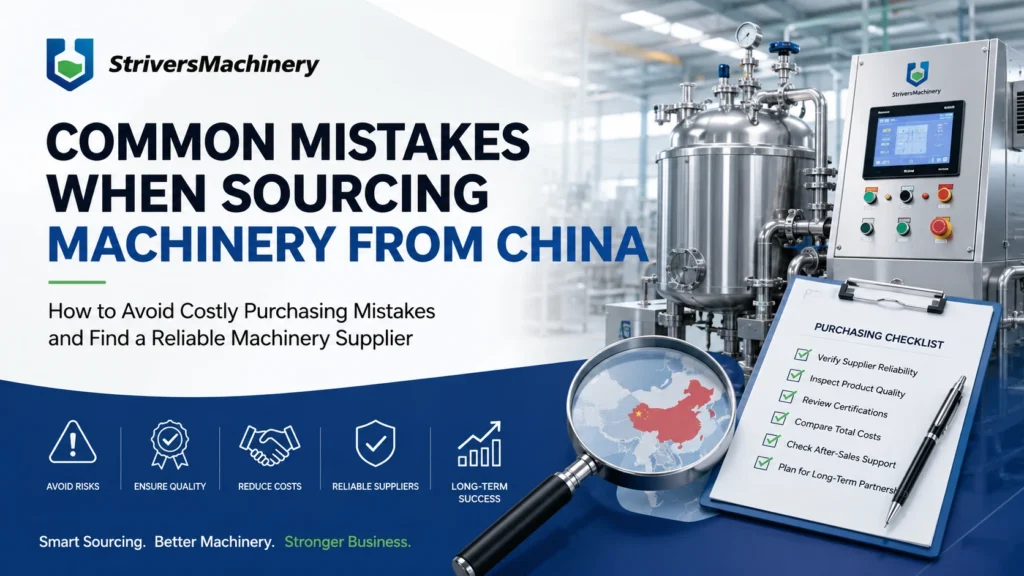
Save this section. Before you place a deposit on any machinery order, run through it.
Think of this list as roughly grouped into four phases: verifying who you’re buying from, locking down what exactly you’re buying, confirming how it gets built and inspected, and making sure everything after shipment — logistics, installation, and support — is actually agreed upon rather than assumed. You don’t need to complete every item in a single conversation, but every item should be resolved, in writing, before you authorize manufacturing to begin.
- Factory verified through video call or in-person visit
- Supplier type confirmed (factory, trading company, or factory-and-trading hybrid)
- Technical specification document signed off by both parties
- Voltage and frequency confirmed against your local power supply
- Contact-part material confirmed (e.g., SUS304 vs. SUS316L)
- Motor, PLC, and valve brands specified by name, not “famous brand”
- Capacity and output rate confirmed against your actual production targets
- Scale-up validation completed if moving from lab or pilot scale
- Future expansion capacity discussed, even if not needed immediately
- Drawing and 3D layout formally approved in writing
- Production schedule with milestones agreed upon
- FAT (Factory Acceptance Test) scheduled and confirmed
- Required certifications confirmed (CE, FDA, GMP, UL, ATEX as applicable)
- Export packing standard confirmed
- Container/shipping method confirmed for oversized equipment
- Installation space, doorway, and ceiling clearance measured against actual equipment dimensions
- Installation and commissioning support terms confirmed in writing
- Operator training plan confirmed
- Operation and maintenance manual to be provided (language and format confirmed)
- Recommended spare parts list obtained
- Warranty terms — coverage, exclusions, response time — documented in the contract
- Payment terms and milestones agreed upon and documented
- Contract includes technical specification as a binding attachment, not just price and delivery date
- Point of contact confirmed for post-warranty technical support
If you can check every box on this list before manufacturing begins, you have already eliminated the majority of the risk in this transaction. It’s worth keeping a copy of the completed checklist alongside your contract and technical specification — if a dispute ever does come up, having a documented, mutually agreed answer to each of these points turns a “he said, she said” argument into a five-minute reference check.
Decision Guide
Part 4: Case Studies
The following examples are drawn from real project patterns across the industries we work with. Client names and identifying details have been omitted. Each one maps back to one or more of the fifteen mistakes above — not because these particular projects went badly, but because the buyers involved specifically avoided a mistake that a less careful process would likely have hit.
Cosmetics: Scaling a Cream Formula Without Losing Product Quality
A mid-sized skincare brand had a cream formula that performed beautifully at pilot scale in a 50-liter mixer but was preparing to launch nationally, requiring a jump to 2,000-liter batches. Rather than simply ordering a larger version of the same equipment, the process moved through formal scale-up validation first — confirming heat transfer time, vacuum draw duration, and homogenizer shear rate all held up at the larger volume. The final specification included a vacuum emulsifying mixer with a scraper system and a properly sized homogenizer matched to the emulsion’s actual shear sensitivity, rather than a generic “big mixer.” The result was a production batch that matched the pilot-scale product within acceptable tolerance on the first full run — avoiding the costly trial-and-error reformulation that often follows a scale-up done on assumptions alone. The lesson generalizes well beyond cosmetics: the equipment specification should follow from validated process data, not from a straight-line extrapolation of a small batch recipe.
Food Processing: Matching Equipment to an Unusually Viscous Product
A sauce manufacturer had struggled with two previous mixer purchases that couldn’t handle their product’s viscosity profile without overheating the motor during extended runs. The underlying issue traced back to Mistake 5 and Mistake 4 from this guide — equipment purchased based on general “sauce mixer” category rather than the product’s specific rheology, with motor sizing that hadn’t been engineered against the actual torque requirement. Working through a proper technical specification process — including named motor brand and horsepower calculated against real product viscosity data — resolved the recurring overheating issue with the next equipment order. What made the difference wasn’t a fundamentally different machine; it was simply insisting on the specific engineering numbers behind the purchase, rather than trusting a category label.
Chemical Manufacturing: Building Long-Term Supplier Continuity
A specialty chemical producer initially ordered a single mixing and filling line, treating it as a one-time capital purchase. Eighteen months later, expanded demand required a second parallel line, plus modifications to the first line’s automation level. Because the original project had been documented thoroughly — full drawings retained, spare parts list on file, and a consistent project management contact — the expansion project moved substantially faster than the original order, without the buyer needing to re-explain their process requirements from scratch to a new supplier. The second project’s lead time came in roughly 30% shorter than the first, almost entirely because the technical groundwork didn’t have to be rebuilt from a blank page.
Part 5: How Strivers Machinery Helps Reduce Procurement Risks
We’re not going to spend this section telling you we’re the best machinery supplier in China — that’s not a claim any reasonable buyer should take at face value from a company’s own website, and it doesn’t actually answer the question that matters: how does working with us reduce the specific risks covered in this guide? Instead, here’s how our project structure maps directly onto the fifteen mistakes above, point by point, so you can judge for yourself whether it addresses the risks that actually matter to your project.
We operate as a factory-and-trading hybrid. Our manufacturing is factory-controlled, which keeps material sourcing, welding quality, and pricing transparent rather than routed through layers of subcontracting. Alongside that, we maintain dedicated engineering and international project management teams — the structure that lets us produce equipment at factory-direct cost while still supporting the documentation, communication, and after-sales processes that international buyers, especially first-time buyers, rely on.
Engineering that starts with your product, not our catalog. Whether you’re mixing a high-viscosity cream, an emulsified lotion, a food sauce, or a pharmaceutical liquid, our process starts with your formula and your production targets — batch size, viscosity, heat sensitivity, throughput — rather than pointing you toward whatever standard configuration happens to be easiest to build.
Quality control built around documentation, not just inspection. In-process checks, final QC, and Factory Acceptance Testing are standard parts of our production workflow, with written inspection reports rather than verbal assurances — because a report you can hold your own quality team accountable to is worth more than a sales promise.
Project management as a named function, not an afterthought. Drawing approval, 3D layout review, production milestones, and regular progress updates are handled by a dedicated project contact for the duration of your order, so “the factory went quiet for three weeks” isn’t a risk you have to manage on your own.
Installation, training, and after-sales that don’t end at final payment. From remote commissioning support to spare parts guidance and warranty service, our relationship with a buyer is built around the assumption that you’ll need this equipment to keep running — and possibly expand — for years, not that our job ends the day the machine ships.
Turnkey capability across the full production line. From mixing and vacuum emulsifying through filling, capping, sealing, labeling, coding, and cartoning — plus supporting systems like water treatment for cosmetic-grade water — we’re able to support projects as a single integrated line rather than requiring a buyer to coordinate compatibility between five different equipment vendors.
If long-term partnership capability (Mistake 15) is the filter that matters most as your business grows, it’s the one we’ve built our project structure around from the start.
Documentation that survives staff turnover on both sides. Drawings, specifications, spare parts lists, and inspection reports are retained on our end for the life of the equipment, which matters more than it might sound — the engineer you worked with three years ago may have moved on, and so might yours, but the project file shouldn’t disappear with either of you when it’s time to order a replacement part or plan an expansion.
Conclusion
If there’s one idea worth taking away from all fifteen mistakes above, it’s this: successful machinery sourcing is about choosing the right partner, not simply the lowest quotation. Price matters — nobody is suggesting otherwise — but price is a single input into a decision that actually depends on manufacturing capability, technical specification accuracy, quality control rigor, communication discipline, logistics planning, installation support, and long-term partnership potential.
None of the fifteen mistakes in this guide require expensive countermeasures to avoid. They require asking specific questions before you sign a contract, putting agreements in writing, and treating the sourcing process as the sequential, verifiable workflow it actually is rather than a shortcut from “quotation” to “wire transfer.”
Print or bookmark the Part 3 checklist and use it on your next quotation, even if you’re already deep into conversations with a supplier you like. Going back to fill in a gap — confirming a motor brand, getting a warranty term in writing, asking for a spare parts list — costs you a slightly awkward follow-up email. Discovering the gap after the machine is running on your factory floor costs considerably more.
Sourcing machinery from China isn’t a gamble, and it isn’t a shortcut either. It’s a project like any other significant capital purchase — one that rewards buyers who ask specific questions early and penalizes buyers who assume good intentions will substitute for a written specification. The fifteen mistakes above aren’t a list of things that might go wrong. They’re a list of things that already have gone wrong, repeatedly, for buyers who skipped a step that felt optional at the time.
If you’re currently evaluating suppliers for a mixing, emulsifying, filling, or full turnkey production line and want a second opinion on a specification or a quotation you’ve already received, our engineering team is available to review it — no obligation, and no pressure to switch suppliers if what you already have checks out.