The Complete Guide to Buying Cosmetic Production Equipment: From RFQ to Factory Handover
Most delays in a cosmetic equipment project aren’t caused by the manufacturer. They’re caused by something much less dramatic — a requirement that wasn’t fully defined, a utility connection nobody checked in advance, a batch size that turned out to be wrong once the quotation was already in hand. Buying a vacuum emulsifying mixer, a filling line, or a full cosmetic production line involves more decisions than most first-time buyers expect, and the ones made early — before a single quotation arrives — tend to matter more than anything decided later.
It’s an easy trap to fall into. A production manager knows roughly what they need, reaches out to two or three suppliers with a brief description, and expects a straightforward comparison of prices to follow. What actually comes back is often three quotations built on three different sets of assumptions, none of which quite match what the buyer had in mind, and none of which are directly comparable to each other. Untangling that mess later costs far more time than defining requirements clearly would have taken at the start.
This guide walks through that entire process in order: preparing your requirements, writing an RFQ that actually gets you an accurate quotation, choosing the right equipment configuration, evaluating suppliers on more than price, preparing your factory before the equipment even ships, running a proper Factory Acceptance Test, handling shipping and installation, training your operators, and avoiding the mistakes that trip up almost every first-time buyer at least once. Strivers Machinery has walked customers through this process enough times to know where it usually goes wrong — and where a little preparation saves weeks of delay later. None of what follows requires specialized engineering knowledge going in. It just requires knowing which questions to ask, and asking them early enough to matter.
Why Preparation Matters More Than Most Buyers Expect
It’s tempting to assume that project delays come down to the manufacturer — a late shipment, a slow production schedule, a factory that overpromised. In our experience, the more common cause sits on the customer’s side of the table, and it’s rarely intentional.
Unclear requirements are the biggest culprit. A buyer requests “a mixer for cream” without specifying viscosity, batch size, or whether the formulation is heat-sensitive, and the resulting quotation ends up being a rough guess rather than an accurate recommendation. Underestimated utilities come next — a factory assumes their existing electrical supply or steam capacity will cover a new machine, only to discover during installation that it won’t, sometimes only after the equipment has already been unloaded and connected. Incorrect batch size is another common one, where a company quotes based on today’s output without accounting for where production is actually headed over the next year or two. And insufficient installation space rounds out the list, when a machine arrives and simply doesn’t fit through the door it was meant to go through, or leaves no clearance for the maintenance access an operator will need every week.
None of these are unusual mistakes. They’re the default outcome of moving quickly without pausing to define requirements clearly, and they happen to experienced buyers just as often as first-timers — sometimes more, since familiarity can make a team assume they already know the answer to a question nobody actually confirmed for this specific project. A well-prepared buyer usually receives a more accurate quotation and a better machine recommendation — not because the supplier tries harder, but because there’s simply more accurate information to work with from the very first conversation.
It’s worth adding that preparation doesn’t mean becoming a mechanical engineer overnight. It means knowing your product, knowing your factory, and being willing to answer a supplier’s questions in detail rather than treating them as an inconvenience standing between you and a quotation. The suppliers who ask the most detailed questions upfront are usually the ones who end up delivering the best-fitted equipment, precisely because they’re not filling in gaps with guesswork.
Defining Your Production Requirements
This is the part of the process that decides almost everything downstream, and it’s also the part most buyers rush through fastest, usually because it feels like paperwork standing between them and an actual conversation about equipment. It’s worth treating it as the opposite — the more precisely this stage is handled, the less renegotiation, redesign, or rework tends to happen later in the project.
Product Information. Start with what you’re actually producing — cream, lotion, serum, gel, shampoo, conditioner, or ointment. Each of these behaves differently under mixing, heating, and vacuum, and equipment sized for one doesn’t automatically suit another, even when the batch volumes look identical on paper. A shampoo and a thick body cream might both be “500 liters,” but the mixing intensity, homogenizing approach, and even the pump type suited to moving each one downstream can look quite different.
Formula Characteristics. This is where a lot of RFQs fall short, and it’s worth spending real time on, since it’s genuinely the section that separates an accurate quotation from a guess. Viscosity matters more than almost any other single factor — a thin serum and a thick ointment need very different mixing and pumping equipment even if both are technically “creams” in casual conversation, and viscosity that seems similar at room temperature can behave very differently once heated during production. Oil content affects emulsification approach and heating requirements, since higher oil-phase formulations often need more aggressive homogenization to achieve a stable emulsion. Powder dispersion, if your formula includes powders that need to be wetted and incorporated without clumping, calls for specific mixing geometry and sometimes a dedicated powder induction system rather than simply dumping powder into an open vessel. Heat-sensitive ingredients change how a heating and cooling system needs to be controlled, sometimes requiring more precise temperature ramps than a standard jacketed vessel provides, particularly where active ingredients degrade above a specific temperature threshold. And foaming tendency affects whether vacuum deaeration is a nice-to-have or a genuine requirement for your product to come out right — surfactant-heavy formulations in particular tend to trap air readily during mixing, and that trapped air shows up later as visible bubbles or inconsistent fill volumes if it isn’t removed before the product leaves the mixing stage.
Production Capacity. Getting this number right shapes almost every equipment decision that follows, from tank size down to pump selection and even the layout of your factory floor.
| Production Scale | Typical Batch Size |
|---|---|
| Laboratory | 5–20 L |
| Pilot | 30–100 L |
| Small Production | 100–300 L |
| Medium Production | 500–1,000 L |
| Large Production | 2,000 L+ |
Future Expansion. It’s worth resisting the temptation to size everything around today’s output alone. Expected production growth over the next few years, additional product lines you might add to the same facility, and automation upgrades you may want down the road all affect whether the equipment you buy now still makes sense in two or three years — or whether you’ll be back in the market sooner than planned, paying to replace equipment that’s barely broken in. A conversation about capacity that only covers this year’s numbers is a conversation that’s likely to need revisiting sooner than anyone would like.
How to Prepare an Effective RFQ (Request for Quotation)
An RFQ that’s missing half the picture gets you a quotation that’s also missing half the picture — usually padded with assumptions that may or may not match your actual situation, and often discovered only once the equipment has arrived and doesn’t quite fit. A properly prepared RFQ, on the other hand, tends to get you a number you can actually trust, and gets you there faster, since a supplier isn’t stuck sending back three rounds of clarifying questions before they can even begin sizing equipment.
Start with basic company information — who you are, where the equipment is going, and what your timeline looks like. This sounds obvious, but a surprising number of RFQs arrive without a clear delivery location or timeline, which makes it difficult for a supplier to advise on shipping method or realistic lead time. Follow that with the product information and formula characteristics covered above, since this is the foundation everything else builds on, and it’s worth attaching any formulation details you’re comfortable sharing rather than describing them in a single vague sentence.
Utility conditions matter more than most first-time buyers realize. Voltage and frequency vary by country and even by region within some countries, and getting this wrong means a motor or control panel that simply doesn’t work when it arrives — a mistake that’s expensive and slow to correct once equipment has already shipped. Steam availability, cooling water access, and compressed air supply all affect which heating and vacuum systems are realistic options for your factory, so include what you actually have available rather than what you think a supplier wants to hear, or worse, what you assume you’ll eventually install without having confirmed it.
Regulatory requirements are worth spelling out clearly too — GMP compliance, CE marking, FDA-related documentation, or other certifications relevant to your target market. A supplier who knows this upfront can quote equipment that’s actually compliant from day one, rather than equipment that needs modification later once the gap is discovered, sometimes during an audit when there’s no room left to fix it quietly.
Automation expectations round out a solid RFQ. Are you looking for manual operation, semi-automatic, full PLC control, or recipe management that lets operators switch between products with a few button presses instead of manual adjustment of every parameter each time? This single decision affects both price and long-term ease of operation considerably, so it’s worth being specific rather than leaving it open-ended and hoping the supplier guesses correctly.
Before sending your RFQ, it helps to run through a simple checklist: production requirements defined, formula characteristics documented, capacity and future expansion considered, utility conditions listed, regulatory requirements specified, and automation expectations stated. Buyers who work through this list before reaching out tend to get quotations back faster and with far fewer follow-up questions — which, in practice, often shaves days or weeks off the entire procurement timeline before a single machine has even been built.
Need help selecting the right machine configuration? Contact our engineering team for a customized recommendation based on your actual formulation and production targets. It’s usually a short conversation, but the questions asked during it — about your product, your factory, and your growth plans — tend to shape the rest of the project more than anything that happens afterward.
Choosing the Right Equipment Configuration
This is usually the largest set of decisions in the entire buying process, and it’s where a knowledgeable supplier earns their value the most — the difference between a generic recommendation and one tailored to your actual formulation often shows up years later in product consistency, not on the day the equipment first arrives.
Selecting the Right Capacity. Bigger isn’t automatically better. A tank sized well beyond your actual batch volume runs inefficiently, costs more upfront, and takes up floor space you may need for something else later — and running a large vessel at a fraction of its rated capacity often produces less consistent mixing than a properly sized tank running near its intended volume. The right capacity accounts for your current output and your realistic growth, not the largest number that fits your budget or the number that felt reassuringly safe during a sales conversation.
Heating Method. Electric heating is simpler to install and doesn’t require a steam supply, making it a common choice for smaller facilities or where steam infrastructure doesn’t already exist, and it also tends to offer finer temperature control for formulations with narrow acceptable heating ranges. Steam heating tends to suit larger operations that already have a boiler system in place, offering faster heat-up times at scale and often lower running costs once the infrastructure is already there. Neither option is universally better — it depends on what utilities your factory already has, how quickly you need to heat larger batches, and how many other pieces of equipment might eventually share that same steam or electrical supply.
Homogenizer Selection. The homogenizer is often where emulsion quality is actually decided, more than any other single component in the line. Shear rate, homogenizing head design, and whether the unit is fixed or movable inside the vessel all affect particle size distribution in your final product — which in turn affects texture, stability, and shelf life. A formulation that separates on the shelf after a few months more often traces back to insufficient or inconsistent homogenization than to a problem with the raw materials themselves.
Mixing System. Anchor scrapers, high-shear disperser blades, and multi-stage agitators each suit different viscosity ranges and formulation types. A mixing system chosen for a thin lotion often underperforms badly on a thick ointment, and vice versa — an anchor that scrapes vessel walls efficiently for a thick product may do very little useful work in a low-viscosity liquid, while a disperser blade sized for thin liquids can struggle to move a thick paste at all.
Vacuum System. Vacuum removes air bubbles that would otherwise show up as visible defects or reduced product stability, and it also plays a role in preventing oxidation-sensitive ingredients from degrading during processing. The required vacuum level depends on your formulation’s foaming tendency and how sensitive the finished product is to trapped air, and it’s worth discussing target vacuum levels explicitly rather than assuming a standard system will automatically suit every formulation equally well.
CIP Cleaning. Clean-in-place systems reduce the labor and downtime associated with manual cleaning between batches, particularly valuable if you’re running multiple product changeovers per day, or if your product category requires strict validation of cleaning effectiveness between runs. It’s worth confirming CIP compatibility early, since retrofitting it later is far more disruptive — and considerably more expensive — than specifying it from the start of the project.
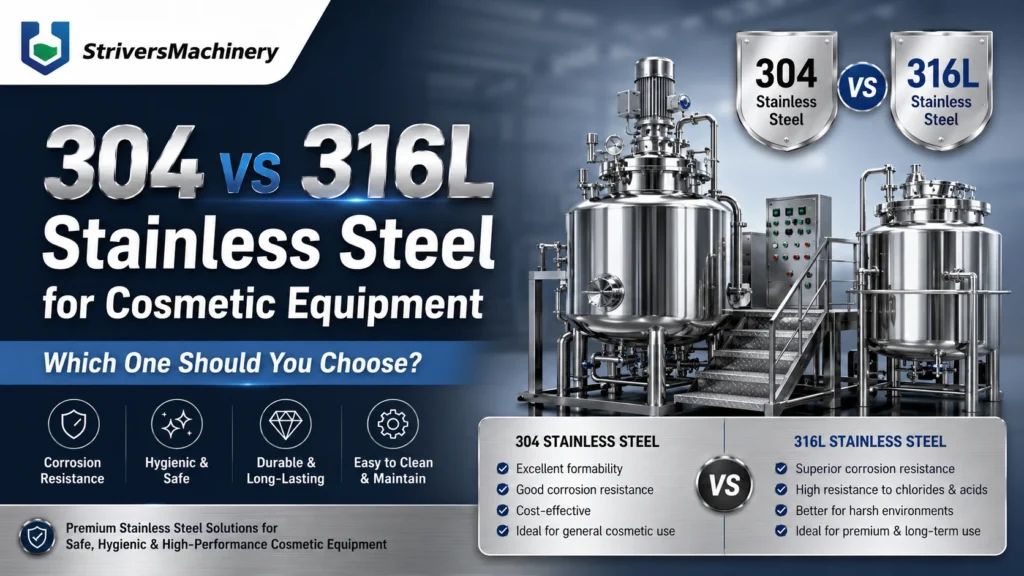
Material Selection. The choice between 304 and 316L stainless steel comes down to what your formulation contains. 316L includes molybdenum, giving it meaningfully better resistance to chlorides, acids, and more aggressive formulations, while 304 handles standard, less aggressive products at a lower cost. Choosing 304 for a formulation that turns out to be more corrosive than expected is a mistake that only becomes visible after the vessel has been in service for a while, by which point replacing it is a far bigger undertaking than specifying correctly the first time.
Automation Level. PLC control, recipe management, and remote support capability all affect how consistently your line runs and how quickly problems get diagnosed when something doesn’t look right. Recipe management in particular becomes valuable quickly once you’re running more than one or two products through the same line, since it removes the guesswork and human error that comes with operators manually re-entering parameters for every changeover.
Strivers Machinery’s vacuum emulsifying mixers, mixing tanks, filling machines, and RO water treatment systems are engineered to work together as a coordinated line rather than as individual components chosen in isolation — which matters more than it might seem once you’re trying to get consistent output across an entire process, not just a single machine. Equipment that communicates well mechanically and electrically across every stage tends to produce fewer surprises during commissioning than equipment assembled from several unrelated suppliers, each of whom only ever saw their own piece of the puzzle.
Evaluating Suppliers Beyond Price
Price comparisons are the easiest part of supplier evaluation, and also the least reliable on their own. A few factors matter considerably more once you look past the number on the quotation, even though they’re harder to compare at a glance across three or four different offers.
Manufacturing experience tells you whether a supplier has actually built equipment like yours before, or whether your project will be their first attempt at a particular configuration — it’s worth asking directly, since suppliers are generally happy to point to relevant past projects when they have them. Engineering support indicates whether you’ll get a real recommendation tailored to your formulation, or a generic answer pulled from a catalog with minor adjustments to the model number. Spare parts availability determines how quickly you can get back up and running if something wears out — a part that has to be custom-made and shipped internationally can cost you weeks of downtime, whereas a supplier who stocks common wear parts can often ship a replacement within days. Technical documentation, including drawings, manuals, and specifications, affects how easily your maintenance team can actually operate and service the equipment once it’s installed, and this becomes particularly important years down the line when the original installation team may no longer be around to answer questions from memory. After-sales service and remote support determine what happens after the invoice is paid, which is often when the real relationship with a supplier begins rather than ends — a supplier who’s responsive during the sales process but slow to respond afterward is a pattern worth watching for during early communication. And installation support — whether a technician comes on-site, or you’re left with a manual and a phone number — changes both cost and how smoothly your line actually starts producing usable output from day one.
A few warning signs are worth taking seriously if you notice them during supplier evaluation. Unrealistically low prices compared to every other quotation you’ve received usually mean something is being cut — material grade, testing, or support, even if it isn’t stated outright in the quotation itself. Missing technical specifications, where a supplier can’t or won’t provide detailed numbers on capacity, motor power, or material grade, suggests either inexperience or a lack of transparency that’s likely to continue after the sale. No Factory Acceptance Test offered before shipment removes your ability to catch problems before the equipment leaves the factory, shifting all of that risk onto your side of the transaction. No documentation provided alongside the machine leaves your team without the manuals and drawings they’ll need for years of operation, forcing them to rely on memory or trial and error. And no clear warranty details, left vague or unwritten, tend to become a real problem exactly when you need that warranty most — usually the worst possible moment to discover the terms were never actually agreed upon in writing.
None of these warning signs are automatically disqualifying on their own, and it’s worth having an actual conversation about any concern rather than walking away at the first sign of one. A supplier who responds to a direct question about missing documentation with a clear explanation and a plan to fill the gap is behaving very differently from one who deflects the question entirely — and that difference in how a concern gets handled often tells you more about what working with them long-term will actually be like than the original quotation ever could.
Preparing Your Factory Before Delivery
Equipment arriving at a factory that isn’t ready for it is one of the more common — and most avoidable — sources of installation delay, and it’s frustrating precisely because almost every issue in this category could have been caught weeks earlier with a bit of planning.
Factory Layout. A clear layout drawing showing where each piece of equipment will sit, how product and materials will flow between stages, and where operators will need access makes installation dramatically smoother. It’s worth working this out before equipment ships, not after it arrives at your loading dock, since moving a heavy tank a second time because the original spot didn’t account for a door swing or an overhead obstruction is far more disruptive than adjusting a drawing.
Installation Space. Door width, ceiling height, maintenance clearance around each machine, and forklift access all need checking against actual equipment dimensions — not assumptions, and not the dimensions of a similar-looking machine from a different project. A tank that fits comfortably in a floor plan drawing can still fail to clear a doorway it was never actually measured against, and discovering that on delivery day, with a truck waiting outside, is not a position anyone wants to be in.
Utilities. Electricity supply matching the equipment’s voltage and phase requirements, steam capacity if your heating method calls for it, water supply for cooling and cleaning, compressed air for pneumatic components, proper drainage for CIP and general cleaning, and internet connectivity if your PLC system supports remote service — all of these need to be in place, not planned for “sometime before installation,” a phrase that has a way of becoming “the week installation was supposed to happen.”
Floor Requirements. Floor flatness affects how level a mixing vessel sits, which in turn affects mixing performance and long-term wear on bearings and seals. Load capacity needs to handle the equipment’s full weight when filled with product, not just its empty weight, since the difference between an empty and a full vessel can be substantial for larger capacities. Chemical resistance matters if cleaning agents or product spills will contact the floor regularly, since standard flooring can degrade faster than expected under repeated exposure. And proper drainage prevents standing water from becoming a hygiene issue over time, particularly in areas subject to regular washdown.
Environmental Conditions. Ventilation, temperature control, humidity levels, and cleanroom requirements — where applicable — all affect both product quality and equipment longevity, and they’re far easier to plan for before installation than to retrofit afterward, when walls, ductwork, and flooring may already be in place around equipment that’s difficult to move.
Request a factory layout review before placing your order. Our team can review your space and utility conditions against your intended equipment configuration before anything ships, catching mismatches while they’re still easy and inexpensive to fix.
Factory Acceptance Test (FAT): Why It Matters
A Factory Acceptance Test happens before your equipment leaves the manufacturer’s facility, and it’s one of the most valuable steps in the entire process — yet it’s also one that gets skipped more often than it should, usually to save a bit of time or travel cost that ends up looking small compared to the cost of a problem discovered only after installation.
A thorough FAT typically covers a motor test confirming the drive system runs correctly under load rather than just spinning freely with no resistance, a vacuum test verifying the system reaches and holds its rated vacuum level over a realistic period rather than briefly touching it and drifting back up, a heating test checking that temperature ramps and holds match specification across the full range your formulation requires, a cooling test confirming the cooling cycle performs as expected and within an acceptable timeframe, a safety test verifying interlocks, emergency stops, and other protective systems function correctly under simulated fault conditions, and a documentation review confirming that manuals, drawings, and certificates match what was actually built rather than a generic template pulled from a different project.
For international buyers who can’t travel to witness a FAT in person, a remote FAT — conducted over video call with the manufacturer walking through each test live, camera pointed at gauges and control panels as tests run — is a practical alternative that catches most of the same issues a physical visit would. It’s worth requesting explicitly rather than assuming a supplier will offer it without being asked, and it’s worth preparing a short list of questions in advance so the call covers everything that actually matters to your specific formulation rather than a generic walkthrough.
Shipping, Installation & Site Acceptance
Once equipment passes FAT, the next stretch of the project shifts from manufacturing concerns to logistics and installation concerns — a different set of risks that deserve their own attention, and ones that catch out buyers who assumed the hard part was already behind them.
Shipping preparation starts with proper packing designed for the actual journey, not a generic crate — equipment that will spend weeks at sea handling humidity and vibration needs different protection than something making a short domestic trip. Incoterms need to be clearly agreed upon so there’s no confusion later about who’s responsible for what stage of transit, since disputes over responsibility tend to surface exactly when something has already gone wrong and everyone’s under pressure to resolve it quickly. And an inspection before the container is sealed catches any last-minute issues while they’re still easy to address, rather than after a container has already crossed an ocean.
Machine installation covers mechanical installation — positioning and securing the equipment according to the layout plan agreed upon earlier — electrical connection matching the utility specifications confirmed during the RFQ stage, and utility connection tying the machine into steam, water, and compressed air supply as needed. Each of these steps benefits from having the original layout and utility documentation on hand, rather than relying on memory or assumptions about what was agreed months earlier.
A Site Acceptance Test (SAT) is where installed equipment gets tested in its actual operating environment, which is a meaningfully different exercise from the Factory Acceptance Test that happened before shipment. FAT confirms the equipment works correctly at the manufacturer’s facility, under controlled conditions with the manufacturer’s own utilities and technicians close at hand. SAT confirms it works correctly at your facility, connected to your actual utilities, in your actual environment — which is ultimately the test that matters most, since a machine that performed perfectly in a factory in a different country still needs to perform correctly connected to your specific power supply, your water quality, and your ambient conditions, none of which are guaranteed to match exactly what the equipment experienced during its original testing.
Commissioning typically moves through stages: empty running to confirm mechanical operation without any product involved, running with water to test heating, cooling, and mixing without risking actual formulation, running with product in smaller test batches to confirm real-world performance before committing to a full run, and finally full production runs once every earlier stage has checked out and any adjustments have been made. It’s worth resisting the urge to skip straight to full production once a machine is installed and running — each intermediate stage exists specifically to catch a different category of problem while it’s still cheap and easy to fix, rather than after a full batch of formulation has already been committed to the vessel.
Operator Training & Handover
Decision Guide
Equipment that arrives and gets installed correctly can still underperform if the people running it every day weren’t properly trained on it, and this step is easy to compress or skip entirely once a project is already running behind schedule and everyone’s eager to start production.
Operator training should cover day-to-day operation — starting, stopping, adjusting parameters, and running through a normal batch cycle — in enough detail that operators feel confident, not just briefed in a rushed half-day session before the installation team departs. Maintenance training covers routine checks, lubrication schedules, and basic troubleshooting that keeps small issues from becoming large ones, ideally demonstrated hands-on rather than only described verbally. Cleaning procedures need to be demonstrated directly, not just described in a manual, particularly for CIP systems and any manual disassembly required for deep cleaning, since a cleaning step skipped or done incorrectly can compromise product quality in ways that aren’t immediately visible.
Handover documentation should include a complete spare parts list with part numbers, so replacement ordering doesn’t require guesswork or a slow back-and-forth with the supplier months later. An operation manual covering normal use and common troubleshooting steps, written clearly enough that a new operator joining the team later can learn from it directly. Electrical drawings for your maintenance team to reference during any future modification or repair work, since working blind on live electrical systems is both inefficient and unsafe. And a maintenance schedule laying out what needs checking, and how often, over the equipment’s working life, so preventive maintenance happens on a plan rather than only after something has already gone wrong.
Common Mistakes First-Time Buyers Make
Some version of these mistakes shows up in nearly every first-time cosmetic equipment purchase we’ve been involved in, which is exactly why they’re worth listing out directly rather than leaving buyers to discover them the hard way, one expensive lesson at a time.
Buying only based on price, without weighing manufacturing experience, support, or documentation against the number on the quotation, is probably the single most common mistake, and often the most expensive one over the equipment’s working life. Ignoring future expansion, and sizing equipment purely around today’s output, leads to premature replacement or costly retrofitting sooner than expected. Ordering no spare parts alongside the main equipment leaves a facility exposed to weeks of downtime over a part that could have shipped in the same container for a fraction of the cost of an emergency order later. Skipping operator training, and assuming a manual alone will get a team up to speed, tends to show up as inconsistent product quality that takes months to trace back to its actual cause. Neglecting factory preparation, and discovering utility or space mismatches only once equipment has already arrived, turns a planning problem into an expensive on-site delay. Ignoring after-sales service entirely when comparing suppliers, focusing purely on the initial purchase, leaves a buyer with nowhere to turn once something inevitably needs attention down the road. Choosing incorrect capacity, either oversized and inefficient or undersized and quickly outgrown, wastes money in either direction. Missing the Factory Acceptance Test, losing the chance to catch problems before shipment, shifts risk onto the buyer at exactly the point when it’s hardest to fix. Ignoring utility requirements until installation day, when they’re far harder to fix, turns a five-minute conversation early on into a multi-week delay later. And not reviewing drawings before shipment misses an opportunity to catch design mismatches while changes are still simple and inexpensive to make.
Downloadable Checklists
Working through this entire process is considerably easier with something concrete to check off along the way, rather than trying to hold every requirement in your head across weeks of supplier conversations. We recommend keeping three checklists close at hand throughout your project: an RFQ Checklist covering everything worth including before you request quotations, a Factory Preparation Checklist covering layout, utilities, and floor requirements before equipment arrives, and a Machine Acceptance Checklist covering what to verify during both FAT and SAT. Ask our team for downloadable versions of all three if you’d like something to work from directly rather than building your own from scratch — it’s a small resource that tends to save real time once a project actually gets underway.
Planning Your Next Cosmetic Production Line
Buying cosmetic production equipment well isn’t really about finding the lowest quotation — it’s about walking through each stage of this process deliberately, from defining your formulation’s requirements through to training the operators who’ll run the line every day. The buyers who avoid the most delays and the most expensive surprises are usually the ones who took requirements seriously from the very first conversation, not the ones who moved fastest to a purchase order.
That doesn’t mean the process needs to be slow. It means the early steps — defining your product, documenting your utilities, being specific about capacity and automation — deserve the same attention as choosing between suppliers, since they shape every decision that follows. A week spent getting requirements right at the start routinely saves months of rework, delay, and frustration later, and it’s a trade almost every experienced buyer would happily make again given the choice.
Planning a new cosmetic production line?
Contact Strivers Machinery for equipment selection, factory layout advice, and complete installation support — from your first RFQ through commissioning and beyond. Feel free to contact us.