Factory + Trading Model: How Strivers Machinery Helps Reduce Your Equipment Procurement Costs
Procurement Cost Is More Than Equipment Price
Ask most buyers what drives their budget and they’ll point straight at the equipment quotation. That’s only part of the picture, and often not even the largest part once a project is fully underway. The line items that actually decide your total spend tend to sit outside the quote entirely, scattered across freight invoices, customs paperwork, and the internal hours spent keeping a project on schedule.
Equipment Price
Still the starting point, and still worth comparing carefully — but rarely the whole story once a project gets underway. Two suppliers quoting a similar machine at very different prices are often quoting genuinely different levels of build quality, material grade, or included support, not just different margins.
Transportation & Packaging
Freight rates, container utilization, and how well equipment is packaged for the journey all shift the real landed cost, sometimes significantly. A poorly packed shipment that arrives with damage doesn’t just cost a repair — it costs the delay while a replacement part is sourced and shipped.
Import Duties & Customs
Tariff classification and documentation accuracy can mean the difference between a smooth customs clearance and equipment sitting at port for weeks while paperwork gets sorted out, with demurrage charges accumulating the entire time.
Installation & Commissioning
Whether a supplier sends a technician, provides detailed remote guidance, or simply ships a machine with a printed manual changes both the immediate cost and how quickly the line actually starts producing usable output.
Spare Parts Availability
A part that’s readily stocked costs relatively little to replace and arrives quickly. A part that has to be custom-made and shipped internationally can shut down a line for weeks — and that lost production time is rarely factored into anyone’s original budget.
Equipment Downtime
Every day a line isn’t running is lost production, and downtime caused by a poor equipment fit, an unclear manual, or delayed technical support rarely shows up anywhere in the original project cost estimate.
Supplier Management
Coordinating quotations, payments, and schedules across multiple vendors takes real staff time — time that has a genuine cost even if nobody ever puts a number on it in a spreadsheet.
Long-term Maintenance
Ongoing service, wear parts, and technical support over the equipment’s working life often outweigh the original purchase price by the time you total everything up across several years of operation.
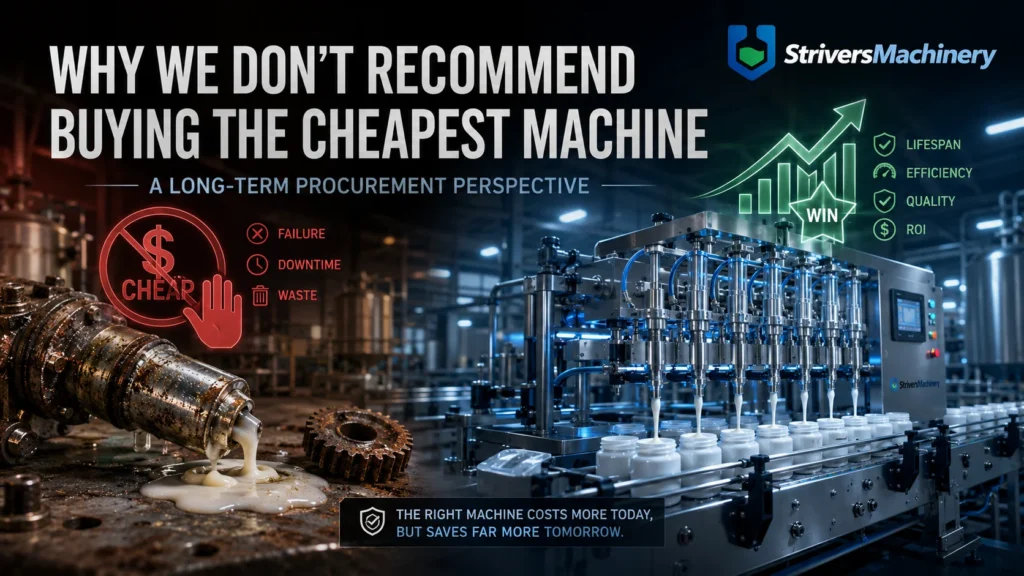
The lowest quotation doesn’t always result in the lowest total cost of ownership. It’s a simple point, but it’s easy to lose sight of when quotations are sitting side by side on a spreadsheet and one number is clearly the smallest on the page.
Why Factory-Only Purchasing Doesn’t Always Save Money
There’s a common assumption in procurement: factory equals cheapest, because you’ve cut out the middleman entirely and you’re paying the manufacturer’s own price. It’s a reasonable instinct, and it’s not always wrong — but it’s not automatically right either, and the gap between the two often only becomes visible once a project is well underway.
Going straight to a factory can come with its own set of problems that don’t show up on the initial quotation. Product range is often limited to whatever that one factory happens to build, which means you’re back to sourcing separately for anything outside their catalog. Export experience varies enormously from one manufacturer to the next — some ship internationally every week, others rarely leave their domestic market and it shows in how they handle documentation, packaging, and communication. Language and time zone gaps can turn a simple technical question into a multi-day back-and-forth. There’s no integrated solution when your line needs several different machine types from different specialties. Logistics end up handled separately for each piece of equipment, with each shipment on its own schedule. And after-sales support can be inconsistent, especially once a factory’s attention has moved on to its next order and yours is no longer the priority.
Consider a fairly typical procurement scenario. A customer needs a vacuum emulsifying mixer, a filling machine, a conveyor, and a capping machine for a single production line. Sourced factory-direct, that usually means reaching out to four to six different suppliers, each with its own quotation process, payment terms, quality inspection requirements, shipping arrangement, and after-sales contact person — assuming there even is a dedicated after-sales contact once the invoice is settled.
Multiply that across a whole project and what actually increases isn’t equipment cost — it’s management cost. Someone on your team is now spending hours every week just keeping four or five supplier relationships moving in the same direction, chasing production updates, reconciling different quality documentation formats, and trying to align shipping schedules so equipment doesn’t arrive weeks apart from equipment it needs to connect to.
What Is the Factory + Trading Model?
This is the model Strivers Machinery is built around, and it’s worth being specific about what it is and isn’t, since the term “trading company” carries some baggage worth addressing directly.
Partner Manufacturers
        ↓
Manufacturing Resources
        ↓
Strivers Machinery
Engineering · Quality Control · Project Management · International Trade
        ↓
Customer
It isn’t a traditional trading company that simply marks up equipment it didn’t build and has limited visibility into how that equipment was actually manufactured. It combines manufacturing capability for our core equipment lines, a strategic network of qualified partner factories for complementary machinery outside our own production, genuine export expertise built over more than a decade of shipping to customers across a hundred-plus countries, and engineering support that sits across the whole project rather than being tied to a single machine or a single supplier relationship.
Six Ways the Factory + Trading Model Reduces Procurement Costs
Understanding where hidden costs come from is only useful if there’s a practical way to address them. This is where the factory + trading model actually earns its place in the conversation — not as a marketing label, but as a set of specific mechanisms that address each of the cost categories above.
1. Eliminating Unnecessary Middlemen
A conventional path often looks like factory, then agent, then trader, then finally the customer — with a markup added at each step along the way. Every one of those handoffs also introduces a chance for miscommunication: a spec gets slightly reworded, a lead time gets rounded generously in the wrong direction, or a technical question takes a week to reach someone who actually knows the answer, because it has to pass through two or three people first.
Working with Strivers Machinery shortens that chain to factory, Strivers Machinery, customer. That removes at least one layer of markup, and just as importantly, it removes a layer of communication that tends to introduce errors. When you have a technical question about seal material or motor rating, you’re talking to someone with direct access to the engineering answer, not someone relaying a question to someone else and waiting for a reply to come back through the same chain.
2. One-Stop Sourcing Reduces Supplier Management Costs
A single production line usually needs mixing, filling, conveyor, labeling, and packaging equipment — sometimes more, depending on the product. Sourced separately, that means five or six RFQs sent out, five or six sets of payment terms to negotiate, five or six quality inspections to schedule, and five or six shipping arrangements to track, often arriving at your port on different dates.
Sourcing all of it through one supplier collapses that down to a single quotation, a single purchase order, a single payment schedule, and — where equipment sizes allow — a single shipment. What you’re saving here isn’t the equipment cost directly. It’s the hours your procurement or engineering team would otherwise spend keeping several supplier relationships moving in sync, chasing updates, and reconciling different documentation formats from each vendor. That labor cost rarely appears on anyone’s project budget, but it’s real, and it adds up faster than most teams expect once a project involves more than two or three suppliers.
3. Better Manufacturing Costs Through Strategic Production
Cost efficiency here comes from a few different sources working together. Equipment we manufacture directly benefits from process control we can optimize over time, rather than a one-off build for a single order. Partner factories are chosen carefully and worked with repeatedly, which builds the kind of familiarity that reduces errors and rework on both sides. Raw material purchasing happens across multiple projects rather than order by order, which gives us better pricing than any single customer negotiating alone could typically achieve. And where equipment specifications allow it, production runs toward standardized configurations rather than one-off custom builds every time, which keeps both cost and lead time more predictable.
None of this comes at the expense of quality. It comes from scale, planning, and repetition — the kind of manufacturing discipline that’s hard for a single factory working in isolation, without a broader customer base or supplier network, to replicate on its own.
4. Logistics Optimization Saves Shipping Costs
This is a part of procurement that gets surprisingly little attention in most conversations, and it’s where real savings often hide in plain sight. Modular equipment design — building machines so major components can be disassembled and reassembled cleanly — makes a real difference in how efficiently a machine loads into a container. A pump station or conveyor section that has to ship in one rigid, oddly shaped piece wastes container space that a modular design simply wouldn’t.
Optimized container loading shifts shipments away from partial (LCL) loads and toward full container (FCL) loads wherever order size allows, which is meaningfully cheaper per unit shipped and also reduces the handling — and the damage risk — that comes with consolidating cargo from multiple shippers at a freight forwarder’s warehouse. And proper export packaging, built for the actual journey rather than a generic crate, reduces the transit damage that turns into warranty claims, replacement part shipments, and installation delays once equipment finally arrives.
5. Engineering Consultation Prevents Over-Investment
We see this pattern often enough that it’s worth calling out directly: a customer producing around a thousand bottles a day ends up purchasing equipment rated for five thousand, because nobody asked the right questions before the quotation went out, and a bigger number on a spec sheet felt like the safer choice.
Strivers Machinery looks at your actual production capacity, your budget, and your realistic expansion plans before recommending equipment, aiming for the configuration that actually fits your next two or three years of production rather than the one with the most impressive numbers on paper. Avoiding over-specification here can be one of the larger cost savings in an entire project — sometimes larger than any discount negotiated on the equipment price itself — and it’s easy to miss entirely if nobody on either side is asking about your actual production targets before quoting.
6. Lower Lifetime Operating Costs Through Better Service
Reducing the purchase price is only half the equation, and arguably the smaller half once a line has been running for a year or two. Remote technical support that actually resolves an issue on a call, rather than requiring a technician flight, installation guidance that gets a line running correctly the first time instead of through trial and error, spare parts that are genuinely available rather than requiring a custom order with a long lead time, preventive maintenance planning that catches wear before it causes a failure, and troubleshooting support that responds in hours rather than days — all of this affects how much downtime you experience over the equipment’s working life.
Downtime, not the original invoice, is usually what actually costs money once a line is running and shipping orders against a schedule. A slightly higher purchase price paired with genuinely responsive support often works out cheaper over three or five years than the lowest quotation paired with a supplier who’s difficult to reach once the sale is closed.
Factory vs Trading Company vs Factory + Trading
| Comparison | Factory | Trading Company | Factory + Trading |
|---|---|---|---|
| Product Variety | Limited | High | High |
| Manufacturing Control | Excellent | Low | Strong |
| Customization | Excellent | Medium | Excellent |
| Export Experience | Varies | Strong | Strong |
| Technical Support | Medium | Low | Excellent |
| One-stop Purchasing | No | Yes | Yes |
| Logistics Coordination | Limited | Good | Excellent |
| Total Procurement Cost | Medium | Medium | Lowest |
No single model wins on every criterion in isolation, and that’s worth sitting with for a moment rather than treating the table as a simple scorecard. A factory genuinely does offer excellent manufacturing control and customization — nobody understands a machine’s engineering better than the people who built it. A trading company genuinely does offer better product variety and logistics coordination than most individual factories can manage on their own. What tends to separate the factory + trading approach isn’t that it wins every single column outright — it’s that it doesn’t force a trade-off between manufacturing control and sourcing flexibility. It holds both at the same time, which is difficult for either a pure factory or a pure trading company to replicate structurally.
Case Study: Reducing Procurement Costs for a Cosmetics Production Line
A European cosmetics manufacturer approached us needing a complete production line: a vacuum emulsifying mixer, a storage tank, a filling machine, a conveyor, and a labeling machine. The details here are kept general at the customer’s request, but the shape of the project is fairly representative of what we see often, and the numbers are close enough to reality to be useful.
Sourced individually, this project would have meant coordinating with roughly five separate suppliers, each shipping separately, and each requiring its own inspection schedule and payment cycle. That alone would have meant five separate quality checks before shipment, five separate sets of shipping documents to reconcile at customs, and five separate delivery dates to plan an installation schedule around — with production start delayed until the last of the five machines actually arrived and passed inspection.
Through the factory + trading model, the supplier count dropped from five to one. Shipping consolidated from what would have been multiple partial LCL shipments into a single 40-foot high-cube container, loaded with all five machines’ components fitted together efficiently rather than shipped as separate, awkwardly sized crates. Delivery time shortened noticeably, simply because there was no longer a need to synchronize five separate production and shipping schedules — everything moved together on one timeline instead of waiting on whichever supplier was running behind. Project coordination on the customer’s side dropped to a fraction of what it would have taken managing everything separately, since there was one point of contact handling technical questions, documentation, and scheduling across the entire order.
The headline number worth noting isn’t the equipment discount — it’s the reduction in total project cost once logistics, coordination time, and delivery delays are factored in alongside the invoice itself. That’s usually where the bigger savings actually live, even though it’s the part that’s hardest to see on a quotation comparison.
Beyond Purchase Price: Creating Long-Term Value
Decision Guide
What actually lowers cost over the life of a production line tends to be reliable equipment that doesn’t need constant intervention to keep running, stable production output batch after batch without unexpected variation, straightforward maintenance that doesn’t require flying in specialized outside help every time something needs adjusting, professional support when something does go wrong that actually resolves the issue rather than passing you between departments, and equipment built to run for years rather than needing early replacement once the novelty of a new machine wears off.
None of that shows up on a first quotation, and none of it is captured by comparing the lowest price across a handful of suppliers on a single spreadsheet. It shows up two years in, when one customer’s line is still running smoothly and another customer’s identical-looking machine from a cheaper quotation has already needed two unplanned repairs and a part that took six weeks to arrive.
Why More International Buyers Choose Integrated Procurement
There’s a broader shift happening across industrial buying more generally, and cosmetic, food, and pharmaceutical equipment isn’t an exception to it. More buyers are consolidating toward one-stop sourcing rather than assembling projects piece by piece across unrelated vendors. More are working with integrated suppliers who can speak to the whole production line rather than just one machine in isolation. More are expecting genuine project management — someone tracking the whole timeline, not just fulfilling individual orders — rather than treating procurement as a series of disconnected transactions. And more are paying closer attention to supply chain optimization as a distinct discipline, rather than an afterthought handled by whoever has time between other tasks.
Part of the reason is fairly straightforward: global supply chains have gotten more complex over the past several years, shipping costs have become less predictable, and the coordination overhead of managing several disconnected suppliers has become a cost that buyers are less willing to absorb quietly than they once were. When freight rates can swing significantly within a single quarter, a supplier who can consolidate shipments and plan around that volatility becomes considerably more valuable than one who simply quotes the lowest per-unit equipment price and leaves everything else to you.
Conclusion
Reducing procurement costs isn’t about finding the cheapest supplier — it’s about building the most efficient procurement strategy from the start, one that accounts for logistics, coordination, and support alongside the equipment price itself. By combining manufacturing expertise, supply chain integration, real international trade experience, and engineering support, Strivers Machinery helps customers reduce both the upfront investment and the long-term operating costs that tend to matter far more once a line is actually running.
The buyers who get the best outcomes from this process usually aren’t the ones chasing the single lowest quotation. They’re the ones asking about the whole picture upfront — how many suppliers this will actually involve, how shipping will be handled, what support looks like a year after installation — and choosing a procurement path that answers those questions clearly rather than leaving them to be discovered later.
Planning a New Production Line?
Planning a new production line or upgrading existing equipment? Contact our engineering team for a free consultation. We’ll help you evaluate your production requirements, optimize equipment selection, and identify realistic opportunities to reduce your total procurement cost — without compromising quality or performance. Whether you’re sourcing a single machine or a complete line, we’re glad to walk through the specifics with you before you commit to a quotation.
Thank you for your time.