500L Vacuum Toothpaste Making Machine with Twin Dispersers & Hydraulic Lifting
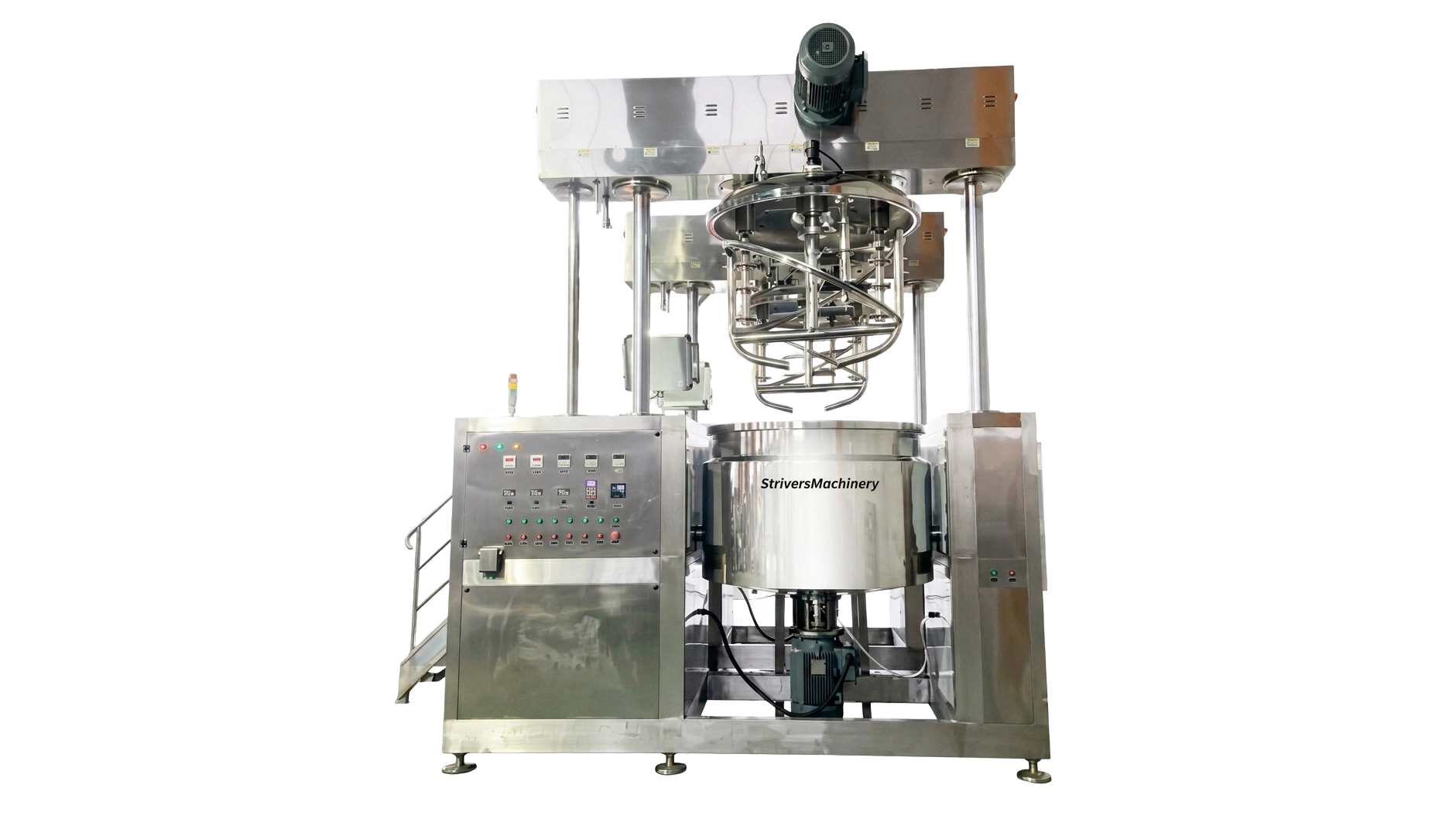
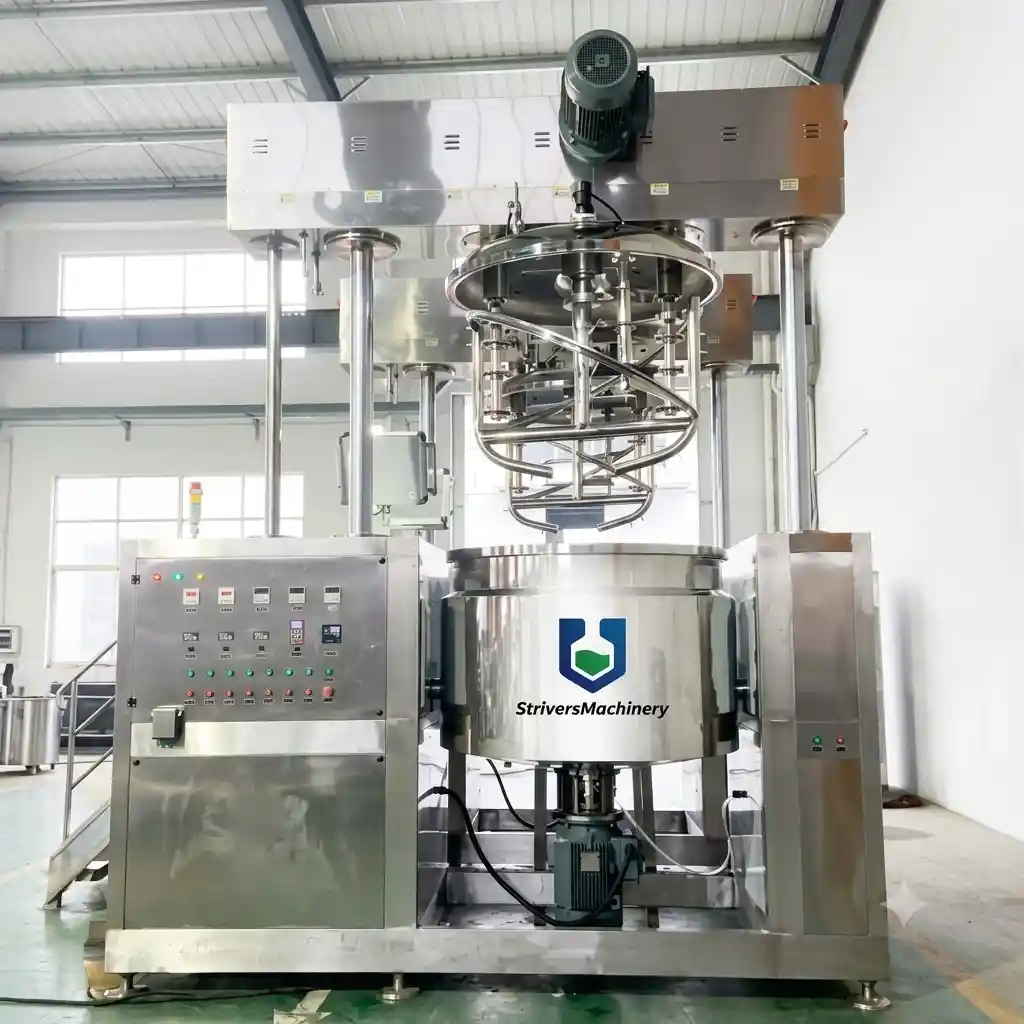
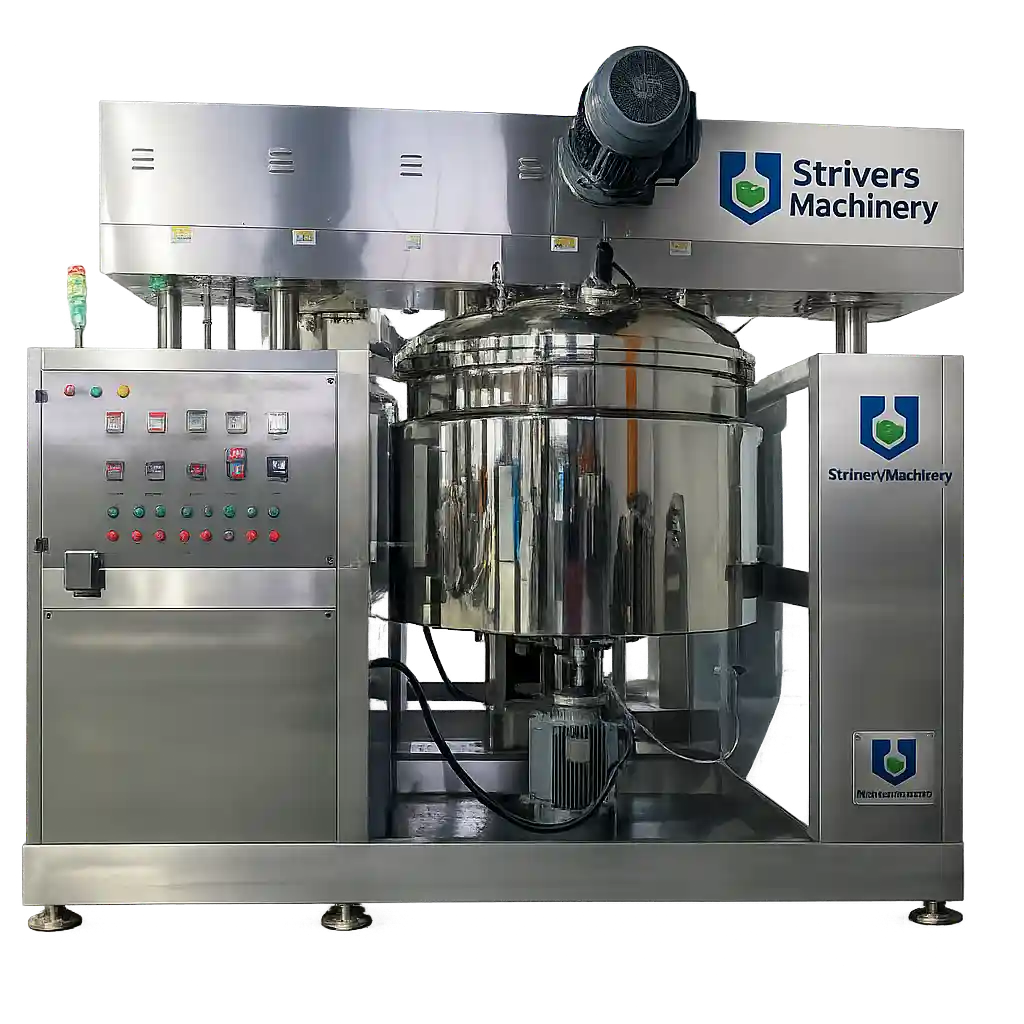
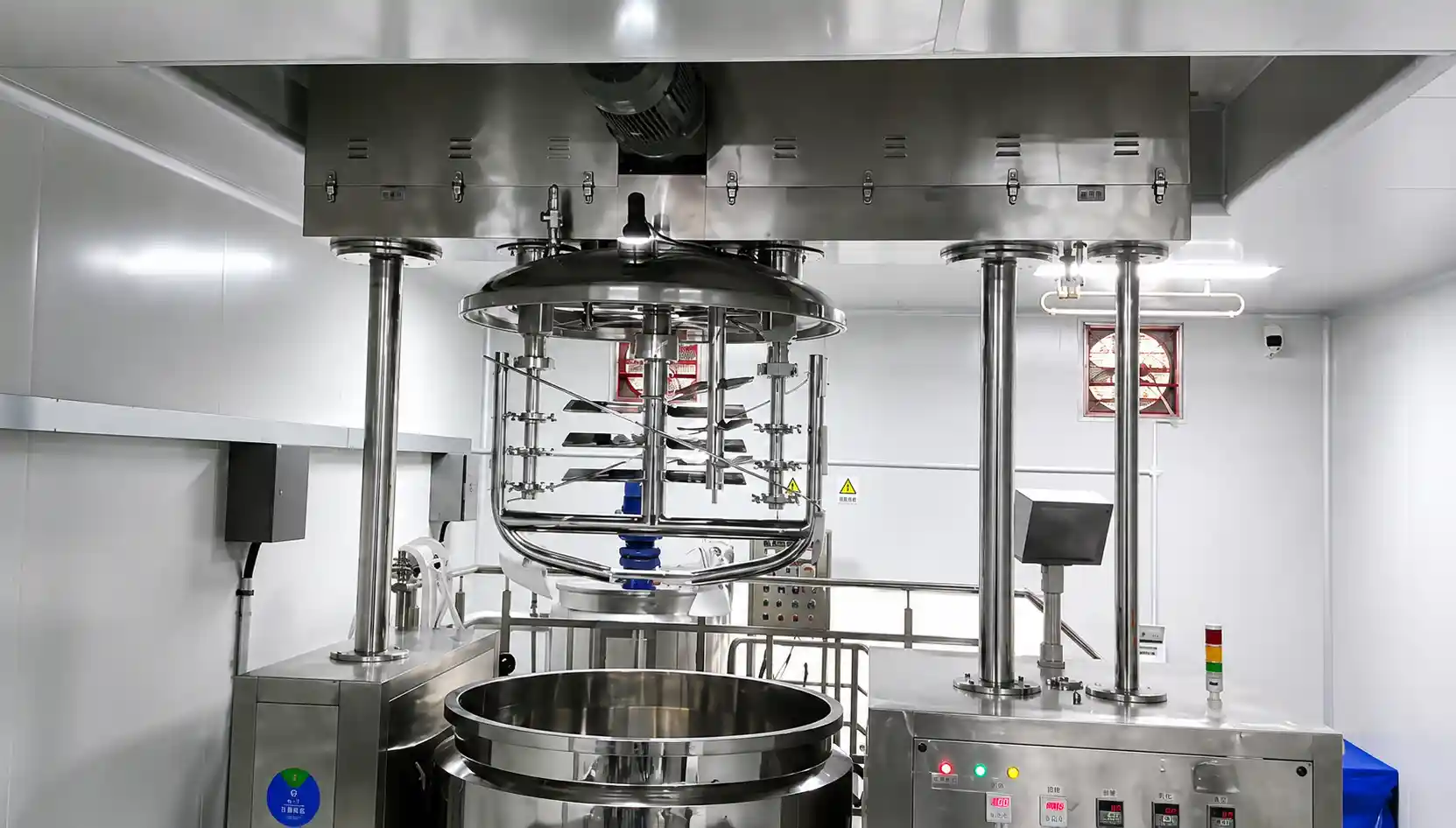
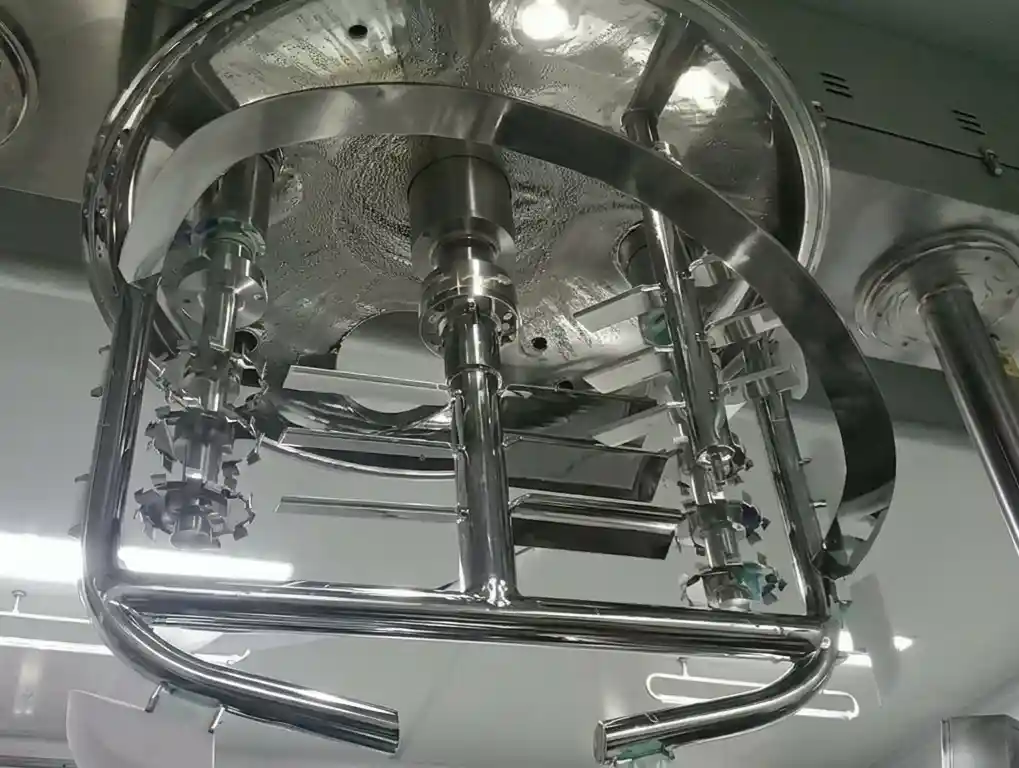
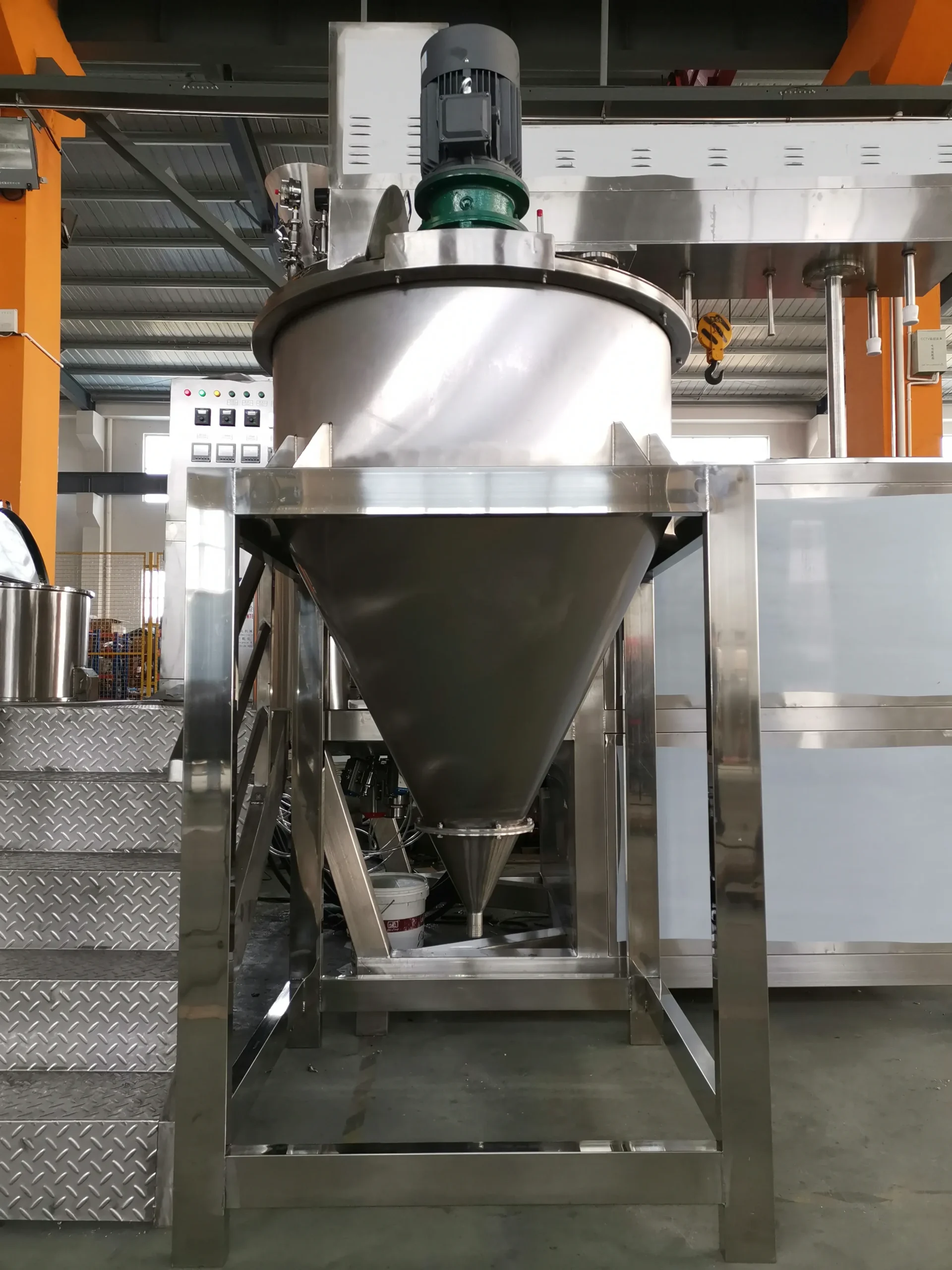
This 500L vacuum toothpaste making machine combines an outer-frame ribbon scraper agitator, two top dispersers and a bottom homogenizer. It prepares toothpaste base from humectants, powders, thickeners and liquid additives, with vacuum deaeration to reduce trapped air before tube filling.
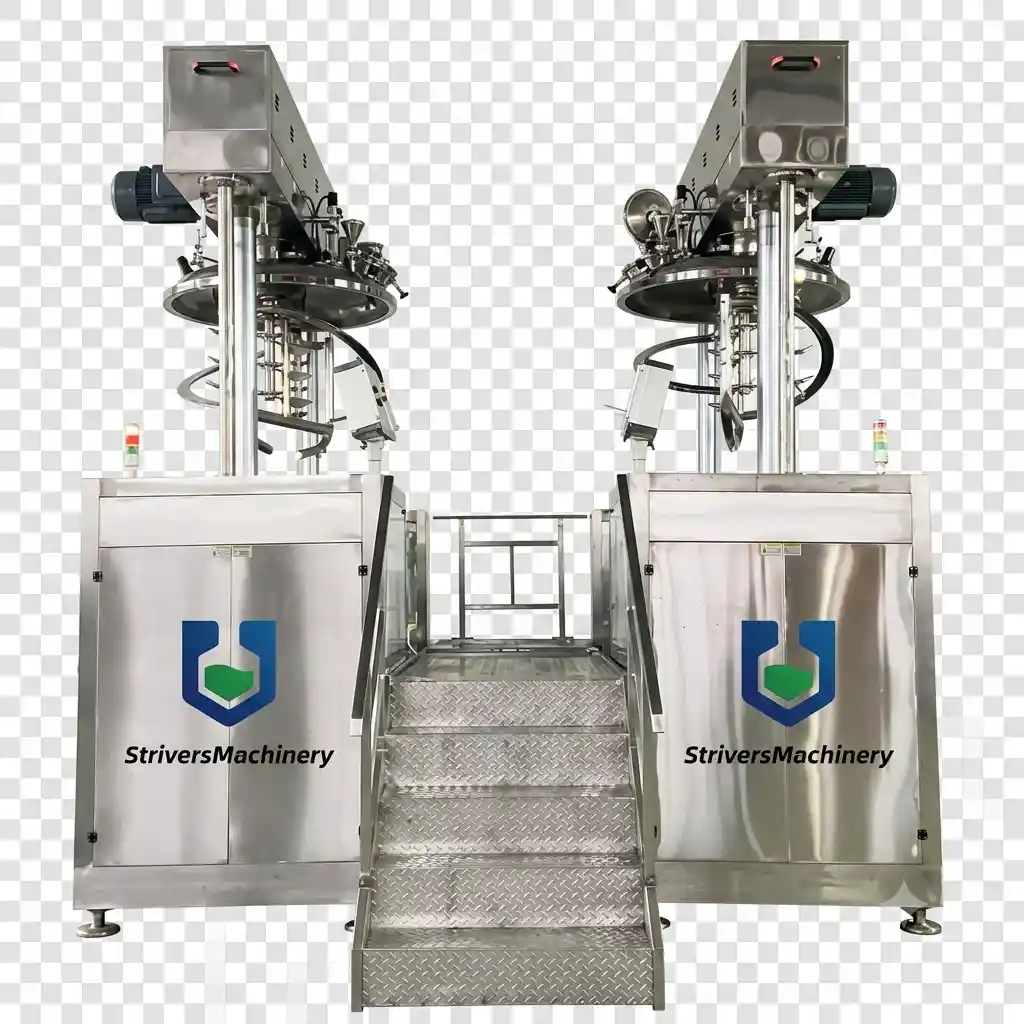
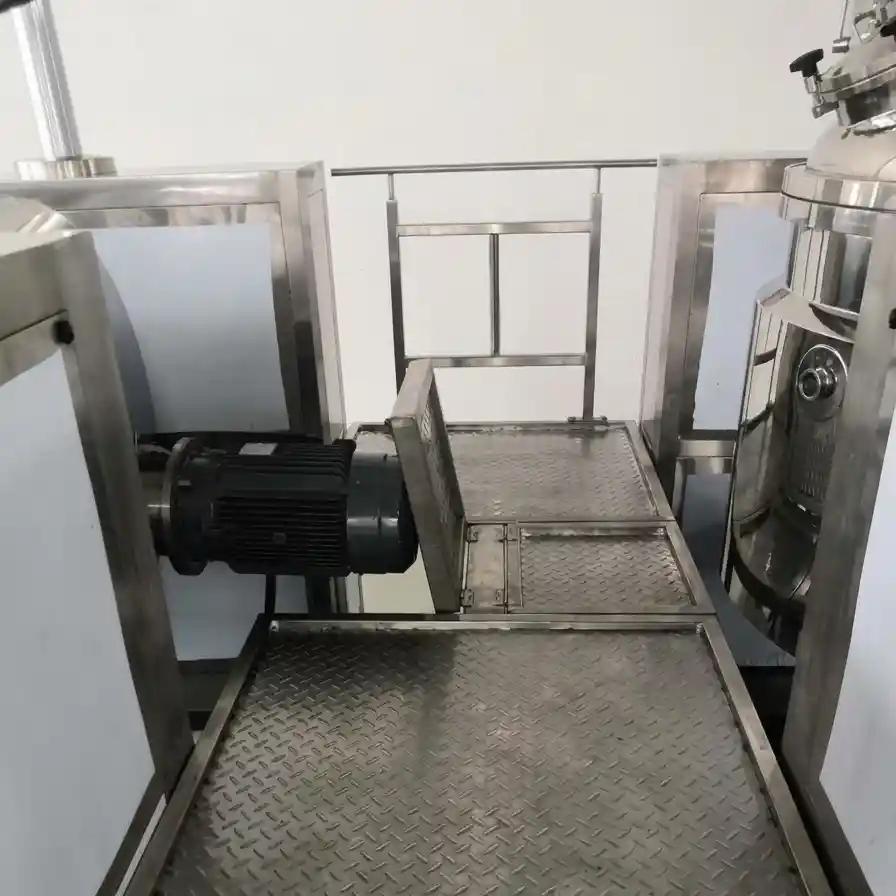
The double-cylinder hydraulic lift opens the lid for charging, cleaning and inspection. In the arrangement shown, two 500L machines share one operating platform and staircase. Each vessel provides a separate batch-processing position within a compact production area.
- Working Capacity (L)
- 500
- Main Tank Mixer Type
- Three-shaft ribbon mixing system-Ribbon agitator with dual dispersers
- Homogenizer Speed (rpm)
- 0–3000 rpm (Variable Speed)
- Contact Material
- SUS316L Stainless Steel
Product Overview
500L Vacuum Toothpaste Mixer for Powder-Rich Paste
Toothpaste production needs both strong bulk movement and effective powder incorporation. High-speed mixing alone is not enough once the batch becomes thick. This machine combines slow scraper agitation with two top dispersers and a bottom homogenizer, so each mixing element has a clear job.
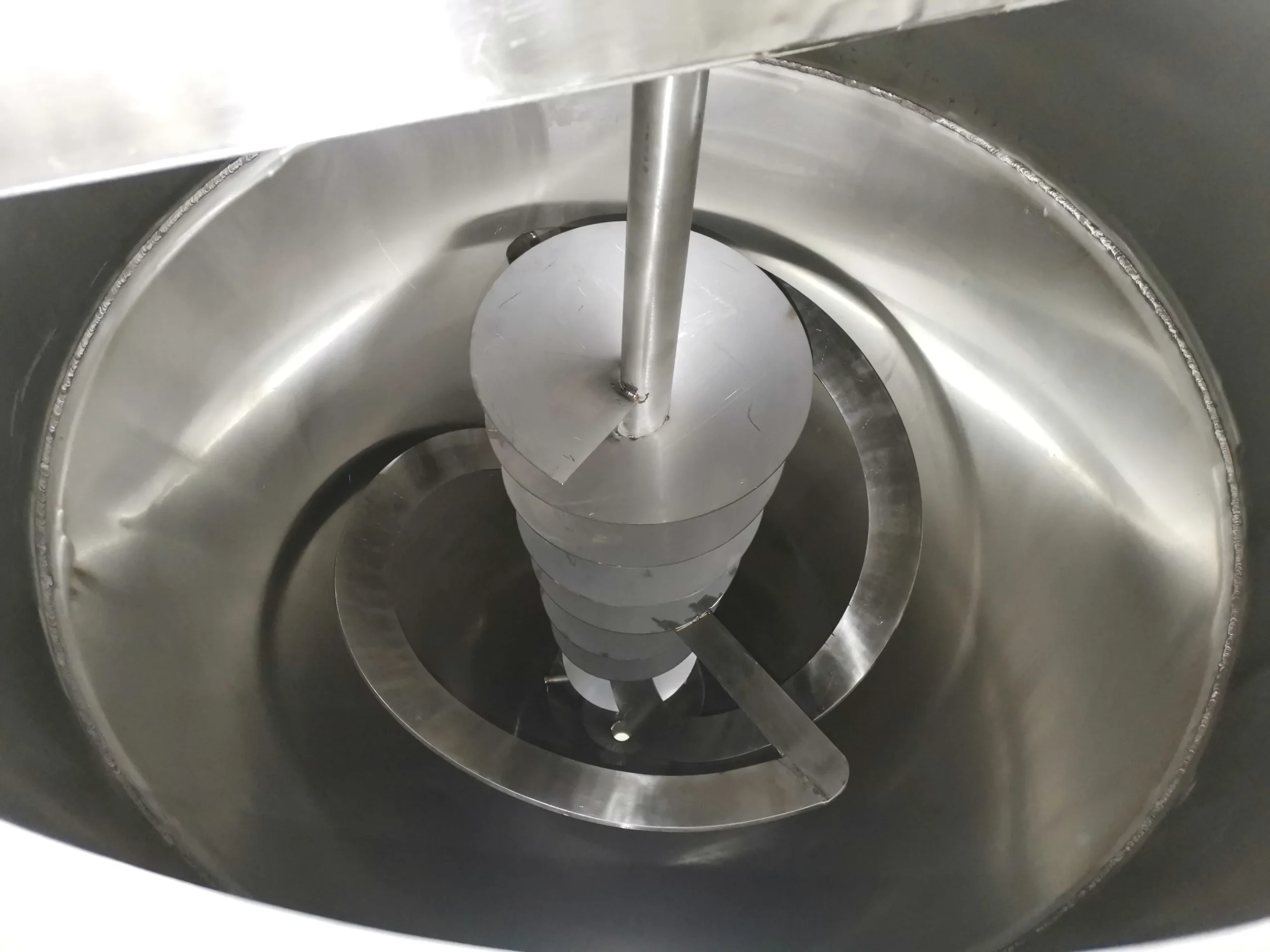
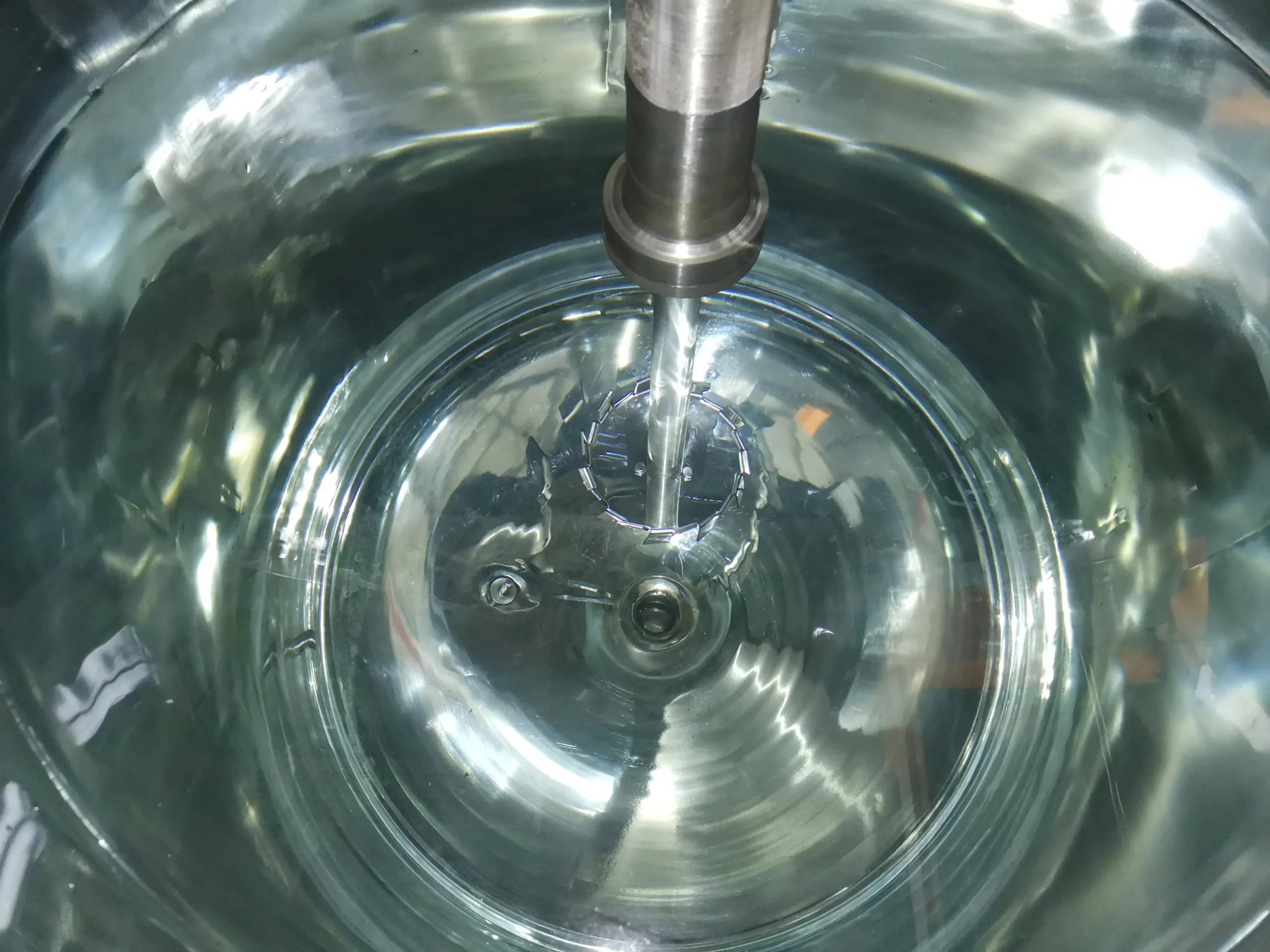
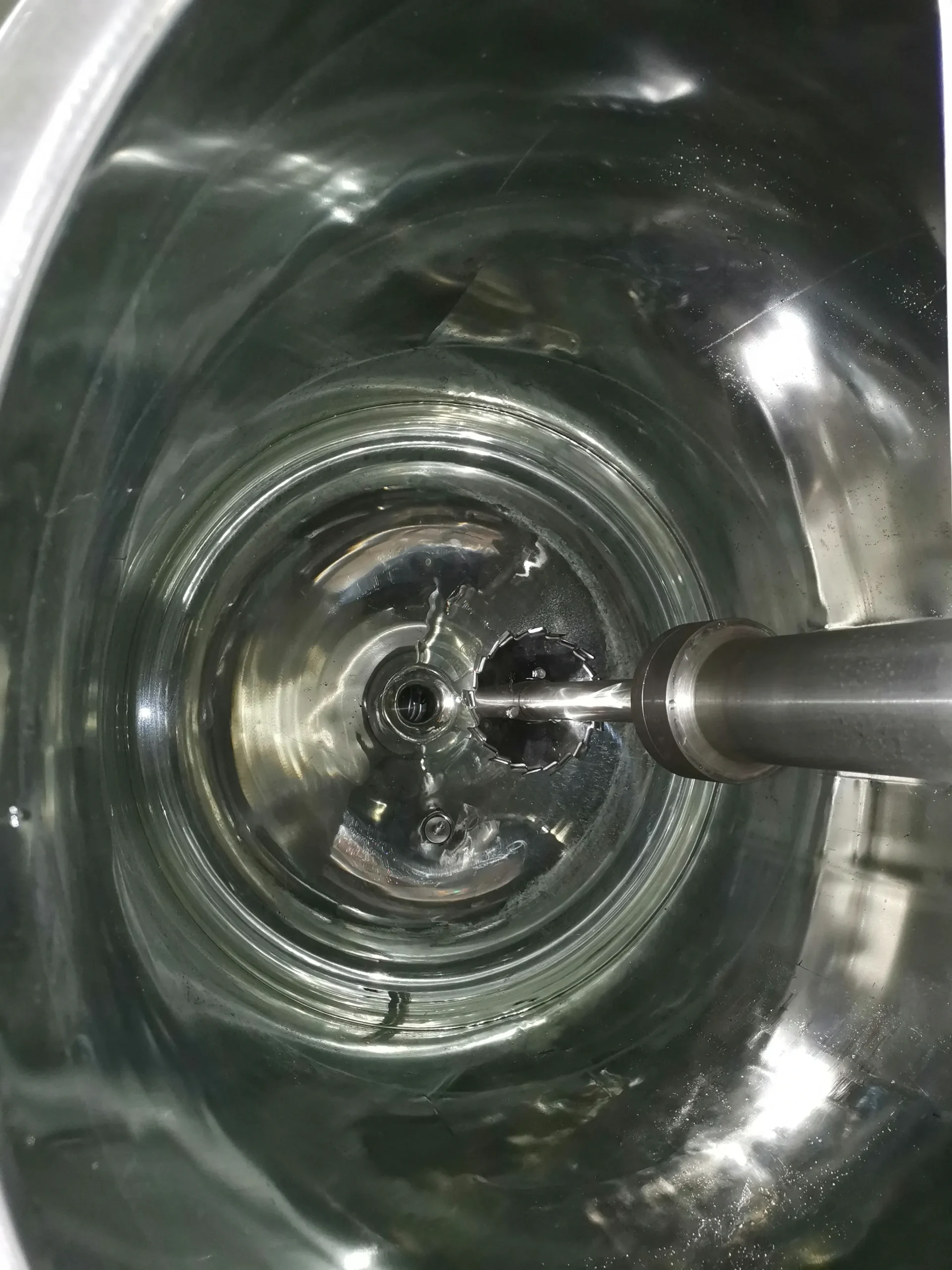
The outer-frame ribbon scraper agitator moves the paste around the vessel and sweeps the wall. The top dispersers help wet powders and distribute them through the liquid base. The bottom homogenizer provides an additional high-shear stage when the formulation and batch condition call for it.
Vacuum Mixing Before Tube Filling
Powder charging and mixing can introduce air into toothpaste. Vacuum processing helps release that air before discharge. A more consistent paste density gives the downstream filler a more stable product to meter.
The charging sequence, mixing stages and vacuum conditions should follow the developed formula. Fragrance addition and the final deaeration stage are planned together to limit unnecessary exposure of volatile ingredients to continued extraction.
SUS316L Contact Surfaces and Jacketed Construction
The vessel has SUS316L product-contact surfaces, an SUS304 outer structure and a heating/cooling jacket with insulation. The specified interior finish is Ra ≤ 0.4 μm. PTFE wall scrapers help reduce wall buildup and support heat transfer as the paste thickens.
The heating arrangement can use jacket electric heating or an external steam supply. Cooling connects to the selected plant-water or chilled-water circuit. The final thermal arrangement should match the formulation and required batch cycle.
Two Vessels on One Operating Platform
The supplied layout places two 500L machines beside a shared platform and staircase. Operators can reach the lid fittings and charging positions from the same working level. The hinged platform panel provides access to equipment below when it is safe to open.
This layout gives the factory two batch positions. Actual daily output depends on charging, mixing, deaeration, discharge and cleaning time, together with the utilities available when both vessels operate.
Connecting Preparation to Packaging
For an oral-care project, the mixer is one part of the toothpaste manufacturing equipment arrangement. Product transfer, holding and packaging need to be matched to the finished paste.
For aluminum-tube packaging, the downstream stage can be assessed alongside a rotary aluminum tube filling and tail-folding machine. Plastic and laminated tubes require a closure method suited to their construction.
Technical Specifications
| Total Capacity (L) | 600 |
|---|---|
| Working Capacity (L) | 500 |
| Min Batch Size (L) | 150 |
| Structure Type | Triple Layer (with Jacket & Insulation) |
| Contact Material | SUS316L Stainless Steel |
| Non-contact Material | SUS304 Stainless Steel |
| Surface Finish | Interior Mirror Polish (Ra ≤ 0.4 μm) & Exterior Satin/Matte Finish |
| Temperature Range | Water up to 98°C | Steam up to 120°C | Thermal Oil up to 200°C |
| Jacket Design Pressure (MPa) | 0.3 |
| Main Tank Mixer Type | Three-shaft ribbon mixing system-Ribbon agitator with dual dispersers |
View All SpecificationsShow Fewer Specifications
| Mixing Speed (rpm) | 0–63 rpm |
|---|---|
| Mixing Motor Power (kW) | 3 |
| Frequency Control | Variable Speed with VFD (Delta, Siemens, ABB, Schneider, Optional) |
| Scraper System | Wall-Scraping PTFE Scrapers |
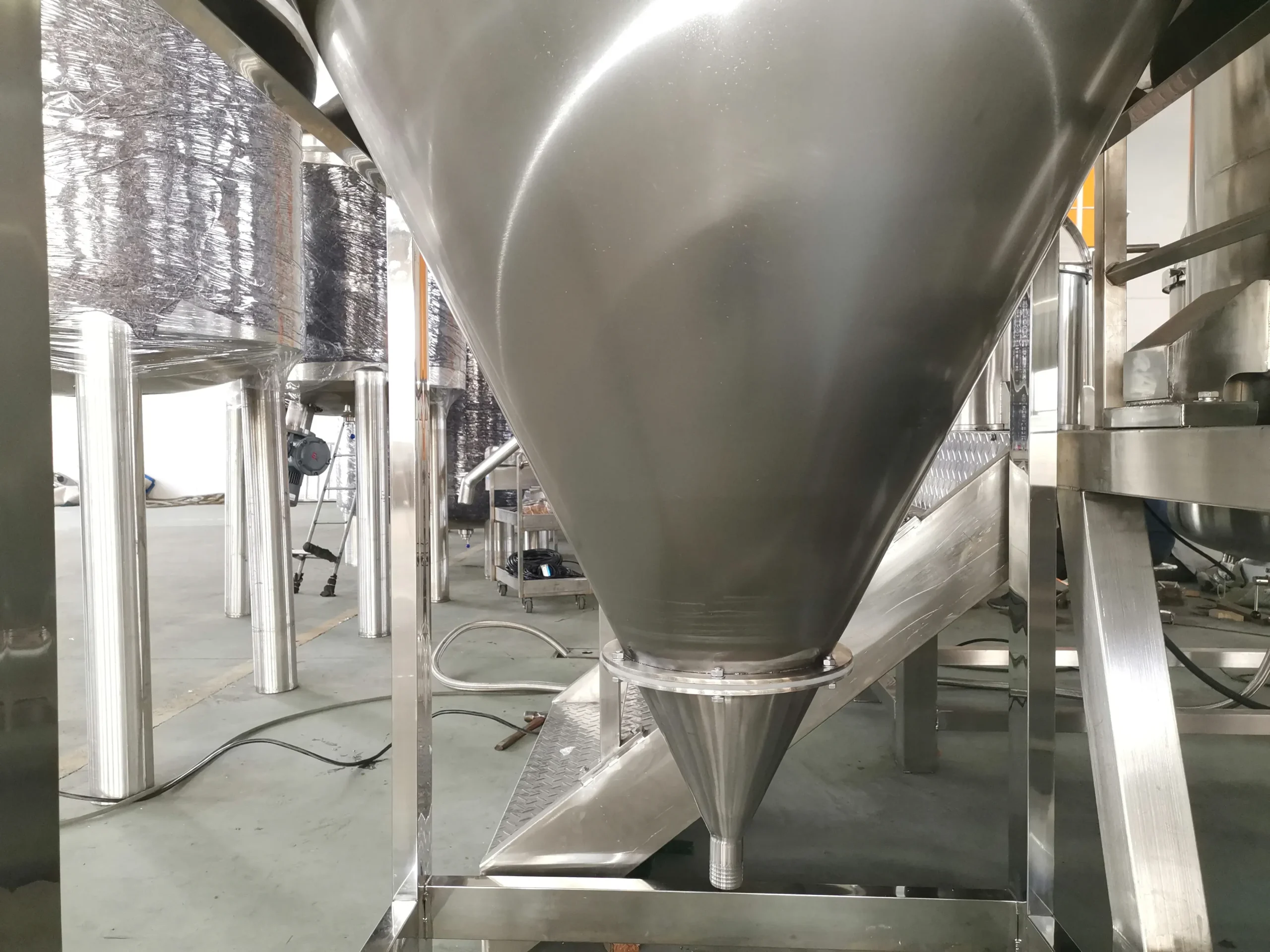
| Homogenizer Position | Bottom-entry Homogenizer |
| Homogenizer Type | High Shear Stator-Rotor Homogenizer |
| Homogenizer Power (kW) | 15 |
| Homogenizer Speed (rpm) | 0–3000 rpm (Variable Speed) |
| Max Processing Viscosity (mPa·s / cP) | 50,000 |
| Heating Method | None (For Cold Process) |
| Cooling System | Tap Water / Cooling Tower Circulation (Chilled Water / Glycol Circulation Optional) |
| Water Chiller | External Water Chiller Unit (Optional) |
| Temperature Control Accuracy | ±1°C |
| Vacuum Degree (MPa) | -0.09 |
| Vacuum Pump Brand | High-quality domestic/joint venture brands |
| Discharge Method | Electric/Manual Tilting Discharge / Bottom Valve Discharge (Optional Rotor Pump) / Bottom Valve Discharge (Optional Air Pressure Assist) / External Pump Transfer System |
| Discharge Valves | Ball Valve |
| Lid Lifting System | Hydraulic Lifting System (Automatic) |
| Mechanical Seal Brand | Double Mechanical Seal (EagleBurgmann) |
| Tilting System | Electric Tilting |
| Types of Upper Heads | Elliptical Head (2:1) / Hydraulic Lifting Head |
| Top Openings & Accessories | Vacuum Port / Vacuum Feeding Port / Powder Feeding Port / Liquid Inlet / Fragrance Addition Port / Manway / Sight Glass with Wiper / LED Inspection Light / CIP Spray Ball / Vent Filter / Vacuum Gauge / Pressure Sensor / Compressed Air Inlet |
| Motor Brand | SEW / ABB / Siemens / Top-Tier Chinese Brands (Optional) |
| Connection Type | Tri-Clamp |
| Oil & Water Pot | Equipped with Integrated Oil & Water Pre-treatment Pots |
| Oil & Water Pot Capacity (L) | Oil: 200L / Water: 400L |
| Platform & Ladder | SUS Anti-slip Platform with Guardrails & Ladder |
| Voltage | Configurable to local grid (110V–480V, 50/60Hz, Single or 3-Phase) |
| Drive Type | Electric |
| Installation Type | Platform-mounted |
| Automation Level | Semi-Automatic |
| Electrical Components | Schneider / ABB / Siemens / Omron / Fuji /Mitsubishi (Optional) |
| Control System | Push Button Control |
| Machine Weight (kg) | 3000 |
Ordering & Delivery
| Warranty | 24 Months | Payment Terms | 40% T/T Deposit, 60% Balance Before Shipment (Alibaba Trade Assurance Available) |
| Lead Time | 15–20 Working Days | Packaging | Standard Export Fumigation-Free Wooden Case |
| OEM / ODM Service | 100% Customizable / Engineering Support Available | ||
Machine Configuration
- Main vessel: 500L working volume per machine, with SUS316L product-contact surfaces, a jacket and an insulation layer
- Interior finish: Mirror-polished product-contact surfaces specified at Ra ≤ 0.4 μm
- Outer structure: SUS304 stainless steel with a satin or matte exterior finish
- Main agitator: Outer-frame ribbon scraper agitator with PTFE wall scrapers and a specified speed range of 0–63 rpm
- Top dispersers: Two lid-mounted disperser heads for powder wetting and dispersion
- Bottom homogenizer: Independently driven bottom homogenizer with a specified speed range of 0–3000 rpm
- Shaft sealing: EagleBurgmann double mechanical seal as specified in the equipment configuration
- Vacuum system: Vacuum pump, vessel connections and vacuum monitoring for batch deaeration
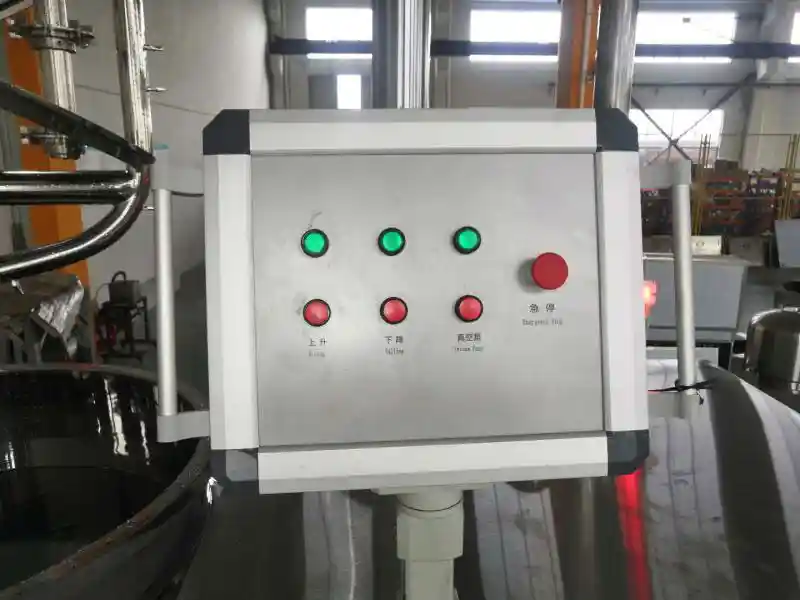
- Hydraulic lift: Double-cylinder, two-column lid-lifting assembly with a separate lift control box
- Process controls: Push-button operation, temperature displays, indicator lights and speed controls for the designated drives
- Lift controls: Raise, lower and vacuum-pump controls with an emergency-stop button
- Status indication: Signal tower light on each machine
- Lid fittings: Feeding and process ports, inspection lighting and sight glass; the final fitting schedule follows the approved drawing
- Shared platform: Checker-plate floor, railing, staircase and a hinged access panel serving two 500L vessels
- Thermal connections: Jacket heating and cooling connections matched to the selected utility arrangement
Compared with a general-purpose hydraulic lifting vacuum emulsifying mixer, this configuration puts particular emphasis on powder-rich paste preparation through its ribbon scraper and twin top dispersers.
Key Features
- Three mixing functions in one vessel: Bulk agitation, top dispersion and bottom homogenization address different stages of toothpaste preparation
- Twin top dispersers: Two disperser heads help incorporate powder additions into the moving base
- Ribbon scraper agitation: Slow bulk movement helps circulate thick paste while PTFE scrapers sweep the vessel wall
- Vacuum deaeration: Reduces air introduced during charging and mixing before the paste reaches the filling stage
- Bottom high-shear stage: Provides additional dispersion where required by the formula, rather than relying on high shear throughout the entire batch
- Hydraulic lid access: The double-cylinder lift opens the vessel for loading, inspection and cleaning
- Jacketed temperature control: Supports the heating and cooling stages required by the selected process
- Shared operating platform: Places both vessels within one accessible working area
- Separate lift controls: Keeps lid movement controls distinct from routine process operation
Working Principle
Build the Liquid Base
Charge the specified liquids and humectants. Start the main agitator once the batch reaches the required operating level. Prepare any thickener premix according to the raw-material instructions and the developed formula.
Incorporate Powders
Add powders at a controlled rate while the ribbon scraper keeps the batch moving. Use the top dispersers during the stages that need powder wetting and breakup of soft agglomerates. Charging should avoid powder accumulation above the active mixing zone.
Apply the Required High-Shear Stage
Run the bottom homogenizer when the formula needs additional dispersion. Select its speed and operating time around the product condition. The process should preserve the intended abrasive characteristics and avoid unnecessary heat generation.
Control Temperature and Remove Trapped Air
Use the jacket for the required heating or cooling duty. Apply vacuum according to the batch procedure, allowing space for foam expansion. Slow bulk agitation helps bring entrapped air toward the surface as the paste becomes more uniform.
Complete the Batch and Transfer
Make the final additions under the specified temperature, mixing and vacuum conditions. Check the required product properties, release the vessel vacuum through the designated arrangement, and discharge through the agreed product-transfer route.
Why Choose This Machine
- Better control as viscosity rises: The ribbon scraper maintains bulk movement while the dispersers and homogenizer provide local mixing intensity
- A clearer production sequence: Operators can assign charging, dispersion, deaeration and finishing to distinct stages
- A more consistent filling feed: Reduced entrapped air helps limit density variation in the paste supplied to the tube filler
- Less wall buildup: Scraper contact reduces stationary paste at the wall and supports temperature control
- Accessible cleaning points: The raised lid exposes the agitator and vessel interior for inspection and the approved cleaning procedure
- Two batch positions in one layout: The shared platform avoids duplicating a separate access staircase for each vessel
- Practical operator controls: Push buttons, temperature displays and designated speed controls provide direct access to the main operating functions
Optional Upgrades & Configurations
Installation Requirements
Reserve sufficient vertical clearance for the fully raised lids and mixing assemblies.
Provide access around the vessels for cleaning, seal service, vacuum-system inspection and hydraulic maintenance.
Confirm the final electrical voltage, frequency, phase and installed power before preparing the supply.
Size shared electrical and thermal services for the intended operating schedule of both vessels.
Provide the heating medium and jacket connections required by the selected electric or steam arrangement.
Provide the specified cooling supply and return conditions. Include chiller or cooling-tower equipment only where it is part of the agreed scope.
Provide vacuum-pump working water where required by the installed pump type.
Provide the mechanical-seal support services shown in the final equipment documents.
Route vacuum exhaust, condensate and cleaning drainage to suitable collection or treatment arrangements.
Provide a paste-transfer route matched to the product and the receiving tube filler.
Keep the staircase, platform access and hinged floor panel clear during operation.
Confirm delivery dimensions, lifting arrangements and the equipment-weight breakdown before installation.
Frequently Asked Questions
1. What is this 500L vacuum toothpaste making machine designed for?
2. Is 500L the working volume of each machine?
3. Why does the machine use both dispersers and a bottom homogenizer?
4. Does the homogenizer need to run throughout the batch?
5. Does vacuum mixing guarantee completely bubble-free toothpaste?
View All FAQs (14)Show Fewer FAQs
6. Can the machine process every toothpaste below 50,000 cP?
7. Can the two 500L machines run at the same time?
8. Is the machine fully automatic?
9. What is the benefit of hydraulic lid lifting?
10. Does the CIP spray ball provide a complete automatic cleaning system?
11. Can compressed air be used to push toothpaste out of the vessel?
12. Can this machine feed a tube filling line?
13. Can flavors be added while vacuum is applied?
14. What information is needed for a quotation?
Ready to Get a Quote?
Contact our team directly for pricing, customization options, and delivery timelines.
💬 WhatsApp Us NowAfter-Sales & Technical Support
Common Problems
1. Powder remains on the paste surface or forms persistent lumps
2. Paste density varies between samples or visible air remains after mixing
3. The main agitator slows, draws excessive current or trips
4. Batch temperature rises during dispersion or homogenization
5. Vacuum pull-down becomes slower than the normal batch
6. Product accumulates on the wall or scraper contact becomes uneven
7. Leakage appears around a shaft seal or process connection
8. The hydraulic lid lifts unevenly or fails to reach its normal position
9. Paste transfer is slow or introduces air before filling
Troubleshooting
Problem: Powder lumps remain in the batch
Possible Cause: Powder is charged too quickly, the liquid base is not ready, or the addition misses the active mixing zone
Recommended Solution: Review the addition rate and batch sequence. Use the designated disperser stage while maintaining bulk circulation. Check wetting and hydration separately before extending high-shear time
Problem: Paste still contains air
Possible Cause: Air enters during charging, the vessel has a leak, or the vacuum stage is too short for the product condition
Recommended Solution: Compare vacuum readings and pull-down time with a normal batch. Check lid seals, closed ports and the vacuum line. Review the deaeration stage before changing mixing speed
Problem: The main agitator trips
Possible Cause: Batch load or viscosity exceeds the selected operating condition, scraper drag has increased, or a drive fault is present
Recommended Solution: Stop repeated resets. Record the drive code, batch quantity, temperature, speed and current. Arrange inspection of the load, scraper assembly and drive before restarting
Problem: Product temperature rises too quickly
Possible Cause: High-shear operation adds more heat than the jacket can remove
Recommended Solution: Review disperser and homogenizer running time. Check cooling supply and return conditions. Use the developed process endpoint instead of extending high shear without a defined purpose
Problem: Vacuum performance declines
Possible Cause: Leakage, restricted pipework, carryover or an issue with the installed pump services
Recommended Solution: Identify the pump type first. On a water-ring pump, check working-water flow, temperature and return conditions. Inspect the permitted external checks before assuming the pump is worn
Problem: Scraping or unusual vibration occurs
Possible Cause: Loose components, worn scrapers, misalignment or unintended contact
Recommended Solution: Stop the affected drive. Isolate the equipment and arrange inspection before further operation. Do not adjust scraper or homogenizer clearances while running
Problem: Seal leakage appears
Possible Cause: Seal wear, damaged elastomers or loss of the required seal-support service
Recommended Solution: Stop according to the machine instructions, assess product impact and identify the leaking fluid. Restore the specified support conditions and inspect the seal before release
Problem: The lid rises unevenly
Possible Cause: An obstruction, hydraulic fault or lifting-system problem
Recommended Solution: Stop lid movement and keep personnel clear. Secure the assembly through the approved support procedure and arrange hydraulic inspection
Problem: Transfer to the filler is unstable
Possible Cause: Paste supply is interrupted, the transfer route restricts flow or air enters at a connection
Recommended Solution: Review the complete discharge route, including pump inlet, pipework, valves and filler feed. Check the paste condition at the transfer temperature
Cleaning Method
1. Recover the remaining paste through the agreed discharge route before starting cleaning
2. Isolate electrical, hydraulic, vacuum and thermal energy as required for the cleaning task
3. Release vacuum and confirm that the vessel is at a safe pressure and temperature before opening
4. Raise the lid through the approved sequence and engage the specified mechanical support before cleaning beneath the raised assembly
5. Remove accessible paste from the vessel, ribbon agitator, dispersers and scraper surfaces using the approved tools
6. Pre-rinse with water at the temperature specified for the toothpaste residue
7. Clean the vessel wall, agitator, lid underside and accessible ports with a compatible cleaning agent
8. Clean the bottom homogenizer chamber and discharge fittings through their approved cleaning or dismantling procedure
9. Inspect scraper holders, seal-adjacent areas, valve cavities and connection faces for retained paste
10. Rinse until the site’s cleaning-agent acceptance criteria are met
11. Inspect gaskets and detachable parts before reassembly
12. Complete the required flavor-changeover and hygiene checks before releasing the machine
13. Record cleaning completion against the product and batch history
Maintenance
1. Isolate the machine and control stored energy before maintenance
2. Record agitator, disperser and homogenizer operating conditions so gradual changes can be identified
3. Inspect PTFE scrapers and their holders for wear, damage and loose fasteners
4. Inspect the disperser assemblies and bottom homogenizer during planned service access, with particular attention to abrasive wear
5. Check the double mechanical seal and its specified support circuit for leakage or loss of service
6. Inspect lid gaskets, vacuum hoses, valves and removable connections for deterioration
7. Maintain the vacuum pump according to its actual type and operating manual
8. For a water-ring vacuum pump, monitor working-water condition, flow, temperature and the return arrangement
9. Inspect hydraulic hoses, fittings and cylinders for leaks or damage, and maintain the specified hydraulic-fluid condition
10. Check the lifting guides and approved lid-support arrangement through the manufacturer’s procedure
11. Verify temperature and pressure instruments through the factory’s calibration schedule
12. Arrange qualified inspection of drives, electrical terminals, protective devices and emergency-stop functions
13. Inspect the shared platform, railing, staircase and hinged access panel during scheduled maintenance
14. Record findings and corrective work before returning the equipment to production
Installation
1. Review the approved layout, vessel drawings and complete supply scope before delivery
2. Check the delivery route against the transport dimensions of the vessels, platform and lifting assemblies
3. Verify the floor and support design for the actual equipment, product and platform loads
4. Position the vessels and shared platform using the designated lifting points and suitable handling equipment
5. Assemble, level and secure the equipment according to the installation drawings
6. Confirm clearance for the fully raised lids and for safe access to feeding and service positions
7. Connect jacket services using the correct supply and return arrangement for the selected heating and cooling system
8. Connect the vacuum system and any required pump working-water circuit
9. Connect the mechanical-seal support services specified for the installed assembly
10. Arrange electrical connection and protective earthing by qualified personnel
11. Connect the agreed paste-discharge and transfer route with independent pipe support
12. Check guards, access controls, emergency stops and the lifting-system operating conditions
13. Verify drive rotation and hydraulic movement through the approved commissioning procedure
14. Carry out the approved liquid test without dry-running components that require liquid or seal support
15. Complete a representative-product trial and record the agreed acceptance checks before routine production
Optional Spare Parts
Optional spare parts are quoted separately. Any included wear-parts kit is listed in the order confirmation.
Mechanical Seal Assembly
Homogenizer Rotor and Stator Set
PTFE Scraper Blade
O-ring Seal Kit
Silicone Sealing Ring
Technical Buyer’s Guide
Recommended Machines

Get Your Download Link
Please fill in your details and we'll send the download link to your email.