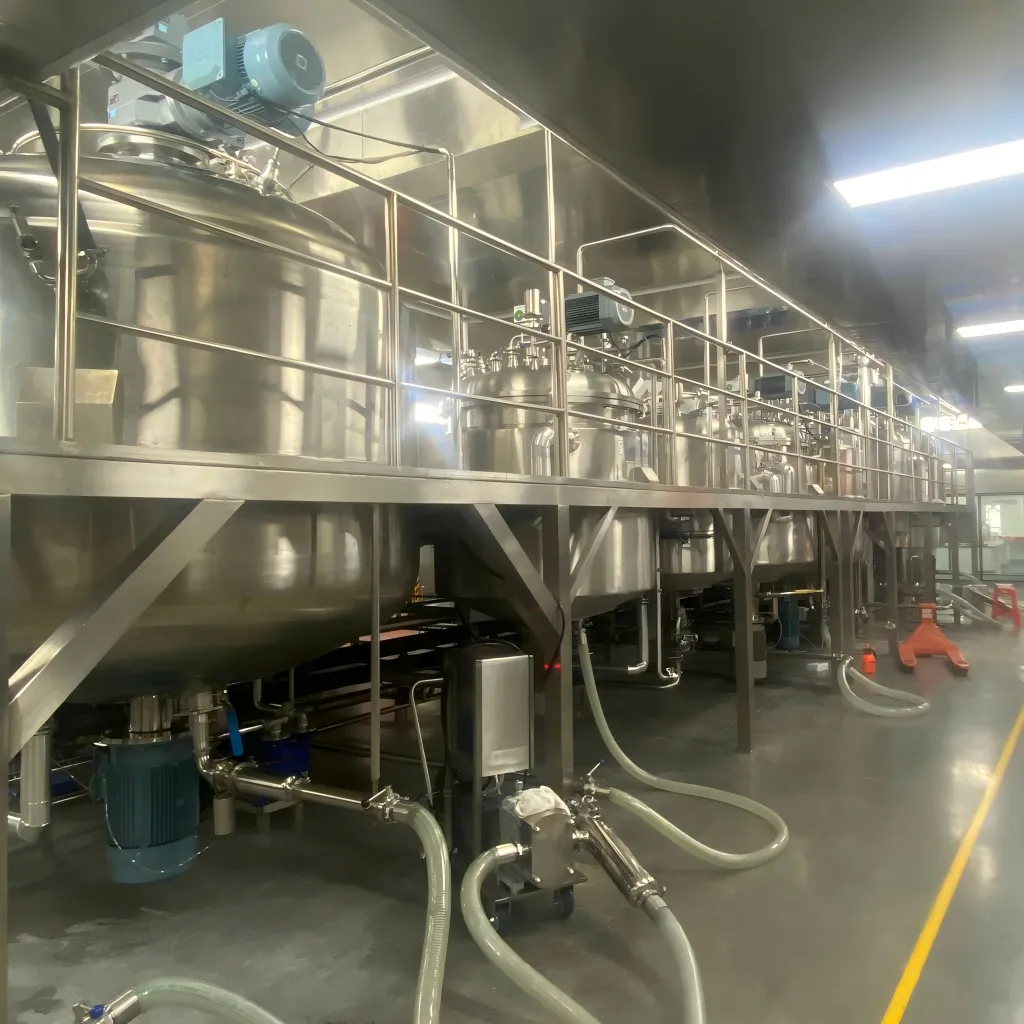
Discover how inner and outer circulation homogenization technology improves mixing efficiency, shortens batch time, enhances product consistency, and reduces operating costs for cosmetics, pharmaceuticals, food, and chemical manufacturing.
Inner and Outer Circulation Vacuum Emulsifying Mixer: The Core Technology for High-Efficiency Large-Scale Production
Why Traditional Vacuum Emulsifying Mixers Become Inefficient in Large Batch Production
Manufacturers across the cosmetic, pharmaceutical, food, and chemical industries are facing the same set of pressures at the same time. Production volumes keep increasing as brands scale into new markets. Formulations are becoming more complex, with higher viscosity creams, thicker gels, and more sensitive active ingredients that demand tighter process control. Quality expectations are rising, with retailers and regulators requiring more consistent batch-to-batch results and better documentation. At the same time, labor and energy costs continue to climb, and customers expect shorter lead times from order to delivery.
A standard vacuum emulsifying mixer was never designed to absorb all of this pressure at once. As batch sizes grow from a few hundred liters to several thousand liters, the physical limitations of a conventional single-circulation design become obvious on the production floor.
Traditional vacuum emulsifiers often suffer from a familiar list of problems:
- Long emulsification time, because the homogenizer can only process a fraction of the batch at any given moment
- Uneven mixing, especially near the tank walls and bottom, where material moves more slowly
- Dead zones inside the tank, where product barely circulates and receives little to no shear
- Temperature inconsistency, as material near the heating jacket heats faster than material in the center of the tank
- Repeated homogenization passes, needed to compensate for weak circulation, which extends cycle time and increases energy use
- Poor batch consistency, with variation in particle size and viscosity from one production run to the next
These issues do not simply slow production down. They translate directly into higher energy bills, more operator hours per batch, higher rework and rejection rates, and less predictable delivery schedules. For a factory running multiple shifts to meet growing order volumes, these inefficiencies compound quickly.
The solution that leading cosmetic, pharmaceutical, food, and chemical manufacturers are adopting is the Inner and Outer Circulation Vacuum Emulsifying Mixer — a machine architecture engineered specifically to solve the circulation and dead-zone problems that limit large batch production.
Rather than treating large batch size as simply a bigger version of small-batch production, this design rethinks how material moves through the tank in the first place. It is the difference between hoping bulk convection eventually brings every liter of product past the homogenizer, and actively engineering two independent pathways that guarantee it does — repeatedly, and on a predictable schedule, throughout every batch cycle.
What Is an Inner and Outer Circulation Vacuum Emulsifying Mixer?
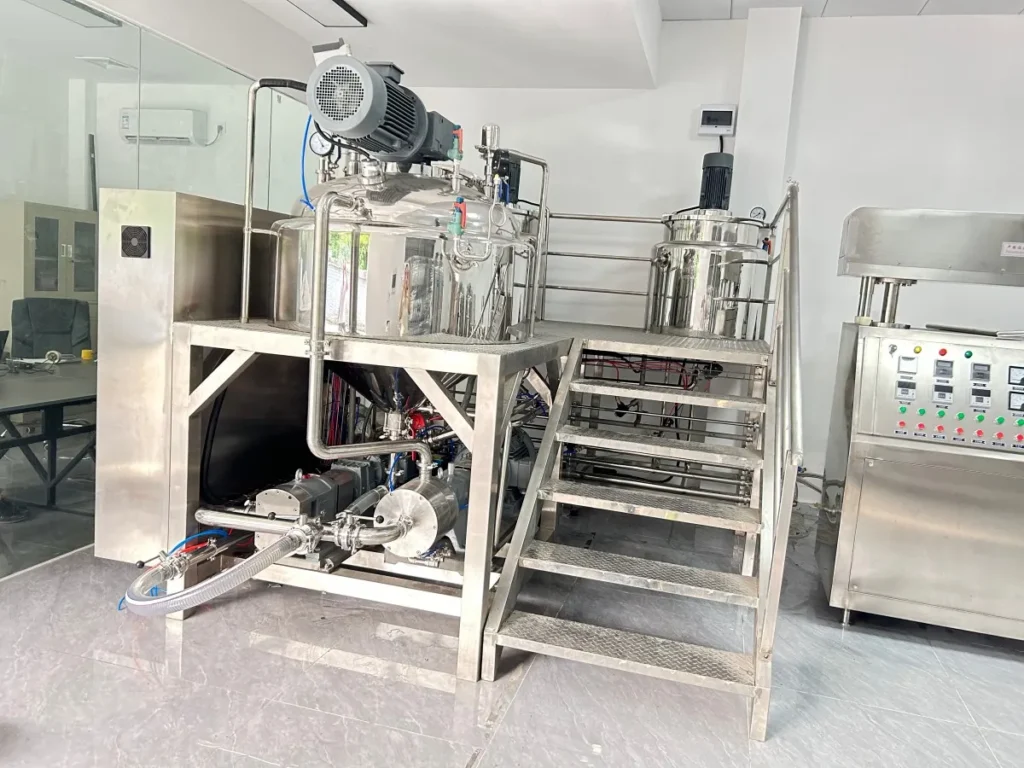
An Inner and Outer Circulation Vacuum Emulsifying Mixer is a large-capacity emulsification system that combines two independent circulation paths — an internal circulation loop inside the main vacuum tank, and an external circulation loop that pumps material out of the tank, through a high-shear homogenizer, and back in — working together to process the entire batch far more evenly and efficiently than a single-circulation machine.
Where a conventional vacuum emulsifier relies on one homogenizer positioned inside or at the base of the tank to gradually work through the full batch, an inner and outer circulation system uses dual, simultaneous circulation paths that continuously pull material from every region of the tank — including the corners, the bottom, and the areas near the tank wall that are hardest to reach — and route it through intense shear before returning it to the main body of product.
This is not simply a bigger version of a standard emulsifier. It is a different approach to how material moves through the machine. Instead of waiting for slow bulk convection to bring product to the homogenizer, the machine actively circulates the entire batch through two coordinated paths at once, dramatically reducing the time needed to reach a uniform, stable emulsion.
Why This Design Was Developed
As batch sizes moved from 500L and 1,000L tanks into 2,000L, 3,000L, 5,000L, and 10,000L+ production tanks, engineers found that simply scaling up a single-circulation homogenizer design led to diminishing returns. The larger the tank, the longer it took for material far from the homogenizer to receive adequate shear, and the more pronounced dead zones became. The inner and outer circulation architecture was developed specifically to solve this scale-up problem, giving manufacturers a way to run genuinely large batches without sacrificing mixing quality or extending cycle times beyond what is commercially practical.
Difference from an Ordinary Vacuum Emulsifier
| Feature | Ordinary Vacuum Emulsifier | Inner and Outer Circulation Vacuum Emulsifying Mixer |
|---|---|---|
| Circulation paths | Single (internal only) | Dual (internal + external) |
| Best suited batch size | Small to medium | Medium to very large |
| Homogenization coverage | Localized, near the homogenizer | Whole-tank, continuously refreshed |
| Scale-up behavior | Mixing quality degrades as tank size grows | Mixing quality remains stable at large volumes |
| Typical use case | R&D, pilot batches, small production runs | Full-scale industrial production |
Typical Capacities
Inner and outer circulation vacuum emulsifying mixers are commonly built in capacities ranging from approximately 500L to 20,000L, with the most popular industrial configurations sitting between 1,000L and 10,000L. The dual-circulation design is what makes these larger volumes commercially viable, since it maintains consistent shear and mixing quality even as the working volume increases well beyond what a single-circulation machine can handle efficiently.
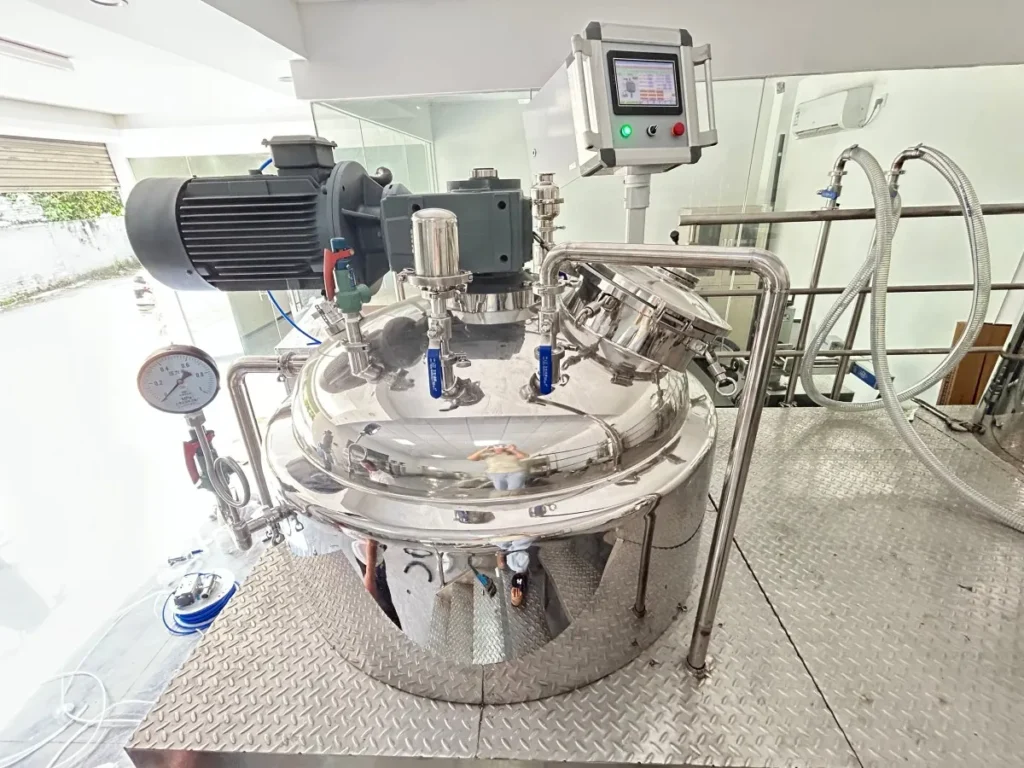
Complete Machine Structure
An inner and outer circulation vacuum emulsifying mixer is built from a series of integrated subsystems that work together as a single production unit. Understanding each component helps explain why the machine performs so much better than a conventional design in large batch applications.
Main Emulsifying Tank
The main tank is the core vessel where oil phase, water phase, and additives are combined under vacuum. It is typically constructed from 304 or 316L stainless steel, polished to a sanitary finish suitable for cosmetic, pharmaceutical, and food contact. Tank geometry — the ratio of height to diameter, the shape of the bottom (dished or conical), and the placement of internal baffles — all influence how effectively the anchor agitator and homogenizer can reach every region of the batch, which is why tank design is never treated as an afterthought relative to the homogenizer itself.
- Jacket — A dimple or channel jacket surrounds the tank body, allowing heating or cooling media to circulate around the vessel wall without direct contact with the product. Dimple jackets are generally preferred for their strength-to-weight ratio and even distribution of thermal media across the tank surface.
- Heating — Steam, electric heating, or thermal oil systems raise the batch to the target processing temperature, typically in the range required to melt oil-phase waxes and activate emulsifiers. The heating method is usually selected based on what utilities are already available at the customer’s facility.
- Cooling — Chilled water or process water is circulated through the same jacket to bring the finished emulsion down to a stable, fillable temperature, protecting heat-sensitive actives and preservatives from unnecessary thermal exposure.
- Pressure — The tank is rated to operate safely under vacuum conditions, with pressure gauges and safety valves monitoring the internal environment throughout the cycle, and interlocks that prevent the lid from being opened while the tank remains under vacuum.
High Shear Homogenizer
The homogenizer is the component responsible for breaking down droplet size and creating a stable emulsion. It is, in many respects, the heart of the entire machine — the tank, agitator, and circulation systems all exist to make sure material reaches this component under the right conditions, as often as possible, during the batch cycle.
- Rotor — A high-speed rotating element that draws material into the shear zone. Rotor design (number of blades, blade angle) is tuned to the viscosity range the machine is intended to process.
- Stator — A fixed outer sleeve with precisely machined slots or teeth that the rotor spins inside. As material is forced through the narrow clearance between rotor and stator, it experiences intense mechanical and hydraulic shear.
- Speed — Homogenizer speed is typically adjustable, often in the range of 0–3,600 RPM depending on model and formulation requirements, allowing operators to fine-tune shear intensity for different products on the same machine.
- Gap — The clearance between rotor and stator determines the intensity of shear applied to the product; a tighter gap generally produces finer particle size but also increases heat generation and load on the drive motor.
- Line Speed — The tip speed of the rotor, a key factor in determining achievable particle size and emulsification efficiency, and a specification formulators often reference directly when scaling a process from lab to production.
Internal Circulation System
The internal circulation system uses an anchor or frame agitator combined with the homogenizer positioned inside the tank to continuously move material from the tank walls and bottom toward the center, where it passes through the high-shear zone before returning to bulk circulation. The anchor typically carries scraper blades or Teflon wipers along its outer edge, so a single rotating assembly performs two jobs at once: bulk mixing and wall clearing. This internal loop keeps material moving even before external circulation begins, reducing the risk of localized overheating or under-processed product near the tank surfaces, and it continues operating throughout the entire cycle as a constant background circulation on top of whatever external circulation is doing.
External Circulation System
The external circulation system is what distinguishes this machine from a standard single-circulation emulsifier. A circulation pump — typically a positive displacement or centrifugal pump sized to the batch viscosity — draws material from the bottom of the main tank, through external piping, through a secondary high-shear inline homogenizer or additional shear stage, and back into the top or side of the tank.
This creates a second, independent processing loop that runs simultaneously with internal circulation, meaning the entire batch volume is turned over and re-processed multiple times during a single production cycle — not just the portion of material physically closest to the internal homogenizer. Because the external loop draws directly from the tank bottom, it is particularly effective at reaching the one region of the tank most prone to settling, sediment, or incomplete shear in a single-circulation design.
External circulation becomes increasingly important as tank size increases. In a 1,000L system, internal circulation alone may be adequate for many formulations, but as batch size increases to 2,000L, 5,000L, or 10,000L, external circulation becomes essential to ensure that material at the far end of the tank receives the same shear exposure as material near the agitator shaft. This is the core reason inner and outer circulation systems scale so much more effectively than single-circulation designs, and it is also why external circulation piping is typically sized and routed specifically for each tank capacity rather than treated as a generic add-on.
Vacuum System
A vacuum pump removes air from the tank during mixing and homogenization, which prevents air entrainment, reduces foaming, and improves product stability and appearance. Vacuum level is typically monitored and controlled through the PLC, allowing operators to hold a consistent negative pressure throughout the batch cycle. Maintaining vacuum consistently — rather than only pulling it briefly at the start of the batch — is particularly important for formulations that generate air during high-speed homogenization, since re-entrained air can otherwise undo the benefit of an earlier vacuum draw.
Scraper Mixing System
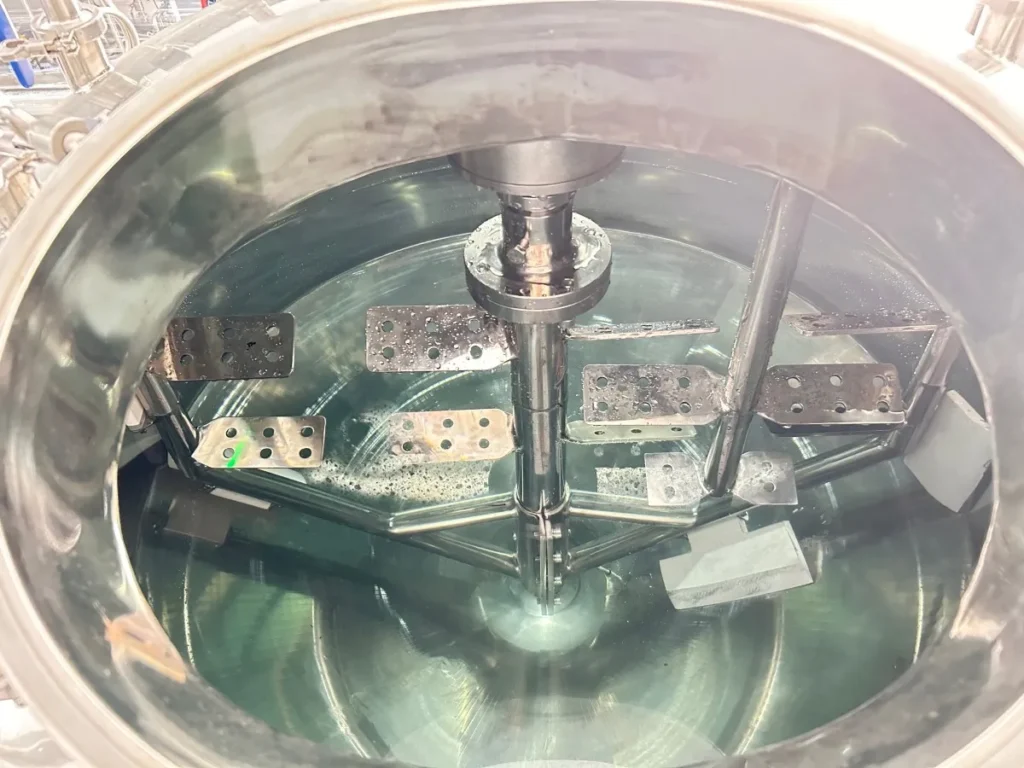
A wall scraper, driven independently or in tandem with the main agitator, continuously scrapes product off the tank wall and jacket surface. This prevents material from sticking, burning, or curing on the heated wall surface, which is especially important for high-viscosity or heat-sensitive formulations, and it also improves overall heat transfer efficiency by ensuring the jacket surface is always in contact with fresh product rather than a layer of material that has been sitting against the wall throughout the cycle.
PLC Control
A programmable logic controller with a touchscreen HMI manages temperature, vacuum level, agitator and homogenizer speed, and circulation timing. Recipes can typically be saved and recalled, allowing operators to run repeatable, documented production cycles and reducing the risk of operator error between shifts. More advanced control systems can also log process data batch by batch, which is valuable both for troubleshooting and for supporting quality documentation in regulated industries such as pharmaceuticals.
CIP System
Clean-in-place spray balls and piping allow the tank interior to be cleaned automatically between batches without manual disassembly, which is essential for meeting cosmetic GMP and food or pharmaceutical hygiene requirements while minimizing changeover downtime. A well-designed CIP program cycles through multiple stages — pre-rinse, detergent wash, and final rinse — each with its own programmed time, temperature, and flow rate, so cleaning validation results are consistent rather than dependent on how thoroughly an individual operator scrubs the tank by hand.
Hydraulic Lifting
On many models, the mixing head or agitator assembly can be hydraulically raised, simplifying maintenance access, homogenizer inspection, and manual cleaning when needed. This is particularly useful for periodic inspection of the rotor-stator assembly and mechanical seals, which are otherwise difficult to access with the agitator lowered into the tank.
Bottom Discharge

A bottom discharge valve, often paired with a discharge pump, allows the finished product to be transferred directly to a filling line or storage tank without manual intervention, reducing product loss and contamination risk during transfer. Bottom discharge also shortens changeover time between batches, since the tank can begin its next fill cycle as soon as discharge and CIP cleaning are complete.
Working Principle
The value of the inner and outer circulation design becomes clearest when you follow a batch through the full production cycle.
Material Feeding
        ↓
Anchor Agitator
        ↓
Rotor-Stator Homogenizer
        ↓
Internal Circulation
        ↓
External Circulation
        ↓
Vacuum Defoaming
        ↓
Heating / Cooling
        ↓
Finished Product
Step 1: Material Feeding
Raw materials are loaded into the tank either manually through the top lid, by vacuum suction directly from drums or IBC containers, or automatically from a weighing and dosing system. Oil-phase and water-phase materials can typically be loaded into separate heating vessels before being combined in the main tank, or added directly depending on the process design. Vacuum feeding is particularly useful for powders and viscous liquids, since it draws material directly into the tank without exposing operators to open containers or generating dust.
Step 2: Initial Mixing
The anchor or frame agitator begins rotating at low to moderate speed, gently combining the raw materials and beginning to distribute heat evenly as the jacket brings the batch up to the target temperature. Running the agitator at a lower speed during this early stage also helps prevent excessive air entrainment before vacuum is fully established.
Step 3: High Shear Homogenization
Once the batch reaches processing temperature, the rotor-stator homogenizer engages, drawing material through the narrow rotor-stator gap at high velocity. This is where the mechanical shear forces break oil droplets down into progressively smaller particles, beginning the emulsification process. Operators typically ramp homogenizer speed up gradually rather than engaging full speed immediately, both to protect the drive motor and to allow the emulsion to form progressively rather than shocking the formulation with maximum shear before the phases are fully combined.
Step 4: Internal Circulation
While the homogenizer works, the anchor agitator and internal flow patterns continuously move material from the tank periphery toward the homogenizer intake, ensuring that product near the walls and bottom is cycled into the shear zone rather than sitting stagnant. This internal loop runs continuously throughout the batch, providing a steady baseline of mixing on top of whatever additional circulation is engaged.
Step 5: External Circulation
Simultaneously, the external circulation pump draws material from the base of the tank, pushes it through the external piping and secondary shear stage, and returns it to the tank. This second circulation path processes the batch independently of internal circulation, so the full tank volume is turned over multiple times per cycle — dramatically reducing the time needed to reach a uniform particle size distribution across the entire batch. On larger tanks, operators often monitor circulation flow rate to confirm the full batch volume is being turned over the expected number of times within the programmed cycle time.
Step 6: Vacuum Defoaming
Throughout mixing, the vacuum system holds the tank under negative pressure, pulling entrained air out of the product. This step is critical for preventing visible bubbles, oxidation of sensitive actives, and inconsistent product density in the finished formulation. Some processes hold a deeper vacuum specifically during the final minutes of circulation, as a dedicated defoaming stage after the target particle size has already been reached.
Step 7: Temperature Control
The jacket transitions from heating to cooling as needed, bringing the batch down to the correct discharge or filling temperature while the scraper system continuously clears the wall surface to maintain even heat transfer. Cooling rate is often controlled deliberately rather than run at maximum speed, since some formulations are sensitive to how quickly they pass through certain temperature ranges during crystallization or gelation.
Step 8: Discharge
Once the batch reaches target specifications for viscosity, particle size, and temperature, the bottom discharge valve opens and the finished product is pumped out to storage, holding tanks, or directly to a filling line, ready for the next batch to begin. Many facilities pull a final in-process sample immediately before discharge to confirm the batch meets specification, so any deviation can be caught and corrected before the product moves downstream.
Why Inner and Outer Circulation Improves Production Efficiency
The core value proposition of this machine architecture comes down to how much more effectively it uses the homogenizer’s shear capacity across a large batch volume.
Faster Material Turnover
With two circulation paths operating at once, the entire batch passes through high-shear processing far more frequently within a given cycle time compared to relying on internal circulation alone. This directly shortens the total emulsification time required to reach target particle size.
No Dead Zones
External circulation actively pulls material from the tank bottom and far corners — the regions most prone to becoming dead zones in a single-circulation machine — and routes it through the shear zone, ensuring that no portion of the batch is left under-processed.
Better Heat Transfer
Because material is continuously moving through both internal and external loops, heat from the jacket is distributed more evenly throughout the batch, rather than concentrating near the tank wall while the tank center lags behind in temperature.
Uniform Particle Size
Since every portion of the batch receives comparable shear exposure through the combination of internal and external circulation, the resulting emulsion shows a tighter, more uniform particle size distribution from the first liter discharged to the last.
Stable Batch Quality
Because the process is less dependent on slow bulk convection to bring product to the homogenizer, results are far more repeatable from batch to batch and less sensitive to variations in raw material viscosity or ambient conditions.
Lower Energy Consumption
Faster, more even processing means shorter total cycle times and fewer repeated homogenization passes to correct for uneven mixing — both of which reduce the total electricity and steam or thermal fluid consumption per batch.
Reduced Production Time
Manufacturers commonly report that moving from a single-circulation system to an inner and outer circulation design shortens overall batch cycle time, allowing more batches to be completed per shift without adding tank capacity or labor.
Suitable for High Viscosity Products
Thick creams, gels, and pastes are historically difficult to circulate evenly in large tanks. The dual circulation paths, combined with a properly sized external circulation pump, make it practical to process high-viscosity formulations at large batch sizes that would be impractical or unreliable on a single-circulation machine.
Traditional Emulsifier vs. Inner and Outer Circulation
| Item | Traditional Vacuum Emulsifier | Inner and Outer Circulation Vacuum Emulsifying Mixer |
|---|---|---|
| Mixing Uniformity | ⭐⭐⭐ | ⭐⭐⭐⭐⭐ |
| Batch Size | Small to medium | Large to very large |
| Emulsification Time | Long | Short |
| Dead Zones | Yes | No |
| Product Stability | Medium | Excellent |
| Cleaning | Difficult | Easy (CIP compatible) |
| Scale-Up Performance | Degrades at larger volumes | Consistent across capacities |
| Energy Efficiency | Lower | Higher |
This comparison is why so many manufacturers scaling beyond pilot or mid-size production evaluate an upgrade path from a standard vacuum emulsifier to an inner and outer circulation system before investing in additional tank capacity — the efficiency gains often mean fewer, larger, better-utilized batches rather than simply running more of the same small batches back to back.
Applications
An inner and outer circulation vacuum emulsifying mixer is a flexible platform used across several distinct manufacturing sectors, each with its own set of representative products.
Cosmetic Manufacturing
Cosmetic formulations are among the most demanding applications for emulsification equipment, requiring fine particle size, excellent stability, and a smooth sensory finish.
- Face Cream
- Lotion
- Sunscreen
- Serum
- Hair Conditioner
- Shampoo
The dual circulation design is particularly valuable here because many premium cosmetic formulations are high in viscosity and contain heat-sensitive actives that benefit from shorter, more controlled processing times. Brands competing on skin feel and texture also depend heavily on consistent particle size from batch to batch, since even small variations can be noticeable to consumers during use — a risk that dual circulation directly reduces by processing the full batch more evenly.
Pharmaceutical
Pharmaceutical and topical drug production demands strict batch consistency and documentation, along with equipment that supports validated, repeatable cleaning procedures.
- Ointment
- Gel
- Cream
CIP compatibility, PLC-controlled recipe management, and sanitary construction make inner and outer circulation systems well suited to pharmaceutical production environments where GMP compliance is non-negotiable. The ability to save and recall validated process recipes also supports the kind of documentation pharmaceutical manufacturers need to demonstrate that each batch was produced under the same controlled conditions as the batch used in stability and efficacy testing.
Food
Food manufacturers rely on vacuum emulsification to achieve smooth texture, extended shelf stability, and consistent mouthfeel across large production runs.
- Mayonnaise
- Sauce
- Cheese
- Yogurt
- Chocolate
Vacuum defoaming is especially valuable in food applications, both to prevent oxidation of sensitive ingredients and to eliminate the visible air pockets that can affect product appearance and shelf life. Because many food emulsions are produced in very large batches to serve retail and food-service demand, the scale-up advantage of inner and outer circulation is often the deciding factor between a machine that can keep up with order volume and one that becomes a production bottleneck.
Chemical
Industrial chemical products often involve higher viscosities and larger batch volumes than cosmetic or food applications, making the scale-up advantages of dual circulation especially relevant.
- Paint
- Latex
- Adhesive
- Lubricant
For chemical manufacturers running continuous, high-volume production schedules, the reduced cycle time and improved batch consistency directly translate into higher daily throughput per tank. Many chemical formulations are also sensitive to shear history, meaning uneven processing can affect final product performance — another reason the more uniform shear exposure of dual circulation is valued in this sector.
Typical Production Process: Face Cream Example
To illustrate how an inner and outer circulation vacuum emulsifying mixer fits into a real production workflow, consider a typical face cream manufacturing process:
RO Water
    ↓
Oil Phase
    ↓
Water Phase
    ↓
Vacuum
    ↓
Homogenizing
    ↓
Outer Circulation
    ↓
Cooling
    ↓
Transfer
    ↓
Filling
Purified RO water is loaded into the water-phase vessel and heated to the target temperature. Oil-phase ingredients — including waxes, emulsifiers, and oil-soluble actives — are melted separately and heated to a matching temperature range. The oil phase is then transferred into the main vacuum tank, followed by the water phase, both under vacuum to minimize air entrainment during combination.
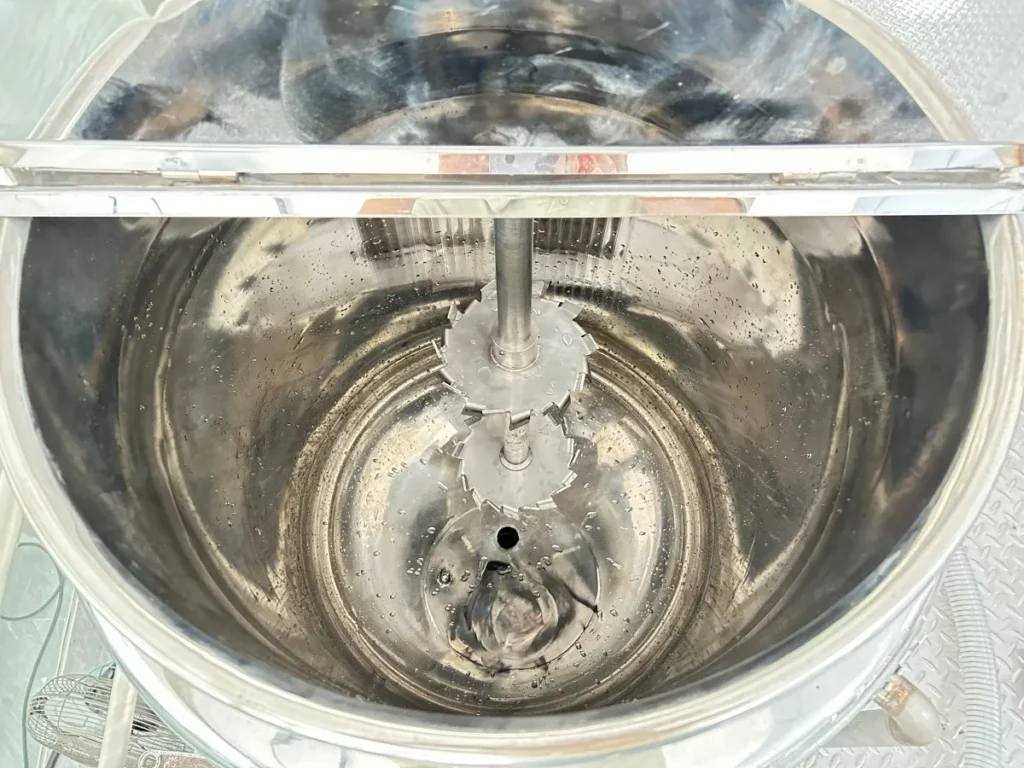
The rotor-stator homogenizer engages to begin emulsification, while internal and external circulation work together to ensure the entire batch is uniformly processed rather than only the material nearest the homogenizer. As the emulsion forms and reaches target particle size, the jacket transitions to cooling while the scraper system continues to clear the tank wall, preventing localized overheating of the finished cream near the jacket surface.
Once the batch reaches the correct discharge temperature and viscosity, it is transferred — either by internal pump or bottom discharge — to a holding tank or directly to the filling line, ready for packaging.
Technical Specifications
Inner and outer circulation vacuum emulsifying mixers are available across a wide range of capacities and configurations to match different production scales. Typical specification categories include:
| Specification | Typical Range |
|---|---|
| Working Capacity | 500L – 20,000L |
| Total Power | Varies by capacity and configuration |
| Homogenizer Speed | 0–3,600 RPM (adjustable) |
| Vacuum Degree | -0.08 to -0.1 MPa |
| Heating Method | Steam / Electric / Thermal Oil |
| Cooling Method | Chilled Water / Process Water |
| Contact Material | SUS304 / SUS316L Stainless Steel |
| Control System | PLC with Touchscreen HMI |
| Voltage | Customizable per region (e.g., 380V/50Hz, 220V/60Hz) |
Exact specifications vary depending on tank capacity, homogenizer configuration, and any optional systems selected, and can be customized to match a customer’s specific formulation requirements, facility voltage standards, and throughput targets.
When reviewing a specification sheet, it is worth paying particular attention to three figures relative to your own formulation: homogenizer motor power (which determines how the machine will perform as viscosity increases), circulation pump flow rate (which determines how many times the batch is turned over per unit of time), and vacuum pump capacity (which determines how quickly the tank can reach and hold target vacuum level, especially important for larger tank volumes with a greater air volume to evacuate). Two machines with the same tank capacity can perform very differently in practice if these three figures are not properly matched to the product being manufactured.
Optional Configurations
To match different regulatory environments, automation requirements, and process complexities, inner and outer circulation vacuum emulsifying mixers can be configured with a range of optional components:
- Siemens PLC
- ABB Motor
- Schneider Electrical Components
- CIP (Clean-in-Place) System
- Flow Meter
- Load Cell (Weighing System)
- Frequency Inverter (Variable Speed Drive)
- Explosion-Proof Electrical Package
- Online pH Meter
- Automatic Weighing and Dosing System
Selecting the right combination of options depends on the specific product being manufactured, local electrical infrastructure, and the level of automation and data logging required for quality assurance or regulatory compliance.
Choosing the Right Capacity for Your Production Volume
One of the most common questions manufacturers ask when specifying an inner and outer circulation vacuum emulsifying mixer is simply: what size tank do we actually need? The right answer depends less on current order volume alone and more on how batch size interacts with cycle time, shift patterns, and planned growth.
Estimate annual output first, then work backward. Start with your target annual production volume in kilograms or liters, then divide by the number of production days and shifts available. This gives a daily output target, which can then be divided by the number of batches realistically achievable per shift given your cycle time — including heating, homogenization, cooling, discharge, and CIP cleaning — to arrive at the batch size needed to hit your volume target without over-extending shift hours.
Build in headroom for growth, not just current demand. Many manufacturers who specify a tank sized exactly to current demand find themselves needing to add a second machine within a few years as volume grows, which increases both capital cost and floor space requirements compared to specifying one appropriately larger tank from the start.
Match tank size to realistic batch scheduling. A single very large tank is not always better than two mid-size tanks if your production schedule involves frequent small-batch changeovers between different SKUs. In these cases, a mid-size inner and outer circulation system that can still be run efficiently at partial fill volumes may be a better fit than a single maximum-capacity tank.
Consider your highest-viscosity product, not your average product. If your product line includes a small number of especially high-viscosity formulations alongside lower-viscosity mainstream products, size the circulation pump and homogenizer specification around the most demanding formulation you expect to run, since retrofitting a circulation system after installation is far more disruptive than specifying it correctly the first time.
Talk to an engineer before finalizing capacity. Volume calculations and viscosity data are a useful starting point, but real-world factors — raw material variability, seasonal demand spikes, and how a formulation actually behaves under high shear at full batch scale — are best reviewed with an equipment engineer who has seen how similar products perform on similar equipment, rather than relying on spreadsheet math alone.
Particle Size Distribution and Emulsion Stability
Particle size distribution is one of the most important indicators of emulsion quality, directly affecting product appearance, texture, viscosity, and long-term stability. Smaller, more uniform droplet size generally correlates with a more stable emulsion that resists separation, creaming, or phase breakdown over the product’s shelf life.
The inner and outer circulation design supports tighter particle size distribution because it reduces the variability in shear exposure across the batch. In a single-circulation machine, material near the homogenizer may be processed many times while material at the far end of the tank passes through only occasionally, producing a wider spread of particle sizes within the same batch. By continuously drawing material from every region of the tank through both internal and external circulation, the dual-loop design narrows this distribution, helping manufacturers hit tighter specifications for viscosity, appearance, and stability testing.
For formulators working with challenging emulsion systems — high oil-phase percentages, sensitive natural emulsifiers, or actives prone to instability — this more consistent shear profile can be the difference between a formulation that passes accelerated stability testing and one that requires reformulation.
How to Choose Between Internal Circulation and Inner & Outer Circulation Models
Not every production line requires a full inner and outer circulation system. Choosing the right configuration depends primarily on batch size, formulation viscosity, and required cycle time.
Internal circulation only tends to be sufficient for:
- Smaller batch sizes, typically under 1,000L
- R&D, pilot-scale, or small-batch production runs
- Lower-viscosity formulations that circulate readily within the tank
- Facilities where cycle time is less critical than capital cost
Inner and outer circulation becomes the better investment for:
- Batch sizes from roughly 1,000L up to 10,000L and beyond
- High-viscosity creams, gels, and pastes
- Manufacturers running multiple batches per shift, where cycle time directly limits daily output
- Products with strict particle size and stability specifications
- Facilities planning to scale production volume over the coming years
For manufacturers uncertain which configuration best fits their formulation and production targets, working with an experienced equipment engineer to review viscosity data, target batch size, and desired cycle time is the most reliable way to specify the right machine the first time, rather than discovering a capacity or mixing-quality limitation after installation.
Common Production Challenges and Solutions
Even with well-designed equipment, formulators and production teams encounter recurring challenges when running large-batch emulsification. Understanding common causes helps operators troubleshoot faster and get more consistent results.
Foaming or Excess Air Entrainment Usually caused by insufficient vacuum level, feeding material too quickly, or agitator speed that is too high relative to the vacuum draw. Increasing vacuum hold time before and during homogenization, and moderating feed rate, typically resolves this.
Phase Separation or Layering Often the result of insufficient homogenization time, an emulsifier system not fully compatible with the oil-to-water ratio, or processing temperature that is too low to fully activate the emulsifier package. Extending circulation time and confirming both phases reach target temperature before combination usually corrects this.
Product Clumping or Grainy Texture Typically caused by adding oil-phase waxes or thickeners before they are fully melted, or by homogenizer gap settings that are too wide for the required particle size. Confirming complete melting before transfer and verifying homogenizer gap settings against the target specification are the standard corrective steps.
Temperature Rising Too Quickly During High-Speed Mixing High shear processing itself generates heat, which can push viscosity-sensitive formulations above target temperature if cooling is not engaged early enough. Bringing cooling online proactively — rather than reactively — as homogenization begins helps prevent overshoot.
Decision Guide
Inconsistent Results Between Batches This is frequently traced back to manual process variation — different operators adjusting speed, timing, or temperature slightly differently between shifts. Saving standardized recipes in the PLC and training operators to run from saved programs rather than manual settings is the most effective long-term solution.
Longer Cycle Times Than Expected When cycle times run longer than the original process design anticipated, the cause is often a circulation flow rate that is lower than needed for the batch size — either because the pump was undersized relative to formulation viscosity, or because partial blockages have gradually restricted flow in the external circulation piping. Reviewing actual flow rate against the original design specification, and inspecting piping for buildup, is the standard first troubleshooting step before assuming a formulation or homogenizer issue.
Maintenance Guide
Routine maintenance keeps an inner and outer circulation vacuum emulsifying mixer running reliably and protects both product quality and equipment lifespan.
Homogenizer Head Inspect the rotor-stator gap periodically for wear, as gradual wear can widen the gap and reduce shear intensity over time, affecting particle size consistency. Clean thoroughly after each batch, particularly around the stator slots where product residue can accumulate.
Mechanical Seals Check mechanical seals on the agitator shaft and circulation pump regularly for signs of leakage, which can indicate seal wear and should be addressed before it leads to vacuum loss or product contamination.
Circulation Piping External circulation piping should be inspected for buildup, particularly with high-viscosity or sticky formulations, and included as a standard part of the CIP cleaning cycle to prevent gradual restriction of flow.
CIP System Spray ball coverage and cleaning cycle parameters — time, temperature, and detergent concentration — should be periodically verified to ensure the CIP program is actually achieving full coverage of the tank interior, not just running on schedule.
PLC and Sensors Temperature probes, vacuum sensors, and load cells (where installed) should be calibrated on a regular schedule, since drifting sensor readings can lead to batches that appear to meet specification on the HMI but do not actually match true process conditions.
A consistent preventive maintenance schedule not only reduces unplanned downtime but also protects the batch-to-batch consistency that is the entire point of investing in an inner and outer circulation system in the first place.
ROI Analysis: Why the Investment Pays Back
Manufacturers evaluating an inner and outer circulation vacuum emulsifying mixer typically compare the higher upfront equipment cost against a standard single-circulation machine to the operational savings generated over the equipment’s working life.
Shorter Cycle Time, More Batches Per Shift Because dual circulation reduces total emulsification time, the same tank and labor shift can complete more batches per day, effectively increasing production capacity without adding floor space or headcount.
Lower Energy Cost Per Batch Faster processing and fewer repeated homogenization passes reduce the total electricity and thermal energy consumed to produce each batch, an effect that compounds meaningfully across thousands of batches per year.
Reduced Rework and Rejection More consistent particle size and batch-to-batch stability mean fewer batches fail internal quality checks or stability testing, reducing the cost of reworked or scrapped product.
Lower Labor Cost Per Unit of Output Shorter cycles and PLC-based recipe control reduce the operator time required per batch and reduce the risk of costly manual errors that require batch rework or disposal.
Scalability Without Re-Investment Because the dual circulation design maintains mixing quality as batch size increases, manufacturers can grow production volume by running larger batches on the same equipment platform, rather than purchasing additional smaller machines to keep up with demand.
Taken together, most manufacturers find that the higher initial investment in an inner and outer circulation system is recovered through a combination of increased throughput, lower energy and labor cost per batch, and reduced rejection rates — typically within a timeframe that makes the upgrade a straightforward capital decision for any facility running multiple large batches per week.
When building an internal business case, it is worth calculating these savings against your own actual batch volume and current cycle time rather than relying on industry averages alone, since the size of the benefit scales directly with how many batches your facility runs per year and how significant your current dead-zone and rework losses already are. For facilities already running near capacity on existing equipment, the capacity gain from shorter cycle times alone is often enough to justify the upgrade before energy and labor savings are even factored in.
Why Choose Strivers Machinery
Strivers Machinery designs and manufactures vacuum emulsifying mixers and complete production line equipment for cosmetic, pharmaceutical, food, and chemical manufacturers worldwide. Our inner and outer circulation vacuum emulsifying mixers are engineered around the same principle that drives every machine we build: large batch production should not come at the cost of mixing quality, consistency, or process control.
Our engineering team works directly with customers to specify tank capacity, homogenizer configuration, and optional systems — from CIP and automated weighing to explosion-proof electrical packages — based on the specific formulation and production targets of each project. Every machine is built in stainless steel construction suitable for sanitary production environments, with PLC-based control systems that support repeatable, documented batch cycles.
As a manufacturer that also supplies complementary equipment — including filling machines and complete cosmetic production lines — Strivers Machinery is positioned to support customers not just with a single piece of equipment, but with an integrated production solution designed around how the emulsifying mixer fits into the full manufacturing process, from raw material handling through to filling and packaging.
Whether you are scaling up from a pilot-scale emulsifier, replacing an aging single-circulation machine, or specifying a new production line from scratch, our engineers are available to review your formulation, viscosity requirements, and target batch size to help you specify the right inner and outer circulation configuration for your facility.
We understand that specifying large production equipment is a significant decision, both financially and operationally, and that manufacturers evaluating this kind of investment need clear, honest guidance on what capacity and configuration will actually perform well with their specific formulation — not simply the largest or most expensive option available. Our approach is to start with your product and production targets, and work backward to the right machine, rather than starting with a standard catalog model and asking you to adapt your process around it.
Conclusion
As batch sizes grow and formulations become more demanding, the limitations of single-circulation vacuum emulsifiers become a genuine bottleneck — not just an inconvenience. Long emulsification times, uneven mixing, dead zones, and inconsistent batch quality all become more pronounced as tanks scale from hundreds to thousands of liters.
The Inner and Outer Circulation Vacuum Emulsifying Mixer solves this problem directly, using two coordinated circulation paths to ensure that the entire batch — not just the material closest to the homogenizer — receives consistent, thorough processing. The result is shorter cycle times, tighter particle size distribution, more stable emulsions, lower energy consumption per batch, and a production platform that scales cleanly from mid-size batches up to very large industrial volumes.
For cosmetic, pharmaceutical, food, and chemical manufacturers planning to grow production capacity without sacrificing product quality or consistency, an inner and outer circulation vacuum emulsifying mixer represents the current standard for high-efficiency, large-batch emulsification.
Ready to Scale Up Your Production?
Whether you are replacing an aging single-circulation emulsifier, planning a new production line, or scaling up batch size for the first time, our engineering team at Strivers Machinery is ready to help you specify the right configuration for your formulation and production targets.
- Request a Quote — Get pricing based on your target capacity and configuration
- Get Free Process Design — Share your formulation and let our engineers recommend the right setup
- Contact Our Engineers — Discuss your specific viscosity, batch size, and cycle time requirements
- Visit Our Factory — See our manufacturing and quality control process firsthand
Contact Strivers Machinery today to discuss how an inner and outer circulation vacuum emulsifying mixer can improve your production efficiency and product consistency.
Thanks for your patience.